Welcome to our community

Be a part of something great, join today!

  • Hey all, just changed over the backend after 15 years I figured time to give it a bit of an update, its probably gonna be a bit weird for most of you and i am sure there is a few bugs to work out but it should kinda work the same as before... hopefully :)

RED 8K Sensor Test 2017

  • Thread starter
  • Moderator
  • #81
What do you do when you need more than 120fps ? ;)

I use the force :)


Your contribution is amazing as always Phil. Thanks a lot for sharing this.
Can't wait to get my Epic-W.

Cheers Joachim.


Sorry if this has been answered, but were the T-stops the same on each camera for the ISO ANALYSIS side-by-side? And were the lenses clean? I've seen some tests where the lens was stopped down or NDed 1 stop on Helium to better compare the noise floor and highlight roll off.

I'm surprised by how well underexposed Dragon looks in this test, hence the question.

Also, curious what glass was used on each cam.

Huge thanks for this test Phil!

Same T-Stop for the ISO Analysis. I would never use a filter for a test like this. T-Stops were adjusted on the Skin Tone/Color stuff more to show what you're getting out of that Balanced ISO Range, which is important.

Glass: Zeiss, Tokina, and a reference lens for the Xyla because vignetting sucks and would contaminate the results.
 
Nothing against these tests, but before buying an 8K camera I really would need to know what the resolution is like in detail, especially when making a 4k crop. Are there any tests I haven't discovered yet, or is anything planned in that direction?
 
Nothing against these tests, but before buying an 8K camera I really would need to know what the resolution is like in detail, especially when making a 4k crop. Are there any tests I haven't discovered yet, or is anything planned in that direction?

Best advice I could give Is find a friend with the camera or a rental house and test by hand before making such a big purchase.
 
I use the force :)

Force... Sounds like a good name for a prototype high speed red camera. Or a special firmware for 8K stormtrooper Helium (get it because Finn is a stormtrooper with force sensitivity?)

Just skeptical Helium sensor has high enough read speed mode to enable higher frame rate at significant resolution. I love surprises though.

I guess there's always 45 degree shutter at 120fps + twixtor / other plugins. Not really a top choice for my clients or for exploding particulate matter plates for instance.

(Off topic deviation over)
 
Force... Sounds like a good name for a prototype high speed red camera. Or a special firmware for 8K stormtrooper Helium (get it because Finn is a stormtrooper with force sensitivity?)

I know this is only a joke, but I would point out that all of the new Star Wars productions have been or are being shot on either film or the Alexa 65....
 
Just got mine over the weekend - what test are you looking for? captured at 8K 7:1 but output to 4K in redcinex?

Nothing against these tests, but before buying an 8K camera I really would need to know what the resolution is like in detail, especially when making a 4k crop. Are there any tests I haven't discovered yet, or is anything planned in that direction?
 
Well the short story on that is indeed what my test here reveals. More or less if you are attempting to match the Highlight Roll-Off 1:1 for Dragon and Helium, you will want to rate your ISO one stop higher "approximately". Though, if you expose for the shot and it's within your rated ISO anyways that's a bit of a wash.

As for the color, I'd say they are slightly different within 5-10% at most, so not a huge process to match. There is indeed a greenish tint to the shadows on Helium, but it is something that can be graded out mostly. I imagine Graeme is still working away on that aspect of the color for now. Helium is still new-ish and Dragon is rather mature, so I'm certain there's more to come.

IPP2 and REDWideGamutRGB/Log3G10 is revealing itself to be wonderful the more I'm digging into it's soup btw. I need to send you some snaps of all the Kodak emulations I've made. I've been having so much fun emulating various negs and print processes from scans to see what exactly can be done. These can then be used on camera, on set, and in post. It's how I managed my last tiny shoot and it's lovely. Graeme hinted in the interview about the newer de-mosaicing algorithm and my 8K footage from the sky is pretty much the highest quality stuff most of have seen even before that. Working on a short reel I'll send your way to watch with the family and friends :)

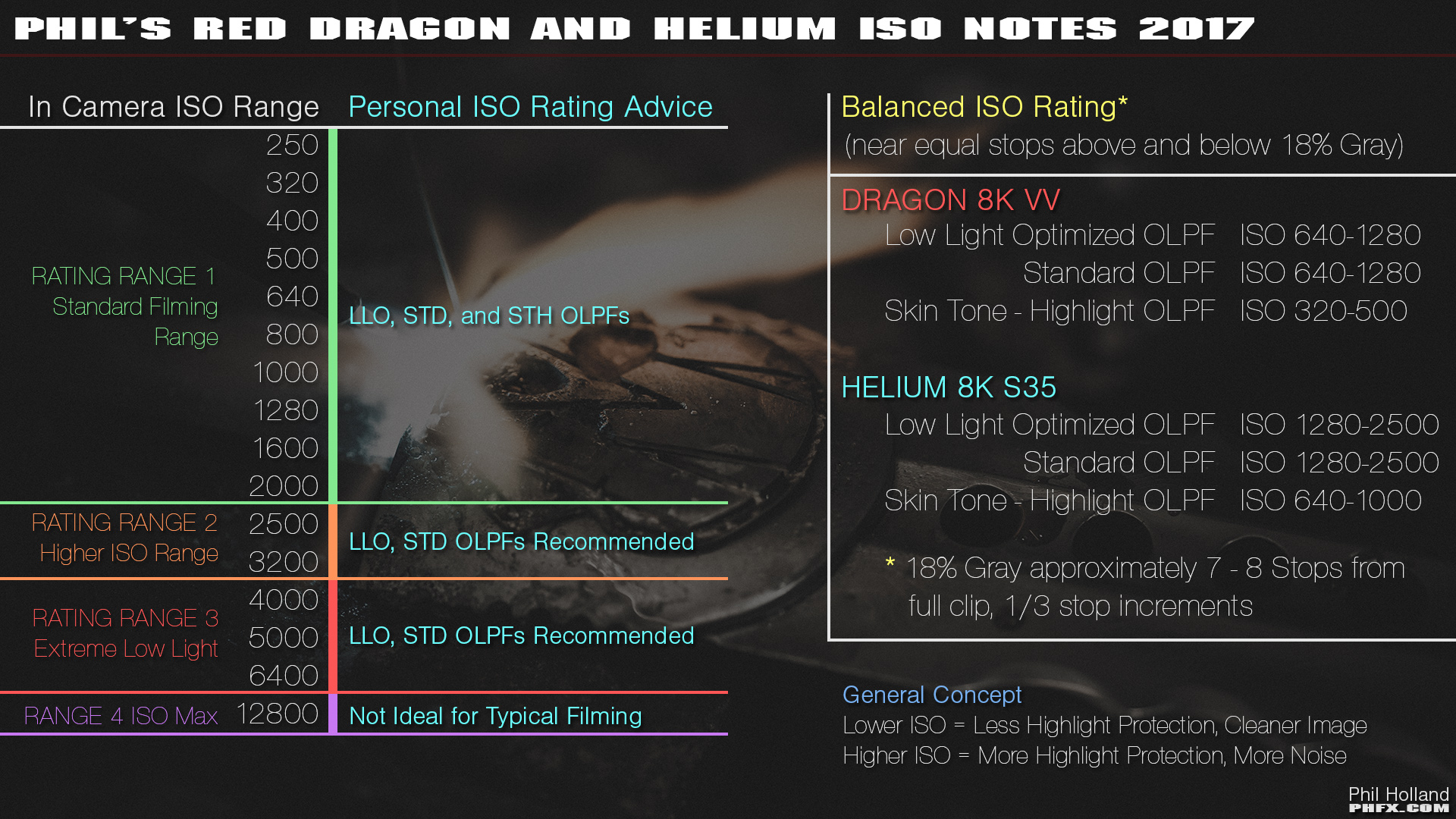
I have seen a few posts that suggest iso 1000 or 1250 to shift for highlight protection / less abrupt highlight rolloff.
Would you go so far as to change the 'sewwt spot' iso recommendation for helium from 800 to say 1000?

Also - how did you focus with 8K (Helium in particular) - via distance on calibrated lens or by eye? If by eye did you find that the 'zoom' in camera was not sharp / detailed enough to nail the 8K sensor in perfect focus? Regardless of display - 720p EVF, 1080P EVF, 1080P touch pad - preview is 1:1 but highly compressed, right?
Thanks,
Mike
 
  • Thread starter
  • Moderator
  • #90
I have seen a few posts that suggest iso 1000 or 1250 to shift for highlight protection / less abrupt highlight rolloff.
Would you go so far as to change the 'sewwt spot' iso recommendation for helium from 800 to say 1000?

Also - how did you focus with 8K (Helium in particular) - via distance on calibrated lens or by eye? If by eye did you find that the 'zoom' in camera was not sharp / detailed enough to nail the 8K sensor in perfect focus? Regardless of display - 720p EVF, 1080P EVF, 1080P touch pad - preview is 1:1 but highly compressed, right?

ISO question = first post, even made a graphic:

ISO

phfx_2017_RED8KSensorTest_REDHeliumDragon_ISONotes.jpg


Critical Focus for everything was locked via 1:1 Magnification, though OLPF swaps didn't need, it was more because the talent is alive and moving. It is not highly compressed, that's the stream out of camera. Note you can Focus Check while magnified in.

I'm using the 7.0" LCD Touch and the RED DSMC2 EVF, which is either the best or 2nd best EVF you can find in the industry depending on who you talk to.
 
AMAZING as always Phil, Love the skin tone and your lighting on that setup & of course you are a master colorist. Just curious as to what lights you were using, lenses and your setup? Looks like a booklight?

Thanks
-JB
 
  • Thread starter
  • Moderator
  • #92
AMAZING as always Phil, Love the skin tone and your lighting on that setup & of course you are a master colorist. Just curious as to what lights you were using, lenses and your setup? Looks like a booklight?

Heh. Well thank you for that :) Luckily, nothing but White Balance here. Lighting was Litepanel Astra Panels through diffusion. I think 2:1 ratio if I'm not mistaken. Hair light was one of those Westcott thingies with some black wrap. Other lights were on the BG somewhere. Glass for her was the Tokina Cinema Vista 50mm T1.5.
 
Nothing against these tests, but before buying an 8K camera I really would need to know what the resolution is like in detail, especially when making a 4k crop. Are there any tests I haven't discovered yet, or is anything planned in that direction?
Here is 8K HD through 3K HD in 1K increments. Without a dolly track and gear head, framing was painful. They are not framed with the level of precision that Phil would have done to match them, but it does give you some idea of cropping the sensor.
 
Stacey,

Thanks for the downloadable samples, always wanted to see the HD framings throughout the Helium 8K resolution range.
 
Stacey,

Thanks for the downloadable samples, always wanted to see the HD framings throughout the Helium 8K resolution range.
Just trying to give back since Phil has given so much to all of us. I wish the room was longer so I could have captured 2K HD. First time around I used the Otus 85mm and 4K HD was the limit. This time I used the Otus 55mm. I could have done the entire thing with the 28mm Otus, I just don't know where the 28mm lands, in terms of quality, which is why I went with the 55mm. I personally find the 85mm nicer (less CA) than the 55mm.

I wish someone would compare the three Otus lenses on a technical level to each other. Rate them on CA, uniformity in light transmission as well as sharpness. What is the true t-stop. I recall someone once posting that it was around a t/1.6 or t/1.8 vs. f/1.4.
 
Just trying to give back since Phil has given so much to all of us. I wish the room was longer so I could have captured 2K HD. First time around I used the Otus 85mm and 4K HD was the limit. This time I used the Otus 55mm. I could have done the entire thing with the 28mm Otus, I just don't know where the 28mm lands, in terms of quality, which is why I went with the 55mm. I personally find the 85mm nicer (less CA) than the 55mm.

I wish someone would compare the three Otus lenses on a technical level to each other. Rate them on CA, uniformity in light transmission as well as sharpness. What is the true t-stop. I recall someone once posting that it was around a t/1.6 or t/1.8 vs. f/1.4.

Stacey,

I have nothing but respect for those that would contribute for the benefit of others. Hopefully Zeiss will introduce other focal lengths in the near future to add to the Otus line. I would also be interested in a test between the three focal lengths

I couldn't really tell the difference between the various HD resolutions,at least on my 1080 laptop screen, and thats good. I also remember that I believe that you have the Dragon 8K VV would it be safe to assume that your tests were done with the 8K VV?
 
I posted earlier in this thread about why I think the helium might have a bit lower dynamic range in the shadows. I decided to run some rudimentary tests. What I think is going on is that the helium sensor actually can see as much as the dragon. But, helium's design has a bit more fixed pattern noise. Red has decided that no fixed noise will make it into their images, so they have absolutely crushed any noise at the level that the fixed pattern noise appears. The red and blue channels are noisier than green, so they get crushed at a different point, side effect is that the shadows get a green cast as the green channel is still usable after red and blue are crushed and sticks around.

Proof is, do a black shade at 1/4 second. Run that at 24fps 180 degrees, 3200 iso STH OLPF or use FLUT +1 or +2. Expose your image correctly et voila, no green cast.

Both of these are white balanced to the light just off screen, 3200 iso FLUT +2 STH OLPF

1/4second blackshade, green T red E
SYZFP6l.jpg


Auto blackshade, green T/E
GoV8tDP.jpg


I wouldn't shoot with this, the noise flickers and if you go even one stop darker than what I've exposed for here the blacks become a bright blue with noise (perhaps because this is a tungsten balanced light). This is the absolute most extreme case, what would be 256,000iso on LLO OLPF
 
Last edited:
I posted earlier in this thread about why I think the helium might have a bit lower dynamic range in the shadows. I decided to run some rudimentary tests. What I think is going on is that the helium sensor actually can see as much as the dragon. But, helium's design has a bit more fixed pattern noise. Red has decided that no fixed noise will make it into their images, so they have absolutely crushed any noise at the level that the fixed pattern noise appears. The red and blue channels are noisier than green, so they get crushed at a different point, side effect is that the shadows get a green cast as the green channel is still usable after red and blue are crushed and sticks around.

Proof is, do a black shade at 1/4 second. Run that at 24fps 180 degrees, 3200 iso STH OLPF or use FLUT +1 or +2. Expose your image correctly et voila, no green cast.

Both of these are white balanced to the light just off screen, 3200 iso FLUT +2 STH OLPF

1/4second blackshade, green T red E
SYZFP6l.jpg


Auto blackshade, green T/E
GoV8tDP.jpg


I wouldn't shoot with this, the noise flickers and if you go even one stop darker than what I've exposed for here the blacks become a bright blue with noise (perhaps because this is a tungsten balanced light). This is the absolute most extreme case, what would be 256,000iso on LLO OLPF

Whoa that is nuts. I seriously hope Graeme can work his magic on the green shadows for this sensor!
 
Further testing and I found any manual-calibrate removes the green tint. Auto-calibration seems to be simply too aggressive.
 
Back
Top