Welcome to our community

Be a part of something great, join today!

  • Hey all, just changed over the backend after 15 years I figured time to give it a bit of an update, its probably gonna be a bit weird for most of you and i am sure there is a few bugs to work out but it should kinda work the same as before... hopefully :)

Dragon Vs Alexa Low Light Tests - Someone?

There's a lot of in camera noise reduction going on in that Canon.

Yes there is, but it is doing it really well. Try and a get the MX capture to look that clean with post noise reduction, I don't think it is going to happen.
 
Thanks for your responses so far. I'd really like to try and keep this focused on either the Alexa or the Epic Dragon.

Here's a little more information regarding the shoot I was doing.

I was using mainly ambient street lighting and shop lighting for a moving car scene with just a small 6x8" iKan LED on a magic arm. Then on some street exteriors I ran a Kino Celeb LED with a Creamsource LED (The smaller one). I was shooting at 1600iso on the Alexa to get 50fps and the images looked great. Then on a rooftop scene I ran the Arri M40 and k5600 2.5k.

On a shop front window smashing scene I ran the Alexa at 800iso as I was able to light it but also ran the Epic MX at 800iso and the difference on the monitors was very noticeable. I'd say there was easy 1 1/2 -2 stops difference.

I guess the main difference I noticed is that on the Alexa I could run my lightmeter and it and the Alexa seemed to be in sync. When using the light meter with the Epic it always seems a stop out as I'm always opening up more to get a nice and healthy histogram.

The noise difference between the Alexa and the Epic MX running both at 1600 iso was significant, and trying to get the most from the street lights and what not, the Alexa was the more logical choice as far as I'm concerned. This is obviously the main difference between the sensitive in RAW (Epic-MX) and the Alexa's sensitivity. I understand the photo site Vs resolution argument - no problem.

I'd love to see a test that ran the Dragon and Alexa side by side, same set ups, same lenses and compared higher ISOs like 800, 1600 and 3200. Matching shots some static and some with motion.

Anyway, if Mark at Off Hollywood gets time, I'd be most interested in checking them out.

Thanks guys :-)
 
I don't think it's a secret Alexa is better at low-light then Epic. It's a newer sensor. I'd be interested to see how Dragon compares. Considering its shooting clean at 2000 I'm reasonably optimistic it will not only be competitive, but possibly superior. With Dragons starting to trickle out, I'm sure we'll see these comparison's relatively soon.
 
Hi All,

Sorry to throw a cat amongst the pigeons but I'm curious.

Background
I own an Epic and love it. Recently I shot a music video, all shot at night, for two nights. The shoot had limited time and resources, although I was able to pull out a few bigger lights - Arri M40 and a K5600 but running 2.5k lamps. I ended up hiring an Alexa body to team with my Ultra Primes as I just wasn't confident with the Epic in low light. I know the sensor from the MX very well and I ended up shooting some 2nd unit shots on my Epic and to be honest the difference was chalk and cheese.

The Alexa looked great at night, the nuances of the image were impressive. The Epic just didn't compare, it was noisy and lacked the depth that I got from the Alexa.

At the moment I'm plotting my next move gear wise and the Amira is looking like a great option assuming it's near $50k.

I'd love it if someone could post some side by side tests of the Dragon Vs the Alexa in low light or night situations. I've watched, reviewed and eeked all I can from Toia's, Pete Collister's and others tests but I need some side by side.

Jarred, Red Team and others. If this sensor is as good as you guys say it is, shoot some comparisons and post some high res jpegs and video for us to see. Or send me one and I can do it for you :-)

I'm sure I'm not the only one that is champing at the bit to see an honest, open and fair comparison of these two great cameras.

Thanks in advance :-)

Adam,

Amira does seem to buck the trend of RAW(Pro Res 4444) and RESOLUTION(HD/2K). It takes Alexa platform forward with higher speed (200fps without windowing+without the penalties of staggering amount of data in RAW), lighter camera with enhanced ergonomics , internal ND, integrated audio, faster media, integrated wireless, interchangeable mounts, great out of camera imagery and greater affordability(fingers crossed). So while many here may be surprised that you are considering Amira as your next camera, I may get one as well as B Camera for my Alexa and use it for handheld operating.

I am hoping the new sensor on the Epic will make shooting a film like Spike Jonze's "Her" possible with Epic.
 
Last edited:
In my testing with a pre-production Dragon 4000 ISO was completely usable with only a very subtle, organic grain structure. Similar to or cleaner than a 500ISO film stock.
The Alexa is not usable past 1600 ISO in my experience.
 
I made a quick test pushing ISO on the files Gunleik posted on his tread, here is the link to download my files:

http://we.tl/cXncknnVIg

Image 01 is 800 ISO, 5500 Kelvin, as shot (and also REDicine-X default)

Image 02 is the same file pushed to 12800 ISO, also 5500 Kelvin. I find it almost unbelievable how little noise there is for 12800 ISO. I mean, sure there is a very noticeable noise, but it has such a fine structure that it should be very easy to remove it with a good noise reduction like neat video while maintaining reasonable sharpness

Image 03 is what blew my mind! It`s the same file, pushed to 12800 ISO and also pushed to 1800 Kelvin (the lowest I could Go on REDcine_X). The increase in noise is there, but not as near as I was expecting... I believe t would be a very usable image if noise reduction was aplied (Hell, it already is without any noise reduction in my opinion...)

We all know that tungsten light is not MX sensor strong point, and while MX would have started presenting blue noise with 800 ISO and 3200 Kelvin in the same situation, with Dragon I could push it to 12800 ISO, 1800 Kelvin and the increase in noise was not that big.


Of course, I would like to se some side by side comparison, same scenario, same light, same lens, but from the little I`ve seen I would bet on Dragon on a Dragon x Alexa comparison

All JPGs files where processed from TIFF snapshots in REDcine-X, the settings where REDcolor3, REDGamma3. No additional contrast or saturation applied.
 
In my experience shooting a music video on a dragon last weekend, and working with the alexa, the Dragon is FAR cleaner. The Alexa is noisy (slightly) at 800 ISO, But it doesn't change much up to 1600, retaining the grain sturcture when pushed a stop. That said, at 800, it looks the same. Slightly noisy. The Dragon is absolutely pristine spotless 800 and below, with an MX800ISO look around 1600-2500 ISO. ISO1250 is a nice sweet spot between grainless, and ridiculous sensitivity, which i believe anything above ISO800 to be. My biggest problem shooting the dragon was fighting ambient fill. My remedy was to turn the camera to ISO250 and use 10k's. It looked amazing.
 
Yea, if you nail in a good blackbalance, and keep it in adaptive mode, to keep the temperature stable, you can push to 2500 with good results. Similar to 800-1000 on mX

Edit: but I reiterate... The best part of the dragon is ISO 250.....
 
I kinda agree with Timur... and not.

I agree fully on the 250-400 statement.

Now here is where I agree:

No problem shooting 1600-3200 on Dragon.

BUT
Do not forget that contrast.

While taking a shot shot at 250-800 and push it to 12800 in post shows off how ISO lifts do NOT create new noise on the Dragon, that is good. But does not really tell the whole story on shooting at say 2000...

Take that 800 shot and lift it to 2000 (or 3200), and THAT is what you should see in the viewfinder to get a similar result.

The Dragon is a lot better both in the top and the bottom. But all the juice, the real sexy undeniable juice...

You will not get that by skipping two stops of lightkit compared to epic.
Taking off an ND .6 OTOH will make the colors and vibrancy pop...

Just my 2.5 cents... :)

Now... as to the VS Alexa...

There are many ways the Dragon is better than the Epic in the bottom...

And it should have signal about two stops (at least) under the alexa. This is a postulated presumption, but it is probably not too far off.

If that means that you can shoot with two stops less lights, will depend on the scene and what kind of mood you are ater.
WHat you WILL get is richer darks with more colorinfo...

The above is to be considered as a speculative hunch...

But still a hunch...

I will have a look when time allows...
 
There is one fundamental concept behind the Red System that's often not exactly understood. It's actually true for all digital cinema cameras as well, but still people for whatever reason get confused about it.

The biggest thing that people must understand is the relationship between what's recorded in REDCODE RAW and the noise floor of the sensor. If you are tapping into the noise floor and cranking the ISO there won't be anything but noise in the tones that are being pushed up. However, within the captured and usable dynamic range you have a great deal of freedom (workable latitude) to move things around.

If you shoot above the noise floor and expose properly I'm getting about 4.6-5 stops of "workable latitude" with Dragon. At least what I deem as workable and usable for a 4K delivery. You could make an argument you get more.

As Timur and Gunleik noted having that freedom to shoot at ISO 250 is a big deal and Dragons massive Dynamic Range is essentially why that works so well. I think most will work with Dragon in the realm of ISO 250-800 for most shooting conditions. Remember you are rating the midtones when manipulating the ISO. If the lighting supports it, higher ISOs are totally reasonable and look great.

There are questions to be asked when shooting. What are you exposing to see? What is in total darkness? What's the final look going to be? If it's not lit the camera won't pick it up. There's no onboard image processing to assist with noise reduction or digital gain. Red prefers to maintain the maximum captured dynamic range the sensor has to offer. This is why it's somewhat important to get a relative idea, although completely the wrong term, of a base ISO. More or less what the sensor sees. Nothing can lift the noise floor of what the sensor can see. There is an absolution bottom essentially.

Anyways, here's how I think about it. Back when working with film I liked ASA 250 and 500 stock to work with for the most part. You could push that about a stop usually and get good results. Film has it's own tonal response curve and that's it's own unique look. Dragon also has it's own curve using the various gamma spaces once applied to the linear camera data. Film had a "bottom floor" as well, even though it's an analog medium. If you pushed it up too much you just get grain/noise/chaos.

If for whatever reason you are tapping into the noise floor (likely low light or underexposed areas) and it can be seen this is the time for noise reduction. Work within the captured resolution 6K, 5.5K, 5K, etc... and do that noise reduction then create your UHD/QHD 4K delivery via scaling. You'll get the benefits of having more resolution as a starting point that way and maintain more detail that way.

For me we are getting a very "film-like" image out of Dragon with the current look of REDlogFilm and REDgamma3. This is without seeing DRAGONcolor or DRAGONgamma yet. I'm going to be utterly fascinated when those are released actually as we might get even more out of this thing soon. The big player here is the new highlight roll-off. The fact that Dragon doesn't have the digital signature of Mysterium-X (and most other cameras) is a clear separation. It's unique and has a more analog feel. Highlights do clip when they are out of range, but they "burn out". The folks who I would still consider "film guys" really need to see this for themselves.
 
Sony f5 (as other camera) applies a denoise in camera to get a clean 4000 asa out of the 4k sensor. I was wondering why Red didn't push the denoise capability of RedcineX as a lot of people do actually finish for 2k and are willing to loose those 6k res in favor of a 6000 asa clean image. Better Red give them this possibility rather than them bashing the camera.

Pat
 
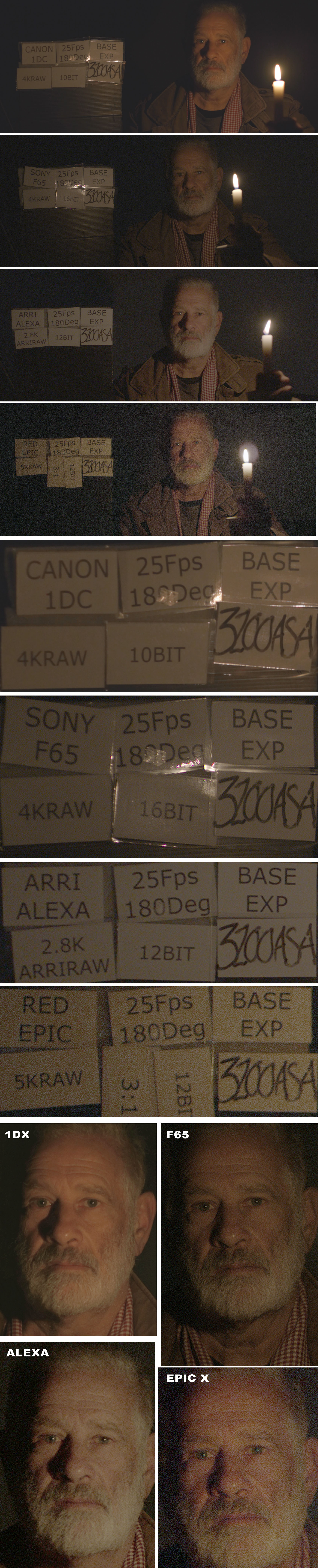
Just to add to what I'm saying above and looking through a few posts here.

In the comparison here:
http://www.cinematography.net/edited-pages/single-candle.html


There's a lot of in camera noise reduction going on in that Canon.

1Dc completely wipes the floor in this test.
I'd rate them 1Dc (clippy but clean) >> F65 (grainy) > Alexa (rough color noise) > Epic (lots of blue noise)

early Dragon low light footage hasn't impressed me THAT much.

Yes there is, but it is doing it really well. Try and a get the MX capture to look that clean with post noise reduction, I don't think it is going to happen.


The Canon 1DC is using dual DIGIC 5+ image processors to handle on board noise reduction seen in the ISO 3200 image examples shown in that test. While clean "out of camera" it is actually murdering the detail found in the 4K image and creating a plasticy look that people tend to try and avoid. The real question here is that at this point are we even looking at what we would consider a 4K image?

I know this test is an "out of camera" test, but...........

If you have color noise in your Mysterium-X or Dragon footage give that "Denoise" slider a look in REDCINE-X Pro. It will eliminate some of the color noise without killing luma or chroma detail. The value range is 0-6 on the slider. Although I think on Dragon they could actually have the algorithm go a bit further and maintain quality results at extremes.

Of course if it's an extreme situation where more noise reduction is needed Neat Video, Dark Energy, Film Master, DaVinci, etc.... This is true for all of the cameras showing noise at ASA 3200.

The camera that performs the best in that specific test for me is the Sony F65 as the color noise is mitigated through the camera and the chroma and tonal detail is retained. The sensor has a lower noise floor and that can be seen here both in tonal richness and density. This will be an interesting test to do again now that Dragon is here. It might be an interesting test to do again further still once the new color science comes down the pipe as well.
 
Nooooooo Davinci sucks for NR. (Well in version 8... I don't know in V10.)
It's very good in in version 10. But like everything else, NR has to be done very carefully, on a shot-by-shot basis. There is no "one size fits all" setting for noise reduction.
 
Nooooooo Davinci sucks for NR.
(Well in version 8... I don't know in V10.)

Please Red.

Pat

Ps NR slider RedcineX is great but could go further in a "red zone" that would even lower res to get that clean image.
NR in V9 was strictly spacial type. In other words, it was very similar to median filter in Photoshop. Not bad for photographs, awful for moving images. V10 introduced a temporal NR, which is pretty standard tool for all high quality NR. Said that, it's just a first iteration of the algorithm, so it's not that great yet, but it's already far superior to the old spacial type of NR found it previous version. Plus now you can always use the good old standard in NR- Neat Video OFX plugin.
 
SONY F65 has always been my favorite for image quality until DRAGON was released. I was quite open when I did the launch video for DRAGON, I openly siad that SONY F65 had the best image out there. Jim even agreed, But DRAGON has taken the title now.
My only reason for not using the f65 in my projects was the size and weight of it. I'm into speed and I cannot afford to be slowed down with a giant camera. And the image qulaity being so close when not shooting at normal ISO's gave me know reason to shoot the F65.


ARRI ALEXA has always a slightly better image with highlight roll off and was smoother. My reason for not using it (much) was only the size and weight of it. Plus I do alot of scaling and FX work, it did not have enough resolution to do what I wanted. ARRI RAW is to heavy and clunky in post... and I did not want to shoot the alternative of HD PRORES. I hate colour backed images that I cannot change afterwards. Simple as that.


RED MX was always been slightly noisier at 3200ASA than the others. Fact. But at 320 iso (my chosen ISO) The MX sings in resoltion with no noise at all.
With the 3200 iso tests below, you can actually pull out that blue noise and smoothen the image to look more like the Alexa quite easily. Not sure why the tester of these shots didn’t do it from the start.? Anyways... ? who knows ? That doesn’t excuse the the fact that you shouldn’t need to.


The 1DX has always been better in super low light hi ISO capture... but don't forget that there is a lot of smoothing going on in camera, meaning all other cameras have to do it in post... And also don't forget all the other image issues you have with the 1DX like super sloppy skew and hi contrast. Still a great camera none the less for the money. C500 is better if you ask me.


With my time using the early test beta DRAGON and now having my own Dragon which has an even cleaner images again due to the constant colour science changes that are comeing through... I'd have to clearly say that the image noise is better than the F65 @6k (not 4k) and at least 2 more stops more latitude over the SONY.


And my new favorite ISO for the DRAGON is 250. :) Making it super smooth and clean.


Lets not kid ourselves... All cameras are great these days, They are all so close with image quality.

So now it's all about using a camera that suites you the best. You as an operator, you as a DP or Producer.
You now choose a camera that is most versatile for you, size & weight. What can give you great frame rates , great ISO, what can be handled easliy, posted and edited easily, what gives you the best resiltion and raw information... and finally what gives you all you need and is most affordable for you. These are the big questions.


For me the EPIC DRAGON ticks all those boxes. It's still not perfect ... but its the closest out of all cameras that suites the way I work.
Everyone has different needs hence, lucky for us all, there is now a lot of choice.


These images from the link shared above are very true tests, but you can get a far better image from the EPIC MX if the camera was set up properly and the image processed correctly . Thats for sure.

EDIT: I stand corrected about the flare on the candle. Yes it is an issue and RED needs to correct, change or alter the OLPF to get rid of these reflections. I haven't noticed it on the dragon as yet. its one test I haven't done yet.

Happy new year all. :)


Noise.jpg
 
Last edited:
Back
Top