Welcome to our community

Be a part of something great, join today!

  • Hey all, just changed over the backend after 15 years I figured time to give it a bit of an update, its probably gonna be a bit weird for most of you and i am sure there is a few bugs to work out but it should kinda work the same as before... hopefully :)

Why Bigger is Better (but not much else) S35mm vs. Vistavision Comparison

First of all 20mm t1.5 VV lens does not exist either(FF is smaller). But I digress...Put a $150 speed booster on that 20mm T1.5 lens you have and voila!!!! problem solved. Your real life shooting scenario ;-)
Actualy I did one better: put BMPCC SB on my 20mm f1.8 sigma and got the same thing on the little M43 Zcam E1... .53x FL ratio, 2 stops speed gain...

The 18 does however http://www.tokinacinema.com/18-25-35-50-85-Prime.html and it seems they are the only ones, but I might be wrong about that ;)
 
Very nice- did not know they had an 18. Live and learn. These a monsters, the size of MPs. But they also cover a lot more real estate ;-)
 
Actually a speedbooster for RED does not exist. The lens I spoke of actually does, as its how I got the image above. The fact that you need to add a speedbooster to mimic a "FF Look" in itself proves there is a visual, creative difference that FF sensors provide, so thank you for your admission.

Well they do http://store-abt.de/de/product/speedmount-ef-dsmc2/ (metabones/caldwell based) and a guy with a presumed drinking problem made a Hasselblad to RED Speedmount adapter (Kipon based). Couldn't find your 20 mm t1.5 VV lens (is it google or is it me?).
 
So many in here argue that FF doesn't look much different from s35mm, disregarding all the points of how it change the physics of how sensors operate, processing and how it change the characteristics of how a certain lens look. I mean, my 35mm has different characteristics than my 24mm so if I get a 24mm-like wide image on a FF with my 35mm that's a good thing. Also, if I want to use T4.0 to get more sharpness out of a lens I can do that, but retain the shallow dof of a wider equivalent lens at wide open (with all the distortions of using it wide open).

I think there's too much semantics in here and not much actual cinematography. If you shoot with a large format camera and a Signature prime 18mm T1.8, please find the equivalent 13,5 T1.3 lens that match up on s35mm and look the same in all aspects of the image; from noise, contrast, colors, CA, distortion, sharpness, smoothness and so on. Mathematical comparison charts are irrelevant when aiming for a certain quality of how an image should look.

We discussed this over Facebook.

Signature primes are, my undeucated guess, extended master primes, the 12mm MP becomes the 18mm signature etc. I doubt that arri that is not a lens manufacturer would build a whole new line up from scratch, why would they. Look at the focal lengths and look at the speed decrease. Kind of looks like a linup of extended masters to me. Sure maybe I´m wrong but you could simply do just that and get to something very similar to the signature lenses.

Arri needs the larger format and lenses to go with it to increase resolution as they have not yet managed to get an equally good sensor with higher pixel pitch then their ALEV stuff. And people tend to buy into the large format stuff. When Arri release their "helium" I think people will sway back a bit.
 
So many in here argue that FF doesn't look much different from s35mm, disregarding all the points of how it change the physics of how sensors operate, processing and how it change the characteristics of how a certain lens look. I mean, my 35mm has different characteristics than my 24mm so if I get a 24mm-like wide image on a FF with my 35mm that's a good thing. Also, if I want to use T4.0 to get more sharpness out of a lens I can do that, but retain the shallow dof of a wider equivalent lens at wide open (with all the distortions of using it wide open).

I think there's too much semantics in here and not much actual cinematography. If you shoot with a large format camera and a Signature prime 18mm T1.8, please find the equivalent 13,5 T1.3 lens that match up on s35mm and look the same in all aspects of the image; from noise, contrast, colors, CA, distortion, sharpness, smoothness and so on. Mathematical comparison charts are irrelevant when aiming for a certain quality of how an image should look.

Signature prime T1.8(2018) on Monstro vs. Master prime T1.3 (2005) on Helium, sure they will look different but that has got nothing to do with the so called "Medium format look".

Try a medium format lens from the 50's T3 on Monstor vs. Master prime T1.3(set to 2.19) on Helium and again they will look different, but it still hasn't got anything to do with the so called "Medium format look"

When your aming for a certain quality of how an image should look your more talking about taste, which is not the point in this thread.
 
Very much looking forward to Phil's in-depth write up. Always appreciate how I don't feel patronized when he's trying to educate. I'll bow out of this discussion until then.

If you are alluding to my posts related to the topic...you have my apology. Not intentional. I'll work on my English (and patience), some syntax and interpretation varies and is challenging at times to translate the exact intent.
 
So many in here argue that FF doesn't look much different from s35mm, disregarding all the points of how it change the physics of how sensors operate, processing and how it change the characteristics of how a certain lens look. I mean, my 35mm has different characteristics than my 24mm so if I get a 24mm-like wide image on a FF with my 35mm that's a good thing. Also, if I want to use T4.0 to get more sharpness out of a lens I can do that, but retain the shallow dof of a wider equivalent lens at wide open (with all the distortions of using it wide open).

I think there's too much semantics in here and not much actual cinematography. If you shoot with a large format camera and a Signature prime 18mm T1.8, please find the equivalent 13,5 T1.3 lens that match up on s35mm and look the same in all aspects of the image; from noise, contrast, colors, CA, distortion, sharpness, smoothness and so on. Mathematical comparison charts are irrelevant when aiming for a certain quality of how an image should look.
If trying to find equivalent of 18mm T1.5 VV lens on S35 sensor is how everyone is trying to push the VV sensor I'm OK with that. I guess we are going to see a lot of movies shot extreme wide angle shallow dof from now on...
 
I guess we are going to see a lot of movies shot extreme wide angle shallow dof from now on...

Like in the old days when every kid shot shallow dof with their Canon 5D2. I thought this hype has long gone.
 
If trying to find equivalent of 18mm T1.5 VV lens on S35 sensor is how everyone is trying to push the VV sensor I'm OK with that. I guess we are going to see a lot of movies shot extreme wide angle shallow dof from now on...

With helium they won't have much of a choice than to go fast, because diffraction kicks in at around F6.9, Monstro/DXL2 at F9.4, BMD UMP at F10.7 and Alev3 at F15.5
 
ARRI's new lenses have nothing to do with Zeiss at all... different manufacturing partner, different look, very different design..even feel different in the hand


We discussed this over Facebook.

Signature primes are, my undeucated guess, extended master primes, the 12mm MP becomes the 18mm signature etc. I doubt that arri that is not a lens manufacturer would build a whole new line up from scratch, why would they. Look at the focal lengths and look at the speed decrease. Kind of looks like a linup of extended masters to me. Sure maybe I´m wrong but you could simply do just that and get to something very similar to the signature lenses.

Arri needs the larger format and lenses to go with it to increase resolution as they have not yet managed to get an equally good sensor with higher pixel pitch then their ALEV stuff. And people tend to buy into the large format stuff. When Arri release their "helium" I think people will sway back a bit.
 
ARRI's new lenses have nothing to do with Zeiss at all... different manufacturing partner, different look, very different design..even feel different in the hand

So who is making them?


Matt Duclos writes: "I don’t have any firm information on the origins of this glass, but it’s not too difficult to deduce a few clues… "

Dotn know what he means with that, but I guess he knows.
 
Helium, diffraction might start at f/7 but it is diffraction limited at f/11 as below.

35.39 mp, 1.3 crop, 1.9:1 aspect

274 Pixels per mm, 137 lp/mm
Pixel pitch: 0.00365 mm
DOF CoC: 0.0234 mm, 6.42 pixels

Diffraction limit f/10.88
 
The subject of format size and image characteristics is a surprisingly difficult and confusing one. Bit I would like to talk about Mark Kenfields tests. At the ASC we have done similar tests and you can also see Panavision's version here https://vimeo.com/253322347 I think its safe to say that the ACS tests and Panavision tests all agree with Mark’s results that assuming the camera and subject don’t move you can always match a smaller sensor shot with a larger sensor by increasing focal length and stopping down. You can also match larger sensors shoots with smaller sensors but there is a limit on your ability to match DOF.

On the face of it that sounds simple and not really a compelling argument for larger sensors but there are a range of factors working here.

Firstly and this is a minor point but mathematically there is a small variation in perspective when you change focal length.

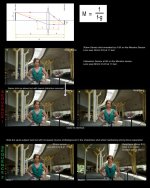
*Please refer to the Diagram attached below

Perspective (magnification) is dependant on focal length which in turn is dependant on sensor size as shown using this formula m = f over f-g. However most practical scenarios where the focal length is far smaller than the object distances the resulting difference is insignificant. The typical focal lengths used on both S35 and Vistavision means there is only the tiniest differences although the closer the subject and the longer the lens the more this perspective difference presents. This can partly explain the small anomalies in some test results we have seen.

Anyway this subtle flattening or compression as focal length increases in images is usually overwhelmed when comparing images by the effects of geometric distortion.

All lenses have some degree of geometric distortions or barrel distortion and this becomes harder and harder to correct as the focal length becomes shorter.

For the ASC test we used the Zeiss CZ.2 28-80mm zoom lens so we could exactly match FOV and lens characteristics but we were wrong in this assumption as the shorter focal lengths saw barrel distortion increase substantially. Below are three images. The first and top image is at 4.5K on the Monstro sensor a physical size that sits between 35mm Academy and Super35. Using q 40mm lens at f2.8. When comparing the originals the barrel distortion made it difficult so the 35mm image below had the distortion corrected in Photoshop

*Please Refer Sequence 1 below

Second image on the right marked “VistaVision” is 8K on the Monstro with a 69mm focal length and we stopped down 1.6 stops to F4 2/3. Its also worth noting that with our subject is at 3.35m and the change from 40mm to 69mm focal lengths according to our formula m = f over f-g our change makes so little difference to perspective that I can’t see it. This is not to be unexpected in our example as the g (distance) value is quite high.

So now lets talk about lenses as this is a big part of the story. I have come to believe that this is one of the key factors. By going to longer focal lengths on larger sensors we are minimising the geometric distortions we associate with short focal lengths. Shorter focal lengths are harder lenses to design and construct and Inevitably involve optical compromise. Assuming you want DOF equivalents you would stop down on the larger sensor again improving lens performance.

Also larger sensors mean pixels do not have to be to made smaller for increased resolution and diffraction is less of an issue when stopped down.

As Mark Kenfield pointed out in the original Blog the extra resolution from the larger sensor has many benefits. Firstly noise is lowered but it is the improvement in micro contrast and the cameras ability to render fine detail that really brings textures to life. This improved rendition of texture goes along way to explain the depth and 3D nature of bigger sensors images.

For me probably the most important part of the test was when we took the same 40mm lens and shot the same (nearly) MS of our subject on both the 35mm sensor and the VistaVision sensor.

Please refer Sequence 2 below

On the VistaVision sensor when we move closer to our subject to maintain subject size and combine this with the greater FOV you can see that we have more background volume and it is pushed back exaggerating the perspective. This could be done on a smaller sensor simply by going to a shorter focal length BUT we would increase the DOF. This is a key aesthetic advantage of larger sensors. You can work closer to your subjects with a wider FOV and stronger perspectives without sacrificing focus separation. I know in my work especially in TVC productions I have avoided wider FOV shots as I have had to use shorter focal lengths with their increased mapping distortion and deep DOF. To my mind wide angle shots with deep DOF lose some of their “perceived”depth as there is little or no focus separation.

I agree with Mark Kenfield on the image improvements in noise and micro contrast but the changed relationship with lenses and focal lengths with larger sensors is not to be underestimated.

I need to suppress my own confirmation bias but having used Monstro on multiple shoots I can clearly see the difference when shooting with the full sensor gate. Hopefully over 2018 more people will get to use these larger sensors and experience the advantages. It is not a chalk and cheese difference but in the wider FOV shots the VistaVision sensor really works for me and I find I am working and framing wider than I would on S35mm.

With Reality TV and docos now leveraging 35mm sensors there is no doubt in my mind larger productions will push to larger sensors as a point of difference. Do not mistake this statement to mean that I think the S35 format is redundant which it clearly is not but today we have another choice.
Composite%20reduser%20frame.jpg
 

Attachments

  • Composite reduser frame.jpg
    Composite reduser frame.jpg
    90.3 KB · Views: 0
Thanks Michael but maybe I'm dumber than I thought I was but I have put maybe 100 hours into researching and testing on this subject. I have spoken to scientists and to lens specialists in an attempt to get my head around this. It has not been easy and I totally get why it can be confusing. There is more to it than I have included here and the rabbit holes are deep indeed.

The easy approach is just to shoot with a Venice, Monstro, Alexa 65 or LF and the difference in "feel" will be clear.

I know what you are talking about! I've spent a fair number of my own CPU cycles, including tests with Monstro vs. Helium S35. My conclusions are the same as yours: there are a range of circumstances where format size makes absolutely no difference if you are careful about honoring the math of nodal points, aperture, etc. And there are also circumstances in which, lo and behold, a unique set of circumstances at the edges of performance really do make a difference. A Tokina 50mm on Monstro at T2 vs. a 35mm on Helium at T1.5 doesn't provide any magical perspective differences, but it does provide differences in noise (Monstro wins) and high-frequency MTF advantages (the 50mm at T2 has higher MTF at 5um pixel pitch than 35mm has at T1.5 at 3.75 um pixel pitch). And, as you rightly point out, if you want to do a relatively shallow DOF shot close to a subject with lots of background pulled in, well...the benefits of both the larger pixel pitch (giving the benefit of a higher MTF % because you don't need quite so many lp/mm) and the benefits of being able to shoot a stop more closed down (when considering equal DOF)--those benefits multiply together, creating basically a full grade higher on effective lens quality for a given shot. And *that* is really make makes the larger format lens/sensor combo sing so beautifully together.
 
The biggest mistake that indie news crews make is shooting wide open. Fuck that's annoying. There's a reason why the big boys - as lame as the MSM is - shoot with ENG cameras. People need to see things IN FOCUS.
 
Back
Top