Welcome to our community

Be a part of something great, join today!

  • Hey all, just changed over the backend after 15 years I figured time to give it a bit of an update, its probably gonna be a bit weird for most of you and i am sure there is a few bugs to work out but it should kinda work the same as before... hopefully :)

SALT VV - VistaVision Lens Shootout

It appears the chromatic aberration Wide Angle (21, 24, & 25mm) jpeg is the wrong slide, it's named "phfx_SALTVV_CAHA_wide01" but it is the same image as "phfx_SALTVV_OOF_ultraWide01."

Thanks for all the work you guys do and have already done for the community.
 
AMAZING!

I have to say I'm very taken with the OTUS lenses... (from what is shown), I don't think they are boring at all; Kinda best of old school and modern/new "school"... In terms of "look" and color fidelity/"rendering" and texture and certain amount of warmth and glossiness to them/silkiness yet fabulous contrast and really interesting blue tones too. There's some real magic there very noticeable on the reflections off the aluminum bare rings and metal cases on the right side of the scene. Decent coverage, not too purple in the left hand corner and really well controlled distortion on the F2.8 28mm Otus... Seems to have some of the warmer tones of the Xenon (almost) but also has cooler crisper characteristics... I really like the slight granular subtle texture of the lens flare... It's like a soft ground glass type of texture and effect. Amazing "internal" quality of the lens to achieve that.

I'm impressed as hell at the Otus. Period.

They seem so good almost daunting/humbling. You really feel that as to what they could really bring.


Thanks so very very much,

@Evin Grant, Mathew Duclos and Phil Holland ... SUPER HEROES!

(That's a ton of pain staking and mind numbing work and difficult to keep your wits about you... amazing and really solid and excellent work that is super useful too !).
 
  • Thread starter
  • Moderator
  • #23
It appears the chromatic aberration Wide Angle (21, 24, & 25mm) jpeg is the wrong slide, it's named "phfx_SALTVV_CAHA_wide01" but it is the same image as "phfx_SALTVV_OOF_ultraWide01."

Thanks for all the work you guys do and have already done for the community.

Thanks for that catch Aaron. Corrected, just refresh your browser.


I'm impressed as hell at the Otus. Period.

In my best Jeremy Clarkson impersonation, "They are very good".


If you guys have a smart tv or Apple TV and happen to have a UHD 4K television, I would say these are well worth logging into YouTube to watch on the larger screen btw. It illuminates a lot.
 
To all of you, thanks for making this happen, a massive thanks also for being honest when it comes to your personal choices.
People can't realize the amount of work, time and concentration needed in such a test and its result.
I stopped working yesterday to watch the entire live on Facebook and it was really instructive and entertaining.
 
thanks Guyss :) nice Work..

and think I was going to buy the Celere ..
But I had the same doubt during a shot, I used the Xeen and either immediately after the Celere, but in post with davinci, they looked the same to the Xeen as a response ...
Now everything is confirmed ...
 
Superb Test !
Thank you for the massive effort and thought that went into this.
Sad I could not make it and help.

Cheers !

Matt Uhry


www.mattuhry.com
 
In addition to the indoor VV portion of this test we also shot an outdoor section of the test on the 8K S35+ Helium.
The higher pixel density of the Helium sensor seems to be a bit more demanding on optics, especially for chromatic aberration but also for sharpness.

Below are 100% comparison matrices of the closest focal lengths. These are from 4K Jpeg snapshots out of RCX50, I also included full 8K R3D snapshots if you want to dig deeper. I did my best to keep things consistent but shooting this many lenses outdoors in a timely manner is going to introduce some variations in lighting and color. If you're looking for critical differences in color rendering download the R3Ds and compare with similar settings.

Also if you dive into the files you'll notice there are snapshots from wide open and then snapshots at varying apertures. I chose to include those apertures where I felt the lenses sharpened up noticeably from wide open (if they did not I did not include and more) and also where the CA on the chart get under control.

<snip images>.


Links...
Canon CN-E
https://drive.google.com/open?id=1nK4mN7bvZYB20dvZGhYajMBxHy661CKR

Hans Innotech Celere
https://drive.google.com/open?id=11mR07PAA-Fpjtyv45WfkCNK4vzUKPzdU

Leica M0.8

https://drive.google.com/open?id=1XKYjQOQYjdJ7Tn4Xopzl-KBzMEhSwLAq

Rokinon Xeen
https://drive.google.com/open?id=1i7iHN2R6y1vemTXkdYk5_QfakKJO64sD

Schneider Xenon
https://drive.google.com/open?id=1ZONKNbIJhLhnR1_L85fCsXdhm1OwLxVE

Sigma Cine...
https://drive.google.com/open?id=1AZ8cHIdfNzTsK-L_AXzw7Ho9BvCuEqnI

Tokina Vista
https://drive.google.com/open?id=1uvIqdXCW3NtqB9e7uzWITviyxTARibVQ

Zeiss CP.3
https://drive.google.com/open?id=1Ydj99VoeG0eQi8tPOOlCvyXCNTm9MbFL

Zeiss Otus
https://drive.google.com/open?id=1HnkCG5zTScZpb_Soup8G6Wgq5avgx4gt
open


Helium is super important. OTUS looks amazing there too, (kinda makes sense given their MTF charts for coping with "Denser" and finer pixel pitch); but even so the contrast for fine detail and rich color rendition for larger pools or patches of color are really outstanding and "Deep". More of a 3D look as opposed to some more conventional glass that looks more flat. These anomalous dispersion type special elements and the aspheric elements seem to be really doing their job! Kinda reminds me a little bit of really high end color diapositives/high end color reversal film but with way more latitude... (thanks to the sensor). Really like how some of the fine detail contrasty elements really "Pop" and group together nicely on a "Micro scale" and yet color rendition seems really well preserved... [It's kinda how super high resolution diapositives (film) works at the grain level, or high resolution film stock that has the orange masking layer removed. ]... I think Zeiss have knocked it out of the ball park on this! And fantastic combination with modern Bayer (based) matrix/sensors... And seems to play very nicely with RED VV and Helium based sensors. Looking forward to seeing monstro 8k VV + OTUS for sure.

Having said that digging deeper on the comparison shots (from Evin's amazing links) There were a few "Standouts" that caught my eye that also kinda resonate with some of the picks from the "Lenses and Lattes" session.


For me surprised by (in a good way) , :

Zeiss 18mm CP.3

Xeen 35 mm (I really agree with that from the shots presented above)!

LeicaM 0.8 35mm @ T1.4

Canon 14mm @ T3.1


Probably the 18mm CP.3 being the most surprising and then the Xeen 35mm .

___________________________________________________________________________________________________________________________________________________________________________________________

I agree it is a bit frustrating that there aren't more focal lengths to choose from on the OTUS... Come on ZEISS!!! Bring it! :-) Meanwhile I say sod conventional mechanics for a (budget sensitive) cinematic rig and just engineer supporting mechanics for OTUS no matter what, like what DUCLOS are doing as the GLASS is so worth it!

___________________________________________________________________________________________________________________________________________________________________________________________

Just as a "Brain fart" if this hasn't been mentioned (already), but those that want to shoot on Helium AND also RED VV (in whatever form) seems that they would be well served by OTUS (apart from having a limited lens choice right now); but I could envision someone having OTUS on VV (RED) and using it on their Weapon based HELIUMS (or is it HELIA?) and even putting said glass to HYDROGEN module that can take "Big" lenses... If you are obsessed by raw image quality (no pun intended) and are all about the image and a bit of "Magic" then OTUS would seem like a great investment for those that have to buy their gear outright.
 
Since I own a set of the Tokinas (25-35-50-85 plus 100 macro) I went straight to the R3D files to see how they fared in the SALT-y conditions. And I noticed something that affects many of the lens tests I have attempted to perform: the focus could be better! I note that B003_C001 reveals a surprising amount of purple CA (fingers holding the phone), but also an incredible amount of detail on the fine arm hairs and the model's red hair on her left (viewer's right) side. However, much of that detail is not present in the face, perhaps because the lens is focused 2-3" in front of the face.

I sympathize, because it is devilishly difficult to focus RED cameras for pixel-peeping purposes as there is no working magnify mode when recording. The RED DOF charts are largely useless in calculating DOF for this kind of testing purpose, because they are based on a circle of confusion layered on top of a textured screen that will never, ever produce the number of line pairs we look for under the microscope of RCX.

Perhaps the outdoor Helium sequences have a slow enough rack that a better representative image can capture the model's eyes as the focus point? If not, I understand. As I said, I've done my own testing, and I know just how difficult it can be to confirm focus when there's a possibility that a standing subject may move an inch or two unconsciously after popping out of magnify mode, with no support in the camera to help you see that error until it's too late.

I agree with the general characterization of the Tokinas, which is that at T1.5 on Helium they have a somewhat lower MTF in the fine detail, but they clean up quickly by T2. I'm hoping that when I get my camera upgraded to Monstro (December?) the larger photosites (and using a 1.33x longer lens) will make these great lenses even better.
 
Michael, you can see the wide open softness of the Tokinas on Phil's VV tests if you watch them on a 4K monitor. That said you may be right about the Helium grab. However I was able to see the difference in wide open sharpness live so I know it exists, and it's pretty consistent across all the Vista focal lengths. They are however excellent performers in every other regard and by no means should be judged strictly on WFO performance. They are especially good at CA control, right up there with sets costing 3x as much. My biggest gripe with them is actuallly thier size and weight. Optically I'd have no qualms using them wide open when I want a softer look and at T2+ for a crisper one. I almost always add a bit of diffusion so I'd probably never notice.
 
Is their footage from the m0.8 on VV?

The Leica M lenses have too steep an exit angle for the Dragon microlens design. This produces a noticable purple vignette on everything wider than 50mm. For this reason they were omitted from the VV portion.
 
Phil, Matthew, Evin and Matt,

Thank you very very much!!
 
The Leica M lenses have too steep an exit angle for the Dragon microlens design. This produces a noticable purple vignette on everything wider than 50mm. For this reason they were omitted from the VV portion.

I am loving the 55 Otus ZE on Monstro, but I am going to be testing a 50 1.4 M Summilux for a smaller daily carry option. Maybe Monstro sensor plays nicer with M's
 
  • Thread starter
  • Moderator
  • #38
purple CA (fingers holding the phone)

Take a look at my lamp crops from the first post. The reason I use the chrome lamp for Chromatic Aberrations is to lock critical focus on the vented top of the lamp and have the circular base going in and out of focus slightly in that range to reveal subtle nuance of axial chromatic aberration (purple fringing) that will be more apparent when objects are out of focus. The top three performers overall being the Zeiss Otus, Sigma, and Tokina in that regard.


Thanks everyone for putting in all the hard work. Is their footage from the m0.8 on VV?

Phil - what lenses other than the CZ zoom do you pair with your otus to make them a set?

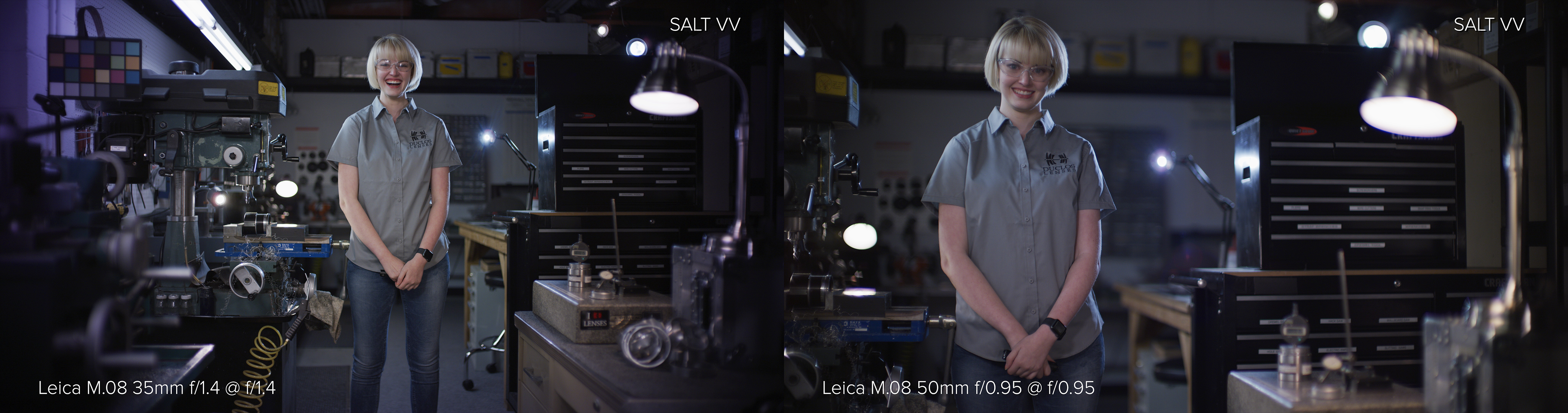
I won't post the footage in the clips, it's just not truly a sign of the lenses potential, but:
phfx_SALTVV_leicaM8_samples.jpg


That's the 35mm and the 50mm. In practice the 35mm and wider produces the purple vignette and pixel smearing near the corners, even stopped down.

However, the 50mm is entirely usable and literally the lens RED made the Leica-M Mount for. So that's good news.

Pairing with the Zeiss Otus I often use the 15mm, more recently 18mm, and 135mm Milvus or CP.3. The 15mm and 135mm could likely be from the previous generation ZF/ZEs as they are so new.


Great test! Now I am curious to know how the Milvus line stacks up against the CP.3?

Optically, extremely close. I just haven't done the tests to figure out if the coatings are the same for the CP.3s.


I am loving the 55 Otus ZE on Monstro, but I am going to be testing a 50 1.4 M Summilux for a smaller daily carry option. Maybe Monstro sensor plays nicer with M's
I'll know real soon. It's appealing for sure to have such a compact shooting package.
 
Are you guys gonna do a zoom lens test as well?
I would love to see what the angie EZ line of zooms look like on VV

Perhaps. But there simply aren't enough FF/VV zoom lens options at the moment. Maybe after NAB when a few more options are made available.
 
Back
Top