Welcome to our community

Be a part of something great, join today!

  • Hey all, just changed over the backend after 15 years I figured time to give it a bit of an update, its probably gonna be a bit weird for most of you and i am sure there is a few bugs to work out but it should kinda work the same as before... hopefully :)

Ask David Mullen ANYTHING

Mr David as a DP you achieved tremendous results with your remarkable work and inspired so many people and guided them with your versatile suggestions in cinematography. like that you may become grate director too, so its better to start new role as a director. you may direct great cinematographic picture like "THIN RED LINE". then you can guide people in all aspects of cinema through these forums in near future. we want to see you like that.
with best regards
nageswara rao surapaneni
 
Hi David,

I'm sure this question has been asked a thousand times but I need to ask. Having shot films on RED for a film-out (or to celluloid projection), what is the timebase setting that you use? 24fps or 23.98fps.

I have read in a number of the posting here with conflicting information. I'd like to think that it should be on 24fps, but labs like Fotokem NextLab suggest 23.98. I'm in Indonesia with little-to-no support on the matter. Please help.
 
Dear David, I learned an interesting thing about lighting a while back. A strip of lights can make specular light on one axis and soft on the perpindicular. and persuing that idea... I saw the bewitched movie. It had a set lit with a large array of pointsource lights ( like pars or something ) Can you comment on an array of point source lights as compared with a bounce off a large white surface? ie Is there such a thing as a contrasty light that wraps? or another notion... would an array of pointsource lights in the same aspect ratio as your film be significant in any way? I know that Panavision lenses have an oval circle of confusion that conforms to the aspect ratio of the film. ie the edges of the oval touch the four frame sides.
 
Hi David,

I'm sure this question has been asked a thousand times but I need to ask. Having shot films on RED for a film-out (or to celluloid projection), what is the timebase setting that you use? 24fps or 23.98fps.

I have read in a number of the posting here with conflicting information. I'd like to think that it should be on 24fps, but labs like Fotokem NextLab suggest 23.98. I'm in Indonesia with little-to-no support on the matter. Please help.

23.98P is more commonly used than 24P. It has no effect either way on the film-out or picture in general... in the end, you transfer one frame of digital to one frame of film and it gets projected at 24 fps.

It's entirely an audio issue because often some post work is done using copies that run at 59.94 Hz, especially if working with NTSC dubs. Even 24 fps film is transferred at 23.976 fps if you use a 60 Hz (59.94 Hz) TV standard. So at some point, there is a need to resolve the speed difference after the final mix or printmaster is made, or before it, depending on if all the audio was recorded and edited for 23.98 or 24.

In this day and age of Quicktimes for dailies and the ability to work at a true 24 fps rate through post, it all seems silly, but since even the HD standard for 60 Hz countries is 59.94 Hz, it doesn't seem to be going away.
 
Dear David, I learned an interesting thing about lighting a while back. A strip of lights can make specular light on one axis and soft on the perpindicular. and persuing that idea... I saw the bewitched movie. It had a set lit with a large array of pointsource lights ( like pars or something ) Can you comment on an array of point source lights as compared with a bounce off a large white surface? ie Is there such a thing as a contrasty light that wraps? or another notion... would an array of pointsource lights in the same aspect ratio as your film be significant in any way? I know that Panavision lenses have an oval circle of confusion that conforms to the aspect ratio of the film. ie the edges of the oval touch the four frame sides.

A bunch of point sources create multiple shadows that give the illusion of being a broad, soft source because one source blurs the shadows made by the point source next to it. Kubrick discovered this when trying to light the huge African landscape sets for "2001", with the film stock being only 50 ASA, he needed a way to create a soft dusk effect over the whole stage and ended up using thousands of photoflood bulbs in the ceiling. Later he was hired as a consultant on "The Spy Who Loved Me" by designer Ken Adams because they could not figure out how to light the submarine pen set, at the time, the largest set ever built -- Kubrick had them install thousands of small lights to cover the set. Roger Deakins apparently did something similar for the bowling dream sequence in "The Big Lebowski", used hundreds of 1K PAR's (I think) in a grid pattern over the top of set.

In theory, the effect of all those little lights is one big soft light, but of course, as you try to flag it, the shadows created by the flag are not perfectly soft-edged, it's a bit fringy from all those tiny multiple shadows.

The softness of a source is still determined by the overall size relative to the distance to the subject (i.e. the relative size of the subject compared to the size of the source.) So a tight array of PAR's that is 4'x4' in total area cannot be softer than a 4'x4' frame of diffusion with a light behind it (or a bounce into a 4'x4' card.)

--

Anamorphic lenses have an oval bokeh because a design decision was made to throw any inconsistencies in the amount of squeezing into the out-of-focus background rather than the in-focus subject. Early CinemaScope lenses had a problem where as you focused to minimal distance (often for close-ups) the subject did not get the full 2X squeeze. But since the projection was always a consistent 2X unsqueeze, faces and other objects shot near minimum focus got fatter-looking. Panavision solved this by keeping the point of focus always at a 2X squeeze, but as a result, the out-of-focus background starts to get more than a 2X squeeze, so even after the 2X expansion during projection, the background gets skinny-looking (and circles become vertical ovals.)

This is a separate issue than the fact the the depth of field is different for the vertical and the horizontal axis, that has to due with the fact that the field of view is different horizontally versus vertically... a 50mm anamorphic lens, for example, has the vertical view of a 50mm spherical but the horizontal view of a 25mm spherical since the anamorphic element acts like a wide-angle adaptor that only affects the horizontal view.
 
Sorry about my angry response (now deleted) to the post saying that I didn't pay attention to editing as a DP -- I just finished a feature shoot, with all-nighters on the last week, so I'm pretty tired.

My point is that any decent DP thinks about editing as much as he does about lighting and composition, it's part of his job. In fact, it's almost part of everyone's job on a film set to think about editing, that's why they take continuity photos, etc. But particularly a DP has to think about it.

Just last week, Robert Duvall, noticing that I was always on top of screen direction issues (I had asked for a pick-up on a B-camera angle with Duvall changing which side of the lens he stood on because in the master with two cameras rolling, he ended up between the A and B cameras and I wanted to make sure that the editor got one take where the screen direction was the same on both cameras for the actors looking at Duvall)... he asked me if all DP's were good at screen direction or left it to the script supervisor. I said it was like any other group of technical & artistic skills that a DP had (or an actor), some people were stronger in one area than another. I'm pretty good with screen direction issues and I understand editing. When in doubt, the director and I will talk it over with the script supervisor and come to a consensus.

Most of my concerns as I am driving to set regard coverage, how many set-ups do we need to tell this story in a way that it can be edited, and when the schedule is tight, often specifically what are the minimal number of set-ups needed. To know that, you have to know editing. Of course, once I get to set, I talk to the director, sometimes the script supervisor as well, about this, find out what the director is thinking, etc. Sometimes I will recommend an extra shot (despite the time pressure) because I worry that the director will have a hard time making a cut between the few set-ups we got (like when we only have shot a wide and medium on A & B cameras and everyone wants to move on to the next scene, I may feel that a reverse angle or cutaway is needed to make it easier to cut, because cutting in directly on the same axis to a slightly tighter shot is always a bit tough.)
 
Hi David,

I find it amazing that find time to answer posts on this forum, and always with such complete, super-well-explained answers. If you had been one of my professors at film school, I gladly would have gotten 5x further in debt to pay for tuition!!!

Your answer to my filter question was so useful (I re-read it several times) that I thought I'd ask another question from a similar angle, but this time about lighting.

We have a few commonly used ways of creating soft light and while I "feel" which gives what, like was the case before your reply about filters, I don't technically know the effective difference. I think solid knowledge is often way more useful than fuzzy knowledge (and I'm not saying art and personal judgment are not important, I think you know what I mean here) , as mentioned before, so why I ask the question.

We have:

Fluos - Divas, etc. The one thing I know about these is that if placed vertically, you get better 3D contouring while still obtaining some softness.

Bounce cards (different kinds, I do get that metallic bonce is harder with more throw and white diffused bounce is softer)

Shooting through a silk

Putting a softbox over an HMI head.

Using a large LED

Using a China Ball.

So... If you have a moment to comment on this.... When do you reach for each of the above, any that stand out you prefer or dislike for any reason, in terms of the quality of light they produce.

Thank you so much for your time. We each and all owe you a round of drinks and then some (to put it mildly).
 
When I first started asking for guidance I was advised to learn how to edit --by actually editing. It was presented to me as the best advise one could follow, the best use of one's energy in order to develop. I think that may be the single best thing one could do.

I guess one could argue that the story is told in the juxtaposition of coverage and editing styles from scene to scene, as well as all other layers. Each scene also being a unit that should be able to stand alone.

Having a fixed schedule duration, SFX & Stunt heavy sequences vs. relatively easy dialogue scenes, INT. vs. EXT., NIGHT vs. DAY --and all while having to remain flexible-- is an admirable job. A good DP is probably the single most important piece of the puzzle for a director to tell the story. And good line producers, UPMs and 1st ADs are also priceless.
 
We have a few commonly used ways of creating soft light and while I "feel" which gives what, like was the case before your reply about filters, I don't technically know the effective difference. I think solid knowledge is often way more useful than fuzzy knowledge (and I'm not saying art and personal judgment are not important, I think you know what I mean here) , as mentioned before, so why I ask the question.

We have:

Fluos - Divas, etc. The one thing I know about these is that if placed vertically, you get better 3D contouring while still obtaining some softness.

Bounce cards (different kinds, I do get that metallic bonce is harder with more throw and white diffused bounce is softer)

Shooting through a silk

Putting a softbox over an HMI head.

Using a large LED

Using a China Ball.

So... If you have a moment to comment on this.... When do you reach for each of the above, any that stand out you prefer or dislike for any reason, in terms of the quality of light they produce..

You always have to start with the basic premise of soft light, that it presents, or shines, light onto the subject from more than a single point in space so that the shadow that the light creates on the subject is not sharp, but blurred. The other thing to remember is that the softness is determined by the size of the source (once a light is bounced off of a card or diffused through a frame of diffusion, the bounce card or diffusion frame is now the "source", not the lamp) and that size is relative to the subject -- in other words, from the point of view of the subject, a 4'x4 frame of diffusion may be the same size in their field of vision as a 20'x20' frame of diffusion much farther away, and if so, the softness of the light will be the same in both cases. What's different, though, is the fall-off of intensity over space, the closer diffusion frame will create a faster fall-off in brightness as the actor moves towards or aways from the source - whereas the larger diffusion frame farther away, though producing a similar softness, would allow the actor to move several feet closer and farther towards the source without a big change in intensity.

This is one reason why Hollywood often opts for huge diffusion frames at a distance, which more accurately simulates the fall-off of, let's say, soft daylight coming through a window... in real life, you can move a number of feet towards and away from a window without getting radically brighter or darker, whereas if you covered the window with tracing paper and lit if from behind, the fall-off would be quite rapid as the actor moved away from the window. On the other hand, sometimes it strikes me as a bit stylized when you have huge soft lights simulating a point source like a candle and the actors don't naturally fall-off in exposure as they move away from the candle. Of course, that may be more practical for the staging of the scene, a big single soft source with little fall-off... otherwise you'd have to keep creating new sources for the actors as they moved around the room.

Just like with the design of diffusion filters, the material used for diffusing light or bouncing it affect the texture and softness of a light. For example, unless a light perfectly fills a frame of diffusion evenly from edge to edge, you can't really say that the size of the source is the size of the diffusion frame, it's somewhat smaller and thus a bit less soft, more specular. This isn't a bad thing necessarily, sometimes we want the light to retain some sharpness. If you shine a light through silk, for example, you don't see a round glow in the center of the material when looking directly at the frame of silk, you see a 4-point star effect in the material as the light behind the silk is spread out in four directions. So this means that your subject is being lit by a fuzzy star-shaped softened source. There is also a bit of hard light leaking directly through the material, creating a faint sharp shadow. Some more loosely-woven muslin fabrics do the same thing.

Now this faint hard light may be annoying, or it may add some texture to the surfaces of the subject that a perfect diffuser may not allow. Remi Adafarasin, BSC, for example, likes to shine light through a variety of fabrics because he finds that the diffusion from plastic material is a bit boring and unnatural, that the light in real life has some textures to it from passing through various materials and bouncing off of various surfaces.

The rules for diffusing light apply to bouncing it, it's pretty much the same thing, if you can evenly fill the bounce surface with no specular kicks, then the soft effect would be about the same as shining it through a diffusion frame of the same size and filling it perfectly and evenly. But bounce surfaces are not all the same, some have a bit of shine to them, or a texture, etc. As to whether I bounce or diffuse a light, most of that is practical / logistical depending on the space and how the actor has to move through the space. You may have more room, if the space is small, to put a white sheet on the wall and bounce off of that rather than put lights behind a diffusion frame.

Now a lot of this is assuming a perfect square or circle as the soft source, if the shape is rectangular -- like a 4' 4-bank Kino -- then the shadows produced by the long direction of the fixture will be softer than the shadows produced by the narrow direction of the fixture. This may also be a factor in how easy it is to flag the Kino.

The advantage, or disadvantage, or Chinese Lanterns, is that they shine in more than one direction. If you end up flagging and skirting a Chinese Lantern to the point that you only have a quarter of its ball shining out, then you might as well use a diffusion frame instead. They are also lightweight and easy to hang, and the light produced does not make it seem like a "movie" lamp is being used. They are hard to gel.

If you need soft light from a ceiling, it may be easier to rig a bounce card or surface up there instead of a lamp. But that may also make it harder to skirt, and anyone who accidentally crosses the path of the beam that is being bounced will cause a change in brightness.

But one reason I like Source-4's so much is that I can use them to hit a bounce card and using the blades inside the fixture to match the shape of the card without needing flags.
 
23.98P is more commonly used than 24P. It has no effect either way on the film-out or picture in general... in the end, you transfer one frame of digital to one frame of film and it gets projected at 24 fps.

It's entirely an audio issue because often some post work is done using copies that run at 59.94 Hz, especially if working with NTSC dubs. Even 24 fps film is transferred at 23.976 fps if you use a 60 Hz (59.94 Hz) TV standard. So at some point, there is a need to resolve the speed difference after the final mix or printmaster is made, or before it, depending on if all the audio was recorded and edited for 23.98 or 24.

In this day and age of Quicktimes for dailies and the ability to work at a true 24 fps rate through post, it all seems silly, but since even the HD standard for 60 Hz countries is 59.94 Hz, it doesn't seem to be going away.

Hi David,

Thank you for finally clarifying that. Everyone has always explained the 23.98p / 24p from a picture standpoint, never an audio issue. I'm finally at ease with this.

Since people in Indonesia (most of Asia) are used to shooting on 25p (because we're a 50Hz TV standard), they usually use 25p all the way through the post process until final mix. Then they resolve the 4.1% pulldown for sync to the printmaster. I personally don't like this method because during the entire process, you instinctively feel the film running at 25p then once you get to celluloid running at 24fps, everything feels slower. Thankfully, tapeless workflow allows me to bypass this. However, I'm just as baffled that even though it can handle true 24p, it's always recommended to use the other timebase for compatibility. I'm sure that's what it boils down to in the end :) I'll double check the facility first to see which they prefer.

Thanks again.

Best,
-Robin
 
You always have to start with the basic premise of soft light, that it presents, or shines, light onto the subject from more than a single point in space so that the shadow that the light creates on the subject is not sharp, but blurred. The other thing to remember is that the softness is determined by the size of the source (once a light is bounced off of a card or diffused through a frame of diffusion, the bounce card or diffusion frame is now the "source", not the lamp) and that size is relative to the subject -- in other words, from the point of view of the subject, a 4'x4 frame of diffusion may be the same size in their field of vision as a 20'x20' frame of diffusion much farther away, and if so, the softness of the light will be the same in both cases. What's different, though, is the fall-off of intensity over space, the closer diffusion frame will create a faster fall-off in brightness as the actor moves towards or aways from the source - whereas the larger diffusion frame farther away, though producing a similar softness, would allow the actor to move several feet closer and farther towards the source without a big change in intensity.

This is one reason why Hollywood often opts for huge diffusion frames at a distance, which more accurately simulates the fall-off of, let's say, soft daylight coming through a window... in real life, you can move a number of feet towards and away from a window without getting radically brighter or darker, whereas if you covered the window with tracing paper and lit if from behind, the fall-off would be quite rapid as the actor moved away from the window. On the other hand, sometimes it strikes me as a bit stylized when you have huge soft lights simulating a point source like a candle and the actors don't naturally fall-off in exposure as they move away from the candle. Of course, that may be more practical for the staging of the scene, a big single soft source with little fall-off... otherwise you'd have to keep creating new sources for the actors as they moved around the room.

Just like with the design of diffusion filters, the material used for diffusing light or bouncing it affect the texture and softness of a light. For example, unless a light perfectly fills a frame of diffusion evenly from edge to edge, you can't really say that the size of the source is the size of the diffusion frame, it's somewhat smaller and thus a bit less soft, more specular. This isn't a bad thing necessarily, sometimes we want the light to retain some sharpness. If you shine a light through silk, for example, you don't see a round glow in the center of the material when looking directly at the frame of silk, you see a 4-point star effect in the material as the light behind the silk is spread out in four directions. So this means that your subject is being lit by a fuzzy star-shaped softened source. There is also a bit of hard light leaking directly through the material, creating a faint sharp shadow. Some more loosely-woven muslin fabrics do the same thing.

Now this faint hard light may be annoying, or it may add some texture to the surfaces of the subject that a perfect diffuser may not allow. Remi Adafarasin, BSC, for example, likes to shine light through a variety of fabrics because he finds that the diffusion from plastic material is a bit boring and unnatural, that the light in real life has some textures to it from passing through various materials and bouncing off of various surfaces.

The rules for diffusing light apply to bouncing it, it's pretty much the same thing, if you can evenly fill the bounce surface with no specular kicks, then the soft effect would be about the same as shining it through a diffusion frame of the same size and filling it perfectly and evenly. But bounce surfaces are not all the same, some have a bit of shine to them, or a texture, etc. As to whether I bounce or diffuse a light, most of that is practical / logistical depending on the space and how the actor has to move through the space. You may have more room, if the space is small, to put a white sheet on the wall and bounce off of that rather than put lights behind a diffusion frame.

Now a lot of this is assuming a perfect square or circle as the soft source, if the shape is rectangular -- like a 4' 4-bank Kino -- then the shadows produced by the long direction of the fixture will be softer than the shadows produced by the narrow direction of the fixture. This may also be a factor in how easy it is to flag the Kino.

The advantage, or disadvantage, or Chinese Lanterns, is that they shine in more than one direction. If you end up flagging and skirting a Chinese Lantern to the point that you only have a quarter of its ball shining out, then you might as well use a diffusion frame instead. They are also lightweight and easy to hang, and the light produced does not make it seem like a "movie" lamp is being used. They are hard to gel.

If you need soft light from a ceiling, it may be easier to rig a bounce card or surface up there instead of a lamp. But that may also make it harder to skirt, and anyone who accidentally crosses the path of the beam that is being bounced will cause a change in brightness.

But one reason I like Source-4's so much is that I can use them to hit a bounce card and using the blades inside the fixture to match the shape of the card without needing flags.

Once again you've turned fuzzy feeling into clear knowledge. I don't know how to thank you enough.
 
But one reason I like Source-4's so much is that I can use them to hit a bounce card and using the blades inside the fixture to match the shape of the card without needing flags.

David, On this Labor Day you patiently enter a textbook description of soft/hard lighting techniques as relates to both large budget and low-budget productions! And I know you have typed the same thing before, perhaps slightly differently either here or on Cinematography.com or both. Some people are out with families and a barbeque ya know!!

I've been reading your extremely informative posts for years and am amazed at the gererosity of spirit you bring to what you do. There are lot of ASC members, but really, of that body of talent both you and Roger Deakins stand alone in your selfless sharing of knowledge gained through hard work. Neither of you hold things back "for the paying workshop", or the book. I'm quite grateful for the time you take to deliver a steady stream of answers well thought out and with accuracy.

Cheers and Thanks,
Paul Nordin, DP
 
Besides direct experience, I've collected a large amount of information from years of reading "American Cinematographer" and whatnot, so it seems only fair to pass that along, since the original cinematographers in those articles passed it along to me and others at the time - it's not "mine" to keep!

Besides, I enjoy good cinematography, so if my advice helps someone shoot a movie and have it look better, then I will be the beneficiary as an audience member later.
 
Besides direct experience, I've collected a large amount of information from years of reading "American Cinematographer" and whatnot...
Thats a wonderful response David. All I'm gonna say is that over time (particularly over the last few years) the cinematographic "meat" in AC has been getting pretty diluted to almost non-existent. Kind of a shift from Scientific American to Popular Science, if that analogy makes any sense. But your advice keeps getting better.

At least from where I sit.

Cheers
 
Hi David,

When you use multiple cameras do you mainly position them to get multiple angles or different shot sizes from the same angle? And, if you had to choose only three primes for a show which three would you go with?

Much Thanks
 
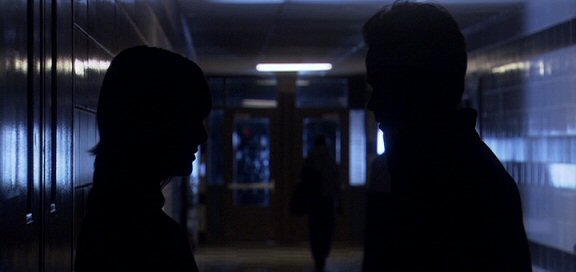
quiet2.jpg


Hi David. How did you get the sheen reflections on the lockers/doors on either side of the hallway with such little room to hide lights? Are those only caused by the overhead fluorescents?
 
Hi David. How did you get the sheen reflections on the lockers/doors on either side of the hallway with such little room to hide lights? Are those only caused by the overhead fluorescents?

I hid a single vertical Kinoflo tube outside the glass doors to the hallway, hidden from camera by the center of the split doorframe. That one tube was reflected many times over in the tiles of the hallway.
 
Hi David,

When you use multiple cameras do you mainly position them to get multiple angles or different shot sizes from the same angle? And, if you had to choose only three primes for a show which three would you go with?

Much Thanks

Just depends... usually lighting problems keep your angle limited, so your keep multiple cameras looking in the same direction, but sometimes it's not a problem, especially outdoors in natural light.

Just depends... the style of a movie will determine the focal length range. In the abstract, I suppose for a Super-35 camera, I'd probably get a 21mm, 35mm, and a 50mm, but that's in the abstract. Odds are high that I would get five primes, not limit myself to three.
 
Hey David,

I am shooting a music video in the near future for an acoustic guitar guy/girl duo. We have the privilege of shooting at the historic RCA B studio in Nashville (where Elvis recorded his stuff) and I had an interesting creative concept that I wanted to get your input on. I'd like to set the musicians on stools in the middle of the room, with cool looking rugs underneath them. I'd then like to go out and buy about 10-15 clear 40watt lightbulbs and hang them from the ceiling at various heights and distances from the musicians. I'd then use 2 dimmer and set a tap tempo chase in time with the song- having various light bulbs fade in and out throughout each take. I'm also thinking of hanging several strands of christmas lights on the wall directly behind the musicians in order to add some spice to the bokeh on closeups. My question is, how would you light the two musicians? Obviously the lightbulbs are going to have some affect, but I'm thinking a bouncing a couple leko theatre lights may be the best solution. I was also debating on using a couple chinese lanterns to bring up the ambient light level in the room. Overall, I'm going for a dark contrasty vintage look as our location is filled with history. I will be shooting on the Red One and a Canon 7D DSLR with "L" glass.

What are your thoughts on this situation?

Thanks in advance for your help!
 
Back
Top