Welcome to our community

Be a part of something great, join today!

  • Hey all, just changed over the backend after 15 years I figured time to give it a bit of an update, its probably gonna be a bit weird for most of you and i am sure there is a few bugs to work out but it should kinda work the same as before... hopefully :)

Ask David Mullen ANYTHING

I'll let David chime in on the cost for film - but it would seem that the cost per minute for Digital is near zero since the media is reusable and the only true sunk cost per minute would be the cost of electricity to charge the battery (pennies). That further complicates the issue with digital since you can shoot more and longer takes without additional media costs.

Agree with what's been said, but I'll note that with digital, you pay for storage and transfer costs (hard drives, laptop), and potentially the hire of a DIT. On a film shoot, you often have a clapper loader (2nd AC/film loader). Furthermore, you tend to shoot more in digital than on film. This stuff matters on low budget shoots more than on big, as Michael points out.

I myself haven't seen an "all-in" number per minute for film vs. digital. This is partially because there are a lot choices you make in post that influence it, such as quality of scan and who does it for you.
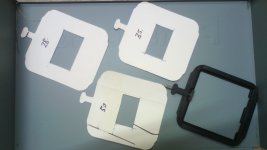
 
Here is where I show my ignorance and lack of knowledge.


Recently, when testing out some improvised internal filters on an Ursa Mini 4.6K there was some very noticeable masking flare from the 35mm f1.4 Nikon lens originating from outside of the actual image area the sensor sees.

The Nikons are full-frame stills lenses so see things the camera sensor does not see directly. Because there was moving dappled shade involved, the flare was very apparent as it came and went.

A DoP friend mentioned what was a commonplace technique of custom matte frames for individual prime lenses. To be honest, the idea never entered my head but I now recall seeing one in a behind-the-scenes promotional documentary about a major feature film. Except for the widest field-of-view, they would be little use with zoom lenses.

I have forgotten the exact name for these things. I thought I would try the idea and have cut and tested pieces of Weetie packet cardboard which I will use as templates for cutting more permanent material.

So far, even though they are outside of the image area seen by the 4.6K sensor, the histogram does change when a matte frame is in place so something is going on, hopefully for the better.
 

Attachments

  • FRAME MATTES.jpg
    FRAME MATTES.jpg
    75.9 KB · Views: 0
Hi David, I'm wondering the effect of a grid/eggcrate on larger frames... do you find they work well in place of flags when controlling spill/spread? I've also always wondered what the spread/angle of something like 1/2 grid through a frame is?
 
Thanks for the replies everyone. So it sounds like approximately $100 per minute for 35mm. I was honestly expecting it to be higher. I assume that includes scanning etc?
 
Happy Summer 2021 Solstice!

I am interested in replacing a variety of tungsten lighting instruments here at the University of Michigan Video Studio with LED equivalents.
Our studio does a variety of work, yet much of it entails staging original musical performances for the camera.
Controlling light is very important to keep it off our large upstage projection screen.

NOTE: Most of our fresnels and par cans we use for color washes, so color changing LEDs are what we are looking for.

Here is a list of aging tungsten instruments we currently have - what might you suggest?

Lowel Rifa 88 (1000W soft box)

Desisti 2K Fresnel

Desisti 1K Fresnel

Par 64

Source 4 750w Ellipsoidal

Kino Flo 4x4 bank

Our current lights have done yeoman's service for 20 years!
With the cost increase of LEDs, one thing we want are instruments built to last and to be serviced if needed.

Thanks in advance!
 
Sorry, I've been shooting for six months on a series so haven't checked in here....

I haven't done the cost breakdown in a long time but it's hard to say that film isn't more expensive than digital to shoot because of the costs of stock, processing, and scanning to get to a similar place in post. Of course, shooting ratio is a major factor but unfortunately most directors today are so used to shooting digital that when they shoot film again, they don't do fewer takes or anything. I did dozens of 35mm features with a budget for 100,000' of stock (so roughly a 10:1 ratio for a final movie that was 10,000') but the last few crept up to 200,000' and I think I'd have a hard time keeping a director below that today.
 
Soft eggcrates can come in different degrees of spread/focus... They reduce spill to the sides but in a graduated fashion that sort of focuses the soft light into the center, whereas a large flag only affects the subject when it starts to cross into the area between the flag and the soft box. For this reason, I have to think about whether to use those grids on soft lights because if an actor misses their mark, they might be darker because of their position relative to the grid. Sometimes it's better to just use flags or skirts around the sides instead. For example, if you have an overhead Litemat 8 (about 4x4) for a soft top light effect and you put a snap grid on it, then the actor is only getting most of the soft light when they are directly under it and it falls off quickly around the edges. But of you put a skirt around it instead, then the walls might be just as darkened as the grid would create but as the actor stands near the overhead soft box, they are lit by it even if they are near the edge instead of the center.

So eggcrates, etc. are just a different way of controlling spill compared to a flag, they aren't a substitute for flagging, it's just a different effect on the soft light. You need the option of doing either or both sometimes.

The way to learn about this is to simply stand where the actor is and look at the soft light and move forward and back a bit and see how the grid or flagging is cutting the light.
 
Hi David,

Thanks again as always for being available and quite descriptive in your answers. A few questions for you:

1) I have a movie that has a number of scenes in a living room with large windows looking out to a night exterior in the woods/lake. Obviously there is a worry of constantly seeing reflections in the glass. Have you experienced this scenario in the past? We’re there certain lighting decisions you made in pre-production to yourself and/or with art department in order to hide lights (LED behind black foam core on the ceiling) or other decisions besides only using practical lighting?

2) Attached to this is shooting during daytime, from outside, looking into an interior of windows. How do you deal with the reflections of the sky and bright objects reflected on to the glass when trying to see inside? It seems that polarizers really don’t help much in this scenario in my experience. It seems to be the same for me when shooting through car windows. Are there scenarios when polarizers will help more? Is all you can do, use lights/bounces to boost the interior lighting to come closer to outside? That’s all I’ve had luck with besides a medium shot when I can put blacks outside the window to take away the reflection altogether. When shooting a driving shot specifically, is the only way to do a process trailer and rig blacks overhead?... there’s no way to decrease the brightness of the reflection besides stopping down and bringing a light in, right?

Thank you again for taking the time.

- d
 
Hi David,

Thanks again as always for being available and quite descriptive in your answers. A few questions for you:

1) I have a movie that has a number of scenes in a living room with large windows looking out to a night exterior in the woods/lake. Obviously there is a worry of constantly seeing reflections in the glass. Have you experienced this scenario in the past? Were there certain lighting decisions you made in pre-production to yourself and/or with art department in order to hide lights (LED behind black foam core on the ceiling) or other decisions besides only using practical lighting?

2) Attached to this is shooting during daytime, from outside, looking into an interior of windows. How do you deal with the reflections of the sky and bright objects reflected on to the glass when trying to see inside? It seems that polarizers really dont help much in this scenario in my experience. It seems to be the same for me when shooting through car windows. Are there scenarios when polarizers will help more? Is all you can do, use lights/bounces to boost the interior lighting to come closer to outside? Thats all Ive had luck with besides a medium shot when I can put blacks outside the window to take away the reflection altogether. When shooting a driving shot specifically, is the only way to do a process trailer and rig blacks overhead?... theres no way to decrease the brightness of the reflection besides stopping down and bringing a light in, right?

Thank you again for taking the time.

- d

I'm sorry to take so long to reply.

1) A black glass window is like a mirror if the interior is brighter than the exterior, so you have to treat it as if there was a big mirror in the room. You either hide things behind large neat black panels (which will be reflected in the glass so hopefully the room is shadowy) or stay to one side out of the reflection. Sometimes some carefully placed furniture can help hide something. A curtain valence or something that cuts part of the top of the window can help hide ceiling lights, or a black teaser. If this is a set, then spending the money to make the large windows tiltable will help (up/down, side-to-side). You have to plan on seeing a lot in reflection which means lighting more with on-camera practicals.

2) Polas work best at a 45 degree angle to the glass. Besides black solids, sometimes you can use nets on a frame to darken the reflection as long as the net itself isn't within the plane of focus and don't mind the reflections diffused by the net. Otherwise you just have to bring up the interior and keep bright objects from being in the reflection (like a hot sky or white building in full sun, etc.) Plants are darker so if you can live with a lot of greens reflected, in the tighter shots you can bring large potted plants into the reflection to have something darker. You can even, if you have the budget, shoot critical tighter shots at night and reflect a translite of the same view in the glass but now be able to balance the exposure. Or shoot at night and light the reflections with a big light so it feels like daylight but dimmer and hopefully in soft focus. All of these tricks only work on tighter shots though.
 
Hi David, I was wondering if you had the inkling or maybe even plans to do like an online video tutorial, teaching Film & Video lighting?

Thank you!
 
Hi David,

Very surprised that no one has posted anything since November. Your knowledge and expertise is so valuable, that it's odd more people don't ask questions. Deakin's website is the only other place to ask such things and he's usually not nearly as detailed and open as you.

1) Anyway, as far as lighting with practicals... in order to have someone actually lit by a practical lamp; won't the lamp shade either always blow out (in order to get enough light from it), or if you dim it down (so it doesn't blow out), you won't be able to get much exposure on the people walking through the room. Or is it just always the case that the people will be underexposed in the wide, and it isn't until you can shoot a close-up and bring in a unit give them a little more that they will be a little more properly lit.
Because if I use a 100w bulb and a 25w bulb, won't I have to dim the 100w bulb down much more than the 25w bulb in order to not have the lamp shade blown out? Or is that not the case and the 100w bulb only needs to be dimmed the same amount, and it will somehow give you more output without blowing out more (at the same dim level as the 25w bulb).

2) Also, I'm curious on sunny daytime exteriors how you deal with actors squinting from the bright sun. Even if you put a diffusion frame in front, an actor will sometimes still squint. How do you deal with this? Or is it just dependent on the actor on how sensitive their eyes are, and if they're constantly squinting you just need to change the blocking and have them looking further away from the sun.

thanks again,
- dan
 
Dan -

I'm sorry I didn't see this until now - between work and a family crisis, I hadn't been checking this site.

1) Whether a lampshade actually doing the lighting on the faces blows out to the clip point depends on a lot of things -- foremost it depends on how close the actor is to the lampshade. Due to fall-off, the exposure for the shade on the actor drops off quickly over distance but if they are close to the shade, then the exposure difference is not that bad. Another issue is dynamic range and how well the particular camera and your settings handles overexposure. As you know, higher ISO settings give you more headroom in general. And finally some shades are white and textureless to begin with, so if they clip, it's hard to tell, they look the same just below the clip point as they do over the clip point.

You can do tricks like ND gel the side of the shade facing the camera, or use an ND grad filter on the lens vertically to darken the side of the frame with the lampshade. Even a bit of masking tape on the side of the bulb facing camera might be enough to keep it from clipping, though you have to be careful with either the tape burning or the bulb looking too dark, so the center of the shade has a dark shadow.

2) There is a conceptual issue with shooting actors in sunlight -- in real life, they'd be wearing sunglasses if the light was too bright, so just by virtue of not wearing sunglasses, it is natural to squint even if you are in the shade and looking out at something bright, even if you don't do any lighting. So it's a problem without much of a solution. Sometimes you can put something dark like a black flag directly in their line of sight to let the eyes relax a bit. When the sun gets lower and frontal, diffusion can actually make things worse -- the bare sun may be just above their line of sight, but put a frame of 1/2 Soft Frost in front of it and that sun is spread out into a big bright area that is hard to look at. I had one actress who had so much trouble looking into anything bright that I had to shoot her in backlight near the end of the day for all her close-ups -- which looked great by the way, so maybe she was manipulating things to favor her lighting, I don't know. But I certainly liked the way those shots turned out...
 
Hi David,

Very surprised that no one has posted anything since November.

If there are no posts it may be because some visitors, myself included are unable to navigate to the most recent posts from the entry header except by stepping one page at a time from go to whoa. No go to last post option appears. I by chance spotted a recent comment and hitting that took me to this last page. I suspect people are just giving up on the new site layout.
 
I use this as my homepage link for the Reduser new site layout:

Code:
https://www.reduser.net/search?searchJSON={view:topic,date:{from:10},sort:{lastcontent:desc},exclude_type:[vBForum_PrivateMessage],exclude:[20,51,29,56]}


The date:{from:10} option can be changed to be any number of days to list recent posts. So this link show all the recent posts for the past ten days in descending order regardless if I have read it or not.


But I can't post the link here without it getting corrupted.
Try amending the default new post link to be something like this and save it as a link in your web browser:

/search?searchJSON={view:topic,date:{from:10},sort: {lastcontent:desc},exclude_type:[vBForum_PrivateMessage],exclude:[20,51,29,56]}

or like this if you what to just cut and paste it in your web browser search bar:

/search?searchJSON={%22view%22:%22topic%22,%22date% 22:{%22from%22:%2210%22},%22sort%22:{%22lastconten t%22:%22desc%22},%22exclude_type%22:[%22vBForum_PrivateMessage%22],%22exclude%22:[20,51,29,56]}

You still need the front end to be https://www.reduser.net.....

or just try this bitly:

https://bit.ly/Reduser_10_Recent_Days
 
Hi David,

I'm curious about your approach to fluorescent style overhead office lighting. I've found myself struggling to add shape to the light while at the same time avoiding a theatrical look. But then I watch Gordon Willis' newsroom scenes in All The Presidents Men and the actor's faces appear nearly shadowless, yet his frames still have beautiful shape to the light. What's your method?
 
I'd love to hear David's response to that question too.

I usually flag off the lights that are directly over the talent's head and then key very soft with a matching light from a high angle. That way it feels kind of office-y but looks better.

Sometimes a big neg on the side can add some shape but the office light is too toppy still -.... in a rush i once used a 4x of opal to spread the office toplight down to better angle.
 
Back
Top