Welcome to our community

Be a part of something great, join today!

  • Hey all, just changed over the backend after 15 years I figured time to give it a bit of an update, its probably gonna be a bit weird for most of you and i am sure there is a few bugs to work out but it should kinda work the same as before... hopefully :)

Ask David Mullen ANYTHING

We used foam baseballs but some were changed in post. I think at some points when the camera got too close to being hit, they mimed the hit (they deliberately missed the ball) and I think a few times they accidentally missed and the ball hit was added.

Very cool. Worked a treat! Thanks.
 
Hi David,

for an upcoming budget shoot at night, interior, I'd like to have 'beam' 'lights' (sometimes) scanningthe room.
I would say a bit 'BladeRunneresque' (the original) is what I have in mind.
Choosing lights, I was wondering wether a 9light maxibrute would give me a desired effect? It probably has to be put quite a few meters away, how much would you ballpark? I don't want super hard shadows, I want them to be visible but with a softish edge.
Would you consider other options that are budget friendly?
No location yet, but the type of location we are looking for will have many 'openings'.

Thanks!
 
Last edited:
"Beam" sort of implies hard light, soft light would just sort of glow the room as it passes. "Blade Runner" used very hard, sharp lights -- Xenons -- for that effect, today I'd consider a Leko or more than one for a narrow beam(s) but they wouldn't fill a window. If you want the beam to fill the whole window, then a light farther back, at which point a MaxiBrute isn't a bad idea, you get multiple shadows (minimal, hard to see) compared to a T12, for example, but one advantage of a MaxiBrute is that they leak around obstructions like blinds and window frames, and maybe is the semi-soft hard effect you are talking about.
 
"Beam" sort of implies hard light, soft light would just sort of glow the room as it passes. "Blade Runner" used very hard, sharp lights -- Xenons -- for that effect, today I'd consider a Leko or more than one for a narrow beam(s) but they wouldn't fill a window. If you want the beam to fill the whole window, then a light farther back, at which point a MaxiBrute isn't a bad idea, you get multiple shadows (minimal, hard to see) compared to a T12, for example, but one advantage of a MaxiBrute is that they leak around obstructions like blinds and window frames, and maybe is the semi-soft hard effect you are talking about.

Have used a bank of two mini-brutes for window fill. Warmed up daylight nicely through blinds to match tungsten interiors.
 
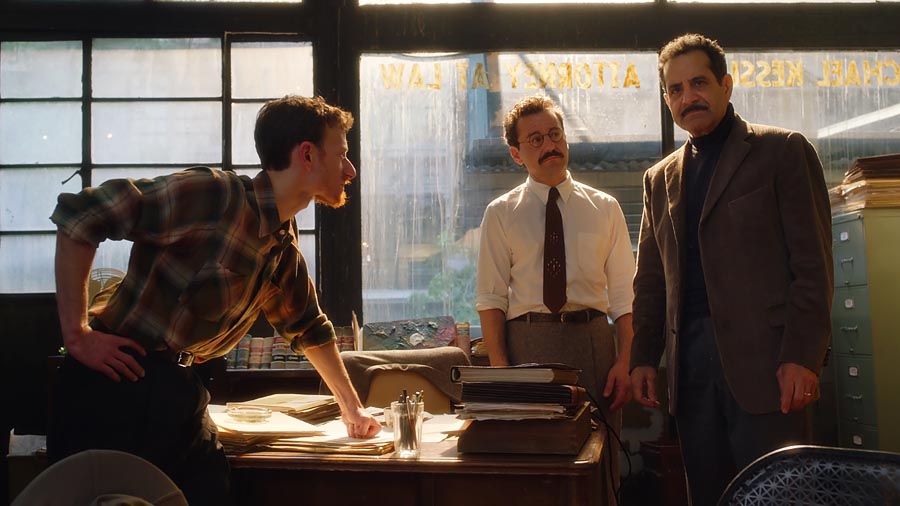
I used a MaxiBrute outside these windows on a condor for a warm backlight:

maisel8.jpg
 
"Beam" sort of implies hard light, soft light would just sort of glow the room as it passes. "Blade Runner" used very hard, sharp lights -- Xenons -- for that effect, today I'd consider a Leko or more than one for a narrow beam(s) but they wouldn't fill a window. If you want the beam to fill the whole window, then a light farther back, at which point a MaxiBrute isn't a bad idea, you get multiple shadows (minimal, hard to see) compared to a T12, for example, but one advantage of a MaxiBrute is that they leak around obstructions like blinds and window frames, and maybe is the semi-soft hard effect you are talking about.

Thanks for the quick reply David!
I might go for both options, since leko's aren't that expensive to rent. If the brute doesn't give the desired effect I can swap it. If it does, the leko can be bounced to use as a fill if necessary.

I also came accross these images (links beneath)

https://scontent-bru2-1.xx.fbcdn.ne...=753caff091762e266639a4b2f1169153&oe=5F184678

https://scontent-bru2-1.xx.fbcdn.ne...=b69767379b3a1781b9be2eeb53d4a863&oe=5F17D122


A bounced leko on to a hard reflector seems to produce a beam as well with the added benefit of being larger surface, filling more of the window.
Sort of like what a brute is doing but less power hungry. Am I right on this part or not at all?
If I'm right, I might skip the brute.
 
It's a mirror board in the photo -- all it allows is for the light to come from a farther distance if you can't back up on a straight line. Being farther away, the light would get sharper, bigger, and dimmer.

Not sure that's a leko in the photo, it is bigger and brighter than a typical leko unless the photo was taken at a high ISO -- could be a JoLeko 800.

You can cluster multiple lekos with narrow lenses to create a single, wider shaft, if you line them all up and angle them carefully to match, it looks like one beam that might be going through some obstruction like a tree branch.

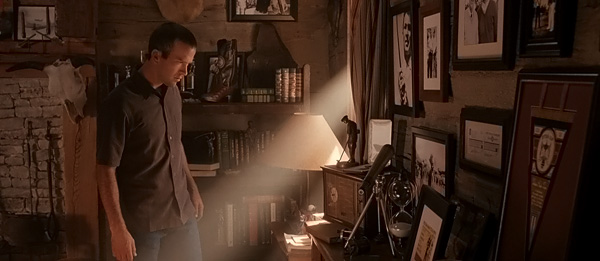
I used three parallel lekos to create this window shaft here:

utopia23.jpg
 
Last edited:
Ok so I was wrong making it a bigger source.

Very interesting on combining multiple leko's for a wider beam. Would have never thought of that.
Looks very good too.
Which leko lenses did you use? 5° to get them as narrow as possible?

I found another picture from that setup showing the light itself.

https://scontent-bru2-1.xx.fbcdn.ne...=f31b057a6bc25a0ad9675dcae7d83870&oe=5F154B8E

It does look indeed bigger than a regular leko 750W Leko.
 
I'm still researching a bit which fixture would serve best and came accross a fixture called 'svoboda'. It seemed similar to brute lights, but after reading up on it it's different.
It uses reflective coated bulbs, and produces quasi parallel beams while also having a softish quality of light (that's what I read). Of course soft light is a different term in theatre than in cinema.

Have you ever used this fixture?
 
Rain and mist and fog...

Rain and mist and fog...

Hi David,

I hope you're enjoying the extended time off during the shut down. I had a couple questions:

1) Besides backlighting rain, are there any other tips for dealing with shooting rain scenes? If the rain is backlit, do you have to even cut off frontal light from the rain at all? When it's exterior daytime, do you still have to backlight the rain if it's an overcast day? Obviously seems much more difficult since you'd need much bigger lights to backlight anything.

2) When shooting wide landscape shots where there is fog or haze in the mountains, are there any filters or specifics for exposure in capturing that haze. Does a haze filter really work? I know they exist for still cameras, but I haven't really heard of them being used for film.

Thanks,
- dan
 
Seeing rain is all about creating highlights in the droplets by backlight and then framing that against a darker background for maximum visibility -- but obviously there are times when you can't achieve that. Outdoors in overcast weather, you see rain when it is framed against a darker background like a row of trees or buildings. If it can be backlit by a hotter sky or lights, all the better. But it is very hard to see rain against a bright background or falling in front of a bright foreground object because it's all about seeing the highlights in the rain droplets. So adding frontal light isn't necessarily a bad thing if you are backlighting rain but it will be less visible in front of the lit foreground objects depending on their tonality.

UV Haze filters cut a little distant atmospheric haze but really work only because film is sensitive to UV, digital cameras tend not to have that problem. Infrared cameras see through atmospheric haze better.
 
Gaffer or DP

Gaffer or DP

Hello David,

I hope all is well for you and yours during these covid times.

What do you do if you are working with a director who is very specific in what he wants, as in,
he says something to you that you might say to your gaffer, such as, I want a 10k Molebeam with
full CTO on it coming in from that loft window? And then he says that he wants the 14mm lens on the camera
and wants the camera very close to the floor looking up etc. And wants some smoke in the room.

The reason I ask is I am wondering if you talk to directors in advance and decline the job if they are
going to try and direct the photography and in some ways talk with you like you were a gaffer.

I am also wondering what other DPs do with directors who are very specific.

I assume that Ridley Scott was very specific back on his earlier films.
 
I've never worked with a director who called specific lighting units like that so I'm not sure how I'd respond, I already drive my gaffer nuts by being too specific so I guess it would be karma to get a director like that... if it looks good, I'd just go with it for now but if it never stops, I'd suggest that the director be their own DP since clearly they are already doing it already. You can be polite about it, respectful, and just say "look, you don't need a DP." Now maybe the DP only got hired because of a union requirement, or the producer insisted, etc.

Most directors are too busy to take over the lighting of sets even if they wanted to.
 
I've never worked with a director who called specific lighting units like that so I'm not sure how I'd respond, I already drive my gaffer nuts by being too specific so I guess it would be karma to get a director like that... if it looks good, I'd just go with it for now but if it never stops, I'd suggest that the director be their own DP since clearly they are already doing it already. You can be polite about it, respectful, and just say "look, you don't need a DP." Now maybe the DP only got hired because of a union requirement, or the producer insisted, etc.

Most directors are too busy to take over the lighting of sets even if they wanted to.

Thank you, David.

If a director is less specific and says something like he wants a gold beam of light to come in through a window
and back light an actor, would that also be stepping too far into the role of the DP?

I wonder because after being my own director of photography for decades I'm not sure how a
hired DP would take to my direction while I'm directing a film.

Do you normally discuss at length during preproduction what a director wants the film to look like,
or do they rely on you to create the look the way you want?
 
Often preproduction isn't long enough to go into detail about how every scene will be shot and lit but you try and establish the visual approach and come up with references that you both agree on. I think the main thing is to learn the director's taste, what they like and don't like photographically.

Twice I shot something for former DPs and they were remarkably hands-off, they simply were relieved to have someone else thinking about the cinematography so they could concentrate on directing.
 
Marvelous Maisel

Marvelous Maisel

Hi David,

I saw your instagram post about the burning house shot for Mrs. Maisel. I was curious... you said you wrapped the house in Broad Channel. What is that? From the picture it looks like the pars on the roof were enclosed in an entire strucutre... of CTO? Why did you wrap it around the sides as well, and not just the front? Is it to make the light bloom on the sides as well? It looks like on the maxibrutes on the porch, you only put gels in the front...

Thanks,
- dan
 
Hi David,

I have a feature coming up where the director likes small movement and push ins.

What I'd like to do is have a small 20" slider on the stix or dolly all the time
so if he calls for a small push I can do it quickly.

My question is what slider or brand would be best for a full built red package and cine lenses,..
around a 18-22lb build??

Thank you,

Curtis
 
Red with Cinema lenses, batteries, monitors, etc. are heavy. Like you say, 20 lbs is not unusual. Buying a slider meant for DSLR is, IMO, trying to put 20 lbs into a 3-5 lb bag. These lightweight systems will hold a RED but not in the rigidity that one expects and needs. So... one answer would be the Dana Dolly. The DD rigs with pipe (aluminum, steel, plastic) and end clamps so it is not real amenable to a single tripod. You can adapt to a large range of lengths but 20 inch of motion would need about 40 inch pipe (end clamps + dolly + travel). I suggest you contact Mike Hall (owner) at Dana Dolly *(623) 561-6490‬. Maybe he has a single tripod option.
 
Back
Top