
Roberto Lequeux
Well-known member
Don't say someday David, and please start looking. I would love to see something directed by you. Especially along those lines.

Follow along with the video below to see how to install our site as a web app on your home screen.

Note: this_feature_currently_requires_accessing_site_using_safari


Hi David,
I'm sure this question has been asked a thousand times but I need to ask. Having shot films on RED for a film-out (or to celluloid projection), what is the timebase setting that you use? 24fps or 23.98fps.
I have read in a number of the posting here with conflicting information. I'd like to think that it should be on 24fps, but labs like Fotokem NextLab suggest 23.98. I'm in Indonesia with little-to-no support on the matter. Please help.
Dear David, I learned an interesting thing about lighting a while back. A strip of lights can make specular light on one axis and soft on the perpindicular. and persuing that idea... I saw the bewitched movie. It had a set lit with a large array of pointsource lights ( like pars or something ) Can you comment on an array of point source lights as compared with a bounce off a large white surface? ie Is there such a thing as a contrasty light that wraps? or another notion... would an array of pointsource lights in the same aspect ratio as your film be significant in any way? I know that Panavision lenses have an oval circle of confusion that conforms to the aspect ratio of the film. ie the edges of the oval touch the four frame sides.
We have a few commonly used ways of creating soft light and while I "feel" which gives what, like was the case before your reply about filters, I don't technically know the effective difference. I think solid knowledge is often way more useful than fuzzy knowledge (and I'm not saying art and personal judgment are not important, I think you know what I mean here) , as mentioned before, so why I ask the question.
We have:
Fluos - Divas, etc. The one thing I know about these is that if placed vertically, you get better 3D contouring while still obtaining some softness.
Bounce cards (different kinds, I do get that metallic bonce is harder with more throw and white diffused bounce is softer)
Shooting through a silk
Putting a softbox over an HMI head.
Using a large LED
Using a China Ball.
So... If you have a moment to comment on this.... When do you reach for each of the above, any that stand out you prefer or dislike for any reason, in terms of the quality of light they produce..
23.98P is more commonly used than 24P. It has no effect either way on the film-out or picture in general... in the end, you transfer one frame of digital to one frame of film and it gets projected at 24 fps.
It's entirely an audio issue because often some post work is done using copies that run at 59.94 Hz, especially if working with NTSC dubs. Even 24 fps film is transferred at 23.976 fps if you use a 60 Hz (59.94 Hz) TV standard. So at some point, there is a need to resolve the speed difference after the final mix or printmaster is made, or before it, depending on if all the audio was recorded and edited for 23.98 or 24.
In this day and age of Quicktimes for dailies and the ability to work at a true 24 fps rate through post, it all seems silly, but since even the HD standard for 60 Hz countries is 59.94 Hz, it doesn't seem to be going away.
 I'll double check the facility first to see which they prefer.
 You always have to start with the basic premise of soft light, that it presents, or shines, light onto the subject from more than a single point in space so that the shadow that the light creates on the subject is not sharp, but blurred. The other thing to remember is that the softness is determined by the size of the source (once a light is bounced off of a card or diffused through a frame of diffusion, the bounce card or diffusion frame is now the "source", not the lamp) and that size is relative to the subject -- in other words, from the point of view of the subject, a 4'x4 frame of diffusion may be the same size in their field of vision as a 20'x20' frame of diffusion much farther away, and if so, the softness of the light will be the same in both cases. What's different, though, is the fall-off of intensity over space, the closer diffusion frame will create a faster fall-off in brightness as the actor moves towards or aways from the source - whereas the larger diffusion frame farther away, though producing a similar softness, would allow the actor to move several feet closer and farther towards the source without a big change in intensity.
This is one reason why Hollywood often opts for huge diffusion frames at a distance, which more accurately simulates the fall-off of, let's say, soft daylight coming through a window... in real life, you can move a number of feet towards and away from a window without getting radically brighter or darker, whereas if you covered the window with tracing paper and lit if from behind, the fall-off would be quite rapid as the actor moved away from the window. On the other hand, sometimes it strikes me as a bit stylized when you have huge soft lights simulating a point source like a candle and the actors don't naturally fall-off in exposure as they move away from the candle. Of course, that may be more practical for the staging of the scene, a big single soft source with little fall-off... otherwise you'd have to keep creating new sources for the actors as they moved around the room.
Just like with the design of diffusion filters, the material used for diffusing light or bouncing it affect the texture and softness of a light. For example, unless a light perfectly fills a frame of diffusion evenly from edge to edge, you can't really say that the size of the source is the size of the diffusion frame, it's somewhat smaller and thus a bit less soft, more specular. This isn't a bad thing necessarily, sometimes we want the light to retain some sharpness. If you shine a light through silk, for example, you don't see a round glow in the center of the material when looking directly at the frame of silk, you see a 4-point star effect in the material as the light behind the silk is spread out in four directions. So this means that your subject is being lit by a fuzzy star-shaped softened source. There is also a bit of hard light leaking directly through the material, creating a faint sharp shadow. Some more loosely-woven muslin fabrics do the same thing.
Now this faint hard light may be annoying, or it may add some texture to the surfaces of the subject that a perfect diffuser may not allow. Remi Adafarasin, BSC, for example, likes to shine light through a variety of fabrics because he finds that the diffusion from plastic material is a bit boring and unnatural, that the light in real life has some textures to it from passing through various materials and bouncing off of various surfaces.
The rules for diffusing light apply to bouncing it, it's pretty much the same thing, if you can evenly fill the bounce surface with no specular kicks, then the soft effect would be about the same as shining it through a diffusion frame of the same size and filling it perfectly and evenly. But bounce surfaces are not all the same, some have a bit of shine to them, or a texture, etc. As to whether I bounce or diffuse a light, most of that is practical / logistical depending on the space and how the actor has to move through the space. You may have more room, if the space is small, to put a white sheet on the wall and bounce off of that rather than put lights behind a diffusion frame.
Now a lot of this is assuming a perfect square or circle as the soft source, if the shape is rectangular -- like a 4' 4-bank Kino -- then the shadows produced by the long direction of the fixture will be softer than the shadows produced by the narrow direction of the fixture. This may also be a factor in how easy it is to flag the Kino.
The advantage, or disadvantage, or Chinese Lanterns, is that they shine in more than one direction. If you end up flagging and skirting a Chinese Lantern to the point that you only have a quarter of its ball shining out, then you might as well use a diffusion frame instead. They are also lightweight and easy to hang, and the light produced does not make it seem like a "movie" lamp is being used. They are hard to gel.
If you need soft light from a ceiling, it may be easier to rig a bounce card or surface up there instead of a lamp. But that may also make it harder to skirt, and anyone who accidentally crosses the path of the beam that is being bounced will cause a change in brightness.
But one reason I like Source-4's so much is that I can use them to hit a bounce card and using the blades inside the fixture to match the shape of the card without needing flags.

But one reason I like Source-4's so much is that I can use them to hit a bounce card and using the blades inside the fixture to match the shape of the card without needing flags.
Besides direct experience, I've collected a large amount of information from years of reading "American Cinematographer" and whatnot...
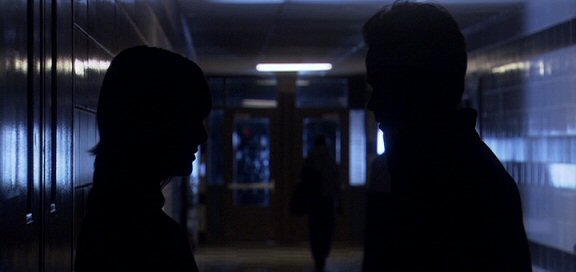
Hi David. How did you get the sheen reflections on the lockers/doors on either side of the hallway with such little room to hide lights? Are those only caused by the overhead fluorescents?
Hi David,
When you use multiple cameras do you mainly position them to get multiple angles or different shot sizes from the same angle? And, if you had to choose only three primes for a show which three would you go with?
Much Thanks
