Welcome to our community

Be a part of something great, join today!

  • Hey all, just changed over the backend after 15 years I figured time to give it a bit of an update, its probably gonna be a bit weird for most of you and i am sure there is a few bugs to work out but it should kinda work the same as before... hopefully :)

Why Bigger is Better (but not much else) S35mm vs. Vistavision Comparison

Sensor size is just the crop.


This whole topic is related to the lens focal length you will use for the same AOV based on the format size/crop.

This is all related to the lens. Format just defines which lens you will use.

Correct so why do you show tests where the "wrong lens is used" one that has larger image circle than needed for the format.


Also trough this whole discussion I been trying to say that you need to look at this in a theoretical way as you will for example not find a s35 50mm lens that is built up identically to a FF 35mm lens. So you will most definitely run into things not looking identical. But it´s not due to the sensor size as some flame here but more or actually only due to the lens design, and normally those differ.


What happens between S35 crop of 25mm FL and Vista crop of 35 mm FL on near to mid distances:


2sakugx.gif


What happens between S16 crop of 24 mm FL and FF35 crop of 50 mm FL on short distances:


f1kro6.gif

Both your test here is polluted with a lot of things. In the Alexa test, the camera is moving / Interest points is not aligned. The bottom one zooms in on the image circle, or adding an element which is not so rectlinear and making one feel flatter and the other more beveled. Also on this test the camera jumps around quite a bit.

So Im not too sure what you try to explain with these differences. As pretty much all has change between the setups. And again, you can not just crop a FL lens and compare when you do that you do not utilize the full lens but a small part of the center of the circle. To make the comparison worth anything you need to have image circles to fit the format.


So these are two more examples where we look at differences between different lenses and difference between different camera positions... The prespective change is there due to the moved nodal point. The beveldness change is there as you zoom into an image circle.

Both claims has little or nothing to do with what this thread was about, the fact that you can trade speed and focal length for smaller sensors.
 
Correct so why do you show tests where the "wrong lens is used" one that has larger image circle than needed for the format.

Nothing is wrong in those tests to see the effect of focal length/format size relation.

Full image circle of each lens alone without the crop context is irrelevant and misleading, FL and format crop are defining factors.
The lack of distinction between full lens coverage and AOV with equivalent format is a confusing factor here.

If you don't consider light rays reflected from the object passing through the focal point, defined by the focal length, you will not understand the trigonometric relations of distance to size, affecting the proportions of projected scene geometry.

It is additionally confusing because the effect varies depending on distance, FL and format size comparisons so one test shot may show it clearly and other may not.

In the example Les posted you can see the difference is minute because of a) larger distance and b) longer focal length, so the focal point defined triangle is smaller in height and longer, so the light ray angles differences between objects are much smaller.

In the example from Mark's test you can see the difference is more obvious, and you can see geometry of objects closer to the camera affected more. Larger light ray angle differences.

In the example I posted the difference is most obvious because it is a 2x larger format crop difference, requiring 2x longer focal length for the same AOV and showing what happens once the objects are closer to the camera with larger light ray angle differences.

So you are less likely to notice the difference between formats on longer distances and larger focal lengths and you will see the differences between CU's shot on 24mm on S35 and 60mm on a medium format.

There is no frikking way an IMAX CU and S35 CU shot with equivalent wides/normals will look the same. You can stop down, play with nodal points or stand on your head, it won't make the geometry the same and IMAX CU will have facial proportions more natural, hence intuitively more appealing.
 
50 mm lens on an APS-C camera with a speedbooster and 50 mm lens on a full frame camera.

9usqk1.gif

Hrvoje, your own test here appears to prove otherwise. Thanks to the use of the speedbooster on the aps-c camera, it's the only proper example we have that is able to use the exact same lens for both the larger and the smaller format.

And what happens when you use the same lens for both images? The result is identical. The geometry of the scene is rendered in exactly the same way. It's the closest match of any image posted so far - the only shift to be seen is the slight vertical offset, caused by the caused by the camera bodies themselves being different sizes.

Surely this is proof that it's not the format that shifts these things, or the specific focal lengths, it's the lenses themselves and how each one specifically renders an image.

I agree with you that the longer focal lengths used for larger formats are more likely to be better controlled for distortion (on average) than their wider equivalents for smaller formats. But (as I think Aaron's tests demonstrate very well) every lens is a little bit different, and ultimately it appears to be the specific distortion characteristics of each individual lens that is going to affect how an equivalent shot between two different formats will be rendered.
 
Hrvoje, your own test here appears to prove otherwise.

It proves exactly what I was saying and shows that "speedbooster" emulates a larger format.

"Speedbooster" changes the APS-C crop to a larger FF crop. It remaps the FF crop image to an S35 plane as if you shot on a larger format. You do actually get a larger format effect. Without it, this image on APS-C would be cropped significantly, with AOV like 75mm on FF. It wasn't. Crop was much closer to 50mm on full frame AOV, but not 100% because the adapter is not exact 0.7.

It is confusing so many misinterpret it as if it simply leaves APS-C crop and you just get more light. It doesn't. You get a larger format lens crop remapped. You are looking it the other way around in this case and starting from the wrong premise. This is not what a S35 crop without the adapter looks like. The adapter gives you a larger chunk of the image squeezing larger AOV onto a smaller plane and the product branding is misleading.

Think of a "speedbooster" as a solution which provides you a larger format lens coverage/extraction.

When I find the time I can shoot a test with and without the adapter if it helps.
 
The larger change in paralax closer to camera that you notice Hrvoje is only due to the nodal point change is relative to the distance to target.

So naturally you dont see much of it on the back wall but for things close to camera the paralax change even for a small offset can look huge and be very noticible.

Trust me on this one i been doing quite a bit of macro moco with our milo during the last 15 years. And I been trough a world of pain by nodal points calculations being slightly off more than ones. So this is a fact. The change of prespective has nothing to do with focal length changed or sensor size altered but all to do with nodal point position.

A good example to make my thesis proven true about that is that you can use any focal lengths you want and a combination there of when you create a 360 panorama, as long as the nodal points are lined up the different focal length shots will match up perspective vice into your 360 dome. I been doing more project with 360 domes than I can even count to and this is simply a truth.
Every time you add CG into a scene you need to shoot 360 reflection maps and stitched them. If I count in my archive I made around 3000 such project. Perspective only change when you move the nodal point not when you crop or enlarge your back plane or change focal length.

Sure the nodal point of a given lens also move slightly when you pull focus as your lens breath, or when you swap focal length. But you are supposed to then move the camera to stay with the same nodal point to make the test valid. But thats again not what is discussed in this thread.
 
It also gets confusing when you have charts and articles and calculators that use the Pinhole Camera Model ( https://en.wikipedia.org/wiki/Pinhole_camera_model ) to draw their conclusions.

Combine that with the fact that most lenses aren't actually the exact focal length they're named as, and that almost nobody would be using a collimator to measure the actual field of view of a given lens. Then factor in the 'breathing' (changing field of view) that most lenses exhibit as their focus shifts.

Then place all that in the context of actual real-world use scenarios, where lens and sensor choice/availablility, and lighting/subject/camera placement (and movement) are often compromised and in turn influence the perception of what is 'good enough' or 'ideal'.

Then consider the variety of final viewing mediums that can make or break the results of all of the above...


I just keep coming back to the point, in my own mind at least, that these 'image formats' are systems comprised of various elements, some of which are interchangeable, but which are (or can be) in their own ways unique. And that while each system or format can be tweaked (and/or distorted with great effort) to imitate another, they work best when used as intended.

I think it's useful to determine points of similarity or difference between the systems/formats, but only in a factual real-world way, which includes factoring in final-use scenarios.

Can't provide a lot of those examples myself, so am interested in seeing what anyone else might come up with.


Edit - Just realized combining different system's elements results in something that could be defined as a Hybrid Format.
 
Last edited:
In HD format the Alexa LF is only 1.13x field of view wider than the Helium in HD format. The resolution disparity is 400%. Considering this is the new thing out there, it is sort of interesting. The Monstro is of course a lot bigger/better.
Thanks for the chart Phil.

http://phfx.com/tools/formatCompare..._typeTech=ARRI|Alexa LF&formatTwo_format=16:9

This is an important point.


And at 2.39 wide screen crop factor it is only 1.23x yet resolution is 343% greater on helium. If sensitivity, DR and noise (which would be greatly reduced if scaled to 4K), is acceptable to the producer I would say it is a pretty big advantage.


VistaVision is 51% bigger than S35 so a much bigger disparity when thinking about the difference from S35 - "traditional" format of the past 20 years..

Remember Helium isn't S35 it is larger at 1.20x crop factor
 
The larger change in paralax closer to camera that you notice Hrvoje is only due to the nodal point change is relative to the distance to target.

So naturally you dont see much of it on the back wall but for things close to camera the paralax change even for a small offset can look huge and be very noticible.

Trust me on this one i been doing quite a bit of macro moco with our milo during the last 15 years. And I been trough a world of pain by nodal points calculations being slightly off more than ones. So this is a fact. The change of prespective has nothing to do with focal length changed or sensor size altered but all to do with nodal point position.

A good example to make my thesis proven true about that is that you can use any focal lengths you want and a combination there of when you create a 360 panorama, as long as the nodal points are lined up the different focal length shots will match up perspective vice into your 360 dome. I been doing more project with 360 domes than I can even count to and this is simply a truth.
Every time you add CG into a scene you need to shoot 360 reflection maps and stitched them. If I count in my archive I made around 3000 such project. Perspective only change when you move the nodal point not when you crop or enlarge your back plane or change focal length.

Sure the nodal point of a given lens also move slightly when you pull focus as your lens breath, or when you swap focal length. But you are supposed to then move the camera to stay with the same nodal point to make the test valid. But thats again not what is discussed in this thread.


That 50mm boosted and 50mm FF test shot perspective difference is because 5Dmk3 is taller than compact A6300. Scene spatial geometry defined by the FL is the same.

I don't doubt your experience with nodal point and related calculations, I am saying that the FL effect is a different one. One more factor which adds to the confusion.

What is the "FL" effect?
 
What is the "FL" effect?


I've just put abbreviation for focal length.


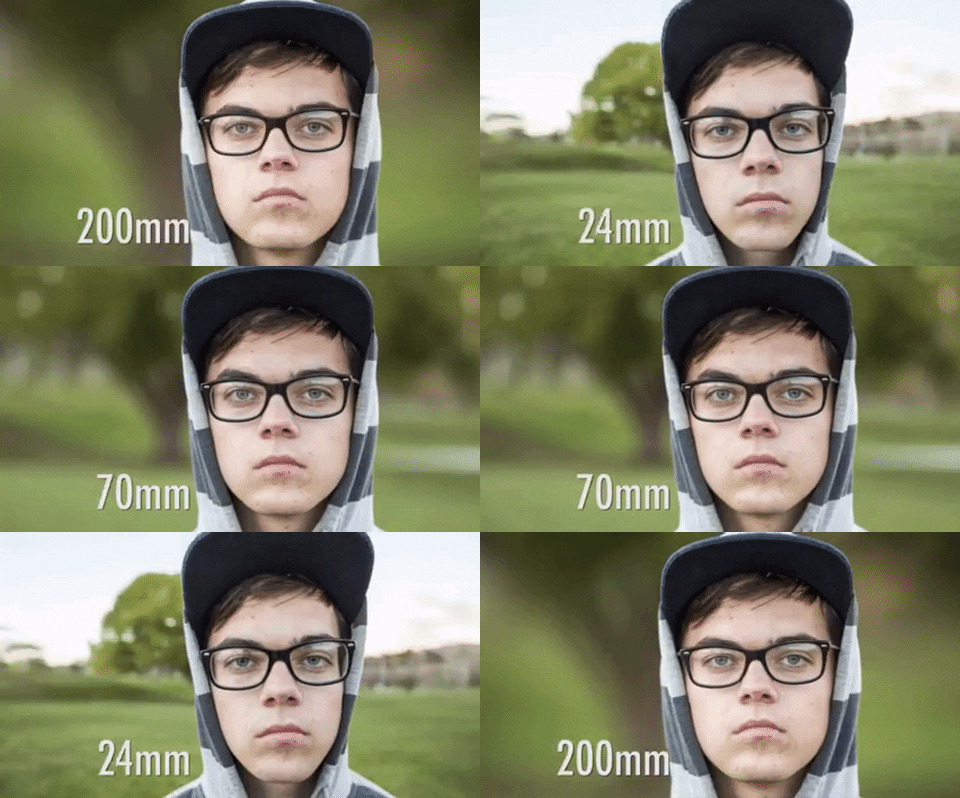
This is the effect we all know, a combination of focal length, distance and format crop:


giphy.gif


If you take away the effect of distance - the perspective difference changes and geometry difference gets smaller. It does not go away.

You can see on Mark's shot Amira in the foreground on FF extraction with a larger focal length as if "compressing" in Z axis compared to 24 mm on S35 extraction. And the same principle of Z axis size relations changing is most obvious in the test I made on short distances, where I've put additional spatial geometry visual references with graphic designer's grid surface and objects of the same size.
Both of these tests had the camera position and orientation fixed.

Also please note that in my 5DMk3 S16 and FF35 extraction test I did not have exact 2x FL ratio (24mm vs 50 mm) and have overlaid the images based on the bottom grid edge, not centered, just to make the effect more intelligible. If I didn't re-position it you'd also see the background "coming closer" and foreground "moving away" as Amira's back does in Mark's shot. This example makes it seem as if just the background compresses to the front. The effect is actually dual and works from foreground to background in opposite directions, with varying strength and falloff, both varying based on focal length and object distances.

So the amount of variables we are juggling here is the main culprit for all the confusion and that is why a single comparison shot will not reveal all that is happening between format/focal length combos and if taken alone as a basis for conclusions may easily mislead.

Another thing to keep in mind is that the "compression" effect is illusion because of smaller format used as a reference. In reality, larger format/FL combo is more accurate in spatial proportions and smaller "stretches" so it is the other way around. We've just became used to S35 extraction as a reference and basis for comparisons.

In the upper example if you would animate the crop instead of distance and focal length, the image would get a larger extraction with geometry of the focal length used.


Hmm,
No you are wrong the change of his facial shape and the scale / paralax change against the backgroundis is only due to the distance, Sure there are small nuances of difference in there due to the optical setups changed, Like if zoom and or changing focus then that brings artifact to the image. Like more or less fish bowl and other distortions but thats lens artifacts and that is not what we descuss in this thread.

So what you see is actually not a ”Focal length” effect but a effect due to the distance to target.

Try it put on a super wide lens, go close, move out in steps, then in post crop the images so they all have the head the same size.... Then you will see the same effect even though you where on the same focal length the whole time.

Sure resolution would vary but that simply prove Focal length have nothing to do with the compression of the scene the only thing relevsnt for that is the distant to target relative to the distances between the objects in the scene.

And for your two tests, no the camera was not fixed at all. Its moving around. And dont confuse the term camera position with camera body position. The nodal point is the xyz center for the camera and that needs to be set to the exact same point. None of your 2 exampels had that.
 
Coming in to this discussion rather late, and new to this forum. Seems like conclusions have been made, disagreements have been agreed to be disagreed upon, etc… But Björn messaged me to let me know that there were some questions on the forum about format size and lensing on Altered Carbon, so just checking in to let you know what we did.

We decided to shoot 5K on the Alexa 65, framed for 2:1 but captured as 16:9 ARRIRAW. The two main deciding factors for that format, after it was clear that we were shooting on the A65, were 1) cost of LTO tape storage, and 2) option of lenses available in 5K. On the first point we were told by post that the difference in LTO-7 tape storage between 6.5K and 4K ARRIRAW over the course of the 10-episode season was estimated to be well over $500k. The producers agreed on a compromise of 5K as a cost saving versus 6.5K, even though the Netflix mandate was only 4K. (Our master footage was immediately converted to 4K Prores (16:9) sub masters, and the original raw files were never used again.) On the second point, we tested three sets of lenses for 6.5K available in Fall of 2016, provided by Arri. Because Arri was making an incredible deal with the producers for us to be able to have five full A65 camera packages for 8 months, Panavision lenses were not an option for us to consider. All 65mm style lenses we tested were starting out at T2.8 or slower (with a few faster focal lengths being exceptions) and generally not great close focus. In 5K mode more options were available, especially in terms of close focus ability and large apertures.

We settled on Canon Cine Primes for 14, 24, 35, 50 and 85mm lenses (all covered 5K in 2:1 except the 14mm which we used in 4K instead). For a while we also carried Zeiss Compact Primes, but we didn’t like the look of them as much, nor the slightly deeper stop. We found that Super35 lenses started covering the whole sensor on longer focal lengths and in the Cooke 5i series the 65mm and the 100mm covered 5K, while the 75mm covered 4K. (There was light vignetting on the 65mm but mostly not noticeable and that lens has a nice field of view in 5K and such good close focus, that it still became one of our most used lenses). We also had Cooke S4 135, 150 and 180, and a spherical 100-400 Hawk zoom (which do cover 6.5K). All cameras were converted to PL-mount to accommodate these lenses.

We shot routinely wide open on the lenses, at T1.3 - T1.5. The depth of field in 5K at those stops is crazy shallow, which is scary - actors trust you to get their performance and stunts and SPX can only be done so many times - but it does give it a certain look. We never calculated what the difference in depth of field between 6.5K and 5K should be, but in our tests we visually estimated 6.5K to be about 1 1/3 more shallow than 5K at the same aperture. Shooting at T1.3 we therefor had significantly more shallow focus than what was then (and still, I think) possible in 6.5K.

For us, 5K (roughly VistaVision), was the prefect middle ground of large format photography because of the wider range of modern lenses available. What was especially fun was being able to get extremely shallow focus even in wide shots where the focus was deep in the frame. See two stills attached, shot wide open on the Canon 35mm, in 5K cropped to 2:1.


Martin Ahlgren
Director of Photography
 

Attachments

  • ExDStill_ALTERED_CARBON_S1_Pt2_170308_003612.jpg
    ExDStill_ALTERED_CARBON_S1_Pt2_170308_003612.jpg
    17.5 KB · Views: 0
  • ExDStill_ALTERED_CARBON_S1_Pt2_170308_003657.jpg
    ExDStill_ALTERED_CARBON_S1_Pt2_170308_003657.jpg
    17.7 KB · Views: 0
Hmm,
No you are wrong the change of his facial shape and the scale / paralax change against the backgroundis is only due to the distance, Sure there are small nuances of difference in there due to the optical setups changed, Like if zoom and or changing focus then that brings artifact to the image. Like more or less fish bowl and other distortions but thats lens artifacts and that is not what we descuss in this thread.

So what you see is actually not a ”Focal length” effect but a effect due to the distance to target.

Try it put on a super wide lens, go close, move out in steps, then in post crop the images so they all have the head the same size.... Then you will see the same effect even though you where on the same focal length the whole time.

Sure resolution would vary but that simply prove Focal length have nothing to do with the compression of the scene the only thing relevsnt for that is the distant to target relative to the distances between the objects in the scene.

And for your two tests, no the camera was not fixed at all. Its moving around. And dont confuse the term camera position with camera body position. The nodal point is the xyz center for the camera and that needs to be set to the exact same point. None of your 2 exampels had that.

I totally agree that this is a common misconception - that the lens distorts the perspective, when in fact it's mostly the closer distance to the subject that creates that look.
 
[...] On the first point we were told by post that the difference in LTO-7 tape storage between 6.5K and 4K ARRIRAW over the course of the 10-episode season was estimated to be well over $500k. The producers agreed on a compromise of 5K as a cost saving versus 6.5K, even though the Netflix mandate was only 4K. [...]

Storage difference between 6.5K and 4K is 2.64x. Therefore 4K LTO-7 would have cost $304,762 and 6.5K LTO-7 would have cost $804,762. 5K compromise = $476,191. Wow! Did you archive in triplicate, or triple-triplicate?
 
I heard of a mechanic who incorrectly believed that higher octane fuel burned more quickly. Thankfully this did not make him a bad mechanic (just like believing in creationism won't make you a bad doctor). But he was still wrong.

Sometimes being wrong doesn't lead to anything either way. But if anyone believes that focal length determines compression/stretching (whatever you call it), they are simply wrong. They can be great DPs and I will love their work, but they'll be wrong.


Love this! :001_smile:

Martin Ahlgren
Director of Photography
 
Storage difference between 6.5K and 4K is 2.64x. Therefore 4K LTO-7 would have cost $304,762 and 6.5K LTO-7 would have cost $804,762. 5K compromise = $476,191. Wow! Did you archive in triplicate, or triple-triplicate?

It's the numbers that post gave us, based on shooting 3 hours a day per unit (main unit every day, tandem unit about 50% of the time) for 8 months of production. But now I remember that they didn't actually compare Alexa 65 4K vs 6.5K - they compared Alexa 65 6.5K to Sony F55 4K as a reference (since that would be minimum requirement from Netflix).

Martin
 
I totally agree that this is a common misconception - that the lens distorts the perspective, when in fact it's mostly the closer distance to the subject that creates that look.

Yeah, the general rule is about 5+ft away from the subject (for portraits anyway) to maintain best perspective with the least proportional distortion.

I find it interesting that production ditched 6.5k partly because of cost of storage (seeing as a lot of people, me included, often scoff, 'if they're shooting on A65, they easily have the budget for storage/post/etc.'). But it makes sense given that 10hours of completed content obviously requires vastly more storage (e.g. ~5x or more than a ~2hour feature.)

I also find it interesting that you guys were aiming for the shallowness of FF/VV at T1.5 or less... That is definitely the worst case scenario (re: focus), yet you guys (and soderberg and fincher) all seem to embrace it (again, in spite of the post-5D-era pundits usually falling on the 'real productions rarely shoot that wide-open'.)

Similarly, the decision to ditch the raw files and immediately transcode to prores files (how much smaller were the 4k prores over the 5k arriraw?) in such a vfx heavy show seems ...weird. Conversely, was there a reason not to shoot directly to 4k prores, and if so, do you recall the rationale behind it? I haven't used an A65, so don't know if it can do 5k>4k-downscaled-prores internally or not.

Martin, next time your in Vancouver (principle photography for AC was shot here, right?), let's grab a beer.
 
Last edited:
Happy to see you on Reduser Martin!

Your name here underlined with "junior member" made me laugh a bit inside. :)


Storage difference between 6.5K and 4K is 2.64x. Therefore 4K LTO-7 would have cost $304,762 and 6.5K LTO-7 would have cost $804,762. 5K compromise = $476,191. Wow! Did you archive in triplicate, or triple-triplicate?

Dont underestimate the costs for actually doing the archives, checking them and putting a stamp of approval on them... I personally could not even calculate what the cost would be to promise some hollywood producers that yes, here you go here is the material from all your cameras for those 10 episodes and yes on all those LTO´s, that together took pretty much a lifetime to make I can assure you that, yes not a single pixel on there is corrupt... To avoid the whole scenario all together I would most likely put the highest number I could think of in my bid, maybe they did the same.
 
Alright here is a great article that shows some depth of field format comparisons calculations using actual science. As I am a mathematical bimbo I have not plugged the 46.31 mm diagonal of the Monstro sensor into the supplied formulas. Can anyone give it a go?

https://www.fdtimes.com/2018/03/13/jonathan-maxwell-on-full-format-vs-s35-dof/
Not that it matters a whole lot (but it does a little) but the diagonal /DOF relation is only maintained for the same aspect ratio formats. Same aspect ratio formats will change the object magnification ratio according to the diagonal. Once you change the aspect ratio of the sensor the magnification ratio will not follow the diagonal change any more... since the DOF if a function of the F-stop and magnification ratio, comparing diagonals of different aspect ratio formats will introduce an error.
I hope I'm somewhat clear here...
What a way do make a 3K post (woohooooo!!!)- sorry- could not resist ;-)
 
Back
Top