Welcome to our community

Be a part of something great, join today!

  • Hey all, just changed over the backend after 15 years I figured time to give it a bit of an update, its probably gonna be a bit weird for most of you and i am sure there is a few bugs to work out but it should kinda work the same as before... hopefully :)

Red V Raptor Rhino S35 Camera

what's actually a gain here?

Outside of the negative attitude and projection, here's what DSMC3 Raptor gets you:
- 8K up to 120fps in VV or S35 formats
- Higher Data Rates & Faster Media Offload Times if your hardware can do that
- Lower Compression Ratios as well as equivalent ratios to DSMC2 REDCODE to about 15:1
- Lower Compressions Ratios at higher frame rates
- 4K SDI Out
- 8K Streaming Out w/ the right setup
- RF Mount Support
- Slightly better cooling/heating setup
- Very improved OLPF/CSF, optical path, and hardware. You can shoot into the sun now without much concern
- XL internal eND, smaller V-Raptor a host of behind the lens ND options
- Low profile compact body on the smaller V-Raptor
- A price point that is 25% or 33% the cost of any of the new digital cinema cameras on the market for the body alone
- Better dual record, REDCODE and ProRes features
- Better fps in ProRes only mode
- Slightly improved DR in the shadows, particularly when it comes to deep shadows. Not a biggy, but a noticeable thing.
- DSMC3 RED Control is very, very good and free + a Pro version most recently designed for more multi-cam focused productions

The main selling points for me personally are fps, data rates, 4K out, and that new CSF. I did in fact keep my Monstros as well. I do like the lower profile body in practice as well, but also not a huge consideration on initial purchase.

For some filmmakers any one of these features might be enough to get the camera. Spoke to two guys who bought the S35 yesterday who own big zooms that are only S35 and the frame rates for commercial productions are a big deal. Their lenses are more expensive than the camera.

Perhaps too personal of a take. REDUSER isn't RED's btw. It's Jarred's. If he didn't care about it, it wouldn't be here.
 
Sorry if this is a question with an obvious answer: Do we know if this sensor will be stitched or a single fab? Not sure if the reason 8k VV is stitched has to do with the size.
 
Sorry if this is a question with an obvious answer: Do we know if this sensor will be stitched or a single fab? Not sure if the reason 8k VV is stitched has to do with the size.
A pretty important point. I have no idea how serious it was/is in the real world but there was certainly a lot of angst over the split and there is an element that will jump on anything to downgrade RED. But it seems likely to me that is a single fab since we have already an 8K S35ish single fab sensor with the Helium and this is only slightly smaller pixels to get to a more S35 lens friendly size.

At $12,500 I would be seriously interested even though I'm not really in a purchasing mode. Not so much at $17,500 - even with the R1 nostalgia factor. $19,500 seems like a fair price but I wouldn't be surprised to see a big reduction next year after the initial rental buyers get in and sales slow down - it seems that the competition is forcing RED to compete on price again.
 
It’s good news for me as a mostly macro and long lens natural history cinematographer who owns his own kit.

I started out on 16mm film, and really have been missing the magnification with my long and macro lenses - especially lately with full frame 35 on the Raptor. Great to have FF for wide angle though!

I’ll probably wait to see how the new sensor tests out with low light and latitude ... but I am positively looking forward to it!
 
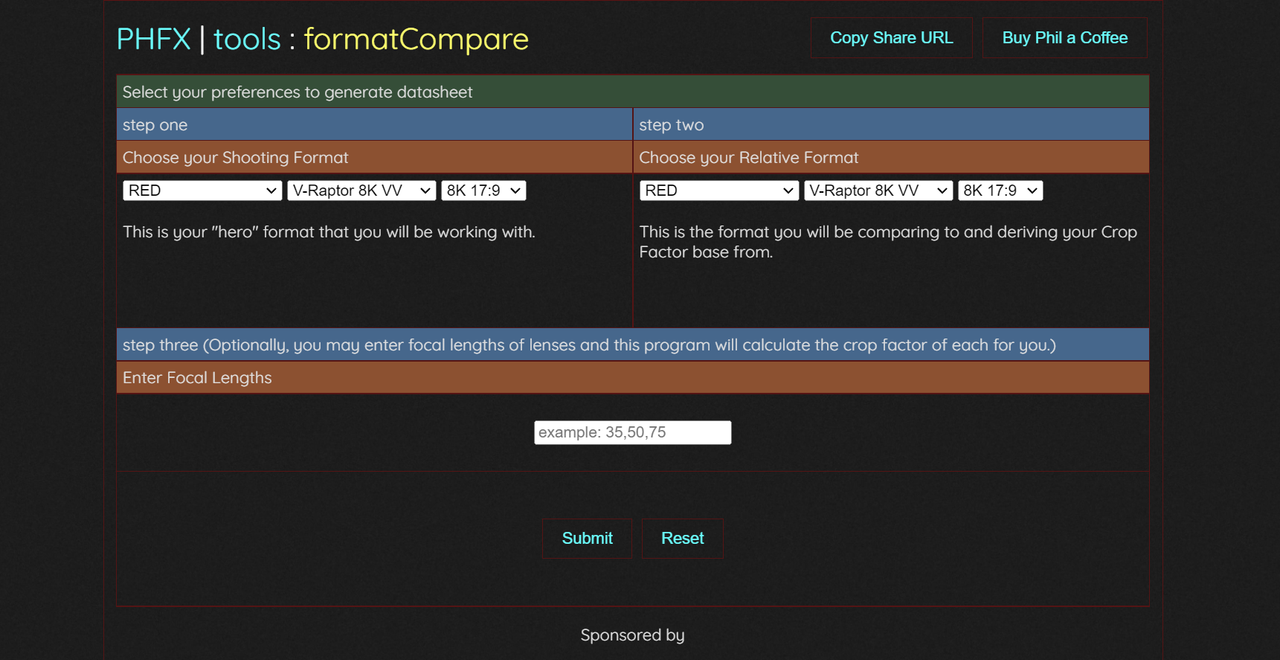
PHFX | Tools : FormatCompare

PHFX.COM | tools - framesToDataRate


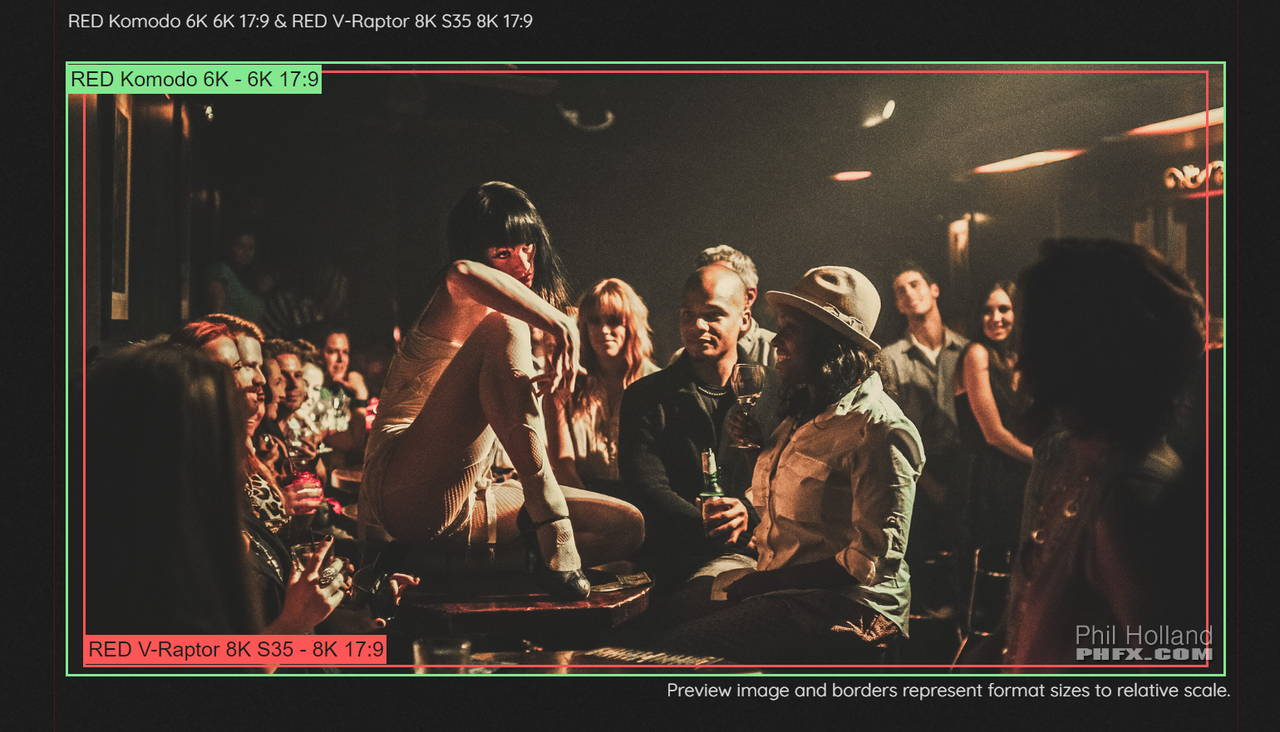
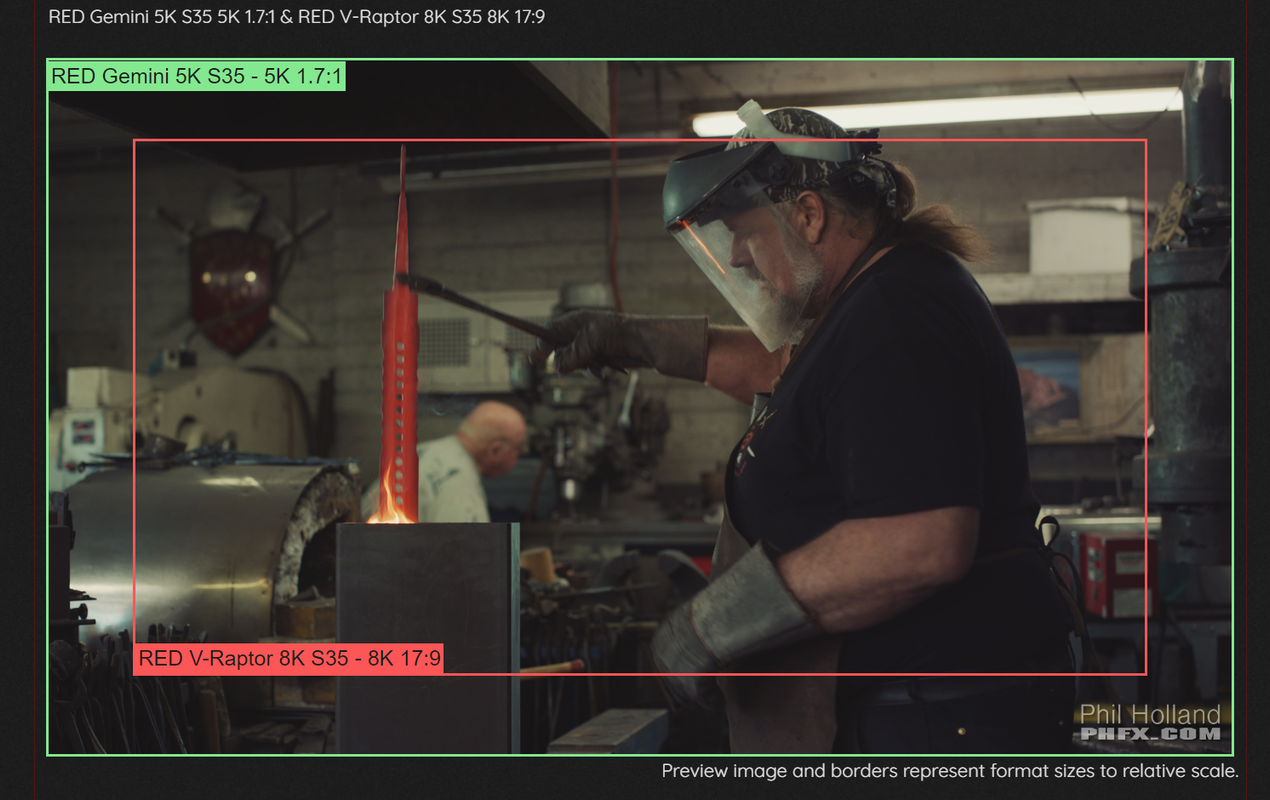
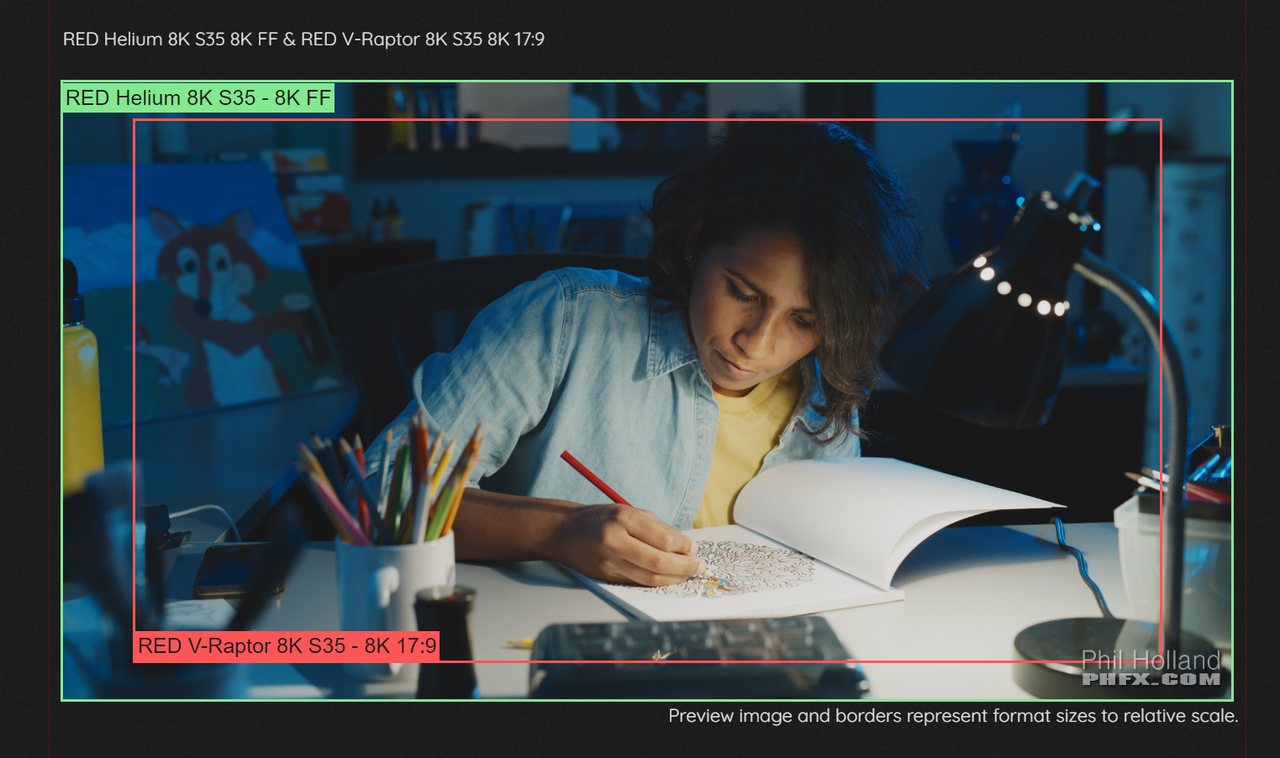
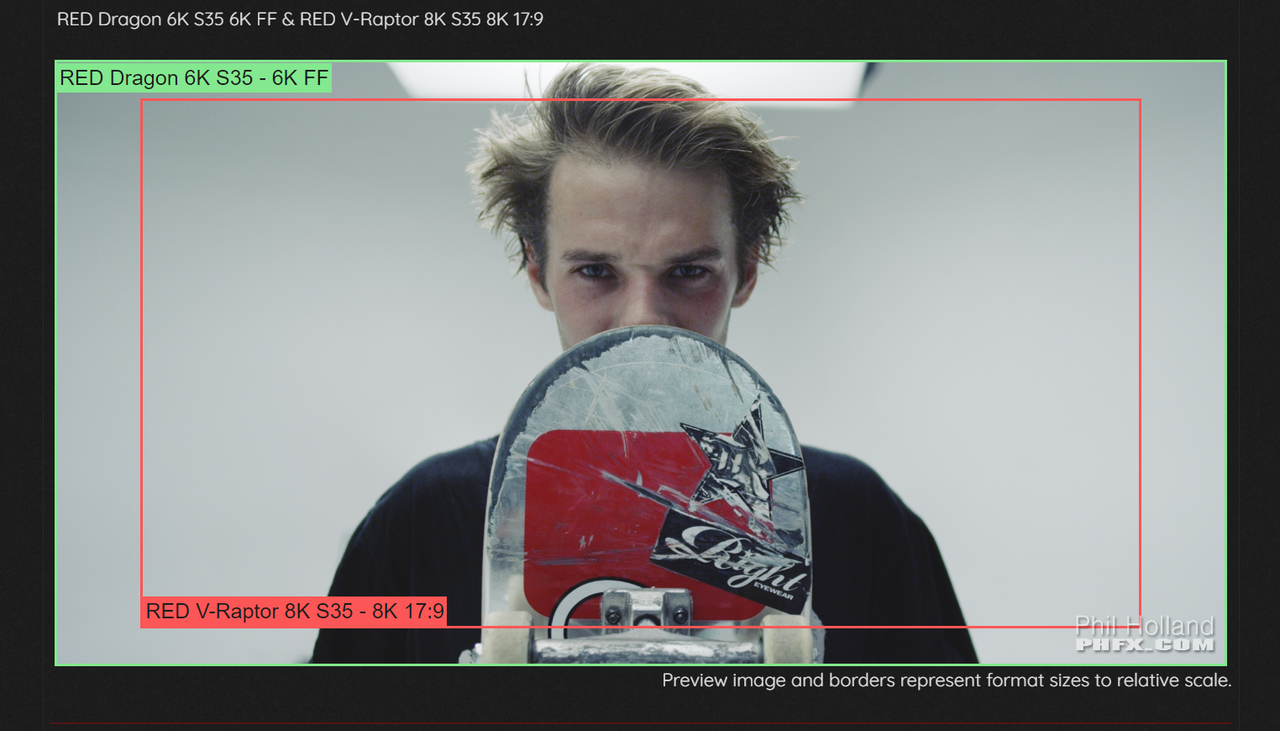
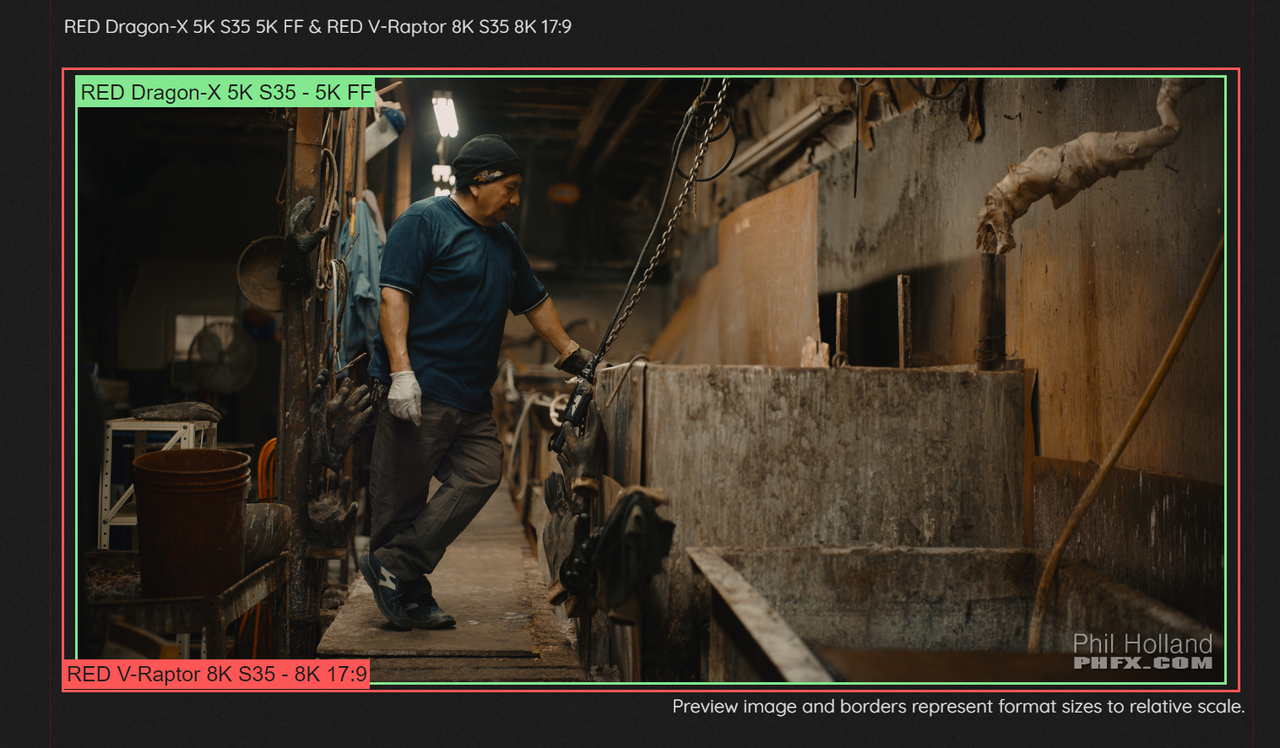
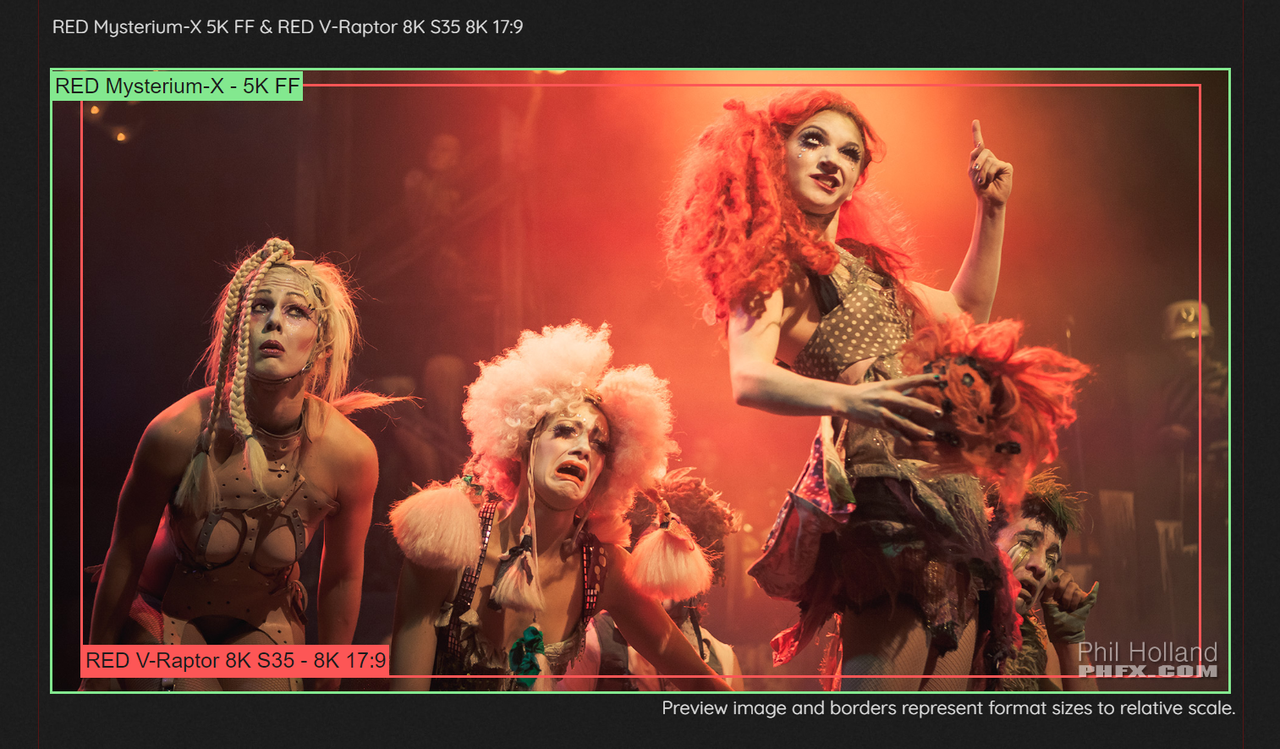
Using Phil's FORMATCOMPARE Tool I compared the previous Red S35 sensor cameras to the new Red V-Raptor s35 and I didn't realize that they were this much bigger, all except the Dragon-X 5K.


Screenshot-7429.png


Screenshot-7422.png


Screenshot-7425.png


Screenshot-7423.png


Screenshot-7424.png


Screenshot-7428.png
 
Last edited:
Will be interesting to see how well this sensor performs but on paper and for the price RED is continuing to trailblaze.
I don't think many are appreciating just how dynamic in terms of features and variety their latest sensors and cameras are.
RED also seem to be really stepping up in designing cameras that are more customized for particularly market segments
a bit more than I remember.
Yes, it would be nice if they could make a camera that sits somewhere between Komodo and V-Raptor that is in that $10-$12k space
but this is a step in the right direction.
Make it for the doc/one man band/small crew filmmaker (with better built in audio) and they will have another hit.

Brian Timmons
BRITIM/MEDIA
 
Outside of the negative attitude and projection, here's what DSMC3 Raptor gets you:
- 8K up to 120fps in VV or S35 formats
- Higher Data Rates & Faster Media Offload Times if your hardware can do that
- Lower Compression Ratios as well as equivalent ratios to DSMC2 REDCODE to about 15:1
- Lower Compressions Ratios at higher frame rates
- 4K SDI Out
- 8K Streaming Out w/ the right setup
- RF Mount Support
- Slightly better cooling/heating setup
- Very improved OLPF/CSF, optical path, and hardware. You can shoot into the sun now without much concern
- XL internal eND, smaller V-Raptor a host of behind the lens ND options
- Low profile compact body on the smaller V-Raptor
- A price point that is 25% or 33% the cost of any of the new digital cinema cameras on the market for the body alone
- Better dual record, REDCODE and ProRes features
- Better fps in ProRes only mode
- Slightly improved DR in the shadows, particularly when it comes to deep shadows. Not a biggy, but a noticeable thing.
- DSMC3 RED Control is very, very good and free + a Pro version most recently designed for more multi-cam focused productions

The main selling points for me personally are fps, data rates, 4K out, and that new CSF. I did in fact keep my Monstros as well. I do like the lower profile body in practice as well, but also not a huge consideration on initial purchase.

For some filmmakers any one of these features might be enough to get the camera. Spoke to two guys who bought the S35 yesterday who own big zooms that are only S35 and the frame rates for commercial productions are a big deal. Their lenses are more expensive than the camera.

Perhaps too personal of a take. REDUSER isn't RED's btw. It's Jarred's. If he didn't care about it, it wouldn't be here.

Reduser used to be the bridge between the users and Red, that's my point, that bridge has fallen and Reduser is now more or less just like any other internet forum. Good luck finding any meaningful discussions on the Red Facebook pages, with multiple pages and thousands of posts just discussing the most basic things over and over and over again. Don't tell me this community is thriving when this forum feels like a wasteland of what it once was.

The price point is the only point that's a plus, but the others aren't really crucial. What I'm questioning is why anyone would use Raptor over DSMC2? Especially if having the Komodo for shots that require a smaller camera body.

My point is that incremental improvements themselves aren't enough, especially during a global economy in the gutter. Even if the price point is low, it's still an upgrade that requires a total re-investment in side gear in order to become fully production worthy. And the rest of the improvements listed aren't actually that crucial for end-point quality. DSMC2 and Komodo still produce 4K end quality that is far above the quality of most productions and anyone pointing out 8K delivery being viable ignore the actual real world out there still not being fully 4K and most 8K TVs just using in-TV upscale for 99% of the content, as well as DSMC2 still having 8K options if needed. Add the storage requirement bump over the previous lineup and it becomes very hard to justify upgrading this time around.

These points may be crucial for niche cases and purposes, but when comparing cameras on the majority functionality that is how cameras should be compared. People seem to miss the benefits of keep shooting DSMC2 and instead throw money at incremental improvements and a more expensive workflow. And the argument that storage is cheaper today misses the simple fact that it's even cheaper if you shoot DSCM2 with these new storage prices.

There's generally a cultural problem among new filmmakers that they think that having the latest gear will drastically improve their cinematography, but looking at all the gear in the market, there's probably more happening at the low end than at the high end to drastically change how we shoot things. Companies like Laowa, DJI, even Blackmagic in some cases, are actually looking at real changes in workflow and photographic capabilities.

There are no real home runs on the list of improvements. Most of the things are essentially just minor fixes for what people thought DSMC2 was lacking. As I said, combining a Komodo for shots that require Red control and a smaller body or whatever is needed, with a DSMC2, will give a superb result that is still market-leading. I'm still waiting for the features that will rock the cinema camera market like Red used to do. Right now it just feels like they wanted to polish the DSMC2 to match the competition better in areas others already have instead of leading the market with features that make a purchase a no-brainer. And it might be a no-brainer for some to get a Raptor, but where's the appeal outside of niche?
 
And it might be a no-brainer for some to get a Raptor, but where's the appeal outside of niche?

I think perhaps the most unique thing from my perspective over the span of my career is uncovering the dynamics of our industry, the reason why people purchase tools, when they choose to, and what they use them for. The additional layer has been emerging and established markets as well as the expanse of the motion picture industry.

Don't want to get too off topic, but when I started in this industry it was very small. Film was highly segregated from anything broadcast related. It truly was a tale of two very different worlds despite often overlapping on the concept of storytelling. When cable happened, the industry grew rapidly. HD snuck in there too. The cameras evolved, the work dynamics changed as well. Fast forward to internet media then eventually streaming, exponential growth again. Extremely capable cameras of all sorts are out there at a wide range of price points. What everybody does professionally is more dynamic than ever in terms of what and how things are shot. As well as perhaps the largest changes across budgets and deadlines I've ever seen.

There are some oddities. People using very high end systems and delivering 720p or 1080p. But finding the usefulness in 4K or 4K+ acquisition for those needs. The actual film industry still makes up for a relatively small amount of global production. It is a special world still in my opinion. Commercial filmmaking has become the mass market of business, and that's not just commercials. To the many, their requirements tend to land in whatever the "commercial filmmaking world" presents them, with some variables. Moderately why a 4.6K S35 camera can be released in 2022 and demand such a price tag. That's good. The industry has grown in that way. Meanwhile there's a host of filmmakers who are looking for tools that do more or less depending on their unique circumstances.

A very interesting thing I enjoy observing is those who float in the commercial filmmaking space or otherwise is when they choose to rent over owning. Then what they do with that from there. Most of my friends who work with certain other cameras more regularly work far less than I do, but own nearly no equipment. There's a host of variables there when it comes to a range of DPs who work through agencies or not as well. I should underline I have not gone that route during my career, but many of my close friends have had agents for a very long time.

Good digital cinema cameras can fit into a variety of workflows and be used for all sorts of projects.

I think the interesting thing I come across is people doing darn near the same work with wildly different tools. But this alludes to variations in market, client, expectations, and generally the services provided. You can shoot talking head interviews on pretty much anything now, but it's interesting when I see $$$ or $$$$ cameras being used in a 1-8X setup versus the $$,$$$ cameras in the same way.

Filmmaking and project world is very different from that though. As is the wilds of commercial productions of all sorts and budget levels.

I have no problem agreeing with "new tools don't make you a better DP", but tools do empower people to create what they want to in the way they see fit. Yes the global economy as a whole is wild, but production work has been extremely busy where I am from about September 2020 onward ramping up to busier than expected times from about March 2021 onward. That posses the interesting question about why cameras at all price points are selling so well during all this. Manufacturers have had a very hard time keeping up with things because it's taking them more time to recover when it comes to supply chain happenings as well as general world-isms. Meanwhile I speak to filmmakers who haven't worked in a while as well. I'm curious about all of it. I've been through several highs and lulls in our industry during my career. I've seen rather successful studios go under during dark times or due to bad decisions. But I generally think about this whole thing like waves as that's the only analogue I can find.

I'll also point out that our industry is still going through a growth period. There's a lot of people investing in new systems who are for the first time investing in any system. Perhaps after renting a while, perhaps to just jump in fully. I have helped a few start their production companies and gearing up. Most are tossing in six to seven figures in doing so. Those are interesting conversations as many either have a solid plan and/or clients then there's the flipside of people going in blind with a heavy investment like that. Pretty interesting.

To wrap this up, I was attending an ASC MITC meeting some time ago and spoke about the expanse and dynamics of our industry as many in the room certainly were focused much more on the 1% of production and sometimes the 0% of interests. The industry as it stands today is fascinating with gear that approaches pretty much every price point with I would dare say the omission of ultra high end. But even that is still there if you can splash in that pool. Localized experience nets a lot of opinion and information, but I do remind people that there's a few out there making seven figure shooting cooking tutorials in their garage on Komodo. There's also filmmakers working for 6 months to get about a dozen shots. Others have to knock out 1-120 setups in a day. Some only work in studios. Some only work abroad. That dynamic nature is moderately why in a time they may make no sense to some, it makes plenty sense to others.
 
Yes, the industry is wide, but the endpoint is usually the same: cinema, streaming, youtube, 2K lieMAX screens, 4K IMAX screens, 8K TVs streaming 4K content, 4K screens, phones, VR/AR. At the end of the day, can the camera in use be used to perform towards all of these formats? Most cameras do and Raptor doesn't really add to what's already out there. To own a camera you aim for the most bang for the buck, otherwise, you're working in a part of the industry where quality needs to be at industry peak performance, and in those cases, the technology used usually ends up being so expensive that it's just more practical to rent. People who, for owner/operator usage, need the very best technology out there as a critical part of their output is a VERY niche group. The rest just need to meet the demand for the endpoint and for that, there's rarely any need for cutting-edge releases, especially in terms of Raptor's features.

This is the reason I'm always talking about features that reshape how our workflow works. The idea of Z-Depth data and virtual camera metadata recording for VFX, post stabilization etc. would fundamentally change how and what we can do with the camera for a post workflow and solutions that would otherwise cost hundreds of thousands traditionally. If Raptor essentially gives me a similar result in both workflow and endpoint result, then the incremental difference from Monstro 8K to Raptor 8K becomes irrelevant for real-world use, especially seen as an investment cost can be put into other gear that fundamentally improves workflow.

My critique has to do with the stagnation of camera development. That we've reached a point where it's irrational to keep buying new cameras and gear since the incremental improvements aren't really changing the fundamental game at all.

In order for digital cinema cameras to be relevant as an investment going forward, they need to innovate into something that makes them fundamentally better than previous systems.

For a camera to be interesting as an investment without changing anything with the image it produces compared to older cameras, it needs to be basically fanless, weatherproof instant startup, and smaller than a Komodo. Something you can have around your neck to produce high-end-grade footage on the level of Red's systems. But since that's not happening, we're in a place of stagnation where I cannot recommend anyone to re-invest if they already have a DSMC2.

Something needs to change
 
Imo, this camera would have been far more interesting if it had a native 4:3 S35 sensor like the Alexa 35. Sadly, it does not. So for me, it’s a hard pass.
 
I’m waiting for ARRI to make a compact s35 8K 120fps fanless camera that can fit in my jeans pocket for under 20 grand. Until that time comes, I’ll stick with RED.
 
We now have 2 Helium, one Raptor and a Phantom.
I think the new Rhino would be very useful for long lens. Canon 50-1000 is not a good match with Raptor but would be excellent with Rhino. That is the lens we use 95% of the time. The extra frame rate is very animals.
Will we upgrade our Heliums? Not atm but maybe later. Our setup is very well kitted so not looking forward to replacing all the top plates, dispays, memory cards etc.

Dsmc3 is a big step forward for us. Double the fps, better prerecord that is stable. You can Zoom in while focusing thank God!! These three are a HUGE step forward for us. Also several smaller improvements like better media and faster UI. Raptor is also much cheaper.
Also step backwards. No HDRX? I love HDRX for timelapses. The mount is less strong. The screen is a big step backward vs the ultra bright for Red. No diving OLPF as well and our 290Wh batteries no longer fit. The accessories are less mature but will prob be fixed in time. Still dsmc3 is still much better in the end.

Some write that the DSMC3 can replace a Phantom. That is taking it a bit far. 120-240fps cannot compare with 1000-2000fps.
even 2000fps is not enough for some insects I film. I look at the Phantom 2640 that can do 13000fps in 1080p but it does not even use batteries and cost $160,000 so Natalie would prob kill me if I suggested it :)
I would upgrade our Heliums if we had heavy duty long lens filming ahead though. Currently focusing on underwater.
personally I think I will use both s35 and large sensor cameras. They work well together and are quite cheap. Its the lenses and extras that cost the most for us.
 
We now have 2 Helium, one Raptor and a Phantom.
I think the new Rhino would be very useful for long lens. Canon 50-1000 is not a good match with Raptor but would be excellent with Rhino.

Thing is though, with the Raptor VV you can shoot 5k and have the same frame size as the S35 but with larger photosites and therefore better DR and low light. That's why the Raptor is so versatile for me. The versatility is due to the fact that it crops the sensor - hence this idea of a "dual format" camera - which it isn't really, but you get what they mean! It means you can have full frame when you want it, and 8k if you need it. But you can have a Super 35 camera at 6k and 160fps, or 240fps at 4k with a smaller sensor area meaning that your lenses have more reach - which is great for slomo as you need faster lenses - i.e. the CN20 can be used up to 570mm at T5 rather than T8.9 at 1,000mm.
 
With all this talk of older glass, is there no PL or LPL mount option? Can't RED license/create a RED version of the LPL mount? Reading ARRI's site I see this: ARRI shares LPL specifications openly and at no charge in order to establish it as the new standard interface between cameras and lenses. ARRI LPL lens mounts are available for ALEXA LF, ALEXA Classic/XT/SXT, ALEXA Mini LF, ALEXA Mini, AMIRA, and ALEXA 65 cameras. In addition, third parties offer LPL lens mounts for non-ARRI cameras, director's viewfinders, and lens testing tools.
 
PL or LPL mount option?

At the moment it's all 3rd party mounts for V-Raptor to go to PL or LPL. I have several solutions for each mount.

What we do know is coming is a RED RF>PL eND. I am hoping in the same breath they make a straight PL as well. Unsure if RED made LPL mount is on the table, but if they go that route a PL adapter would be welcome.

Raptor XL ships with a PL Mount.
 
I’m waiting for ARRI to make a compact s35 8K 120fps fanless camera that can fit in my jeans pocket for under 20 grand. Until that time comes, I’ll stick with RED.

It won't be Arri or Red that makes something like that.
 
At the moment it's all 3rd party mounts for V-Raptor to go to PL or LPL. I have several solutions for each mount.

What we do know is coming is a RED RF>PL eND. I am hoping in the same breath they make a straight PL as well. Unsure if RED made LPL mount is on the table, but if they go that route a PL adapter would be welcome.

Raptor XL ships with a PL Mount.


As an indie-filmmaker, I'm no longer RED's target market, so what I think hardly matters, but standardization is sorely needed for fast and efficient on-set workflows. I hope RED considers an LPL/PL Mount Adapter for the new cameras. ARRI's signature prime lenses page mentions red cameras, and red's pages should start to mention their compatibility with other companies products. Workflow is the new king/queen, and RED could be the one to pave the path here.
 
Last edited:
LIVE STREAM 11-11-22 -Let's Talk About The RED V-Raptor S35 Rhino w/ Jarred Land

By Scott Balkum

 
My suggestion was that this camera should land at around $12500 when people speculated about it. I'm not sure why someone would choose this over the VV Raptor seeing as the price difference is so small. For rental of course it makes sense to have both VV and s35, but since the Arri s35 is out, I have a hard time seeing this being picked for VFX heavy shoots over the VV (since a larger sensor gives better pixels) and for anything else, the Arri is already having a sensor with superior image quality.

And the fact that this news didn't even break on the recon page, that's proof enough that Red just doesn't care about Reduser anymore. It's all social media marketing now. We're at a breaking point now where I think Red has stagnated because improvements are so incremental and the only way to push tech is to lower prices. Since that's not happening here, I'm wondering where Red will be in five years from now.

Is it worth investing in Raptor if you already have a DSMC2 and a Komodo? What's the actual benefit? Seen through the lens of the trash economy the world is in right now, what's the actual benefit for creators? With the change to compression type, the older DSMC2s will be cheaper to use and there's no way near that big of a difference between DSMC2 and Raptor to make an impact on the productions being made.

Raptor is a good alternative to Phantom, but for normal productions, what's actually a gain here? Especially compared to the Arris new s35 when just speaking about image quality.

in my opinion everything what was said here is 100% true. I have a Gemini - tested vs raptor and the only thing what’s impressive are the increased framerates. Since I don’t need VV and don’t need 8k why should I get a raptor s35 or VV

and also correct: alexa35 will be superior the next years. I know many ppl who say image quality over resolution
 
in my opinion everything what was said here is 100% true. I have a Gemini - tested vs raptor and the only thing what’s impressive are the increased framerates. Since I don’t need VV and don’t need 8k why should I get a raptor s35 or VV

and also correct: alexa35 will be superior the next years. I know many ppl who say image quality over resolution

Seriously? 100%? He keeps going on and on about the ARRI Alexa 35 - an $80,000 camera with prohibitively expensive proprietary media and a 4.6K sensor - and the Phantom, which neither the Alexa nor the RED are replacements for. A V-Raptor VV and V-Raptor s35 together are nearly half the cost of a single Alexa 35! He's comparing apples to oranges. I also fail to see how not making a massive announcement on Reduser equates to not caring about users: I don't know of a single other CEO who spends as much time answering questions, listening to feedback and talking camera development with DPs as does Jarred. He spoke for nearly three hours this morning with Scott Balkum and viewers about the camera, fielding questions about future firmware updates for the Komodo and V-Raptor, the V-Raptor s35 XL, menus, autofocus, dual card slots, Canon L-series lenses that GDU might consider rehousing, focus motors, electronic ND adapters, HDRx, issues with third party monitors and a bunch of other topics - something no CEO of any other major camera manufacturer does as regularly as Jarred, if at all! From what I'm seeing, the Raptor VV has got more latitude than the Gemini, so not sure how you can claim that the only difference is frame rates. Asking why you should purchase a Raptor when you say you don't need 8K or VV is like someone asking why they should get a Sony a1 if they're happy with their a6400 and ____ [fill in the blank with any camera of your choosing] - no one is forcing anyone to buy anything. You may not appreciate an outstanding cinema camera that records 8K s35 RedCode RAW, but wildlife photographers certainly will.
 
Last edited:
Back
Top