Welcome to our community

Be a part of something great, join today!

  • Hey all, just changed over the backend after 15 years I figured time to give it a bit of an update, its probably gonna be a bit weird for most of you and i am sure there is a few bugs to work out but it should kinda work the same as before... hopefully :)

RED Monstro 645 Speed Booster Experiment

I suggest you take a camera out sometime and try for yourself. I have.

http://www.reduser.net/forum/showth...-Drity-Crop-Factor-Test&p=1735297#post1735297

Your test shows comparison between different lens in different formats and this topic is related to what happens with same lens with different formats.
Because speed booster type of adapter gives larger format equivalent.


Thanks for the suggestion.
Cheers from a vacation.


x2nckl.jpg
 
It's actually the same lens, a zoom, and you should post in that thread, I'd love to debate specifics there.
 
Phil, you still haven't mentioned if this is intended to be compatible with all interchangeable mount DSMC1/DSMC2 cameras... would love to be able get ~FF35 equivalent from a Scarlet/Epic-X.
 
Having shot a lot of still 4x5 and 6x7 back in the day, I've always felt some of the difference in feel of an image shot on a larger format compared to a smaller one ( independent of FOV and format resolution and comparatively wider aperture/less depth of field) lies in the difference in what is effectively the pupil size of the lenses front element, that the image is formed from something other than a single point perspective. Something of the effect seems to happen with zooms with really large front elements as well. Anyone else have feeling on this?

It would probably be the tonality given by the larger surface area. I think that maybe the contrast between shadows and highlights might be effectively lower - a more 'open' look.

Good old days..

phfx_brookWillard_SensorChart2008.jpg

This should be on Pinterest!

No, but it does allow you to tap into the coverage of 645 lenses and what they would approximately look like on a sensor of this size.

That's what I eventually understood. It's a pretty good compromise, in some way. Personally I prefer using lenses with image circles larger than the sensor. I use adapted lenses on APS-C cameras.

And I think it needs to be repeated: focal length does not 'compress' or 'stretch' distances between subjects. It's a strange affectation, this idea of telephoto compression (and as silly as the affectation that shooting wide-open is 'cinematic'). I don't expect anyone here to be an engineer. I'm not, either. And let's face it, knowing facts about optics isn't necessarily going to make you a better DP. Many photographers that I have read are quite ignorant of certain things, but some of them produce great work.
 
Great stuff here, Thanks Phil.
Can you maybe give us some of the lenses used with which image? That might help to understand what sort of changes are going on with each lens.
This is really some cool stuff thanks again and can't wait for the PhilmColor part. Maybe some PHilmColor LUT's??? I'm in.
 
Any "works with every lens " Speedbooster-style appliance is likely to enhance the "apparent" image quality of some lenses and be positively hostile to some others. On a Speedbooster Nikon F to BMPCC version, which I modified to IMS-Mount for the SI2K, I found the image from some lenses in my Nikon set to be disappointing, the 35mm f1.4 in particular. Overall the Speedbooster improved the "apparent" image quality from the stills lenses compared to using the same lenses directly to the SI2K with the IMS-Nikon mount.

My best Nikon stills lens yielded sharpness numbers at best 65 if focused in the lens aperture sweet spot to a carefully lit chart. Via the Speedbooster it yielded a sharpness number of 115 to the same chart framed identically. The "apparent" contrast is increased. Whether that is a good or bad thing is yet to be determined for me. I found that having to use external ND filters and the necessary IR filter to keep the sensor in its best gain setting and lenses within their aperture sweet spot was a bit of a hassle and works against agility. Then again, if I want agility I should use a smaller camera suited to the task.

It will be interesting to see where this experiment with medium format lenses ends up. It will be one more tool in the toolbox useful for certain situations, to be used when it should, not just because it can be. Regardless of the tech involved, if it makes the image look good for a particular purpose, then that is all that matters in the end.

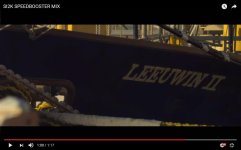
This image is not the sharpest kid on the block but without the Speedbooster, this longreach zoom stills lens looks a lot soggier direct to a Super16mm sized sensor.
 

Attachments

  • STS LEEUWIN.jpg
    STS LEEUWIN.jpg
    63.2 KB · Views: 0
Speedboosters does not increase the sensor size. They decrease the focal length, and projection circle and possibly increase the speed. Which is different from having a larger sensor.
 
  • Thread starter
  • Moderator
  • #91
Speedboosters does not increase the sensor size. They decrease the focal length, and projection circle and possibly increase the speed. Which is different from having a larger sensor.

This is correct.

And what you see of the taking lens is "what you'd see" FOV-wise on that larger sensor.
 
This is correct.

And what you see of the taking lens is "what you'd see" FOV-wise on that larger sensor.

I know it's still experimental, but is this focal reducer intended to be compatible with all DSMC1 and 2 cameras (that have a swappable mount)?
 
This is correct.

And what you see of the taking lens is "what you'd see" FOV-wise on that larger sensor.

I'm no lensing professional as will become evident when I ask my question... but for image quality alone, why is it better to record a MF lens in its entirety rather than just the center cut you use when recording sans Speed Booster?
 
This is correct.

And what you see of the taking lens is "what you'd see" FOV-wise on that larger sensor.

It's trivial to say a larger sensor is a large sensor and that's why it's not a smaller sensor. What's different about the image in general?

I can think of

- Diffraction (Though does this change with a speedbooster?)
- Speedbooster adds at least 2 more air/glass interfaces, and another element.

Curious if that's all?
 
First, this is shot on the RED Weapon Dragon 8K VV.

Second, you are discounting exploring lenses for various reasons. Meaning if you are in love with say your Pentax 105mm f/2.4 (which some folks are) you now can see more of what that lens is designed to do while using a speed booster.

And while I understand your reasons for arguing against it, do know that speed boosters are a product that sells well, which I'm sure you're aware of.

Personally, I'm just exploring the format size and what's possible when taking optics into account with it for creative purposes.

Phil, I'm in love with my Pentax 105 f/2.4. Are there plans for different MF mounts? Mamiya/P67/Pentacon 6/ ect? I really want to test one of these speed boosters out when/if they're available.
 
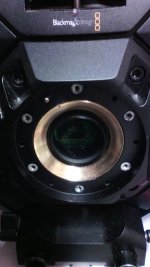
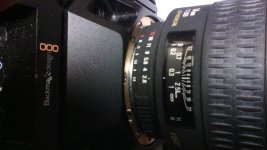
Inspired by this experiment, I had a go at building a Metabones 0.71 "Ultra" speedbooster optical cell into the throat of a Blackmagic URSA 4K, the one with global shutter. This sensor is very close to the size of the sensor the 0.71 optical cell was intended to serve. Due to the optical character of the focal reducer, the flange face for a given lens mount has to be moved 4.2mm rearwards to keep infinity focus. Because I have a good Nikon AI/AIS stills lens set, I also built a Nikon mount and intermediate adaptor. Results were encouraging. A PL-Mount version does not seem to be an option due to the large diameter of the PL-Mount clamp ring and limited space within the front of the camera body to clear this very wide mount. A Canon EF-Mount may also not be an option as the flange face is 2.5mm closer to the sensor than the Nikon. The latch pin mechanism cannot be accommodated so a system which is expected to cope with focus servo motors and their calibration function, lockless mounts are not much use because the motors when finding end of travel will simply screw the lens out of its mount and gravity will do the rest. A fixed pin and a PL-Mount style front lockring arrangement as found in the P+S Technik IMS Pro Nikon Mount would have to be implemented.
 

Attachments

  • URSA 4KV1 SPEEDBOOSTER INTERNAL ASSY.jpg
    URSA 4KV1 SPEEDBOOSTER INTERNAL ASSY.jpg
    55 KB · Views: 0
  • URSA 4KVA SPEEDBOOSTER1 RESIZED.jpg
    URSA 4KVA SPEEDBOOSTER1 RESIZED.jpg
    38.1 KB · Views: 0
Last edited:
It's trivial to say a larger sensor is a large sensor and that's why it's not a smaller sensor. What's different about the image in general?

I can think of

- Diffraction (Though does this change with a speedbooster?)
- Speedbooster adds at least 2 more air/glass interfaces, and another element.

Curious if that's all?

Hi Anton,

When you use a 2x extender, for example, on a 300mm lens, do you say that you've cropped the sensor or do you say you've extended (i.e. doubled) the lens?

Every single camera person I've worked with across four continents says the latter.

When someone, even Phil, puts a reducer on a 300mm lens, the suggestion here is that our language express facts correctly, namely, that just as an extender extends the lens a reducer reduces it, in other words -- that nothing happens to the sensor. The sensor records the same amount of data that it did before the lens was modified with either the extender or the reducer.

This is why a lot of us are calling out this confusing and unhelpful language.

---

I think you're wanting to express that putting a reduced ff lens on a s35 sensor or in Phil's case a medium format lens on VV sensor is valid.

As someone from another time has said, "Art needs no justification". Reducers are totally valid for many reasons. I'm sure no one here fundamentally disagrees with that.

There is however caution (from especially Jacek) that these are not perfect optical solutions. Generally speaking, the set designed for s35 will outperform the set designed for VV on a s35 sensor. Sure.

But thank goodness for exceptions where some lenses look surprisingly beautiful reduced, doubled, scratched, fogged and otherwise modified. Richard Gale has been exploring this as well as anyone! So has Probst and Bjorn (wow!).

That's a different discussion than whether or not a reducer changes the sensor.
 
On a lighter note (pun intended), has there been any progress Phil?

Still no mention if this is being experimented with in the hopes of creating a DSMC/DSMC2 mount speed booster or if it'd strictly be for VV sensors and MF lenses... OR if it's just a big tease...
 
Generally speaking, the set designed for s35 will outperform the set designed for VV on a s35 sensor. Sure.

Why is this? Wouldn't using a VV lens on a S35 sensor be optically superior? Since you are only using the center part of the VV lens, versus the entire field of the S35 lens?
 
Back
Top