Welcome to our community

Be a part of something great, join today!

  • Hey all, just changed over the backend after 15 years I figured time to give it a bit of an update, its probably gonna be a bit weird for most of you and i am sure there is a few bugs to work out but it should kinda work the same as before... hopefully :)

KOMODO....

Status
Not open for further replies.
So when you ask who is its market, it is actually harder to answer than you would imagine. ... Its first and foremost for our existing customers. And then probably anyone who shoots a lot of action. And then perhaps it fits into an entirely new market.

To me that sounds like a fast read out speed - so minimising rolling shutter which is a great thing. I do feel that in fast moving sequences most cameras exhibit jello to some degree - my epic-w especially so, although in practical terms it doesn't come up that often but i would never do a bourne identity with it. Anybody in vfx who tracks fast hand held fights would know....

Also very rarely am I high frame rating either - i think that's a minority of cases IMHO.

I'd love for Komodo to be a practical stills camera too but not sure if that would really work.

It's getting to that point that i will need to replace my a7sII. The III version is awol, there's a whole slew of 6K sensors at the moment but R3D in a smaller form factor is exciting.

To be honest the sigma fp is looking really nice too. The DNGs from it are looking good and the size is bonkers.

So i would love to see sample R3Ds in challenging situations from Komodo, worth waiting for. So i don't know when we might see sample teases of images?

cheers
Paul
 
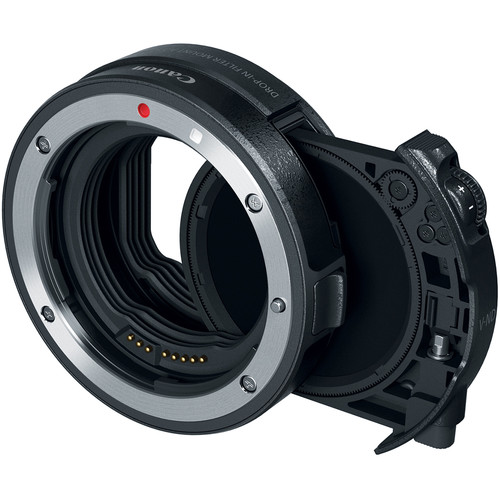
I wonder if you or Kippertie or whoever could implement a better ND solution between RF and EF, like electronic ND or Revolva style swappable glass

The RF to EF adapter from Canon seems to fit your need :
1536860156_1433719.jpg

https://www.bhphotovideo.com/c/product/1433719-REG/canon_mount_adapter_ef_rf_with.html
 
To me that sounds like a fast read out speed - so minimising rolling shutter which is a great thing. I do feel that in fast moving sequences most cameras exhibit jello to some degree - my epic-w especially so, although in practical terms it doesn't come up that often but i would never do a bourne identity with it. Anybody in vfx who tracks fast hand held fights would know...

I’ve been really spoiled by the global shutter on my Bolex. I’d take a global shutter or super fast read out over high frame rates any day.
 
Along the way Komodo inherited the Hydrogen program, which of course was indeed targeted at that market, so there is a natural absorption.. and confusion.

This causes me confusion. Is the Komodo a replacement for Hydrogen modules and an answer to the Hydrogen's Red camera control/monitoring feature?

EDIT: Jannard said that "instead of the HYDROGEN team running the pro camera for HYDROGEN, RED is". Is the Komodo the pro camera for Hydrogen?
 
Last edited:
Jarred says it's a very specific camera not really made for beginners and that does not really exist on the movie camera market. In my opinion, this is not a classic camera as we know it. maybe it's an infrared camera, a thermal camera for the night or very sensitive for specific wavelengths. Or is it something in the color matrix of the sensor...
It intrigues me a lot !!
 
Other RED cameras already exist that do 50fps in 6K including the one you already own...

Maybe I'm looking for a replacement camera that reduces the maintenance costs it has, has a smaller camera body that works on less expensive gimbals sliders and mounts, has a faster rig and boot time and uses less expensive side-gear. The DSMC2 has its limits too and at this time, when Z Cam and Pocket 6K reached a critical moment of delivering pretty high-quality results while having much lighter and smaller camera bodies, the Komodo would be the perfect replacement for my work.


I’ve been really spoiled by the global shutter on my Bolex. I’d take a global shutter or super fast read out over high frame rates any day.

Sure, but then comes some job that requires slight slow motion, what then? I'd take 50 fps over slight rolling shutter any day rather day.

I'm a bit curious as to which owner-operators who shoot 24 fps only, all the time. Do you never encounter any work that needs slow motion? The current Red cameras have a rolling shutter and it's not even noticeable, so how is this an argument against higher fps? If the rolling shutter is as good as the other Red cameras, then I'd rather have that and 50 fps.
 
Does anyone know when is the Estimated Launch Date for this camera ? I have sold 2 of my cameras and now waiting for this to launch.

Damn you shouldn't have sold your gear (FOR buying a Komodo but you may have other reasons that are none of my business at all ^^) since no release date has been announced yet and the only clue is that it has been in the hands of selected few for heavy field testing and will be for another few months.
 
Jarred says it's a very specific camera not really made for beginners and that does not really exist on the movie camera market. In my opinion, this is not a classic camera as we know it. maybe it's an infrared camera, a thermal camera for the night or very sensitive for specific wavelengths. Or is it something in the color matrix of the sensor...
It intrigues me a lot !!

It's not an infrared camera. Do you think Soderberg shot a feature film on infrared? I'm sorry, but the wording that "this is in a market of it's own" is in my ears just a way of trying to dismiss the competition. It's a way of saying that because the camera lacks some features compared to them, it's an entirely other type of camera and therefor justifies the increased price for what it does. I'd like Red to prove me wrong in this, but I still don't get any sound arguments for why the Pocket 6K is such a different and worse camera for half the Komodo's price. To say it exists in its own market is just weird. It exists in a camera market around the price it has, that is how something exists in a specific market.

It's like going to a clothes store finding a red t-shirt that looks and feels perfectly the same as another store but costs double. Then the owner comes out and tells you "this t-shirt is different and exists in a different market than any other t-shirt". How is that a good response and why would you choose that t-shirt based on that? We can only speculate until full specs, but the lack of higher fps options severely limits the flexibility with the camera.
 
You and me both :)

High read outs and low rolling shutter are important, but so is at least 120 @4K. If it could do higher than 120 even at 2K that would be super useful as well. Basically, this camera needs to do everything for everyone and be the perfect camera haha. Which to date, nothing has been, so why start now.

PS please give it 4k 120.
 
Do you think Soderberg shot a feature film on infrared?

Bouncing on that... Did you Guys watch The Laundromat on Netflix and if so, what did you think of the cinematography and the picture look?
 
High read outs and low rolling shutter are important, but so is at least 120 @4K. If it could do higher than 120 even at 2K that would be super useful as well. Basically, this camera needs to do everything for everyone and be the perfect camera haha. Which to date, nothing has been, so why start now.

PS please give it 4k 120.

If Jarred says it wont be as good as BM in terms of frame rates, then it probably maxes out at 30fps in 6K, which makes 120 in 4K highly unlikely.
 
Well interesting that Canon just announced the EOS-1D X Mark III with 4K 4:2:2 10-bit and 60fps.... Competition is heating up. I do feel Komodo does need at least 50fps speed...even if it means going down to 5k.
 
Well interesting that Canon just announced the EOS-1D X Mark III with 4K 4:2:2 10-bit and 60fps.... Competition is heating up. I do feel Komodo does need at least 50fps speed...even if it means going down to 5k.

I expect Komodo will do 4k at 60fps, but Canon compressed video is not in the same game.

If we speculate 4k @ 60fps then 5k would likely be 48fps and 6k 30fps. Seems reasonable given the size, weight, and cost difference compared to a DSMC2, especially if the image quality in all respects is at least as good as DSMC2.
 
I expect Komodo will do 4k at 60fps, but Canon compressed video is not in the same game.

If we speculate 4k @ 60fps then 5k would likely be 48fps and 6k 30fps.

I agree that it's not in the same league...but when recorded to an external device and exposed properly the image you get out of cameras like Canon, Sony, Pana is pretty amazing. Now dont get me wrong I'd still prefer using RED over any of those and that's why I'm hoping Komodo will compete with them...even if it's not the market it's intended for. I'd be ok 4K with or 5K at 48fps and that's really what I'm hoping for. I guess my expectations are high because RED was the leader and while they are still the leader in image quality, they have lagged behind a little in tech features. I'm hoping Komodo addresses both. :-)
 
I expect Komodo will do 4k at 60fps, but Canon compressed video is not in the same game.

If you can do at least 50 fps in 5K mode, that is better than nothing, but at 4K you won't get any supersampling benefits at all. And on the topic of compression, I have seen the point that states that higher resolution is better than low compression, it has been the Red marketing narrative for some time now. So when other cameras come out with higher compression at higher resolution, it's then the opposite and not good anymore? I get that Red uses wavelet compression on its R3D, but the level at which people bash other brands in this thread based on mere specs gets a bit biased. If people check out the actual images produced by the other brands, I'd challenge the viewpoint that Red is so superior to others that they don't even come close to Red's quality. Red is good, together with Arri, they are the best cameras out there, but the market is changing, the image quality of other cameras have started to catch up. If we look at the competition as it is now, Komodo isn't even out and won't be for months. During this time we will see improvements to the other brands, either in upcoming cameras and maybe even new ones. If, say, the Pocket 6K matches up its specs to Komodo at this moment in time and even surpass it in some by giving 50 fps at 6K, then what do people think will be around, either in upcoming tech or newly released by the time Komodo is ready for shipment?

Let's say that there's a new Pocket, new BM, new Z Cam released as news or camera at the time Komodo opens for sale. Let's say that BM increased the specs of the Pocket to such a degree that it justifies a price increase to match with the Komodo. That might end up being, based on their current specs and price, an 8K camera capable of 60 fps, maybe even full-frame. With their new BRAW, that will get more and more support in different NLE's and finishing tools. How will Komodo be able to compete with that? Will one more stop of DR cut it? Will a global shutter cut it when the current rolling shutters are perfectly good for most shoots? Will R3D and color science be so vastly better that people won't be able to create great images with new BM cameras?

I'm trying to get perspective on things here, since I think many keep saying arguments that sounds more like justifying their decision to get a Komodo. And I do so with the love I have for Red's ambition, which I think has been lost a little into marketing narratives that plays off customer loyalty. I have never been loyal to the Red brand, but I've been loyal to the vision and philosophy of cameras that Red has stand by. A philosophy and vision that I think have lost its edge in order to stay relevant in a market that is currently pushing down prices and trying to justify premium cameras over a tier that's previously been brushed off as toys in comparison.

I'll say this. If Komodo is to be a cutting edge camera going forward, with the competition in mind, it cannot be considered existing in "its own market" because it doesn't, it exists where every other camera under this price exists and it will be considered to be so by everyone and judged accordingly. So in order to make it relevant in this market, it has to meet the expectations of its price.

A good example of this is the Hydrogen One. It was marketed in a similar way, like a phone that exists "in its own market". It had a premium price but was capped in many areas people take for granted when it comes to a premium-priced phone. No one can deny that it failed the market and against the competition. This is why I urge Red to stop the "exist in its own market" narrative and focus on delivering a camera that actually looks at the competition. This would be a whole other thing if the specs were already locked down, but they aren't, so I urge Red to push forward the possibility of upping the specs to meet the expected ones of the existing camera competitors. That way, when Komodo is released, it matches the competition at this time, but exceeds in areas the others fail, mainly DR, R3D and workflow. If that requires a slight increase in price I don't think anyone would care as long as it's not unreasonable. But I rather pay $8000 for a 6K 50 fps camera with Red's quality than a $5000 camera that's capped far under what you get for half the price of that.

Ten years ago, Red was somewhat of a revolution in what it could deliver for its price. But today Red is only one guy in the neighborhood. Here's the solution; once again make the best camera possible for such a low price, it would disrupt the market and put Red ahead once again. Red was a democratizing company, putting top-tier quality in the hands of those who couldn't afford it before. This is the philosophy I am loyal to, not the marketing narrative that pushes a tribalist mentality against other brands in order to stay relevant.

Other brands won't sleep while this is happening.
 
Maybe twice a year for me out of probably ~125-150 days on set.

And for me and many colleagues of mine, it's the opposite. Commercials, music videos, corporate videos and so one make up for most jobs available, while narrative work is a fraction of that. But even in narrative work, you still benefit tremendously by having this option and for the tech-savvy cinematographers and directors, having at least 50 fps makes HDRx possible when needed.

I consider 50 fps to be a basic feature, not something special. I don't agree with some others that say it needs 120 fps at 4K, because that's what I consider being a high-speed camera. 50 fps is more than just slow motion.
 
Status
Not open for further replies.
Back
Top