Welcome to our community

Be a part of something great, join today!

  • Hey all, just changed over the backend after 15 years I figured time to give it a bit of an update, its probably gonna be a bit weird for most of you and i am sure there is a few bugs to work out but it should kinda work the same as before... hopefully :)

Komodo Native ISO

vincent kardasik

Well-known member
Joined
Apr 11, 2009
Messages
1,492
Reaction score
17
Points
38
Age
45
Location
Hossegor, France
Website
www.lkrtel.com
Back in the days, when Dragon was first released, there was a lot of talk and sometimes disagreement regarding the camera and sensor native ISO reference.
I've just received my Komodo production unit and I'm trying to shoot as much as I can in random light environment to be able to make the most of this sensor.
So far it looks great, I was expecting a baby Helium but after my first couple takes with it, I have to say the sensor reacts differently.
I first tried outside on an overcast day shooting high contrast objects with 800 ISO as a reference and I have the feeling that even if I want to protect highlights, it's probably not the best reference.
I shot mostly real life tests, indoor and outdoor and I really suck at shooting charts...
What are your thoughts so far regarding "native iso" reference of the Komodo?
 
Back in the days, when Dragon was first released, there was a lot of talk and sometimes disagreement regarding the camera and sensor native ISO reference.
I've just received my Komodo production unit and I'm trying to shoot as much as I can in random light environment to be able to make the most of this sensor.
So far it looks great, I was expecting a baby Helium but after my first couple takes with it, I have to say the sensor reacts differently.
I first tried outside on an overcast day shooting high contrast objects with 800 ISO as a reference and I have the feeling that even if I want to protect highlights, it's probably not the best reference.
I shot mostly real life tests, indoor and outdoor and I really suck at shooting charts...
What are your thoughts so far regarding "native iso" reference of the Komodo?

I call it the base ISO instead, because native ISO is a bit misleading. ISO 800 maximizes the DR range and Red's losses in DR over the course of a few ISO changes up and down from that usually won't affect the image that much. However, I would always try to keep it as close to 800 as possible, since it gives you the most out of the image.

However, I'm not really sure what question you are asking? Base ISO is just a technical thing and highlight protection comes down to the amount of DR you have, exposed properly and work with the highlights in post to smooth them out.
 
I call it the base ISO instead, because native ISO is a bit misleading. ISO 800 maximizes the DR range and Red's losses in DR over the course of a few ISO changes up and down from that usually won't affect the image that much. However, I would always try to keep it as close to 800 as possible, since it gives you the most out of the image.

However, I'm not really sure what question you are asking? Base ISO is just a technical thing and highlight protection comes down to the amount of DR you have, exposed properly and work with the highlights in post to smooth them out.

Thanks Christofer, I should have probably written "base" and not "native" but we're talking about the same thing, which "reference" set-up to make the most of the image.
I wouldn't say base ISO is just a technical thing, using it as a reference helps make the most of the dynamic range and so when needed protecting highlights in a very bright environment. On Monstro for example, there's situation where I will expose for 1280 ISO and some for a stop or two under, it depends on the subject I'm shooting and the latitude I will find in post.
For Monstro and Helium, I found my sweet spot but I'm still looking for it when it comes to Komodo but I just had that camera 5 days ago.
 
How does applying more gain (800 ISO vs shooting at 250 ISO) maximize dynamic range? If shooting at say 6k/40fps at F10 on a bright day how would adding ND to shoot at 800 ISO be better than shooting without ND at 250 ISO if exposed properly to get a fat negative? With REDcode I thought ISO is irrelevant really and is just how much gain you apply in post to taste and it really depends on your exposure in the forefront when capturing the shot that matters? I own Gemini and Komodo and my process has always been to keep ISO as low as possible at all times and just focus on exposing properly with a thick histogram and watching the stoplights to make sure nothing is clipping at all times. If you can get a fat negative / histogram at 250 ISO then how would pushing gain to 800 ISO be a benefit? I am not a super technical expert but I can get absolutely gorgeous images at 250-400 ISO and I have never thought there would be a benefit to pushing ISO versus adding extra light to get a better exposure if required. Maybe I am missing something but I have always heard talk about native/base ISO of 800 with RED's but never quite understood this considering REDcode metadata architecture.
 
Andrew, I don't think ISO is irrelevant when shooting Redcode Raw.
Back in the days when shooting with the Red One, I used to shoot with close to the lowest ISO setting on camera.
After collaborating with several Red Ops and owners and looking their set-up, I realized how important it was to choose the right Base ISO when setting up a shot.
If I remember well Mark L Pederson created a really interested thread about that subject back in the Dragon days, it also really opened my eyes about that subject.
I won't develop more as English is not my native langage and I already did a mistake in the title of the thread as Christoffer pointed, I don't want to make this more confusing.
 
Vincent I will definitely look that thread up as I would like to learn more on this subject. I am all for maximizing IQ. If anyone else could shed some more light on the subject I am all ears.

Andrew, I don't think ISO is irrelevant when shooting Redcode Raw.
Back in the days when shooting with the Red One, I used to shoot with close to the lowest ISO setting on camera.
After collaborating with several Red Ops and owners and looking their set-up, I realized how important it was to choose the right Base ISO when setting up a shot.
If I remember well Mark L Pederson created a really interested thread about that subject back in the Dragon days, it also really opened my eyes about that subject.
I won't develop more as English is not my native langage and I already did a mistake in the title of the thread as Christoffer pointed, I don't want to make this more confusing.
 
How does applying more gain (800 ISO vs shooting at 250 ISO) maximize dynamic range?

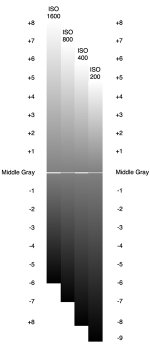
My understanding is that changing ISO on a raw capable digital cinema camera does not so much adjust gain or sensitivity in the classical sense (Kodak 5203 vs 5207 for example), but simply shifts where middle grey lands on the DR range.

Imagine the total dynamic range of the sensor as a left-to-right series of steps from 0 (black) to 255 (white).

|...|...|...|...|...|...|...|...|...|...|...|...|...|...|...|
Black.........................Grey........................White​

A given sensor can record, say, 16 stops or steps between pure black and pure white. No matter where you are in an exposure range, there's middle 18% grey - which is what any light meter references when it spits out a given exposure value. This always lands smack in the middle of our 16 steps.


It feels counter intuitive, but raising the ISO of the camera shifts middle grey into a higher range, which means all of the other stops correspondingly shift up with it. Now the side of our chart that looks into brightness are able to peer further into brightness, giving us more highlight retention. Our ability to see into black shifts further toward middle, thus detail in darker objects will clip sooner. We might also introduce more noise, but in a bright scene that would call for the extra highlight range our ability to perceive that noise goes down.

On the flip side, dialing down to, say, ISO 100 shifts middle grey towards the dark side. Our ability to see and capture highlights shifts to the left - bright whites will clip sooner, but we gain a ton of ability to see dark objects before they drop off of 0 and into noise. Noise becomes annoying in the dark areas first, so it might actually help us to shoot dark scenes at a lower ISO if we are going for that smooth and sharp look.

Once must look at the scene they want to capture and decide where they want middle grey to land - do we care more about highlight retention in our beautiful mountainous background with wispy clouds and a setting sun, or does the dark blue sports car in our foreground deserve better black retention? Do we feel confident that we can lift the mid-blacks in post to give it good presence without introducing more noise? Doe we have enough lights and gear on set to speed up or slow down the extreme ends of the contrast range?

Choosing the "right" ISO is always a balancing act and there is no universal solution.
 
In my experience, regardless what RED or anyone has always said, most DPs that I've worked with shoot at a lower ISO, generally 320 to 640.

It's therefore RED is usually overexposed and they say RED has less DR than Arri. Arri's sensor is less sensitive than most RED's sensors and apply some strange denoise or DR enhancing algorithm that does their trick. I'm used to shoot all at 1600iso with LLO on Dragon and Monstro, and you are clean even at 2000iso even when you do a DCP4k.

But you have different PoV like different faith when you try to tackle that question.
 
It's therefore RED is usually overexposed and they say RED has less DR than Arri. Arri's sensor is less sensitive than most RED's sensors and apply some strange denoise or DR enhancing algorithm that does their trick. I'm used to shoot all at 1600iso with LLO on Dragon and Monstro, and you are clean even at 2000iso even when you do a DCP4k.

But you have different PoV like different faith when you try to tackle that question.


You are not really overexposing unless you are clipping the highlights. As long as you don't clip the highlights, the lower the ISO the better, since your'e not really loosing DR
 
In my experience, regardless what RED or anyone has always said, most DPs that I've worked with shoot at a lower ISO, generally 320 to 640.

That doesnt mean anything except they may not fully understand how to get the best image possible out of the camera. In my experience, most underexpose RED cameras and then wonder why the image has more noise than their Alexa.
 
That doesnt mean anything except they may not fully understand how to get the best image possible out of the camera. In my experience, most underexpose RED cameras and then wonder why the image has more noise than their Alexa.

To be fair, until IPP2 came along (and gave RED cover to make the change), RED's ISO calibration was a stop off. No wonder so many RED users, for so many years, were underexposing their shots and complaining about shadow noise!! At least now, when you select ISO 800 as your base ISO and you meter to expose middle gray where it belongs, it goes to the right place. And for those who wonder what's the base ISO setting that minimizes shadow noise? <= new ISO 800 (which is <= old ISO 400).
 
To be fair, until IPP2 came along (and gave RED cover to make the change), RED's ISO calibration was a stop off. No wonder so many RED users, for so many years, were underexposing their shots and complaining about shadow noise!! At least now, when you select ISO 800 as your base ISO and you meter to expose middle gray where it belongs, it goes to the right place. And for those who wonder what's the base ISO setting that minimizes shadow noise? <= new ISO 800 (which is <= old ISO 400).

LOL...so true. But sadly it still happens even with the ISO calibration.
 
Best setting for mainly shooting Lowlight?

Best setting for mainly shooting Lowlight?

I have a question regarding LOW LIGHT shooting.

Would you recommend lowering the ISO for max. dynamic range? Or does the amount of stops change, if I lower the iso? (ex: 10 stops in shadows, 6 in highlights?)

The image just as an example (Arri Pro Res Test)
 

Attachments

  • Alexa-Dynamic-Range-Spread.jpg
    Alexa-Dynamic-Range-Spread.jpg
    19.6 KB · Views: 1
So I may have been one of those who beat the dead horse on the native/base iso equation many moons ago. As it currently stands things have improved greatly. The reality is and always has been more exposure leads to a cleaner image. To me, the base exposure rating tussle was always about scene contrast and exposure. There is a lot of talk about DR capabilities but the fact remains that the Alexa has and continues to have a very unique approach to highlights. One that allows that camera to pull in the top end allowing DPs to overexpose and still retain an aesthetically pleasing image. This is not true with other cameras so placing or exposing the highlights in your image becomes much more critical. The idea of shooting raw and being able to shift ISO as a way to benefit capturing "better" DR or "less-noisy" images is more marketing than reality. Changing your lighting contrast ratios for the scene is the key. Of course, this is a lot harder to do than shift ISO.

FWIW shooting RED in 2020 I like 800-1600 just fine.
 
Back
Top