Welcome to our community

Be a part of something great, join today!

  • Hey all, just changed over the backend after 15 years I figured time to give it a bit of an update, its probably gonna be a bit weird for most of you and i am sure there is a few bugs to work out but it should kinda work the same as before... hopefully :)

General Question About CMOS Rolling Shutter

RED One MX can do 1/10000th.
It can't do 5k 120fps because it's processing can't handle it.

I get why it can't do 5k 120fps because it requires more processing power and bandwidth than the current hardware in the RED ONE can handle. I was just wondering why it can't do the same shutter speeds as the Epic as that doesn't seem to require processing speed (I might be wrong). Obviously - the sensor boards aren't the same from the MX to the Epic... I also read somewhere that there's a difference in the read-reset time between the MX and the Epic. Is that true?
 
I get why it can't do 5k 120fps because it requires more processing power and bandwidth than the current hardware in the RED ONE can handle. I was just wondering why it can't do the same shutter speeds as the Epic as that doesn't seem to require processing speed (I might be wrong). Obviously - the sensor boards aren't the same from the MX to the Epic... I also read somewhere that there's a difference in the read-reset time between the MX and the Epic. Is that true?

There is a difference between the clock speed the sensor can run in R1 and EPIC... which leads to different read-reset times. And if we could give you higher shutter speeds in the R1, we would.

Jim
 
There is a difference between the clock speed the sensor can run in R1 and EPIC... which leads to different read-reset times. And if we could give you higher shutter speeds in the R1, we would.

Jim

Noted - thanks Jim. I wasn't implying you guys were holding back on purpose - just plain old wonder :001_smile:
 
How well does the faster read/reset cope with camera flashes? The banded camera flashes caused by rolling shutter provide a very different aesthetic to film and I often struggle to avoid them when shooting in a flash intensive scenario.

Twice as good as a R1. Sync for stills...

Jim
 
During the early weeks of R1-MX's life i remember that rolling shutter was reduced but then it was returned back to R1's speed via a firmware update. RED said that they were working on enabling the faster read-reset times again for RED-MX cameras but i think that it never actually happened.

As it was one of the features that persuaded me to upgrade my RED to the RED-MX i always wondered if RED forgot about this feature or it was actually impossible to implement without messing up something else in the camera.
 
Sync for stills...

Jim

OK. I was going to ask this earlier, but held back. So instead of forcing me to twist my brain into a pretzel trying to figure it out from what has been revealed so far, I'll bite. What is the sync speed?

I'll guess a little: Faster than 1/125 I'm sure - at least 1/200, but maybe a lot faster, depending on how fast, and how, the electronics in stills mode read the sensor. Given the camera is capable of 1/10,000 shutter speeds, the electronic equivalent of first curtain (the speed at which the "start reading" order travels down the sensor lines) must have a very fast maximum speed, and "first curtain" may be set up to run at that maximum speed in stills mode. (I'm thinking this might look unnatural in motion mode - and may not be possible).

BTW, have you thought of just going to miniplug instead of PC for more sure contact? PC sync plugs can be a PITA sometimes.
 
I get why it can't do 5k 120fps because it requires more processing power and bandwidth than the current hardware in the RED ONE can handle. I was just wondering why it can't do the same shutter speeds as the Epic as that doesn't seem to require processing speed (I might be wrong). Obviously - the sensor boards aren't the same from the MX to the Epic... I also read somewhere that there's a difference in the read-reset time between the MX and the Epic. Is that true?

You're asking for greater than 1/10000th in R1MX then?
 
The current build of EPIC shutter speed tops out at an embarrassing 1/8000th sec. We can certainly go higher. I just wonder how much of this stuff is academic. Should we be focused on more or should we be getting cameras out the door? Your call...

Jim
 
The current build of EPIC shutter speed tops out at an embarrassing 1/8000th sec. We can certainly go higher. I just wonder how much of this stuff is academic. Should we be focused on more or should we be getting cameras out the door? Your call...

Jim

Max shutter speed at 1/8000th sec is a standard in DSLR world.

Let's get cameras out the door!!!
 
The current build of EPIC shutter speed tops out at an embarrassing 1/8000th sec. We can certainly go higher. I just wonder how much of this stuff is academic. Should we be focused on more or should we be getting cameras out the door? Your call...

Jim

Get cameras out the door please. :smile5:
 
You're asking for greater than 1/10000th in R1MX then?

Nope - I'm not asking. I was wondering why there was a difference in the shutter speed offered in the Epic vs. the R1MX since sensors should be the same. Pure technical ponder :001_smile:
 
Tony.

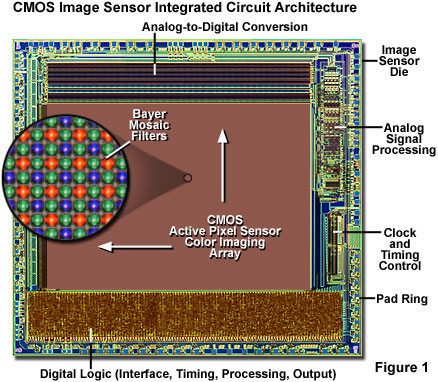
I guess that there is something around (often described as an analog-to-digital converters, Digital Logic, etc, read more about it at the link below)

that the sensor's data treatment make pretty different between R1 MX and EPIC MX and that Epic CMOS also has a faster data read out at the first...

Just for the illustration:

cmoschipsfigure1.jpg


Introduction to CMOS Image Sensors>>>
 
Can anyone point me to examples of skew and other shutter artifacts in material shot on film cameras? People talked a lot about doing side by side tests when red ones were first delivered, but I've never seen any such tests. Just curious. I'd assume that arris would never have skew on verticals, only horizontals, because of the orientation of the shutter. Not sure about panavision cameras. Never shot with them.
 
Paris, there have been a number of film cameras that have used bottom shutters that wipe sideways across the aperture.
Arris: 2B&C series, Arriflexes 1-4
Eclaire: Cameflex, NPR (16mm)
There are others.

Most other films cameras use the side shutter which wipes top to bottom or vice versa, depending on the manufacturer, and type of film movement.

The above cameras all leave a sideways skew if panning too fast. This is similar to the digital sensor skew being discussed in these threads.
 
Thanks for the info, Randall.

Daniel, if the shutters on the Panavisions swipe from the side, they'd have skew verticals, or things moving through the frame horizontally, though. Whereas Arri's will have skew on horizontals, or things moving through the frame vertically. Which to me is a better orientation, since there aren't many shots that require vertical whip pans, or things to move very quickly through the frame vertically.

I understand the mechanics of it in theory. And very much in practice on my RED and dSLRs. I'm just wondering if there are any glaring examples in films or anywhere else that people have come across, with material shot on film. Just curious.
 
I need to correct myself.

The Arri 2Bs&Cs do have a side axis shutter, and wipe top to bottom. Having the motor in the bottom hand grip crossed me up momentarily.
 
Back
Top