Welcome to our community

Be a part of something great, join today!

  • Hey all, just changed over the backend after 15 years I figured time to give it a bit of an update, its probably gonna be a bit weird for most of you and i am sure there is a few bugs to work out but it should kinda work the same as before... hopefully :)

First Look - Schneider Xenon FF-Prime Lenses

Regarding the comment about stop, I think 2.1 is a great stop for lenses of this budget. I personally don't like shooting much wider than T2 and I find whenever I do many other issues crop up. Also, when cameras are now coming with 800 ISO as a base, or much higher, the number of places you're going to walk into and have exposure trouble are becoming fewer and fewer.

The CA on the Xenons is still very disappointing and, for me, distracting. I think it should not have been hard to design a 35-50-75mm lens at this stop and budget. It's hardly an unusual lens.

Thing is that T2.1 lenses usually have problems with CA and things that faster lenses have at faster apertures. Which means that if you, like most, shoot at T2.0 or higher, you will have much cleaner images on those apertures when using faster lenses (good ones). I tried out the Canon CN-E and they blow these out of the water in my opinion. They are usable at T1.3 for many low light situations and look awesome at T2.1 compared to the Schneiders. At T4.0 the Schneiders look beautiful, but that's a high price for a lens that is at it's best at T4.0. Just try and shoot dusk scenes where you need to feel the light of the dim sky and not overlight your subject, it's not gonna happen at T4.0 and I'm not really feeling safe with such a slow lens.
Being on a production means that you first and formost need to be prepared... all of a sudden you have no ambient light for a T2.1 and you're stuck.
 
It all depends on your shooting style. I have yet to run into any problems shooting wide open on them. They are great production lenses. Robust and have a nice look. No image shift issues like I had on some of my Leica-R lenses. Just a solid set that delivers the goods and works well with my Rtmotion. I also own the GLOptics 18-35 1.8 which can aid in lower light situations. But thats rare for me to feel trapped with not having a T1.4 lens. But if that really worries you, have a fast nikon or Canon lens in your kit for reassurance. There is no perfect lens for every situation. Try to figure out where 80 percent of your work is and go from there.
 
I've yet to have a client complain about the Xenons. Do they have CA? Absolutely, but as we've seen in recent posts comparing them to the Canons, CP2 and UPs, all lenses demonstrated some CA. I had them on a commercial last month in the most tortuous set up I've used them on to date: shooting a dancer against a large, split-paned window with thick LA late afternoon haze backlighting. I was interested to see how the lenses would do, and they held up fine on the 6K r3ds. I also had a 24 – 290 (which was pretty flawless on the CA in this set-up) and two Angeniuex DP series lenses that had to be replaced by the Xenons because the CA was too high in one or two set-ups.

Beyond issues of CA, it was the look of the Xenons that I responded to when comparing them to the other lenses in the price range. Because that's what were talking about right now, isn't it? A good lens in a price range, not the perfect lens. To my eye, these lenses have a classic feel and superior bokeh compared to other lenses in the price range. If the RPPs covered 6K+ then it might be a different discussion.
 
I just wrapped a feature where I used Canon zooms (hated them) and used the Xenons. I loved the not so clinical look, and the flares? those were just out of this world! Just the right amount, and the quality of the flares was nothing I've ever seen. As the camera moved with the light in the frame, the flare looked like flying crystals. Thats the best way to describe it. Just awesome. That was with the 50mm
 
They are great production lenses. /QUOTE]

Nicely put Bob. Also, lovely image.


I just wrapped a feature where I used Canon zooms (hated them) and used the Xenons. I loved the not so clinical look, and the flares? those were just out of this world! Just the right amount, and the quality of the flares was nothing I've ever seen. As the camera moved with the light in the frame, the flare looked like flying crystals. Thats the best way to describe it. Just awesome. That was with the 50mm

One thing I've respected a hell of a lot about Schneider is they have somehow been able to balance a smooth draw, lovely flare, and perhaps one of the nicest out of focus images (bokeh) you can get out of currently available lenses. And I'm not just talking Xenon FF-Primes, I'm also saying this because of how the Cine-Xenar IIIs render things. The lenses have character, consistent character. For some it's important.


I've yet to have a client complain about the Xenons. Do they have CA? Absolutely, but as we've seen in recent posts comparing them to the Canons, CP2 and UPs, all lenses demonstrated some CA.

You are correct Hal. And you guys know me. I've literally used or tested every freaking lens that's out there now. In depth. I'm also finishing up another year where I've filmed on a strangely large variety of glass for each job, which certainly provides a unique perspective on all of this.

Chromatic Aberrations. I'm about to say something that will make me rather unpopular perhaps. I see a lot of folks "complaining" about CA. I firmly believe that when an Director of Photography is presented any lens it's important to evaluate it's performance, strengths, and weaknesses. Discovering how and where CA occurs is important. Knowing how to handle it through iris, filtration, or lighting decisions is part of the job. There are lenses out there that people adore that have more CA than the Xenons (oh hi there Baltars!), but they are used and loved. In fact I know DPs who use a variety of lenses because they exhibit CA which sometimes leads to a more colorful out of focus image (K35s for instance).

Motion picture photography requires you to look at lenses differently and get to know them intimately. We all have different things we like. Which is why I find it hard to give everybody purchasing advice these days, hard to get to know everybody and their style of shooting. I personally mostly shoot on Zeiss and Schneider glass and some Leica in there too, but boy do I have some wacky vintage lenses I whip out occasionally because they have a funk I sometimes enjoy.

CA in high contrast situations is something most can live with wide open as they can problem solve it through diffusion or iris adjustments. If the lens is softer than wet toilet paper wide open, that's a whole other thing (I don't want to name names on that one) and not something that can be easily dealt with if you are hoping to film wide open.

It also depends on you as a shooter as well. Many aren't buying fast or standard speed lenses to use them wide open, but rather for what they do in the T2.8-T5 range, that vicious sweet spot where most lenses look their best. I know folks who only have worked at that T2.8/4 split for decades because that's just how things work for them. I'm more of the school of thought of I shoot however the shot, scene, or story influences me and work from there.

I feel mostly the same about glass. I know pretty quickly these days if I'm into a set of primes or zoom. And outside of charts and test shoots, it quickly becomes just a feeling. That feeling is often relating to the total lens character.
 
Many aren't buying fast or standard speed lenses to use them wide open, but rather for what they do in the T2.8-T5 range, that vicious sweet spot where most lenses look their best. I know folks who only have worked at that T2.8/4 split for decades because that's just how things work for them. I'm more of the school of thought of I shoot however the shot, scene, or story influences me and work from there.

I feel mostly the same about glass. I know pretty quickly these days if I'm into a set of primes or zoom. And outside of charts and test shoots, it quickly becomes just a feeling. That feeling is often relating to the total lens character.


I agree with you about pretty much everything, but I want to remind people that you need to test lenses. Test test test. When lenses are designed, they CAN be designed to perform best at different speeds. The sweet spot rule of thumb isn't a rule but a generality. It's possible to design lenses to perform best at any aperture you desire, although sometimes difficult. The general rule is generally true because most lens sets aim to compromise by spreading the curve across as many stops as possible. In an unrealistically ideal world, you could have an different lens set designed for each shooting stop. It's clearly unrealistic, but true.

Just saying anyone who buys 1.4 lenses for the sake of using at T/4 because they think the lenses will be better than T/2 or T/2.8 lenses at a T/4 might be wrong. Test your lenses.
 
Here's a comparison I made when I first got my Xenon's, up against my Zeiss ZE lenses, the 35mm f1.4 and 50mm 1.4 variants. 1:1 crops from my T2i which is a little higher pixel density than the dragon, I think.

lCFmH4I.jpg


One thing I can note is that the green serial number looks a lot darker and more colorless on the Xenon's 35mm, and it's because of the CA. The purple fringe from the bright paper mixes with the green and it adds to a dark grey. Xenons win in sharpness and contrast though I think the Zeiss 35mm at T2.8 (~f2.5) is the sharpest in these 8 images, definitely near or at the resolution limit of the T2i. I imagine a comparison with the CP2s would be similar.

edit: small typo in the image, the Xenon's are obviously T2.1 wide open.
 
Last edited:
I also love the look of the Xenon FF's. I find them to be smooth and creamy without being overly romantic, and as several have already said, they have beautiful flaring and bokeh. I have yet to have a serious issue with CA, but I only shoot WFO occasionally. Generally, I think it's more important to nail focus than to have super-shallow DOF. And mechanically, I think these lenses perform on a much higher level than any of the direct competitors. Personally, I think the Xenons represent the best value available in the $20K price range (for set of 5), and I'm eager for additional focal lengths to round out the set (hoping there's a 60 Macro and a 14mm coming at some point). Of course, YMMV...
 
End of 2015 is approaching... anyone heard any rumor on 18mm and 135mm Xenons? Dates and/or prices? Other focal lengths?

I demoed the Xenons at Duclos yesterday. Matt mentioned that the 18mm is next to come out, but he didn't say when.

I told him I'd love to see a 65 and 40 next.
 
Okay. I've been watching this thread for a while and pretty much what Matt Duclos said is spot on.

A few things that need to be understood about Chromatic Aberrations and Lens Aperture. You are entirely at the mercy of a few things like Scene Contrast Ratio, Lens Design, Lens Coatings, etc...

That first one is the big one and seems to be the thing that many people are either confused about or don't understand that shooting in high contrast ratios is what truly reveals CA the most.

So with special thanks to Matt Duclos I zipped down to Duclos Lenses and grabbed a few lenses to test out some common lenses at T2.1 so you guys can literally see an A/B/C/D comparison. I have done a dirty setup with some extreme contrast and clipped the highlights which will reveal the subtle differences between these lenses the most. Though as you'll see all are "in a wheelhouse" of general performance.

If you click any of these images you'll load up a 2560x800 pixel version so you can really inspect these 100% crops from Epic Dragon 6K WS.

For this test setup we had the Zeiss Ultra Prime 32mm T1.9, Schneider Xenon FF-Prime 35mm T2.1, Zeiss CP.2 35mm T2.1, and Canon CN-E 35mm T1.5.

To point out explicitly the Zeiss Ultra Prime and Canon CN-E are stopped down to T2.1 so you can see how all of these lenses behave at the widest aperture available on the Schneider Xenon FF-Primes.


So again, we literally have an Ultra Prime here and also some of the direct price competitors to the Schneider Xenon FF-Primes. I chose the 35mm because that's what I hear the most "chatter" about. I think the one thing that is particularly noticeable from an aesthetic perspective is much earlier in this thread I said that these lenses had a "classic yet modern look". If you look at the foil crops you can see that slight haliation/glow on the specular highlights that attributes to that characteristic. It's subtle, but certainly is a nice and welcomed effect for those thinking about using a filter to get a similar effect.

Another observation I made as I rolled through various apertures on additional lenses like a Zeiss Standard Speed 32mm T2.1 and a Cooke MiniS4 32mm T2.8 was the Schneider Xenon-FF Primes are a bit less contrasty until stopped down in the T4-5.6 range in comparison to these other lenses.

I saw Red Pro Primes mentioned. They are more in line with Ultra Prime-like performance FYI. They are a very good value and horrifically underrated among cinema lenses, but they do have difficulty covering larger formats of course. More of what I think should be useful here is looking at the Canon, Zeiss, and Schneider images as you are looking at lenses designed for FF35 and that's the actual thing going on here.

Hope this clears up a few things.

I love me some lens tests. Just curious where in the image was the crop? Center? Corner?

Thanks for sharing. This falls in line with what I would have guessed except I have little experience with Schneider Xenon, so it was very informative.
 
Also, to Phil, how did you do the uneven field illumination test? I have built and designed many different methods and I'm always curious to see how others do.

Thanks!
 
I love me some lens tests. Just curious where in the image was the crop? Center? Corner?

Thanks for sharing. This falls in line with what I would have guessed except I have little experience with Schneider Xenon, so it was very informative.

Oof. Tough to recall, I'll have to dig up the frames, but there are samples from center and corners in there. Just don't know which square was from where anymore. Shot that about a year ago.


Also, to Phil, how did you do the uneven field illumination test? I have built and designed many different methods and I'm always curious to see how others do.

Some are pretty plain to see without anything special. Others I bring out a diffused illuminated panel. Often you'll see me shining a source into the lens to figure out why the uneven illumination is occurring. Big lens tests use the panel though.
 
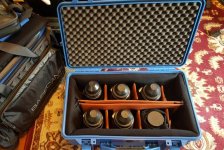
FYI, The promotional blue 4 lens case from Schneider is the portabrace PB-2550DK. I bought the insert kit for it ($112.) and it works pretty good. Not the prettiest and I wouldn't ship anything in it, but it's fine other than that. and one more spot left over for the 18mm (soon I hope). The top foam holds them nice and snug.

http://www.portabrace.com/wheeled-hard-cases/2550-hard-case-with-divider-kit.html
 

Attachments

  • Schneider Xenon case.jpg
    Schneider Xenon case.jpg
    102.5 KB · Views: 0
About Xenon´s CA...
I own a full set of the present lenses and I´m quite happy with them. Really like out-of focus look, bokeh, slight softness, mechanics.
But a week ago, shooting daylight at the end of the day, 25mm on a Dragon set to 6k, f/2.8 the young first AC asked me sort of astonished "What is this?". Right in the upper left corner (of course a critical area) just appeared a dark pole against white burnt sky: the dark pole had a rather wide, well-defined dark purple fringe at the right side, kind of thing I don´t recall having seen for years. I sort of mumbled some probably incoherent explanation and did a fast reframing avoiding the pole and that was it... but left me sort of worrried. I bought the lenses basically for rental... and I will have to rehearse some good convincing explanations for this issue as problems will certainly arouse.
I would have preferred the lenses to be, let´s say, 10 or 15% more expensive but have this issue reduced.
Guido
 
I've had the Xenons for quite a while now. I won't sugar coat it, the purple fringe CA is bad. But that's the only bad thing about them. In most shooting situations, the CA is not a problem... The lenses are fantastic in every other regard, the size and weight are ideal, the mechanics are wonderful. Overall I'm very pleased with them and I wish that more clients would give them a chance rather than insisting on shooting with CP's or Ultras. Same issues there that we have with the RPP's. I love the look these lenses impart to the image. Very silky smooth with good retention of detail. They flare beautifully too, if you like that sort of thing. I would choose the Xenons in an instant over the CP.2's, especially in a controlled lighting environment. Obviously the CP.2's have the advantage of more focal lengths to choose from. But we have to be careful there as well, not all CP.2 lenses are created equal and there are a few duds in that lineup with their own set of issues.
 
I mean that I find every characteristic of the lenses to be great... except for the lateral CA which is really bad. Shouldn´t the lenses have been more "balanced"? Schneider hasn´t been producing cine lenses for some decades, and I think a comeback may have been more controlled. I used their old stuff in the ´80s and early ´90s and I know the brand well. But young DPs, ACs, etc in Argentina know Schneider to be a popular local beer... and as one of the few owners of these lenses we have to work hard to reintroduce them. A defect that would be admitted to something branded Zeiss -simply because of that- would not be admitted the same way to a vaguely known brand. Subjective issues are very important, as we all know.
Just a thought.
 
Back
Top