Welcome to our community

Be a part of something great, join today!

  • Hey all, just changed over the backend after 15 years I figured time to give it a bit of an update, its probably gonna be a bit weird for most of you and i am sure there is a few bugs to work out but it should kinda work the same as before... hopefully :)

DRAGON vs EPIC MX Noise - NOT GOOD

Status
Not open for further replies.
Virtually every "pro" camera out there does exponentially more noise reduction internally than any RED camera. A perfect example is the Sony F55 which uses extensive on board DSP to achieve roughly 14 stops of DR. IMO the image looks "airbrushed", with subtle textures lost along with the noise. When viewed on a 1080 monitor, even the Dolby, the image looks pretty darn good as the downscale process combined with the resolution limits of the monitor dovetail nicely. The "price" of this approach is a more "artificial" looking result with no guts - AND - no way to change that personality.

IMO, noise reduction in developing/processing (RCX, Scratch, Resolve) that didn't require significantly more resources (read time) would be ideal. As a practical matter, a new calibration that trades a little bit of high frequency detail for less noise seems like the right move. Thanks to the Dragon's (roughly) 18 megapixels (or even the 9 John Galt might posit) I really doubt even a "de-tuned" decode would be too soft. As others have noted, the reality of such adjustments are several times more complex and interdependent than such broad terms can adequately describe.


This is where the war on the motion picture front is truly happening. There is a contingent of cinematographers, directors, producers, studios, filmmakers, etc.... Who absolutely will not shoot with cameras that utilize on board noise reduction. There's also a contingent that don't care or "know".

With filmmakers like Quentin Tarantino having extremely strong thoughts about digital versus film (very real thoughts actually) there is a battle between glass clean images and something with a bit more character.

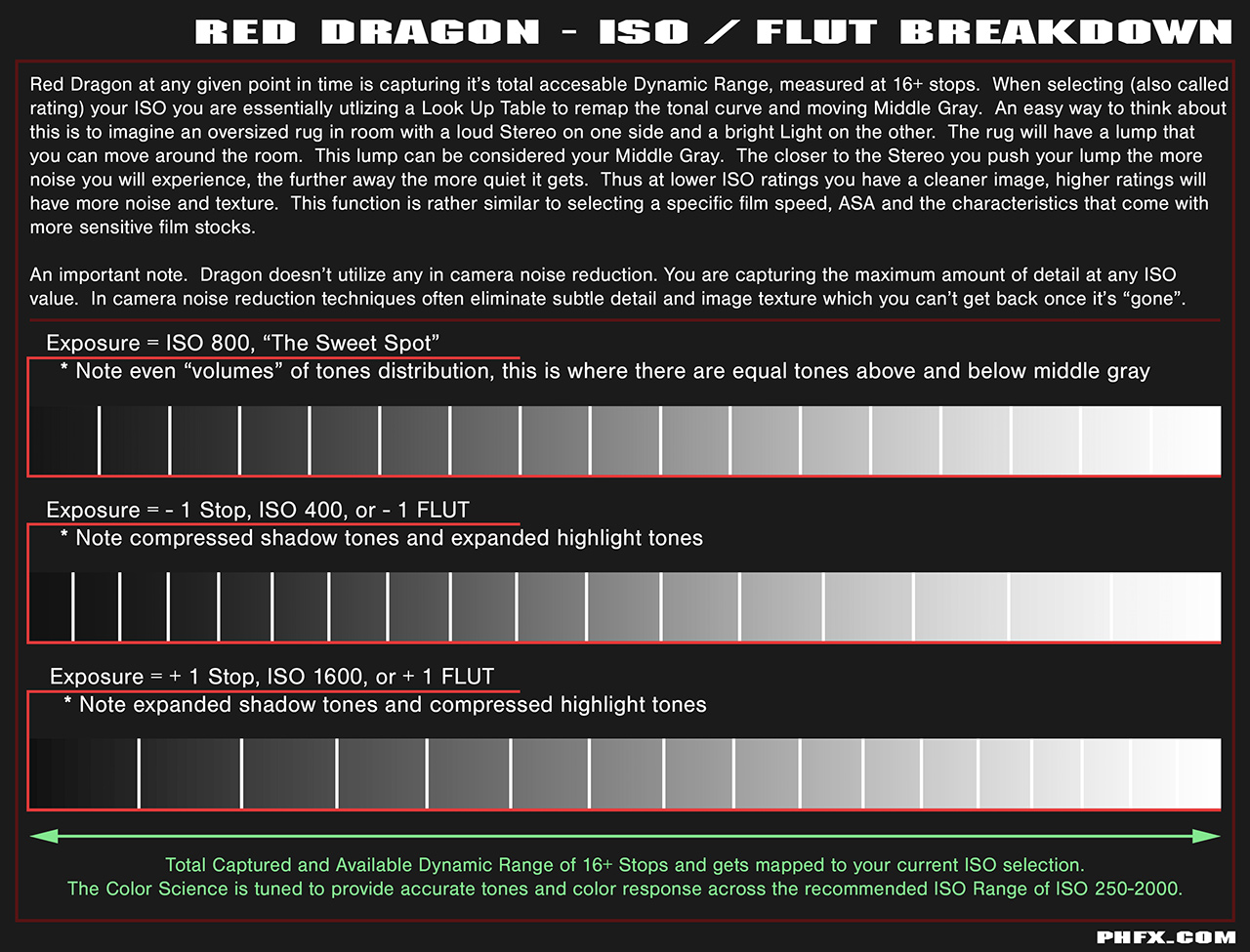
Red is producing cameras that capture the maximum dynamic range and detail within the system. Increasing the ISO has a similar effect to selecting various film speeds. Higher speed film = more grain. This is why film guys "really get" what Red cameras are all about.

There are those who want just a "clean image" all the time at any ISO. That's fairly intense. But we have to observe what the cost of on board noise reduction is. And that's usually texture, fine detail, and resolving power. Which more or less hinders you when shooting at a specific resolution because you are losing that detail. Red does oversample handsomely and it receives post noise reduction nicely when shooting at high ISOs and scaling that image down to a deliverable resolution is an interesting approach if necessary.

What I will say, that if you shoot properly you don't "need" noise reduction within the recommended ISO range of 250-2000. You do have to acknowledge what the differences are of shooting low ISO versus high ISO though.

I've examined the noise/texture characteristics fairly closely at ISO ranges 100-6400. The texture itself is actually pretty pleasing and I think Red is doing some voltage magic somewhere back there even.
 
I see a lot of assumptions (on both sides) about how big or small an issue this will be. Probably best to not be reactionary: I've found that speculation is not the most accurate predictor of the future. Now that the community helped provide examples, let's give Red time to work their magic..

It's a small issue if you're just filming out the window. It's massive if it could ruin a shoot. And with Red it feels like there are a constant stream of these 'fixed in the next firmware issues'. You can spend your life tidying up after yourself or you could just not make a mess in the first place. The Red Eco-system has always felt very messy.

Then there's the disconnect between the claims and the reality. To me it's either a case of over hyped marketing or the dragon sensors users are getting are different to those the original tests were done on. I've never understood why, if your goal is to make the best images possible, you would cripple an originally 18+ stop sensor by putting it in a 4 year old 'matchbox'.
 
David,

You'r probably right. Not every one is ready for the RED ride.
But for the passionate ones that are willing to take the "risk" to make a movie and to shoot it on RED, it's a beautifull journey.
I put the word "risk" because the RED Eco-system, as you call it, is an evolving one and can have some hiccup.
I've taken that risk several times and have been rewarded with outstanding pictures.
But you need some passion to understand your tool.
I understand the pain for rental houses, because they can't stay on the bleeding edge as they should read RU on a daily basis...

Pat
 
I will always fall more on the film side. A more romantic image, but an ass kicking detailed on at 50asa as well. That is what dragon and red has always strived for. An aesthetic, a quality and a unique image, not sony, not arri.

To to me the dragon sensor is the best digital film stock available for a multitude of reasons. 16mm or 35mm form factor, price point, accessible dragon color, but more so, a company that has been listening to customers since the start and stuck with RAW, no sharpening, no noise reduction in camera. An honest digital image that we process as per creative choice.

That is what the digital replacement to film is supposed to be, at least to me anyway.

Battistella
 
The digital replacement to film is not something that will be decided by philosophy.

The digital replacement to film will be decided by film-makers.

if we are judging on numbers then RED has not made the digital replacement to film in most markets. (certainly not in the last few years)

There are many ways to skin a cat, RED got this in some respects by designing a modular system but missed a lot by shutting off certain tools to help produce an image because of 'philosophical' reasons. I think that is naive. But what do I know.
 
But then you're not getting the full range of the Dragon. When you shot both, did you notice you could open up on Dragon more before the sky clipped? If you shot both at the same stop you're not pushing Dragon to its limits, therefore you will not see much of a difference.

Next time, shoot both again, expose for MX and open up until it begins to clip, note the t stop. Do the same for Dragon and open up until clipping, note the t stop. Dragon should be able to open up a couple stops more. Then do this Redlogfilm test and see how the Dragon highlights come back while MX is gone... You could even take them down to 50ISO and investigate further.
I did see a difference in when the two clipped as evidenced by the "exposure" overlay when it clipped red. I didn't note exactly the difference between them but it was not insubstantial. But if I understand what you are suggesting, I would then be riding the Epic at just below clip and Dragon at just below clip, and the highlights would look the same, and maybe more room on the bottom end. My test was if I exposed for my foreground properly and had an uncontrolled background, what would happen. Part of having high dynamic range is to not sweat the highlights too much. Now granted, the slightly off axis angle and the fact that one was 35mm and one was 50mm don't help things, as I didn't expect to be doing massive blowup comparison. I thought I would pull both up and go "Yep, Dragon has more range!" and leave it at that.
And I would be happy to share the clips. Anybody got any advice on how to do that and save me from scrolling through this thread? My Wordpress Site wont even save my full res Tiffs from my "video camera" (LOL) so an actual r3d is probably out of the question. Yousendit or something?
Did I mention I am simple Caveman Cameraman, your internet protocols confuse me.
 
I can see your point of view Ivan. It all has to start with some philosophy, an idea, a wanting. That does not mean it will work out, but it's nice that the ball got rolling back in 2006. We could very well have been on HD cameras or dslrs until now, but there was a push ahead. At the very least it's gutsy and disruptive.

You are right, film makers will ultimately be the deciding factor.

Battistella
 
David,

.
I put the word "risk" because the RED Eco-system, as you call it, is an evolving one and can have some hiccup.

Pat

If I was RED I`d be disappointed at this stage of their cameras development and business development that customers still feel they are taking risks using their equipment. No. I cant imagine RED would feel good at all.
 
It seems to me like there are two dominant paradigms in the early part of the signal chain:

1) A one step process where the image at the SDI (or HDMI) spigot can be used either as is, or by toggling on a pre-set conversion like LogC>rec 709 with "custom" offsets, if any, achieved by "painting" in the camera's on board DSP old school style

2) A two step process where the camera original is processed with specific intent (think printer lights, pushing, flashing, whatever you like) and the exposure/contrast of the scene lighting/practical filtration/etc is biased to support the planned processing/development. Only after this two step process is completed, at least on a global level, do you have the intended look. This mimics much of the film negative to SR pipeline with shot to shot matching done tape to tape on old school DaVincis if time/budget allowed. (This is oversimplified for brevity).

I'll understand if RED never embraces a hybrid alternative, they are the manufacturer after all - but I think well sorted LUT support would leverage the modern image creation environment in powerful ways. To wit:

Using red.com sort of like the Apple App Store, allow people to create LUTs, upload them to RED for vetting - nobody wants to introduce a virus or bug - then allow folks to download them for a couple bucks, split the revenue with the LUT author and use the other half to pay for hosting/engineering costs. This would allow for some pretty sophisticated image control to be achieved in camera for monitoring and for the initial metadata that drives the portrayal of the image when first opened. Is this concept dangerous to the underlying premise of always being able to go back to the "uncooked" digital neg? In the sense that one might make more extreme exposure/lighting choices based on the manipulated monitor image that reduces the total amount of info that makes it into the in the R3D, then yes. (This is the same "feedback loop induced user error" phenomena that shows up in ISO debates) But the good news is that you can still strip the metadata and "re-develop" the image, you just may have a "thinner" neg/file than if you had taken the wide/fat at capture approach then introduced the LUT in processing.

If you're really savvy, and this kind of LUT usage becomes a well supported feature, it will allow you to aim your on set choices at the hero target reproduction metrics while still being able to toggle to a gamma encoded RAW view of sensor response voltage so you know where response becomes non-linear or hits a S/N threshold. Some of this functionality has been enabled in various camera firmware builds, but as Mark (Off Hollywood) has pointed out, there is still a lot of untapped potential. Most of the bigger shows I'm on that want a way to "audition" the intended look during production use robust 3rd party solutions from the usual suspects, which, as you might imagine, typically involves a DIT (sic) and either a LUT box or functional equivalent of same. Being able to bring this functionality on board would simplify on-set monitoring support and move shows closer to a consistent representation of color throughout the process (yes Virginia, still many challenges to true fidelity).

Cheers - #19
 
A perfect example is the Sony F55 which uses extensive on board DSP to achieve roughly 14 stops of DR. IMO the image looks "airbrushed", with subtle textures lost along with the noise. When viewed on a 1080 monitor, even the Dolby, the image looks pretty darn good as the downscale process combined with the resolution limits of the monitor dovetail nicely. The "price" of this approach is a more "artificial" looking result with no guts - AND - no way to change that personality.

I

Yes. The only digital cinema cameras that let the decision to the cinematographer how the texture will unfold are Red and Arri. I had Sony footage in my post and yes, it's vibrant, good gradable when log encoded but in the end it is processed and hence shows hardly any personality. The colour science, however, is well done though.

This is where the war on the motion picture front is truly happening. There is a contingent of cinematographers, directors, producers, studios, filmmakers, etc.... Who absolutely will not shoot with cameras that utilize on board noise reduction. There's also a contingent that don't care or "know".

You are right, of course. But this approach is not only applicable to RAW cameras. RAW cannot been eyeballed on a screen an thus need always a RGB transfer. Actually there is no real RAW camera. But this transcoding can be all or nothing. If you watch Alexa threads you will find some similarities to this thread. Alexa LogC is nothing else than RedLogFilm done in-camera.


IMO, noise reduction in developing/processing (RCX, Scratch, Resolve) that didn't require significantly more resources (read time) would be ideal.
Cheers - #19

At reduser Neatvideo is a constant follower. There are literally hundreds of threads that praise the power of Neatvideo. And they are right. But the concept that noise can be reduced to a reasonable amount by killing the personality/texture with a software is a declaration of bankruptcy. Personally I want to deal wit the sensor as pure as possible. I have that with Alexa's ProRes LogC and with Red's R3Ds.

I'm mentioning Alexa because currently it is statically the "camera of choice" by the vast majority of industry professionals.

Ok. I never used Neatvideo and I never used the noise reduction button in RCX. I'm shooting on Red since 2008 and before that on Kodak or Fuji for that matter. In the 90ies we had the opportunity to use noise reduction on the Ursa/Spirit (BTS Noisreducer) but never used it, killing the grain was no option.


Hans
 
Leveraging the power of the RR-X

Leveraging the power of the RR-X

IF, big IF, bit IF, you could adjust noise per shot in RCX (and similar SDK compliant tools) without a significant speed hit that seems like the holy grail.

I'd say pretty much the same thing about sharpening in the decode.

In my ideal world the RedRocket-X would allow real time adjustment of such things, as well as the alchemy suite, with real time or faster flips to RGB formats. Anyone interested in a fully interactive UHD/4K virtual darkroom at their fingertips? If all you needed was a workstation class rig that supports full PCIe 3.0 x16 I/O (doable for under $5K plus storage), an optimized/more fully enabled RR-X, software scopes/histo and a legit UHD/4K monitor…

Cheers - #19
 
...I'll understand if RED never embraces a hybrid alternative, they are the manufacturer after all - but I think well sorted LUT support would leverage the modern image creation environment in powerful ways....

All seasoned colourists use LUTs for grading. There are quite a few available fro free. For a start check Adobe's Speedgrade. Inside Speedgrade one can export the available LUTs to a format that swallow Autodesk Flame/Smoke or Resolve.

For on-set I find a LUT-less existence much better. I deal with the SDI-Out as a super-resolving video tap as we formerly had with 35mm. I find the WYSIWG philosophy dangerous, to exaggerate a bit. Having all rightly done on set leaves not much to the phantasy and hardly anything surprisingly to the later off-line, or even on-line approval by the client. I like the idea of unfinished capture/shooting, the creative headroom in any direction on set, and the grading process sometime later in the chain with a fresh mind.

INHO, the idea to keep a WYSIWG experience via metadata from the set to the NLE/postproduction is a video approach that has its reasons for some parts of the industry but is much better covered by Sony for instance than Red or Arri. A cobbler should stick to his last.


Hans
 
This thread has been very informative and I am glad it was brought up. One of our Epic is coming back from being Dragonized and we probably would have freaked out at the noise. But thanks to reduser at least we now know what to expect and how to deal with it until red implements a fix with the color science. :)
 
One observation I have with the Dragon noise that I don't think I've seen pointed out in this thread is that it is a lot more organic than what we see on the MX. The noise on the MX sensor is less colorful than what Dragon is giving us with the current calibration, but it is a lot more structured and artificial looking. Dragon noise looks a lot more like organic film grain.
 
All seasoned colourists use LUTs for grading. There are quite a few available fro free. For a start check Adobe's Speedgrade. Inside Speedgrade one can export the available LUTs to a format that swallow Autodesk Flame/Smoke or Resolve.

For on-set I find a LUT-less existence much better. I deal with the SDI-Out as a super-resolving video tap as we formerly had with 35mm. I find the WYSIWG philosophy dangerous, to exaggerate a bit. Having all rightly done on set leaves not much to the phantasy and hardly anything surprisingly to the later off-line, or even on-line approval by the client. I like the idea of unfinished capture/shooting, the creative headroom in any direction on set, and the grading process sometime later in the chain with a fresh mind.

INHO, the idea to keep a WYSIWG experience via metadata from the set to the NLE/postproduction is a video approach that has its reasons for some parts of the industry but is much better covered by Sony for instance than Red or Arri. A cobbler should stick to his last.


Hans

Hans,

I agree 100% with your last two posts.
We are exactly on the same wavelength.

George
 
One observation I have with the Dragon noise that I don't think I've seen pointed out in this thread is that it is a lot more organic than what we see on the MX. The noise on the MX sensor is less colorful than what Dragon is giving us with the current calibration, but it is a lot more structured and artificial looking. Dragon noise looks a lot more like organic film grain.

Does film have more "grain" in the shadows, the mid-tones or is it equally distributed? Does it dance around? I always wondered about this comparison of noise to grain. Can you spot something shot of film / digital immediately based on the grain aesthetic?

BTW: I watched Taxi Driver again the other night. What amazing low light photography on that film. Like 60% was shot at night and a bunch with available city light only. The clarity, saturation and DR from a film that is almost 40 years old was stunning to see again given the context of our discussion today. Highlight roll off . . . check. Clean shadows . . . check. Skin tones . . . check. NYC circa 1970's film grit . . . check. Amazing glamor shots of Cybill Shepard looking totally lava hot . . . Fuqin A CHECK!!!
 
One observation I have with the Dragon noise that I don't think I've seen pointed out in this thread is that it is a lot more organic than what we see on the MX. The noise on the MX sensor is less colorful than what Dragon is giving us with the current calibration, but it is a lot more structured and artificial looking. Dragon noise looks a lot more like organic film grain.

Truth.


Does film have more "grain" in the shadows, the mid-tones or is it equally distributed? Does it dance around? I always wondered about this comparison of noise to grain. Can you spot something shot of film / digital immediately based on the grain aesthetic?

BTW: I watched Taxi Driver again the other night. What amazing low light photography on that film. Like 60% was shot at night and a bunch with available city light only. The clarity, saturation and DR from a film that is almost 40 years old was stunning to see again given the context of our discussion today. Highlight roll off . . . check. Clean shadows . . . check. Skin tones . . . check. NYC circa 1970's film grit . . . check. Amazing glamor shots of Cybill Shepard looking totally lava hot . . . Fuqin A CHECK!!!

Film's grain response is directly tied to it's sensitivity and the tonal range found in the exposure. In terms of it's visibility in modern and old stocks. It's certainly more visible in shadows and midtones and seems "fall away" closer to highlight clip/overexposure. It's still providing texture up until the last moments of recorded value, but around 88-90 IRE there is certainly a noticeable drop in it's appearance. At least when scanned and projected.


My last update to the Red Dragon Info and Data Sheets thread wasn't totally on accident :)

It's actually very relevant to this particular conversation about image noise, texture, and natural image quality.

We have put Dragon up next to Vision3 and the news is good.


Red Dragon - Film Relevance


Red Dragon - ISO / FLUT Breakdown


Red Dragon - ISO Examples

 
Great work Phil! As always.
 
Status
Not open for further replies.
Back
Top