Welcome to our community

Be a part of something great, join today!

  • Hey all, just changed over the backend after 15 years I figured time to give it a bit of an update, its probably gonna be a bit weird for most of you and i am sure there is a few bugs to work out but it should kinda work the same as before... hopefully :)

Ask David Mullen ANYTHING

Convincing a Director to try RED

Convincing a Director to try RED

Hi David,

Once again asking you a question. I have a very good friend of mine, a Director, that wants me to work with him on 3 commercials in February. Well, he has never shot anything on a RED. The problem is he says many people have problems with the RED. Not really sure what problems these people have, but, what I can tell him to convince him to at least try it out? What would you tell him? I know it is a open question, and for me a bit strange how some people resist new things, and how some people speak badly about things they don't even know or have even used...But that is the nature of people...It is a pitty me and him are not near, because I could just go out with him and shoot something for him to actually see the RED in action.
Any way, if you can, give me some pointers.
Thanks again,

best

Antonio
 
I would shoot some tests for him, take them to a post house that has RED experience, and look at them -- I'm sure he'll be convinced. Especially if you compare it to something in the same price range... Though if you guys can't be in the same room together at some point, it's going to be hard to convince him of anything. Without some prep time to convince him, you might as well stick to something that you both mutually know will work from past experience.
 
Without some prep time to convince him, you might as well stick to something that you both mutually know will work from past experience.

he is inclined to shoot on Super 16...That is like shooting 2K on the RED. Am I wrong?
 
Super-16 has a "look" but it can be fairly slick if shot and posted right. It's not the same thing as shooting the RED at 2K other than in terms of depth of field.

If the choice is between Super-16 and RED, it should be an issue of which look is best for the project, and what camera & format is most appropriate logistically.

Shoot some Super-16 tests compared to the RED and show it to him. All you might need is a few seconds of Super-16 footage just to show him the differences. Even a few frame grabs might convince him.
 
Super-16 has a "look" but it can be fairly slick if shot and posted right. It's not the same thing as shooting the RED at 2K other than in terms of depth of field.

If the choice is between Super-16 and RED, it should be an issue of which look is best for the project, and what camera & format is most appropriate logistically.

But, is it not possible to shoot on the RED and then in post make it look like Super 16? Or is it just easy to just shoot straight to S16?
I thought that if we shoot 4K then in post we can make it look like S16 (and have the possibility of reframing, correcting etc...)? Do I make sense, or is this impossible?
 
I'm sure it's possible, but if the director is happy to shoot in Super-16 and wants it to look like Super-16, then why shoot on the RED only to make it look like Super-16? Why not let RED look like RED and Super-16 look like Super-16? What's the problem with shooting in Super-16 anyway if that's what the director wants? Now if he wanted it to look like 35mm, you could perhaps argue with him that RED would have the sharper, finer-grained look and the depth of field of 35mm, whereas Super-16 would have the dynamic range of 35mm.
 
I'm sure it's possible, but if the director is happy to shoot in Super-16 and wants it to look like Super-16, then why shoot on the RED only to make it look like Super-16? Why not let RED look like RED and Super-16 look like Super-16? What's the problem with shooting in Super-16 anyway if that's what the director wants? Now if he wanted it to look like 35mm, you could perhaps argue with him that RED would have the sharper, finer-grained look and the depth of field of 35mm, whereas Super-16 would have the dynamic range of 35mm.

Got your point. Ok. Just that I have got used to shooting on RED, and I like it, and I have it...
But Super 16 is cool. I like it as well, just that I think shooting on the RED we end up having many more options.
 
Man, I've always wanted to get into this thread, but I hate coming into threads all new, and not knowing what's gone on before my post.

But 2,575 posts to read? That's like 2 or 3 books! :embarassed:

I read every single post in this thread before I posted a single thing on Reduser. It is like a book, and it's one of the best cinematography books every written. I read every single post Mr. Mullen has on this site and on cinematography.com. Well worth the time.
 
David,

I just have one more question. As you might remember from a few posts back, I'm both directing and working as cinematographer on my next film (can't afford DP unfortunately), so every single shot and lighting setup in being planned well in advance by me and my lighting guy/gaffer to ensure there's minimal issues during the tight shoot.

There's a shot in particular of a boy sat at a table, and in front of him (on the table) there is a brown package (say 1 1/2) feet away. Id like a shot in front of the boy, like the camera is on the table, whereby the package (which is almost right in front of the camera but slightly to the left) and the boy are both in clear focus. So fundementally just a really deep focus shot.

The room is lit brightly and I'll be using an 18mm Zeiss prime so it should already be pretty god damn deep focus. My only concern is that the small size of the room means the package will practically be as close to the lens as we can get it (whilst keeping it in focus), and the boy will be some distance away at the foot of the table.

Any thoughts/ideas are really appreciated.
 
I read every single post in this thread before I posted a single thing on Reduser. It is like a book, and it's one of the best cinematography books every written. I read every single post Mr. Mullen has on this site and on cinematography.com. Well worth the time.

I second that. :)
 
David,
There's a shot in particular of a boy sat at a table, and in front of him (on the table) there is a brown package (say 1 1/2) feet away. Id like a shot in front of the boy, like the camera is on the table, whereby the package (which is almost right in front of the camera but slightly to the left) and the boy are both in clear focus. So fundementally just a really deep focus shot.

The room is lit brightly and I'll be using an 18mm Zeiss prime so it should already be pretty god damn deep focus. My only concern is that the small size of the room means the package will practically be as close to the lens as we can get it (whilst keeping it in focus), and the boy will be some distance away at the foot of the table.

Any thoughts/ideas are really appreciated.

I think with a fairly contained shot like that that the simplest solution is to just get the light level up and stop down the lens, the more the better. Looking at a DOF chart, if you set an 18mm lens at f/8 and the focus to 2', then everything from 1'6" to 3'2" would be in focus.

A split-diopter filter wouldn't work even though the box has a straight edge on it to hide the split -- the reason is that, oddly enough, a split-diopter filter needs to be used on a fairly shallow-focus shot that is not too telephoto or too wild-angle. Too wide-angle/deep focus and the cut edge of the filter comes into focus, and too telephoto and the cut edge is too big of a blur.

A tilt-focus lens would help, though the pre-set ones come in select focal lengths (24mm, 45mm, 90mm)
http://www.arri.de/camera/lenses/35_format_lenses/tilt_focus_lenses.html

And when you use these lenses for deep focus trick shots, they work better the more you stop down, just as with a regular lens.

So either way, just find a way of getting the light level up as much as possible.

I'll use that approach then. There's a window running across the right hand side wall, so it will be really easy to get the light level up.

Thanks again David :seeya:
 
That car commercial looks so heavy in post composite work that I'm sure they shot it all in focus, did the composites, and added the blurring effect later in post.

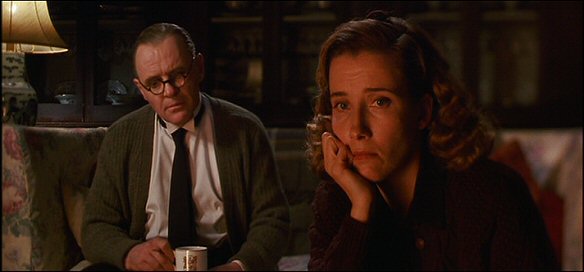
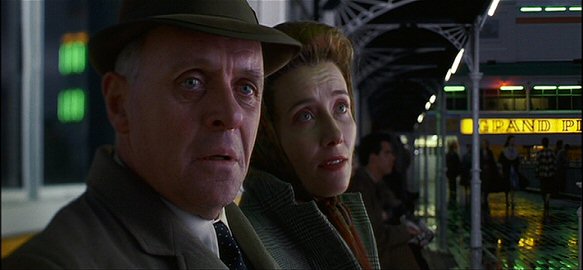
"Remains of the Day" used a tilt-focus lens for deep focus effects now and then:

remains.jpg


remains2.jpg


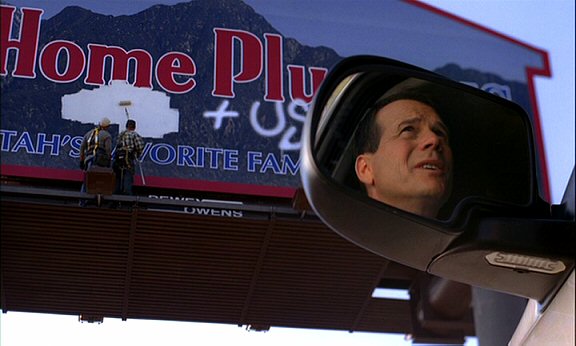
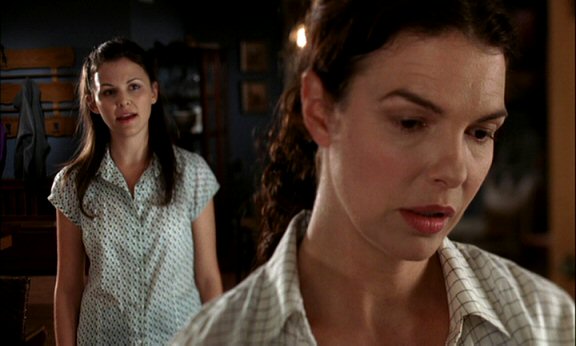
I used one for these two shots from "Big Love":

biglove25.jpg


biglove26.jpg


You can see in the second example how the effect is more obviously distorted at wider apertures -- it still helps to stop down.

I first noticed the use of the tilt-focus lens for deep-focus effects in "Remains of the Day" and some movies shot by Dante Spinotti ("Quick and the Dead" and "Heat") I think there is a simple raking two-shot in a truck during a daytime driving scene in "Heat" where he used an anamorphic tilt-focus lens to hold both people in focus.

Now I've also used it the other way too, to throw part of the frame into soft focus.
 
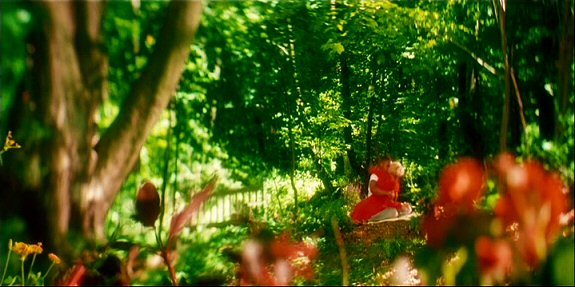
Here's an example where I used a tilt-focus lens to blur part of the frame:
shadowboxerDVD8.jpg


I believe that is what comes to mind, the selected focus area, when i think of the shift-tilt lenses. I'm a big proponent for in camera effects yet with the technology of post work today, it seems that path is less critical.

Thank you once again.

Matt
 
I believe that is what comes to mind, the selected focus area, when i think of the shift-tilt lenses. I'm a big proponent for in camera effects yet with the technology of post work today, it seems that path is less critical.

Thank you once again.

Matt

Seems to me that post-effects on a two-dimensional plane will only give you...two-dimensional effects. I greatly admire still and cine -photographers who are not afraid to "command" the light before it is captured on a flat surface (film or sensor plane). There is a difference on how the light "dances" through diffusion and focus especially noticeable in... the play of the highlights? I've seen all sorts of post-blurring, rarely does it achieve the organic feel of something that was shot "that way". Kudos to Mr. Mullen and others who go to the trouble for in-camera fx... you have fans! :thumbsup:
 
In that example I posted, you'll note that by tilting the lens so that the big tree on the left fell out of focus, the flower in the extreme foreground fell into the plane of focus - something that would not have happened if I did the blurring entirely in post.

However I will admit one thing -- there was only one focal length lens in 35mm Panavision anamorphic that was converted into a tilt-focus lens, a 90mm (roughly the equivalent of a 45mm in 35mm spherical in terms of horizontal view). So I had a few wider shots where I had to switch to a 40mm anamorphic that had no tilt-focus effect, but in post I was able to blur part of the frame so that those shots intercut with the 90mm slant-focus anamorphic.
 
Back
Top