Welcome to our community

Be a part of something great, join today!

  • Hey all, just changed over the backend after 15 years I figured time to give it a bit of an update, its probably gonna be a bit weird for most of you and i am sure there is a few bugs to work out but it should kinda work the same as before... hopefully :)

Ask David Mullen ANYTHING

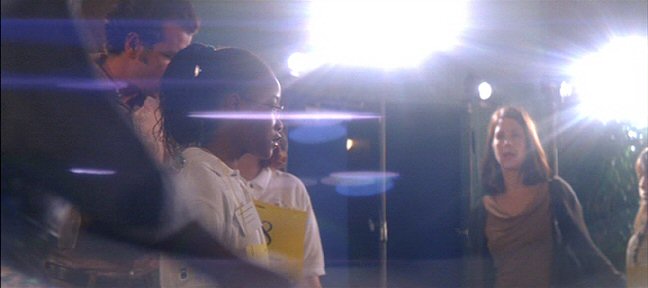
Some of those shots remind me of a question I wanted to ask you, David. I watched Akeelah and the Bee recently and I was wondering about the shot where Akeelah is walking through the hall with all the press and photographers right before Scripps starts. How did you create all the flares and bokeh in that shot? Were they created in post or was that actually done in camera, because it was really quite stunning.
 
HDCAM-SR version?

HDCAM-SR version?

Beautiful lighting, David .... and of course, great exposure .... there's something so graceful about how 35mm film handles highlights and shadows.

If you have an SR version of the movie I'd be more than happy to do a private screening for you in our theater .... you can invite whoever you like (40 people max) and we can have an informal party outside the Fairbanks building.

See you soon.

Neil
 
Wow David. there's some great composition and lighting in there, I especially liked the the previous page.
 
Unfortunately, Sony owns the SR master now and they don't know me from Adam...

I believe that shot from "Akeelah" was a Steadicam move, so it would have been one of the two C-Series anamorphics I was carrying, the 40mm and rare 60mm, probably the 60mm (if it was a dolly move, it was probably the 50mm or 75mm Primo anamorphic). I put every little light I had on a stand in the shot, mostly Dedolights plus Peppers, some Lowel kits, etc. all hitting the lens. I had a #1 GlimmerGlass diffusion on the lens as well. So anamorphic lenses + diffusion.

akeelah6.jpg
 
Beautiful lighting, David .... and of course, great exposure .... there's something so graceful about how 35mm film handles highlights and shadows.

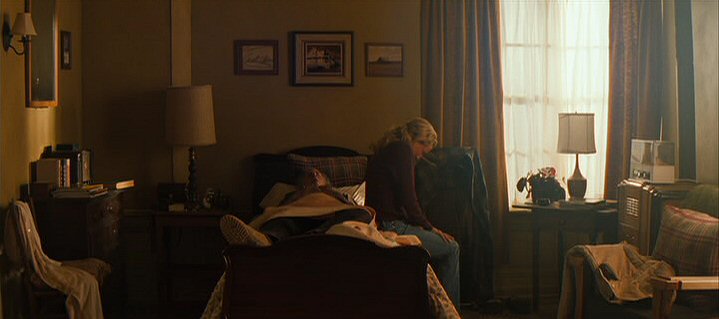
Since I mostly used available light for day interiors, plus a little HMI bounce or Kinos to wrap it, it was tricky exposing when I wanted to hold some detail outside the windows, so I really was using the full dynamic range of the stock. Other scenes, I didn't mind if the windows blew-out, or conversely, the foreground went silhouette.
 
Hi David,

I greatly enjoyed the cinematography in Assassination of a High School President and appreciate your contributions to this forum, the ASC manual, and the ASC documentary.

I'm curious how often you use a lighting meter in your work flow. Do you use one when working on video, or just rely on various on location scopes?

Also I'm curious on how you would define a full stop. I'm currently reading various cinematography books, but have yet to find a definition that defines what a stop is in a more practical term.

For example, are these all of the various full f/stops? f/1, f/1.4, f/2, f/2.8, f/4, f/5.6, f/8, f/11, f/16, f/22, f/32, f/45, f/64, f/90, f/128, etc. How can I figure out a half step versus a full step?

Thank you for any help or guidance.

http://stevenswigart.com
 
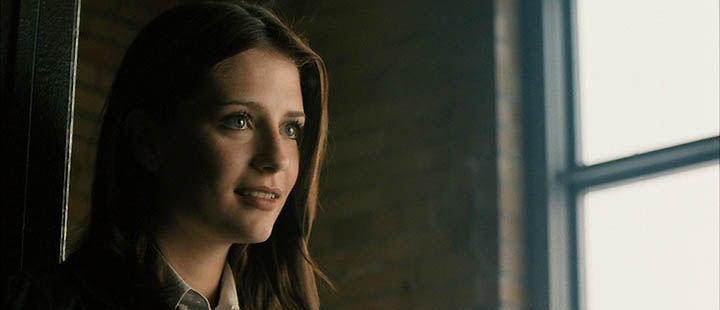
David, I really like this closeup
assassination12.jpg


Could you remember how you did it? In addition to lighting setup, any filtration on lens? What focal length was it? Mischa looks really great in that shot and she hasn't looked that great as of late, so it's saying something.
 
Steven, there's a great article on f-stops here. It's worth the read for any serious photographer. To your question, it has charts of full stops, half stops, and third stops. But it also explains how the numbers work, the difference between f-stops and t-stops, and a bunch of other good stuff.

Hi David,

I greatly enjoyed the cinematography in Assassination of a High School President and appreciate your contributions to this forum, the ASC manual, and the ASC documentary.

I'm curious how often you use a lighting meter in your work flow. Do you use one when working on video, or just rely on various on location scopes?

Also I'm curious on how you would define a full stop. I'm currently reading various cinematography books, but have yet to find a definition that defines what a stop is in a more practical term.

For example, are these all of the various full f/stops? f/1, f/1.4, f/2, f/2.8, f/4, f/5.6, f/8, f/11, f/16, f/22, f/32, f/45, f/64, f/90, f/128, etc. How can I figure out a half step versus a full step?

Thank you for any help or guidance.

http://stevenswigart.com
 
David, I really like this closeup
assassination12.jpg


Could you remember how you did it? In addition to lighting setup, any filtration on lens? What focal length was it? Mischa looks really great in that shot and she hasn't looked that great as of late, so it's saying something.


It was very simple -- the wide shot just used the window light, on the close-up, I added a 4' 4-bank Kino next to the window (in the corner of the stairwell), with a 4'x4' frame of 216 in front of it, to wrap the window light around her face. I believe it was Fuji 250D, and the filter was a #1 Smoque, because I couldn't smoke a four story stairwell, unlike the classrooms.

Focal-length-wise, it was a tight space, with the camera down a step or two and backed against a wall, so it may have only been a 40mm Zeiss Ultra Prime.
 
Last edited:
Steven, there's a great article on f-stops here. It's worth the read for any serious photographer. To your question, it has charts of full stops, half stops, and third stops. But it also explains how the numbers work, the difference between f-stops and t-stops, and a bunch of other good stuff.

The wiki page explains it, but the main thing to remember is that, unfortunately, you just have to memorize the standard progression of full stops. One mental trick is that if you double the f-number (ignoring that it is actually a fraction) you get the value two-stops down the list, more or less, hence:

1, 1.4, 2, 2.8, 4, 5.6, 8, 11, 16, 22, 32, 45

Not a hard list to memorize.

I try to not be a slave to metering, lighting by eye mostly. I check the key with my meter to make sure I'm in the ballpark, stop-wise, of where I want to be, and then balance by eye, and then check to see how it looks on a monitor (when shooting digitally.) Only then, I may check a waveform or something when I'm concerned about how hot something is getting, etc.
 
It was very simple -- the wide shot just used the window light, on the close-up, I added a 4' 4-bank Kino next to the window, with a 4'x4' frame of 216 in front of it, to wrap the window light around her face. I believe it was Fuji 250D, and the filter was a #1 Smoque, because I couldn't smoke a four story stairwell, unlike the classrooms.

David.

did you use anything for negative fill ? Her fill side falls off nicely.

Michael
 
David, thanks! I dont understand your statement "...the filter was a #1 Smoque, because I couldn't smoke a four story stairwell, unlike the classrooms."

How does the filter being a #1 Smoque have anything to do with the stairwell? Is that fake brick you're disguising?

This is the first time I recall you mentioning use of a Smoque filter. Do you use it much?
 
Most of the movie was smoked, at least day interiors were, to soften the colors, contrast, etc. and give the movie a patina that was the opposite of the high-key colorful look of many high school movies. But it was hard to smoke very large spaces that couldn't be sealed up from drafts. So for those scenes, I tried the Tiffen Smoque filter.

I started using the filter around the time of "Astronaut Farmer", another smoked-up movie -- the actors started complaining about breathing smoke for so many weeks. I had actually gotten the Smoque filter to solve another problem, which is that when you smoke a room, the smoke is dimensional, so when you shoot close to something, like a tabletop insert, the smoke seems to disappear and the shot looks too sharp because you aren't looking through much smoke and it's hard to backlight it. So before, I usually used a light ProMist for inserts to keep some of the hazy softness of the smoked wide shots. But the Smoque filter, which uses similar mist particles to an UltraCon, Double Fog, etc., looks a lot more like haze in a room.

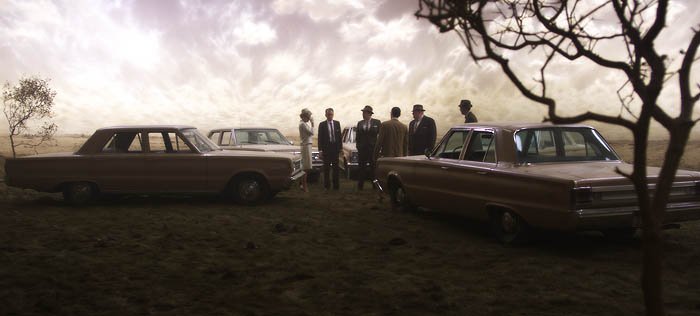
I used a Smoque filter, rather than smoke, for this shot in "Astronaut Farmer":

af10.jpg


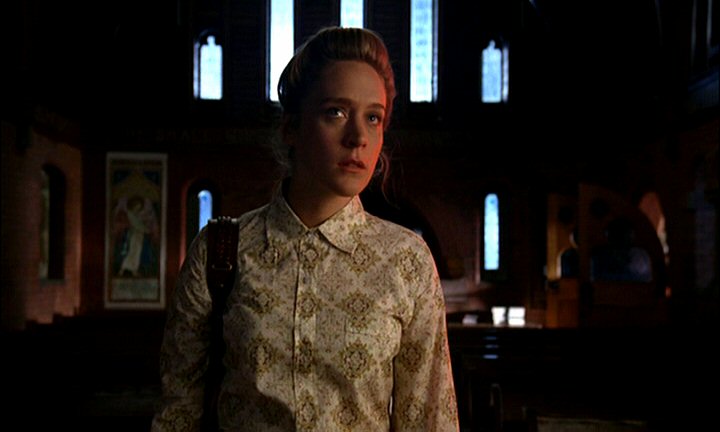
And this church interior in "Big Love" (though hard to tell):

biglove28.jpg


I used it for wide shots on stage in "Manure" though I started adding real smoke to the mix after awhile. At first, I avoided smoking that giant stage because I was worried that every light in the ceiling would create a beam in the air, plus it would be hard to clear the smoke if necessary. But it looked better to add a little bit of real smoke because it blurred the far backdrop, so I used real smoke too. But I think in this wide shot, you're mostly seeing the effect of the Smoque filter (plus overexposing the backdrop):

700manure148.jpg


The biggest problem with the Smoque filter is that it reacts to light sources in the frame, causing them to bloom as if the room was hazed. But if the camera pans off the light source, or an actor momentary blocks it as they cross the frame, the effect momentarily disappears. In that shot from "Astronaut Farmer", she gets up at the end and walks up to the lens and closes a door in front of the lens, which blocks the windows and the smoke effect disappears as she is shutting the door (but the shot ends right then, plus the door was flat and white so you don't miss the loss of the haze). In another stairwell scene in "Assassination of a High School President", two people are walking and talking as they walk down the stairs, and the hazy flare from the window, due to the Smoque filter, disappears as they momentarily block the windows as they cross the frame. So the Tiffen Smoque filter a useful tool to carry on a movie using smoke a lot, but it's not a complete replacement for real smoke.
 
Last edited:
Hi, David.

I have a question in regards to height differences between the talents. On several occasions when either because of the natural height difference or the makeup of the terrain itself, I've had a distracting contrast in height. On two occasions I've actually asked one of the talents to splay their legs to an extreme degree in order to get a natural-looking OTS of the other talent. I was wondering how you normally deal with such issues and how to work with the director on the matter to avoid making it too unnatural an environment for the talent to work under.

I hear for some situations where it would be too distracting a height difference there's generally just a lot of avoidance of wide angles of the two talents in the same frame, but how are conversations normally handled? Does the director usually take care in staging the actors or is it just up to the DP to work some magic?

Thank you so much for this thread, by the way. I find it one of my most favorite stops out of all my daily rounds on the internet forums. You have an amazing talent explaining things behind the keyboard =)
 
There are movies where they want to consistently make an actor taller or shorter than they really are -- such as making Meryl Streep look as tall as Julia Child actually was in "Julie and Julia". And then there is the run-of-the-mill problem of actor height difference.

Having shot two seasons of "United States of Tara" I ran into this all the time, because John Corbett is quite tall, 6' 5" I believe, and Toni Collette is closer to my height, around 5' 8" I think. And playing a married couple, you always end up in a scene where they hug or kiss, etc. Lighting was the bigger problem, when Toni was standing a foot from John in an intimate dialogue scene, her head was at his chest and it was like trying to light someone whose face was a foot from a dark wall.

We generally didn't cheat the height issue although John, who runs into this problem all the time, would occasionally spread his legs or take off his shoes to lower himself an inch or so. We also tried to stage a scene where he sits down on some steps or plays downhill on staircases or outside when possible. You don't really shoot overs because the height difference makes one direction a low-angle and the other one a very high angle, so we raked his side more often than not to shoot Toni's direction.

Now and then, we'd do the apple box trick but you have to make sure you have enough of a spread of boxes so that the actor can step into the shot and out again without stepping down, and then the taller actor doesn't have to cross over the boxes either.

This also affects lighting -- when John was in a scene, I couldn't bounce a light off of the ceiling or turn on the spacelights behind the muslin ceiling pieces because you always ended up seeing the ceiling behind John's head.

So you pretty much have already listed the basic tricks, you either raise one actor or lower the other, or you live with the extreme difference in height.

I think the person who has the worse is the boom man because a tall actor's head is closest to the ceiling, so not only does the mic have limited room to get out of the shot, but it's also much farther from the shorter actor in the same shot.

Sometimes I'm reminded of the old TV show "Police Squad!" with the character who was so tall that you only saw them from the neck down.

In terms of staging, most directors see the height problems right away on the monitor or through a lens finder, and if not, you can point it out to them. I also try to get stand-ins with matching heights so we see the problems when setting up the lights and camera. I find the best thing is to get the taller actor to sit or lean or do something that naturally lowers them. Unless the extreme height difference serves a dramatic purpose.
 
Last edited:
Hi Mr. Mullen,

I really enjoy your erudite visuals! In a shot such as this, maybe after reviewing dailies or watching the DI in progress, would you ever suggest to add a smoke/haze effect in post just to keep the continuity of the look?

And this church interior in "Big Love" (though hard to tell):
biglove28.jpg


...So the Tiffen Smoque filter a useful tool to carry on a movie using smoke a lot, but it's not a complete replacement for real smoke.
 
Back
Top