Stefan Christou
Well-known member
- Joined
- Jun 23, 2008
- Messages
- 514
- Reaction score
- 0
- Points
- 0
Is there a set list of filters you will always have at hand? What is each used for? (Sorry if this is a bit long and tedious to list.)

Follow along with the video below to see how to install our site as a web app on your home screen.

Note: this_feature_currently_requires_accessing_site_using_safari

Is there a set list of filters you will always have at hand? What is each used for? (Sorry if this is a bit long and tedious to list.)
Hi Mr. Mullen,
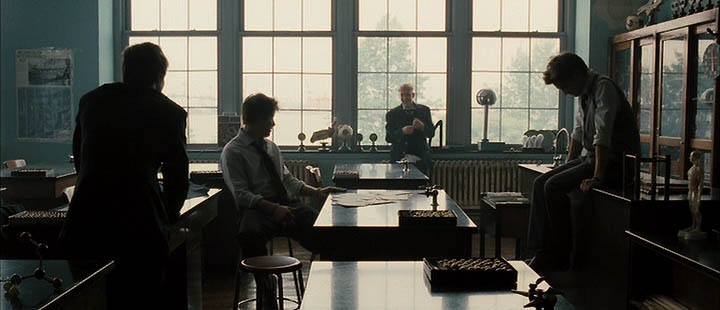
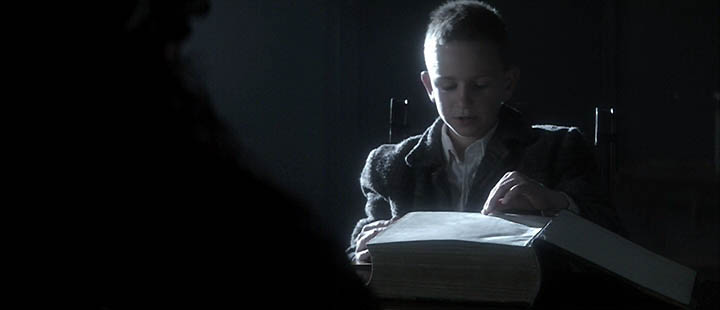
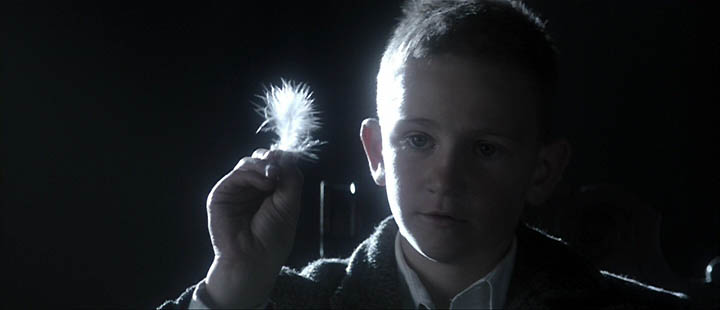
I really enjoy your erudite visuals! In a shot such as this, maybe after reviewing dailies or watching the DI in progress, would you ever suggest to add a smoke/haze effect in post just to keep the continuity of the look?

Daivd, how do you feel about the use of telephoto diopters and wide-angle converters? Are they difficult to match to prime lenses? What are the real barriers to using them? Would you say that they can be used to replace the wider and longer ends of the focal length range, or just used as a narrow supplement?
And given all that, who, in your opinion, makes the best ones?
Thanks.


Well, in this imaginary ideal world, I'd probably use a mix of in-camera and post techniques to create the diffused look, like "Lord of the Rings" did. It's not so much a gross issue of quality so much as a difference in look and the question of time and effort, on set and in post. If it's easier to do it on the set and it looks good, then you've saved yourself some time in the final color-correction to concentrate on other, more important things. Unless this ideal world also includes an unlimited budget for post so you can take as much time as you want.
But honestly, if all you want is a lampshade to halate a little in a shot and it's easy to do it in-camera, then I don't see why someone would save it for post unless they're the type of filmmaker who can't commit to a creative impulse and wants the opportunity to endlessly change their minds. I tend to believe that one grows as an artist by making bold choices and living with the consequences, good or bad, and learning from the experience and then moving on. So it's partly a philosophical issue, I like the creative process of making movies during the photography phase -- that's why I became a cinematographer! If I believed one should save every important creative decision that affected the image until post... I would have gone into post.
Not to say that post isn't creative, because it is -- it's just that I subscribe to Kurosawa's notion that shooting and post, or picture, editing, and music in his words, is a multiplicative process, not an additive one. You build on the previous stage to create something stronger than merely the sum of the parts. He also said that if directing could be simplified into a few rules, it would be that you put the best elements you could in front of the camera, you shot it in the best manner you could, and then you edited it the best way you could, etc. So production is not merely fodder for the post phase -every step has to be done as well as possible. Hence why I believe you have to go "all out" and shoot the movie in the best manner possible, figuring that post can only make it better -- rather than see production as merely gathering raw material to then create the art in post.
But coming down from my high horse, obviously imagemaking and cinematography involves an understanding of the entire chain of events and techniques leading to the final presentation, and you have to know what is better or more efficient to do in post versus doing it in camera, so you use your time and budget efficiently.
Practically speaking, I've mentioned this before, but I'm of the "half-and-half" or "50-50" philosophy, that you get some of the look baked into the original and then you finish it off in post, rather than create it wholesale in post. From merely a technical standpoint, this often looks better anyway because you aren't pushing an image signal around to extreme levels trying to create a look from footage that isn't close to being correct, you are instead putting the final touches, the final polish, onto the work. Garbage-in, garbage-out still applies to digital photography and post. The best images in a movie, that go through the D.I. process the best, often were the best images going into the process, and the worst shots often still are the worst shots at the end of the process.
But as for whether a Classic Soft or a ProMist diffusion effect looks better done in-camera or in post, it just depends on your taste -- to my eyes, I can generally tell when a filter effect on the large screen (not so much on TV) is done optically or through image processing. And philosophically, I feel that diffusion should feel like an optical phenomenon or artifact in most cases -- however, I also admit there are exceptions, when the diffusion effect is more of an added visual texture, like printing a photograph on parchment paper would be a texture and not an optical artifact. So it partly depends on the visual style and intent of the project.
As I also said, one problem with a lot of post digital diffusion tricks is that they have the side effect of defocusing noise and grain because most processes are based, like optical diffusion, on the notion of superimposing an out-of-focus layer over a sharp layer (except that when it's done with an optical filter, it doesn't soften the grain). Sometimes that's a good thing, when you want a cleaner image, but other times, it can make the image look too plasticy and sterile, too clean, especially if it's a film-shot project and you're intercutting shots that aren't processed with ones that are, so the grain level keeps jumping.
I'd probably shoot "4K HD" mode, aka "Quad HD", which is actually 3.8K (1920 x 1080 doubled in all directions, so 3840 x 2160). Apparently this downconverts to 1920 x 1080 HD a little better because it's a simpler whole integer process. I haven't tested it myself yet, that's just what I've heard here.