Welcome to our community

Be a part of something great, join today!

  • Hey all, just changed over the backend after 15 years I figured time to give it a bit of an update, its probably gonna be a bit weird for most of you and i am sure there is a few bugs to work out but it should kinda work the same as before... hopefully :)

Ask David Mullen ANYTHING

Multiple hard lights produce multiple shadows, unless clustered very close together and very far away from the subject (like a Maxibrute on a condor), so generally you can't use three small lights to create the effect of a single point source from a bright light, not if you want a single sharp shadow.

However, you can put multiple lights through a diffusion frame or into a bounce to blend them into a single soft source.

I've also used multiple spotted lights shining through a window in a smoked room to create the effect of the sun being broken up into multiple shafts, as if shining through a tree (I recently did it with three Source-4 lamps with 19 degree lenses). The rays all have to be parallel though for that to look like a single light. Same goes for a scene in a forest, you can use multiple hard lights all in the same direction, spaced apart, to suggest a single sun coming through gaps in trees.

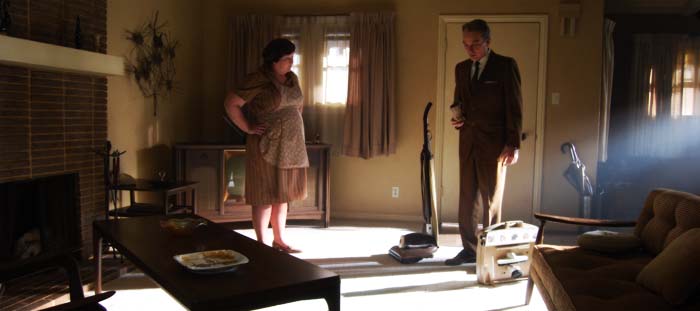
For example, I used two HMI Source-4 ("800w Jo-Lekos") lamps for a scene in "Manure" to create this shaft of light, just off-camera inside the room, not through the window. But since the Source-4 produces a very sharp light that you can cut to shapes with internal iris blades, I could keep the beams from overlapping on the floor and creating two shadows, instead they created two spots with a small gap between them. Now you get two shafts, but since the rays are parallel, it looks a bit like a single beam being broken up by passing through something like the frames of a window or something. It's hard to do this with any other type of light however because a normal light has a lot of spread, unless you use snoots or something, which is why I like Source-4's.
manure32.jpg


Now enough point sources, close together, at a distance, starts to look like a single soft source -- Kubrick lit the Africa sets in "2001" for an early dawn look by using hundreds of photoflood bulbs in the ceiling of the soundstage. It worked so well that apparently he was consulted by Ken Adams as to how to light the huge submarine hanger set in "The Spy Who Loved Me" and Kubrick suggested the lightbulb trick again. And when Roger Deakins had to light a big empty stage for a fantasy bowling dream sequence in "The Big Lebowski" he used hundreds of PAR lamps in a grid pattern in the ceiling. When a subject is lit by enough point sources from multiple directions, all the tiny shadows sort of blend into a fuzzy soft one.

But there really isn't a substitute when you want the effect of a big single point source creating a big single shadow.

David, I was curious as to what, if any, the benefits of using a larger light in lieu of several smaller lights aimed at the same space? Are multiple shadows unavoidable? Or if say 3-4 1.2ks are pointed at the same object, either bare or through diffusion, would it be distinguishable from a single 4k pointed at the same object?

Im looking to invest in a stronger light than what I have, and I'm wondering if it wouldnt be smarter to instead buy several joker 800's or arri 1.2ks. That way they could be either used as one source or split up into individual sources. Possible? Pros and cons?


Thanks Mr. Mullen - Hope you will have time to answer!
 
Last edited:
A movie I shot two years ago in New Jersey called "Assassination of a High School President" just got released this week on DVD. I was fairly happy with what I was able to do with a high school setting on this one, but the company that made it went out-of-business during the period between the post and the theatrical release, so the movie was in legal limbo until now. I guess it got sold off to Sony Home Video.

Shot in 3-perf Super-35 on Fuji stocks. When I get some time, I'll post some still frames from the DVD. There's a review here:
http://screenrant.com/assassination-high-school-president-dvd-review-kofi-29547/
 
Yes, I just noticed that it's available on Netflix yesterday night.
Great, I'll be check it out!

A movie I shot two years ago in New Jersey called "Assassination of a High School President" just got released this week on DVD. I was fairly happy with what I was able to do with a high school setting on this one, but the company that made it went out-of-business during the period between the post and the theatrical release, so the movie was in legal limbo until now. I guess it got sold off to Sony Home Video.

Shot in 3-perf Super-35 on Fuji stocks. When I get some time, I'll post some still frames from the DVD. There's a review here:
http://screenrant.com/assassination-high-school-president-dvd-review-kofi-29547/
 
For example, I used two HMI Source-4 ("800w Jo-Lekos") lamps for a scene in "Manure" to create this shaft of light, just off-camera inside the room, not through the window. But since the Source-4 produces a very sharp light that you can cut to shapes with internal iris blades, I could keep the beams from overlapping on the floor and creating two shadows, instead they created two spots with a small gap between them. Now you get two shafts, but since the rays are parallel, it looks a bit like a single beam being broken up by passing through something like the frames of a window or something. It's hard to do this with any other type of light however because a normal light has a lot of spread, unless you use snoots or something, which is why I like Source-4's.

manure32.jpg


David,
I love the use of the leko in the room to create the shaft. The overall ambience in that room feels so natural. How much of it was environmental bounce off the floor, and how much was created from off an off camera source. Beautiful cinematography. Thank you so much for all the wonderful answers and insights...

Robb Fischer
Midwest DP
 
The joke of the scene was that a vacuum cleaner salesman throws manure onto a white carpet to show off the power of his vacuum cleaner, only to have the vacuum cleaner not work. So I thought it would be funny to make the carpet look really white by overexposing it with sunlight, so it was glowing. So most of the room is lit by the bounce of the HMI Source-4's off of the white carpet.
 
Reminds me of this classic joke:

A little old lady answered a knock on the door one day, only to be confronted by a well-dressed young man carrying a vacuum cleaner.

Good morning, " said the young man. "If I could take a couple of minutes of your time, I would like to demonstrate the very latest in high-powered vacuum cleaners. "

"Go away!" said the old lady. "I haven't got any money!" and she proceeded to close the door.

Quick as a flash, the young man wedged his foot in the door and pushed wide open. "Don't be too hasty!" he said. "Not until you have at least seen my demonstration." And with that, he emptied a bucket of horse manure onto her hallway carpet.

"If this vacuum cleaner does not remove all traces of this horse manure from your carpet, Madam, I will personally eat the remainder."

The old lady stepped back and said, "Well I hope you've got a darn good appetite, because they cut off my electricity this morning."
 
Hi David, I have a diffusion question.

I am a 7D shooter, on a budget as I need to stay on track for scarlet. Schneider classic soft filters are out of my price range. There is a series from Tiffen called Digital Diffusion Filters that seem very affordable (eg 82mm 1/4 white is only $60, link) and but I have concerns over their quality.

I did a search on reduser and did not find any reviews, but I did see a post from you that I think referenced them briefly (link). What is your opinion on these filters? Their price almost makes me want to avoid them because they are so cheap and I can almost afford Tiffen Soft FX but I am reluctant to go that way because of cost.
 
I believe Tiffen Digital Diffusion-FX filters are just their Black Diffusion-FX filters with the pattern of black dots removed so that they don't come into focus on cameras with 2/3" and smaller sensors.

Digital Diffusion-FX works fine as a diffusion filter in terms of softening the image. Probably closest in effect to the Schneider HD Classic Soft.

Regular Schneider Classic Softs have larger "lenslet" bubble patterns that can come into focus on cameras with a lot of depth of field, but these larger circular indents create a more obvious halation around a bright light, almost like a double edge on a hot edge, or an out-of-focus ring or circular blob of light on longer focal lengths.

The smaller lenslets of Tiffen Diffusion-FX (Black, Digital, Gold, whatever) and the Schneider HD Classic Soft (and Hollywood Black Magic) don't create that effect.

So basically the Digital Diffusion-FX will just soften details without much flaring, halation, etc. That's good for when you just want to soften a face without looking like you stuck a filter on a camera because the other shots are unfiltered -- what I call "invisible diffusion" (as long as you don't go super heavy). But some people use diffusion filters for more optical artifacts like halation around points of light -- what I call "visible diffusion". So it just depends on the reason you are using the filter, which type is better than another.
 
Last edited:
Hi David...
I was wondering if you have any experience or Ideas how to light a cinema. I have to shoot one on Saturday and the amount of available light isn't enogh at all. It's not possible to change the fixtures. The ceiling is painted red, which makes it impossible to bounce. The only thing I can think of at the moment is to bounce some Pas against the white screen and using dimmers to create flickers. But then I would have to avoid showing the screen or try to matt paint a picture in later. What would you do?
 
Generally the light in real life that bounces off of a screen is very weak, so the exposure for the angle on the audience is very different than the exposure for the reverse angle on the screen if you want the screen image to be exposed properly, in which case in real life the foreground would go silhouette.

So it's not unrealistic for the angle on the audience for you to just bounce a lot of lights into the white screen, some fading up and down on dimmers, some flashing on and off, or waving flags in front of them randomly, etc. That's probably the easiest angle to light and shoot unless the actors are in the back row, in which case you may need to bring a bounce closer to them.

The hardest thing to light is when the room goes from overhead lighting on to the movie starting up, requiring a cue, plus creating room lighting if the real thing is too dim. Also, it's tricky because when the cue happens and you go to the room being lit by the screen bounce, it has to feel much darker than before but soon you want to expose more normally as if your eyes have gotten used to the dimmer levels. It's a little like when a room goes from being lit by practical lamps and then they go off and you still have a long scene of them in moonlight.

The other hard thing is an angle towards the screen with the audience in the foreground but you want them softly backlit, not silhouette. That requires somehow getting light up there, with bounces or lighting fixtures rigged up. Perhaps you can get some tall ladders and drape a white banner across the ceiling near the front row and then bounce into that, flagging it off of the screen so you don't wash out the projected image. Or maybe just shoot that angle with only a few heads in the foreground that are easier to backlight from off-camera. If you don't see end to end on the room, you can sometimes build a goalpost rig with two combo stands and speedrail.
 
...good for when you just want to soften a face without looking like you stuck a filter on a camera because the other shots are unfiltered -- what I call "invisible diffusion"

exacltly what I am looking for ... thank you very much David.
 
Assassination...

Assassination...

Hi David. I just finished watching Assassination of a High School President.
People who read your postings here acknowledge your prodigious knowledge and experience, but seeing your work reveals your excellent craftmanship and artistry.

I have three questions about your lighting, and hope you don't mind answering them.

The light fixtures in the Catholic school add a lovely touch, so much better than fluoros (which are seen in the public school that Funke visits). It looks like there were tungsten bulbs in the fixtures, mixed often with hot daylight balanced sources. Often the timing of the coloration is weighed one way or another, depending on the scene. Was it a matter of expedience to use tungsten bulbs, or did you want that contrast between interior warmth and exterior blue? I assume you could have put blue photoflood ph bulbs in those fixtures, but I know how their short life span and dimmer illumination can be a hassle.

My second question has to do with your classroom scenes. For the wider shots, you have your exterior daylight sources, and I'm not sure whether you had enough space for floor level fill units in the wides. Did you use any top rigged fill in the classrooms, and were they kinos?

My third question has more to do with grippage. It looks like your grips put some diffusion material over almost all the windowed daylight scenes. Can you tell me what the diffusive material was? Tracing paper?

Again, really solid work especially considering the budget. My favorite character was the Spanish teacher - really wacky and yet kind of spot on as an eccentric private school teacher. I look forward to catching Jennifer's Body sometime, to compare how you use those school spaces, and more...
 
Last edited:
We swapped the bulbs in the hanging fixtures with 100w globes that were blue-dipped, but they still read as warmish since they ended up more around 4800K, compared to the skylight coming through the windows, which was over 6000K. In a few shots, we still had the 3200K bulbs in the fixtures since we could only afford to switch one hallway at a time, and sometimes when running around the school, we left the fixtures with the original bulbs.

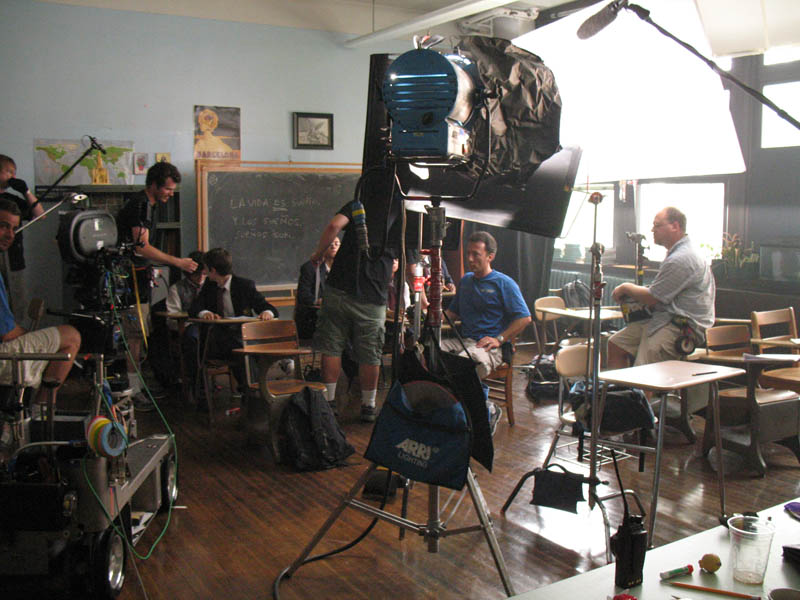
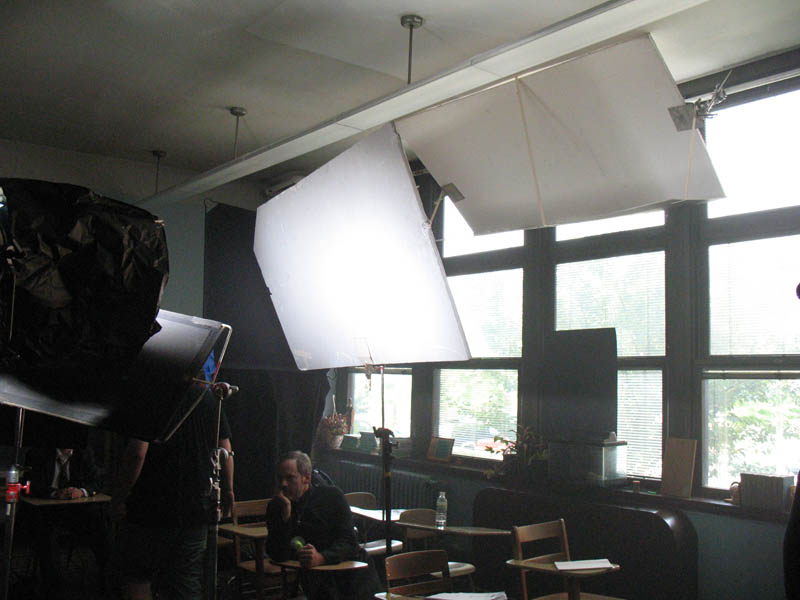
I tried to keep a natural look by using as much available light, mixed with just a little bounced light to augment the exposure. I usually had the grips put white foamcore above the windows so I could bounce an HMI Source-4 or a 1200w HMI PAR (or brighter) into the white card and get a soft backlight from the same direction as the windows. A few other times, I just used available light. You can see some of the lighting approach here in these photos. You can see the row of smaller white cards rigged above the windows for the wide shots, blocked by the larger cards in the foreground -- for closer shots, we moved in with larger white boards and brought the bounce closer:

assassination1.jpg


assassination2.jpg


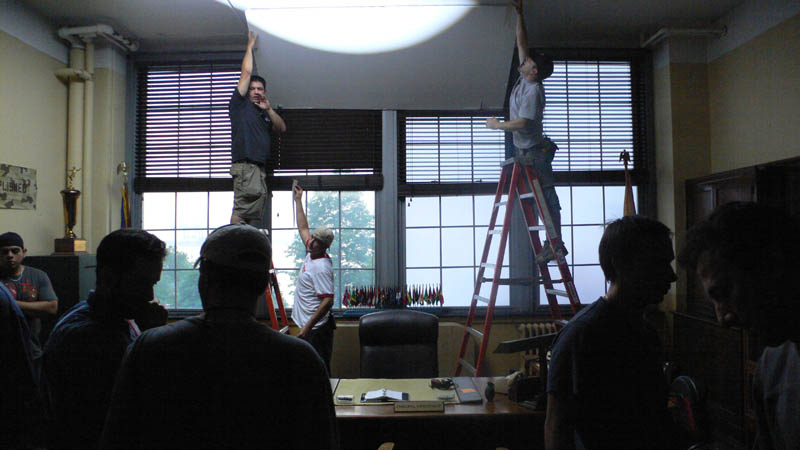
You can see here the effect of the HMI Joker800 Source-4 hitting the white card, we hadn't finished tilting the spot down into the card and cutting it to match the shape of the card. I could only find two HMI Joker800 Source-4's out there in New Jersey for the shoot, I normally carry at least four -- they are much better for hitting far bounce cards than PAR's or fresnels because the beam can be so precise (you can see all the flagging I had to do for the regular HMI's hitting the bounce cards in the first photos -- Source-4's don't need all that). More places rent the Joker400 version, but I perfer the brighter Joker800 Source-4:

assassination3.jpg


We smoked all the rooms, or when we couldn't, we used a Tiffen Smoque filter -- that and the hot windows from using mostly available light is what made them blow-out. But in the last photo above, we were losing the light and I still had a couple more scenes in the principal's office, so besides the soft backlight from the bounce, I had to use 1000H paper on the windows, blow them out with some HMI's, and then close the blinds partly over them and shoot night-for-day. You can see that the right side windows are covered with 1000H paper, the left side hasn't been finished yet, and we hadn't hit the windows yet with the HMI's outside.

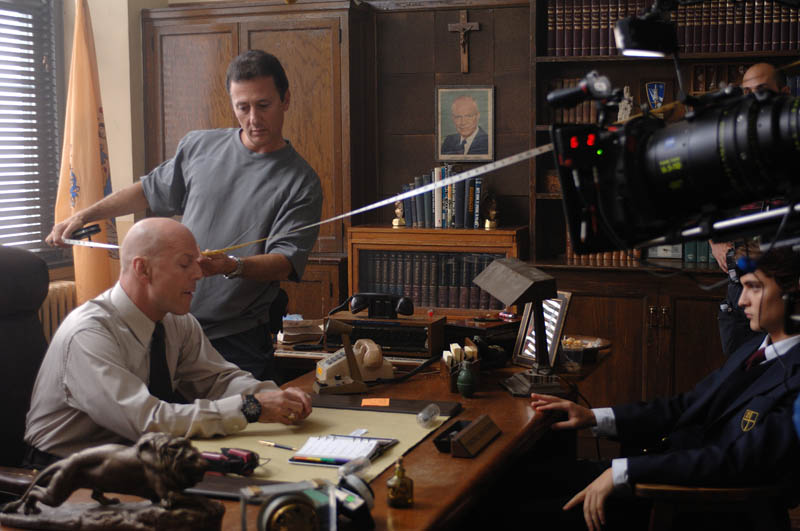
You can see us shooting that scene at night (for day) in the office here:
assassination4.jpg
 
Last edited:
We swapped the bulbs in the hanging fixtures with 100w globes that were blue-dipped, but they still read as warmish since they ended up more around 4800K, compared to the skylight coming through the windows, which was over 6000K. In a few shots, we still had the 3200K bulbs in the fixtures since we could only afford to switch one hallway at a time, and sometimes when running around the school, we left the fixtures with the original bulbs.

I tried to keep a natural look by using as much available light, mixed with just a little bounced light to augment the exposure. I usually had the grips put white foamcore above the windows so I could bounce an HMI Source-4 or a 1200w HMI PAR (or brighter) into the white card and get a soft backlight from the same direction as the windows. A few other times, I just used available light. You can see some of the lighting approach here in these photos. You can see the row of smaller white cards rigged above the windows for the wide shots, blocked by the larger cards in the foreground -- for closer shots, we moved in with larger white boards and brought the bounce closer:

assassination1.jpg


assassination2.jpg


You can see here the effect of the HMI Joker800 Source-4 hitting the white card, we hadn't finished tilting the spot down into the card and cutting it to match the shape of the card. I could only find two HMI Joker800 Source-4's out there in New Jersey for the shoot, I normally carry at least four -- they are much better for hitting far bounce cards than PAR's or fresnels because the beam can be so precise (you can see all the flagging I had to do for the regular HMI's hitting the bounce cards in the first photos -- Source-4's don't need all that). More places rent the Joker400 version, but I perfer the brighter Joker800 Source-4:

assassination3.jpg


We smoked all the rooms, or when we couldn't, we used a Tiffen Smoque filter -- that and the hot windows from using mostly available light is what made them blow-out. But in the last photo above, we were losing the light and I still had a couple more scenes in the principal's office, so besides the soft backlight from the bounce, I had to use 1000H paper on the windows, blow them out with some HMI's, and then close the blinds partly over them and shoot night-for-day. You can see that the right side windows are covered with 1000H paper, the left side hasn't been finished yet, and we hadn't hit the windows yet with the HMI's outside.

You can see us shooting that scene at night (for day) in the office here:
assassination4.jpg

These kinds of posts are sooo valuable to me - I just spent all day wrangling flags and black foil. but never again. Joker-source 4 here I come. Thanks for continually providing such an amazing wealth of information, David.
 
OK, I'll send my copy back... eventually :frown:
Thanks David, for your response and great pics! Man, you made those Fuji stocks look amazing.

 
David,

I was wondering what you think of shooting night for day? Any thoughts or tips would be greatly appreciated.

The couple of times that I have done it, I have actually enjoyed it as it felt almost like working in a studio as I could put light where ever I wanted it and I could really determine the overall ambience as I was not being overpowered by the sun.
 
Back
Top