Welcome to our community

Be a part of something great, join today!

  • Hey all, just changed over the backend after 15 years I figured time to give it a bit of an update, its probably gonna be a bit weird for most of you and i am sure there is a few bugs to work out but it should kinda work the same as before... hopefully :)

Ask David Mullen ANYTHING

Note on Jennifer's Body.

Note on Jennifer's Body.

The print that I saw at a relatively modern multi-plex seemed very low resolution. I have seen this in theatrical presentations of S16 material but I assume Jennifer's Body was originated on 35 due to the profile of Megan Fox.

Just curious what the DI path was, if they opted for lower cost print stock or anything else you are aware of that might have caused it to look so low rez.

Cheers - #19
 
It went through a 2K D.I. at EFILM -- I saw one of the release prints projected at the The Bridge at the Howard Hughes Parkway and it looked normal. Maybe your presentation was out-of-focus. Or maybe a bad print slipped out, I don't know. I believe the release prints were by Deluxe Labs.

It was shot in Super-35 3-perf, 1.85, mostly on Panavision Primo prime lenses, no diffusion, Kodak 5217 and the new 5219 stock so it should have looked OK considering it was 1.85 projection.
 
David,

I was wondering what you think of shooting night for day? Any thoughts or tips would be greatly appreciated.

The couple of times that I have done it, I have actually enjoyed it as it felt almost like working in a studio as I could put light where ever I wanted it and I could really determine the overall ambience as I was not being overpowered by the sun.

It would be cool to do day-for-night for large landscapes with no other logical light sources than moonlight if I could get some visual efx post work done to add things like stars into the sky, etc. I've been in the desert at night during a full moon and it feels like a day-for-night shot in a movie other than the sky is black.
 
It went through a 2K D.I. at EFILM -- I saw one of the release prints projected at the The Bridge at the Howard Hughes Parkway and it looked normal. Maybe your presentation was out-of-focus. Or maybe a bad print slipped out, I don't know. I believe the release prints were by Deluxe Labs.

It was shot in Super-35 3-perf, 1.85, mostly on Panavision Primo prime lenses, no diffusion, Kodak 5217 and the new 5219 stock so it should have looked OK considering it was 1.85 projection.

If I get a chance I'll screen it again at a different venue. I find the variation between theatres appalling, particularly considering the ticket prices are routinely over $10 here in SoCal.

Usually 5219 looks stunning, its my favorite Kodak stock. Primo primes are the holy grail, so I doubt they hurt resolution.

It is my belief that cheaper print stocks, too many passes on the IN, and other cost cutting measures are all too often the point at which otherwise clean images get abused. It wouldn't surprise me if a Megan Fox vehicle aimed at a back to school release window was targeted for a wide release and expected to last a relatively short time in theatrical - plenty of motivation to cut per print costs.

Cheers - #19
 
David what kind of lights do you use when you want to project a shadow pattern in the whole room, like venetian blinds shadows? Should I go for a HMI PAR or a Fresnel?

How would I go about that? Since the further away I place my venetian blinds the sharper will be the shadows (I want them sharp enough) and I'm on a apartment, don't have the budget for cranes hehe, I'm thinking putting a big ass mirror next to the room window (which is in the end of the balcony) to bounce the light from the HMI at the beginning of the balcony.

I can't recall you talking about shadow patterns or posting examples of this here. Thanks a lot in advance.
 
A mirror will help a little, but it also complicates things -- the real solution is to change location so you can put a light farther from the window for starters. Then you can figure out which light gives you a sharper pattern. My general trick on a stage is to remove the fresnel lens from a fresnel lamp, like a 5K or 10K. You lose some brightness too doing that, but for a sharp moonlight pattern, that's OK (depending on how dim the moonlight pattern can be, even a tweenie or 1K with the fresnel removed may be bright enough, depending on how heavy a blue gel you plan on using).

For a sharp sunlight pattern, you have to expose more and sometimes that means using a fast lens or film stock -- which is fine on stage, but on location during the day, the balance between the fresnel-less 10K and the natural light won't be correct. The solution in old movies was to use a carbon arc light for that effect.

It's a real problem, getting really sharp sunlight shadow patterns that are bright enough -- I've been tempted to find some DC power and drag out an old-fashioned carbon arc light at times. I sometimes take the fresnel out of a 20K tungsten on stage, but the bulb is so large that it's not as sharp as a 10K or 5K globe. Like I said, for moonlight, which is much dimmer, it's a lot easier.

In really small spaces, one solution I've done in a pinch is to use a 750 Source-4 (like a 1K Leko) with a theatrical gobo pattern slide inside of it to project a sharp pattern of a window frame or tree branches, etc. The only problem with that trick is that if you look closely at the edge to the pattern, there is some chromatic aberration, an orange or blue fringe to the edge.

PAR's aren't so good for creating shadow patterns unless they are far away.

Also, if the light creating the sharp pattern is too close to the window blinds, even if the pattern is sharp (like from taking the fresnel lens out of a fresnel lamp) the rays are not parallel enough, the shadow lines sort of spread outward -- another reason you need a brighter light farther away.

The other trick is that for close-ups, back the light far away but take the venetian blinds off of the window and hang them off of a c-stand closer to the actor.
 
It would be cool to do day-for-night for large landscapes with no other logical light sources than moonlight if I could get some visual efx post work done to add things like stars into the sky, etc. I've been in the desert at night during a full moon and it feels like a day-for-night shot in a movie other than the sky is black.

David,
I think Ryan was asking about the other way around, night for day, where you're faking sunlight through the windows when in total darkness outdoors.
 
Well, I seem to be doing that everyday when working on soundstages for "United States of Tara" for our main family house sets...

Faking sunlight is a necessary skill for any DP. It's fun to some extent to have the control to make a scene sunset or twilight or night quickly... the time-consuming part is recreating the ambient light, and getting a realistic view out of a window if you don't want it to just be white. I spend a lot of time using fake trees, dayblue backings, e-fans, and overexposure to get a background that looks believable. Somewhat burned-out bushes and trees that are moving slightly in a breeze helps a lot to sell the effect. When I can't get the view to look believable, I sometimes put Half Hampshire Frost on the glass, which blurs the view, throws it out of focus. Helpful also if you are shooting on 2/3" video and can't get the view out the window to go soft enough in focus.

I try to get the effect of warm hard sunlight and cooler fill from the sky coming through the windows. I also have a couple of spacelights right above each window to get the soft toplight on the window sill and floor effect.

I also do a lot of bouncing off of the floor covered with white bedsheets, or low bounce cards, for the ambient fill, plus make sure all the sets have white ceiling pieces, which I rarely pull (despite the fact that it makes our sets hotter). When you have no ceiling on a set, the ambience just disappears into the soundstage rafters, making the contrast too high.

The tricks on location are similar once it turns to night. Just last night, I had a panicked day shooting all-day-long in a backyard for a day scene, losing the light by the end. I had one medium close-up left and had to match the wide shot, which had hot sunlight on a bush behind his head, plus soft daylight ambience over his head -- I put a large dayblue bounce over his head and bounced an HMI into it for the skylight, put a warm spotlight on the bush behind his head... it looked OK, in fact, in some ways, it looked better than the real light did when we shot the wide shot, because I had trouble dealing with real sunlight and heavy shade.

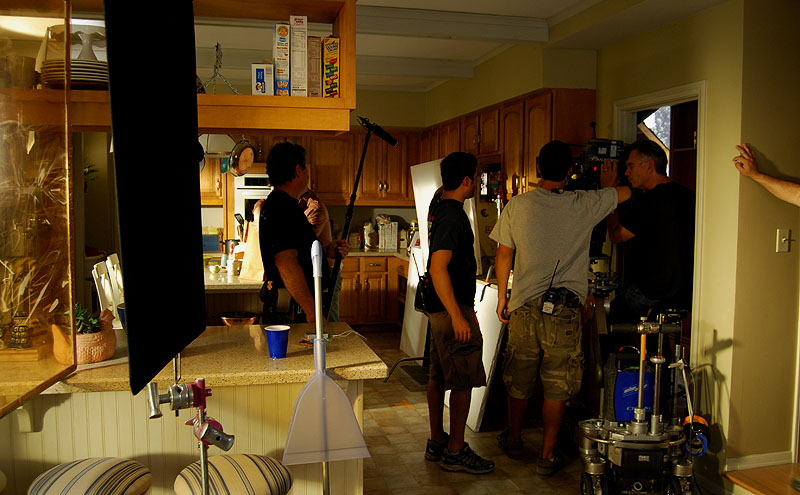
Here's a shot from the stage last year on "Tara" where I had warm sunlight coming through a kitchen window and I used bounce cards to bounce it back into the face of the actor:
UST37.jpg


Here's a shot of some stand-ins this year on another set. Here I used a couple of Source-4's for the sunlight beams, so I could use skinny light stands and dress them out with some greens, as opposed to a big 10K or something:
tara2.jpg
 
Last edited:
A mirror will help a little, but it also complicates things -- the real solution is to change location so you can put a light farther from the window for starters. Then you can figure out which light gives you a sharper pattern. My general trick on a stage is to remove the fresnel lens from a fresnel lamp, like a 5K or 10K. You lose some brightness too doing that, but for a sharp moonlight pattern, that's OK (depending on how dim the moonlight pattern can be, even a tweenie or 1K with the fresnel removed may be bright enough, depending on how heavy a blue gel you plan on using).

For a sharp sunlight pattern, you have to expose more and sometimes that means using a fast lens or film stock -- which is fine on stage, but on location during the day, the balance between the fresnel-less 10K and the natural light won't be correct. The solution in old movies was to use a carbon arc light for that effect.

It's a real problem, getting really sharp sunlight shadow patterns that are bright enough -- I've been tempted to find some DC power and drag out an old-fashioned carbon arc light at times. I sometimes take the fresnel out of a 20K tungsten on stage, but the bulb is so large that it's not as sharp as a 10K or 5K globe. Like I said, for moonlight, which is much dimmer, it's a lot easier.

In really small spaces, one solution I've done in a pinch is to use a 750 Source-4 (like a 1K Leko) with a theatrical gobo pattern slide inside of it to project a sharp pattern of a window frame or tree branches, etc. The only problem with that trick is that if you look closely at the edge to the pattern, there is some chromatic aberration, an orange or blue fringe to the edge.

PAR's aren't so good for creating shadow patterns unless they are far away.

Also, if the light creating the sharp pattern is too close to the window blinds, even if the pattern is sharp (like from taking the fresnel lens out of a fresnel lamp) the rays are not parallel enough, the shadow lines sort of spread outward -- another reason you need a brighter light farther away.

The other trick is that for close-ups, back the light far away but take the venetian blinds off of the window and hang them off of a c-stand closer to the actor.

I went to the location and tested it a bit.

I took my tungsten 1K Fresnel, tried it on spot, flood and without lenses. It worked better without the lenses.

However I also got my cheapo crappy open faced lights, so I decided to test them anyway... And the best result came from the crappy lights hehe.

I played with the venetian blinds, it's ok that I'm getting more streaks of light than streaks of shadow but I liked the result (the Fresnel would soften the shadow edges no matter how), pretty close to what I envisioned in the first place. Plus I don't have to use a mirror or a Source-4.

dsc00432w.jpg


dsc00428o.jpg
 
David,
You have talked about the time required for prep on a feature, generally sounds like four weeks. What about pay? Is it based on a percentage of the pay production days or something else?
Barry

Usually I get paid at the same hourly rate for prep as for production, it's just that I work fewer hours per day during prep. Truth is that they usually make an offer -- let's say three weeks of paid prep -- so you fill-out your weekly time sheet and just write "worked one week prep" on it, they sort of break that down into an 8-hour day for five days total, etc.

But the weekly rate offered is generally the same for prep as for production.

Now often you end up working more days of prep than what they are paying for, just to put the work in and be prepared, help the director, etc. Basically once I'm hired, I figure I'm working on the show.
 
Thanks David.

So far all my features have all been ultra low budget and there has been no pay for prep, but as you say, once you accept the job do the best work you possibly can.

Does this formula apply to post? Or does a DP ever get paid for sitting in on color grading?

Thanks, Barry
 
Does this formula apply to post? Or does a DP ever get paid for sitting in on color grading?

Thanks, Barry

You've brought up a sensitive issue in the industry...

Traditionally, a feature DP would volunteer his time in post, which mainly consisted on three or four visits to a lab to watch an answer print, which happens in real time -- so that's a couple of hours of time committed per screening, maybe three or four answer prints, maybe a few other visits to look at check prints from the dupe neg, etc.

Then we also started supervising the color correction for the home video version, which was about three more days in a telecine suite, also unpaid work (but these were full 8-hour days usually).

Now we supervise the color correction of the D.I., which is two weeks of work, five days a week, often all day long. Plus looking at check prints at the lab, looking at the home video master made from the D.I., etc. Some DP's put in a solid month of post work -- unpaid -- to finish up a feature.

It's a bit silly to be sitting in D.I. sessions for two weeks surrounded by the post supervisor, the colorist, the director, maybe the editor, plus assistants -- all getting paid to be there -- and an unpaid DP is more or less supervising the color correction, making major decisions.

So this tradition of the DP "volunteering" to work on post has got to stop, we should be paid for our time. But the studios are pretty adamant about not starting a precedent of paying a DP for post work, so it's like pulling teeth to get such a commitment in a deal memo. The union hasn't been much help either in this regard, hoping that enough powerful DP's get paid for post work that a precedent is started so that they can then go to the studios and start making it part of the Basic Agreement.
 
Hi David - I have a question regarding so called "book lights."

Now, I know that Robert Richardson and others swear by them, but I cant wrap my head around why they should work. If the softness of a light is dictated by the size of the source and the distance to the subject, why should one use a book light? Why bounce a light into a 6x6 frame (bead board, muslin, etc), then diffuse that bounce with another 6x6 frame of diffusion? Arent you just loosing intensity without "gaining" softness? I mean, its still a 6x6 source at whatever distance to the subject. The light itself doesn't actually change by virtue of being bounced, does it?
 
Well, just because you shine a light through a 6'x6' diffusion frame (and Richardson is working on much larger scales than this) doesn't mean that the light fills it evenly from corner to corner -- once that happens, yes, you are right, in theory it can't get any softer.

But in reality, it's hard to fill a frame of diffusion that evenly, hence why (if you have the light output) people use heavier diffusers like Full Grid or Muslin, they double-up on diffusers (I often have an intermediate diffusion frame, like a light shining through a 4'x4' frame of diffusion and then putting a 6'x6' or 8'x8' frame of diffusion in front of that) or they use a book light and bounce the light and then diffuse the bounced light further. But yes, you are ultimately limited by the size of the soft source relative to the distance to the subject. Once you fill a surface perfectly evenly -- bounced or through something -- it cannot get softer and all you are doing is losing light output (and generating more heat in the room!)

But nothing in life is a perfect diffuser. In fact, one reason some people like putting muslin in front of a light is that it's an imperfect diffuser -- a very weak amount of specular light can pass through if the weave is loose enough, causing a faint amount of sharp light to mix with a lot of soft light. For some people, this feels more "organic" than plastic diffusion material. Though in Richardson's case, bouncing light off of muslin and then passing the bounced light through muslin again, there is absolutely no specular light leaking through the process, it's a super soft light.
 
But in reality, it's hard to fill a frame of diffusion that evenly, hence why (if you have the light output) people use heavier diffusers like Full Grid or Muslin, they double-up on diffusers (I often have an intermediate diffusion frame, like a light shining through a 4'x4' frame of diffusion and then putting a 6'x6' or 8'x8' frame of diffusion in front of that) or they use a book light and bounce the light and then diffuse the bounced light further.


Ahhh. Thanks for the very clear answer - sometimes I forget that theory and practical reality aren't always the same thing!


I just saw Assassination of a High School President, btw - and while it is not the type of movie that I normally expect to enjoy, I thought it was a blast. Very funny, and some really fantastic framing and lighting...
 
David, we have used helium blimps (4 to 5) at a time for large indoor shots. (Aerolight). But are there times when using helium blimps can be used for different lighting? - How do they (daylight or tungsten) control those?
 
Helium lighting balloons can come with HMI, tungsten, or a mix of the two. You can even get some with metal halide or sodium vapor fixtures for matching industrial lamps better. For "moonlight" I like to get the balloons that have both HMI and tungsten globes in them so I can get a color temp somewhere in between 3200K and 5600K when shooting on tungsten stock (for the RED camera, I'd just get the HMI balloon for moonlight effects.)

You can use them for lighting large interior spaces where rigging is difficult and you want a soft toplight effect, you can use them outdoors as well, though they are very susceptible to wind -- you can use tag lines to hold them in place but that won't stop them from flying downwards in a heavy gust. Some people mount them to the underside of a condor crane, which holds them in place during wind though you lose some of the advantages of the balloon, the ease in positioning it regardless of terrain.

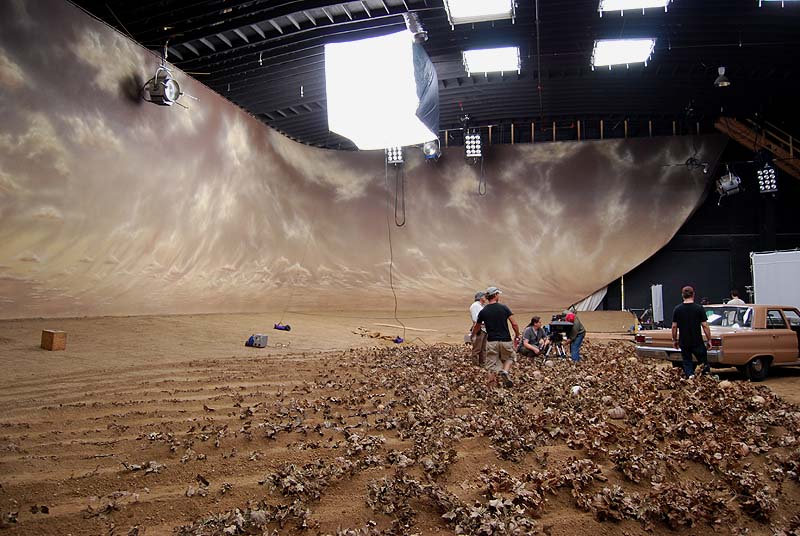
I used HMI lighting balloons to light the fake exterior landscapes for "Manure" (plus Kino blanket lights in the ceiling):
balloonHMI.jpg

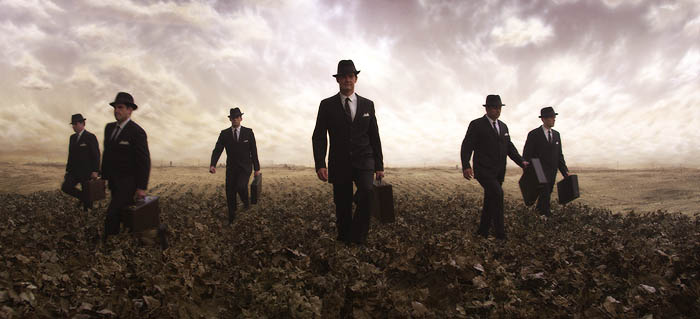
For an overcast look, I just used the balloons and the Kinos in the ceiling:
700manure156.jpg


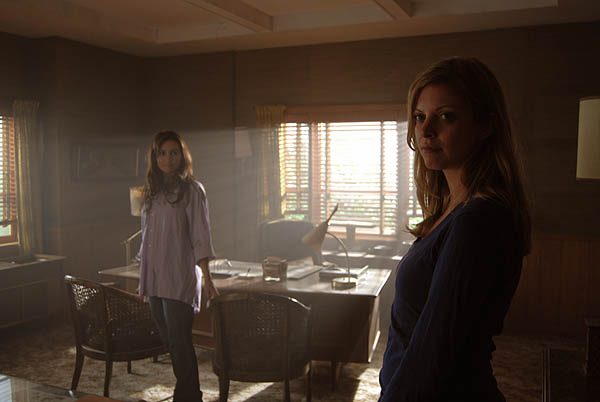
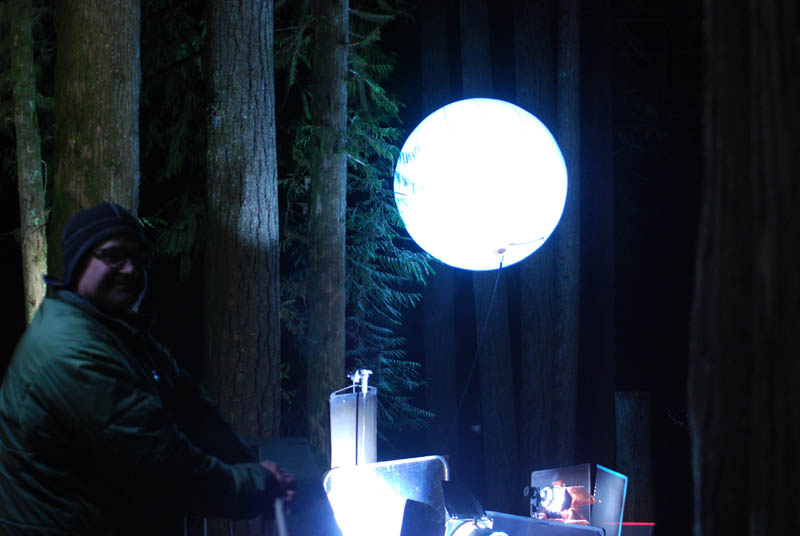
We used a round balloon to add some soft overhead fill in a moonlit woods scene in "Jennifer's Body" - here is a shot of the balloon:
balloonHMI2.jpg
 
Last edited:
Back
Top