


David Mullen ASC
Moderator
Multiple hard lights produce multiple shadows, unless clustered very close together and very far away from the subject (like a Maxibrute on a condor), so generally you can't use three small lights to create the effect of a single point source from a bright light, not if you want a single sharp shadow.
However, you can put multiple lights through a diffusion frame or into a bounce to blend them into a single soft source.
I've also used multiple spotted lights shining through a window in a smoked room to create the effect of the sun being broken up into multiple shafts, as if shining through a tree (I recently did it with three Source-4 lamps with 19 degree lenses). The rays all have to be parallel though for that to look like a single light. Same goes for a scene in a forest, you can use multiple hard lights all in the same direction, spaced apart, to suggest a single sun coming through gaps in trees.
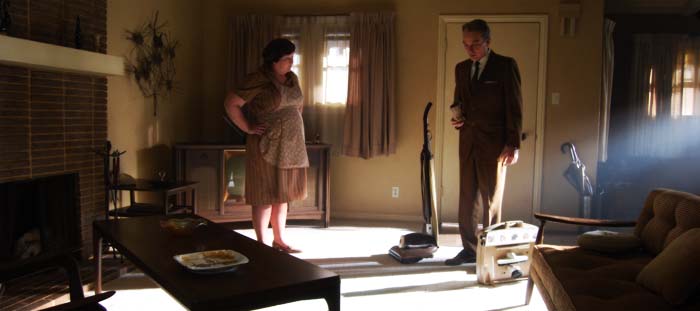
For example, I used two HMI Source-4 ("800w Jo-Lekos") lamps for a scene in "Manure" to create this shaft of light, just off-camera inside the room, not through the window. But since the Source-4 produces a very sharp light that you can cut to shapes with internal iris blades, I could keep the beams from overlapping on the floor and creating two shadows, instead they created two spots with a small gap between them. Now you get two shafts, but since the rays are parallel, it looks a bit like a single beam being broken up by passing through something like the frames of a window or something. It's hard to do this with any other type of light however because a normal light has a lot of spread, unless you use snoots or something, which is why I like Source-4's.
Now enough point sources, close together, at a distance, starts to look like a single soft source -- Kubrick lit the Africa sets in "2001" for an early dawn look by using hundreds of photoflood bulbs in the ceiling of the soundstage. It worked so well that apparently he was consulted by Ken Adams as to how to light the huge submarine hanger set in "The Spy Who Loved Me" and Kubrick suggested the lightbulb trick again. And when Roger Deakins had to light a big empty stage for a fantasy bowling dream sequence in "The Big Lebowski" he used hundreds of PAR lamps in a grid pattern in the ceiling. When a subject is lit by enough point sources from multiple directions, all the tiny shadows sort of blend into a fuzzy soft one.
But there really isn't a substitute when you want the effect of a big single point source creating a big single shadow.
However, you can put multiple lights through a diffusion frame or into a bounce to blend them into a single soft source.
I've also used multiple spotted lights shining through a window in a smoked room to create the effect of the sun being broken up into multiple shafts, as if shining through a tree (I recently did it with three Source-4 lamps with 19 degree lenses). The rays all have to be parallel though for that to look like a single light. Same goes for a scene in a forest, you can use multiple hard lights all in the same direction, spaced apart, to suggest a single sun coming through gaps in trees.
For example, I used two HMI Source-4 ("800w Jo-Lekos") lamps for a scene in "Manure" to create this shaft of light, just off-camera inside the room, not through the window. But since the Source-4 produces a very sharp light that you can cut to shapes with internal iris blades, I could keep the beams from overlapping on the floor and creating two shadows, instead they created two spots with a small gap between them. Now you get two shafts, but since the rays are parallel, it looks a bit like a single beam being broken up by passing through something like the frames of a window or something. It's hard to do this with any other type of light however because a normal light has a lot of spread, unless you use snoots or something, which is why I like Source-4's.
Now enough point sources, close together, at a distance, starts to look like a single soft source -- Kubrick lit the Africa sets in "2001" for an early dawn look by using hundreds of photoflood bulbs in the ceiling of the soundstage. It worked so well that apparently he was consulted by Ken Adams as to how to light the huge submarine hanger set in "The Spy Who Loved Me" and Kubrick suggested the lightbulb trick again. And when Roger Deakins had to light a big empty stage for a fantasy bowling dream sequence in "The Big Lebowski" he used hundreds of PAR lamps in a grid pattern in the ceiling. When a subject is lit by enough point sources from multiple directions, all the tiny shadows sort of blend into a fuzzy soft one.
But there really isn't a substitute when you want the effect of a big single point source creating a big single shadow.
David, I was curious as to what, if any, the benefits of using a larger light in lieu of several smaller lights aimed at the same space? Are multiple shadows unavoidable? Or if say 3-4 1.2ks are pointed at the same object, either bare or through diffusion, would it be distinguishable from a single 4k pointed at the same object?
Im looking to invest in a stronger light than what I have, and I'm wondering if it wouldnt be smarter to instead buy several joker 800's or arri 1.2ks. That way they could be either used as one source or split up into individual sources. Possible? Pros and cons?
Thanks Mr. Mullen - Hope you will have time to answer!
Last edited:


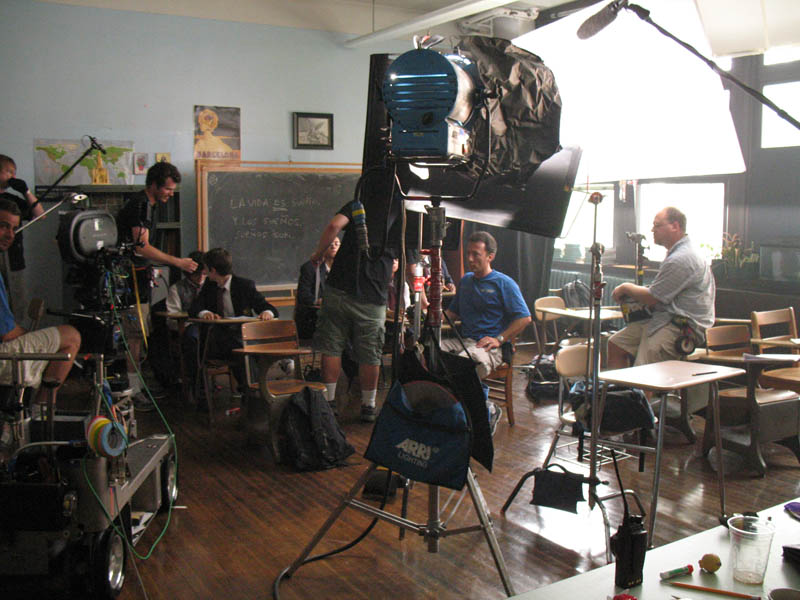
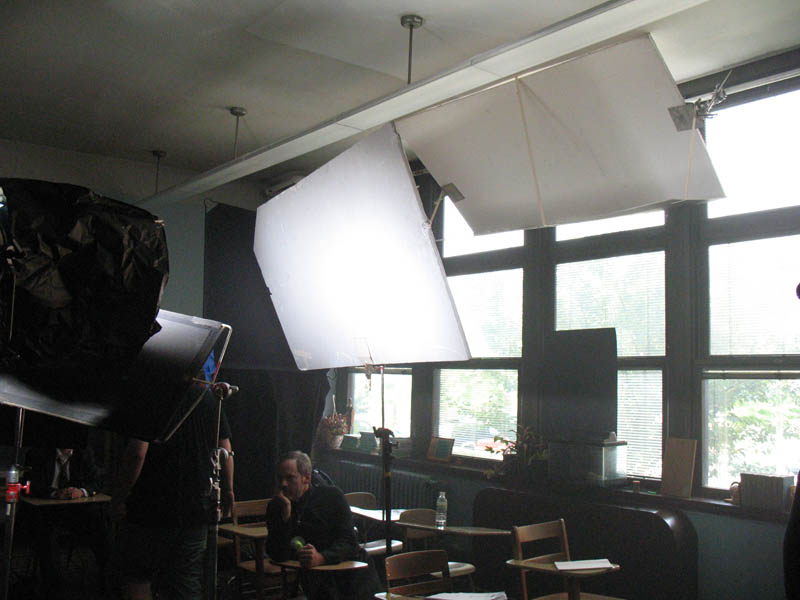
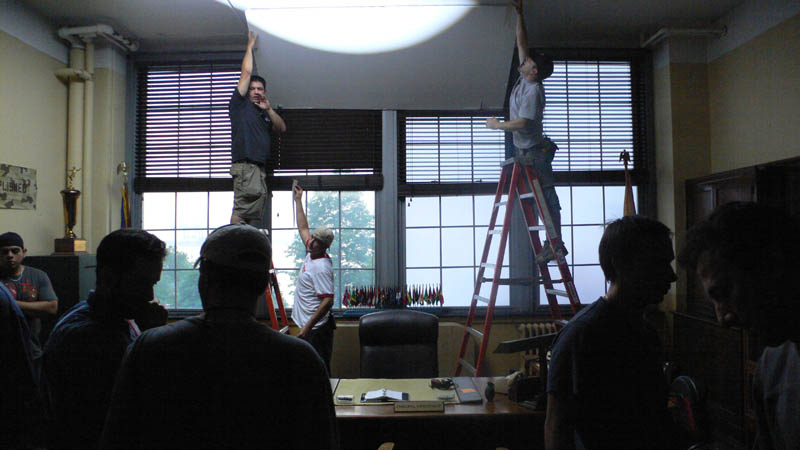

 Those shots are great, and I have the movie in my netflix que and look forward to watching it.