Welcome to our community

Be a part of something great, join today!

  • Hey all, just changed over the backend after 15 years I figured time to give it a bit of an update, its probably gonna be a bit weird for most of you and i am sure there is a few bugs to work out but it should kinda work the same as before... hopefully :)

Ask David Mullen ANYTHING

Hi David,

I saw your instagram post about the burning house shot for Mrs. Maisel. I was curious... you said you wrapped the house in Broad Channel. What is that? From the picture it looks like the pars on the roof were enclosed in an entire strucutre... of CTO? Why did you wrap it around the sides as well, and not just the front? Is it to make the light bloom on the sides as well? It looks like on the maxibrutes on the porch, you only put gels in the front...

Thanks,
- dan

We smoked up the area so there would be white light mixed into the orange if hadn't covered everything with gel. But I could have just gone ungelled and dimmed everything for warmth and used a higher Kelvin setting on the camera too.
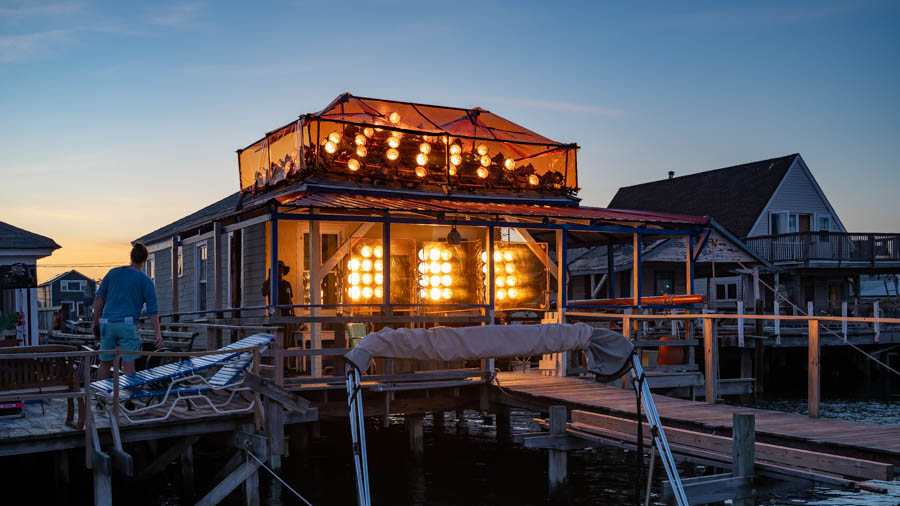
maisel15.jpg
 
Hello David

I'm looking to do a very specific emulation of a shot from Bergman's Persona (1966). I've linked to an imgur site with the reference and a floorplan: https://imgur.com/a/BxgAiCI

We're shooting a day exterior in a forrest, what me and the director really like about the still from Persona is how her face is still just barely visible and not a total silhouette.

My Plan is to encircle them with negative fill to bring out the contrast difference between them and the background, and then bounce accordingly, beneath them. I am a little worried how to get a proper bounce on the front subjects forehead as it seems to me that, a bounceboard from that angle would be covered by the actors and the negative fill and not really be able to bounce a whole lot. Also i'm a bit worried about the lack of catch light, as I think the director will want that and i'm not sure a bounceboard will give that.

Do you think my approach makes sense, or do you have anything to add before a pre light? Especially in regards to the catch light, I wonder if one could do this with only natural light.

Best regards
 
Your plan sounds good -- I think surrounding them with negative fill (and you'll need some overhead negative fill) will be enough, the background ambience will wrap around them. Yes, a bounce card to one side can add a little side light if needed. The contrast of your viewing LUT will also be a factor in how fast the shadows fall off. I don't see why a catchlight would be needed in a day exterior shot.
 
Hi David,

My wife and I started binging a couple of episodes a night of The Marvelous Mrs. Maisles series recently. Really love the richly colored almost surreal look of it. Beautifully done. How did you achieve that look?
 
fire trick

fire trick

We smoked up the area so there would be white light mixed into the orange if hadn't covered everything with gel. But I could have just gone ungelled and dimmed everything for warmth and used a higher Kelvin setting on the camera too.

maisel15.jpg


Hi David,

thanks for the reply. What is broad channel though?
 
Hi David, I was thinking if you could clear up something for me about old lens designs, back when film cameras were non reflex.

In the ASC manual, on page 116, Iain A. Neil ASC writes:

1)
"In fact, it is interesting to nota that in the case of old wide-angle, short focal length lenses, their back focal length was normally smaller than their focal length"

Further down on the page, he writes about the new lenses of 1950s with coatings and on reflex cameras with increased distance to the film plane:

2)
"Even those troublesome wide-angle lenses, now sitting at a film distance mostly exceeding their focal lengths, could be relatively easily constrcuted.

These two paragraph greatly confuse me. In paragraph 1) he mentions a "back focal length" and a "focal length". It seems to suggest that there are two focal lengths, i´ve only ever learned of one, which is the distance from the rear nodal point to the film plane.

In paragraph 2) he mentions a distance from the film plane to the lens exceeding a focal length? If the focal length is the distance from the rear nodal point to the focal length, how can the lens exceed that?

I hope the questions makes sense, I thought you might know this, since you seem well vested in cinematography history.

Best regards!
 
Hello David,

I have always disliked the term "negative fill".

Do you know of an alternate name for it, or perhaps even the different historic names for it?

I wonder what "negative fill" was called back in the good old days? I keep thinking that it is a fairly new term.
 
Old film stocks, printing systems, and early video were all so much more contrasty that I doubt there was as much call for negative fill, they were fighting for positive fill!

The terms has been around for thirty years at least as far as I know, I was using it in film school. I think the alternative is just to say "I want to flag or block the ambience or bounce light".
 
Old film stocks, printing systems, and early video were all so much more contrasty that I doubt there was as much call for negative fill, they were fighting for positive fill!

The terms has been around for thirty years at least as far as I know, I was using it in film school. I think the alternative is just to say "I want to flag or block the ambience or bounce light".

Thanks!

I will continue to say "let's reduce the fill light etc.".


Merry Christmas, David!
 
Hi there David! Happy new year, I hope you're doing well.

I'm about to start another feature film and I would like to try a meter that reads footcandles. A really simple, but reliable one. It doesn't matter if it has another features, but I would like to work with that scale and be able to make myself a quick idea of the levels of each light and setup.

I was wondering if you use this tecnique, or still use it in digital. With RED cameras I find the histogram very useful, and I use the false color or video check for fine tuning. But it would be nice to go back to the roots and do some metering as well.

I'm also hearing recommendatios for particular models that will do the job (not the expensives ones), if David or anyone else have any suggestions I'll appreciate it!

Regards, Nacho.
 
Last edited:
Hi Ignacio, Sekonic and Spectra-Cine make great units. I had the Spectra IV which I loved for about 15 years before it was stolen. It's a simple incident meter but very reliable with lots of film-oriented options and easily calibrated. I've used the Sekonic 758 Cine ever since. It's been nice and has incidence and a spot meter, which is nice. Can't go wrong either way.
 
I'm also hearing recommendatios for particular models that will do the job (not the expensives ones), if David or anyone else have any suggestions I'll appreciate it!

Nacho- Hal's reply is a good recommendation, those seem to be the standards among those who use meters in my experience here in New York.

If you're looking for something at a bargain price, a lot of photographers still love the old Minolta incident meters. They don't display in footcandles but, if you're interested simply in measuring ratios (and you don't mind using a shutter speed approximation instead of shutter angle), they're simple and great.
 
Hey David.

I apologise if this question has been covered before. I've tried to google the answer and just can't find a definite number.

In the end, how much more does it cost to shoot 35mm film vs digital. Can it be broken down to a per minute rate to cover the costs of film stock, processing, scanning etc?


I know many have argued that film isn't significantly more expensive but I just can't believe that. Everything in the film process is much more expensive correct?

If it could be broken down to a cost per minute the camera is rolling it would be helpful.

Thanks in advance.
 
I'll let David chime in on the cost for film - but it would seem that the cost per minute for Digital is near zero since the media is reusable and the only true sunk cost per minute would be the cost of electricity to charge the battery (pennies). That further complicates the issue with digital since you can shoot more and longer takes without additional media costs.

Beyond that you simply have the cost of maintenance and depreciation of the camera and media which is essentially indeterminate because it depends on what you pay for the camera equipment and the cost per minute is based on how much it is used - and that issue is the same for any camera - film or digital.

From there you really would get into all the other costs of the production and it seems like the idea that shooting film is not much more expensive is based on the idea that on major features all of the other costs (cast, crew, lighting, sets, insurance, travel, hotels, etc) dwarf the cost of the camera and media so it doesn't matter much if film cost and processing is 1% of the overall budget and digital is 0%.

The difference becomes important mainly on small or micro budget films.
 
I'll let David chime in on the cost for film - but it would seem that the cost per minute for Digital is near zero since the media is reusable and the only true sunk cost per minute would be the cost of electricity to charge the battery (pennies). That further complicates the issue with digital since you can shoot more and longer takes without additional media costs.

Beyond that you simply have the cost of maintenance and depreciation of the camera and media which is essentially indeterminate because it depends on what you pay for the camera equipment and the cost per minute is based on how much it is used - and that issue is the same for any camera - film or digital.

From there you really would get into all the other costs of the production and it seems like the idea that shooting film is not much more expensive is based on the idea that on major features all of the other costs (cast, crew, lighting, sets, insurance, travel, hotels, etc) dwarf the cost of the camera and media so it doesn't matter much if film cost and processing is 1% of the overall budget and digital is 0%.

The difference becomes important mainly on small or micro budget films.

+1

hey Troy

I'll just tell you from a micro budget perspective until Dave comments
(for me)
with 16mm I was getting about 11 minutes for 340$ including everything you mentioned

35mm around 4 minutes for the same price

(if you use short ends you can get it even cheaper)

this was for commercial spots where if you were renting a digital camera it did turn out to be cheaper on film (depending on shooting ratio)
 
Back
Top