Welcome to our community

Be a part of something great, join today!

  • Hey all, just changed over the backend after 15 years I figured time to give it a bit of an update, its probably gonna be a bit weird for most of you and i am sure there is a few bugs to work out but it should kinda work the same as before... hopefully :)

Ask David Mullen ANYTHING

Most anamorphic lenses, including Panavision's, have a 2X squeeze factor. This means that the area used on 35mm film or a digital camera will only end up being a 1.20 : 1 aspect ratio if it has a 2X optical squeeze, because unsqueezed it would be 2.40 : 1.

So out of a 16x9 (1.78 : 1) sensor, you'd be cropping it to a 1.20 : 1 area if you used a 2X anamorphic lenses.

The only anamorphic lenses designed to get you a 2.40 image on a 16x9 sensor are the new 1.33X Hawk anamorphics -- if you can find them and can afford them, that's great. (There is also the rare Canon 1.33X anamorphic rear-adaptor for B4 video lenses, but that's for 2/3" CCD camcorders...)

Otherwise on a 16x9 camera, you'll either be using spherical lenses and cropping top & bottom to get 2.40, or 2X anamorphic lenses and cropping the sides to get 2.40.
 
You take on "Knowing"

You take on "Knowing"

David,

Can you give us your take on Knowing from the cinematic perspective,aside from its merit from the story line angle?

Thanks!
 
Hi David,

Forever the opportunist, I wanted to ask if you would be interested in me working with you or if you could help in anyway.

I've come from working in senior roles, hands on roles in TV, Film technology, having worked for SKY and Avid, along with freelancing for notible Visual Effects houses.

I am returning to work after taking time out to look after kids and did some retraining at the UK's NFTS on Camera's. Obviously I would lend myself very well to working as part of a crew with digital systems such as RED.

Also with my background in managing highly complexed technical and creative projects, manging very talented experts in their own feilds and with control of significant budgets (£400K to £M), I have no problem Directing and Producing.

Some recent images from my own film project I am currently in the early stages of developing (More up soon);

http://www.flickr.com/photos/3635893...18376772/show/

Just get in touch if you would like more info.

All my best,
Samantha Hamer
 
Hey David.

OK, got that out of the way. What I would like to know is how much you set the colours in your projects 'in camera'. Do you tend to create the colours with gels on the lights on set, or in post? If it is the former where do youo get your inspiration?

I do whatever seems most efficient to me, on set or in post, doesn't really matter as long as it works.

For subtle shifts in overall color tone, I prefer not using pale filters because it's just extra glass (though in the case of RED, I would consider using pale blue filters to help reduce the noise in tungsten light). When shooting film, I used to use light warming filters like the 1/8 Coral or 81B, etc. but half the time, the dailies colorist timed it out, and even if they didn't, when I did the final timing of the conformed negative, the first answer print would have been timed to look neutral, so I would find myself adding printer lights to get back to the look of the pale filter. So I thought, if it's so easy for the colorist to cancel my filter effect in dailies, and if I just end up in the final answer print recreating the look anyway, what's the point of the warming filters? I can just shoot a grey scale at the head of the roll under the pale blue light and the dailies will come back timed on the warm side, without the need for extra filters.

But for stronger color effects, I prefer that the negative have some of that look built in because I don't like pushing an image too far from its original look.

There's a couple of ways to approach color. One is an overall tint or tone to the image and the other involves mixing colors within the frame. And this can include art direction, not just cinematography. Some movies I've shot are very monochromatic, like all gray in "Northfork" or all brown in "Manure". Others have been more pop art in look, with clashing strong colors. But my favorite approach is to use simple but strong color schemes for scenes, like green and black, or gold and red, etc. whether by getting the art department to provide those colors, or by lighting a monochromatic subject with a strong color. I find that this is a more painterly approach than just throwing a lot of colors at the screen.
 
Hey David,

In your and Kris Malkiewicz' book "cinematography" you mention that contrast can have an effect on apparent graininess, since the grain structure is more visiable in flat areas of midtones than in pure black or white.
I was wondering if you find this also true of digital noise?

Cheers
Dave Gray
 
No, I tend to find that noise is more visible in blacks in a digital image.

With film, the image itself is made up of grains, so the inherent structure is most visible in an even field of midtones. But in a digital image, the basic image is not made up of noise.
 
Hi David,

I know that American Cinematographer has played a significant role in both your artistic development and eventual invitation to the ASC. As a student myself, I'm wondering if you have any tips for getting the most out of the magazine. I find myself hitting a barrier with some of the lighting lingo and also don't exactly have the cash to play around with elaborate lighting set-ups. I have access to a 3-piece Lowell Omni kit, which hasn't let me down yet, but I'm yearning to learn more. At this stage of my development, should I be focusing more on the artistic approaches that various DPs employ, or is it possible for students with limited equipment to effectively extract some technical knowledge?

Many thanks for your time and insight.

Eric
 
It's complicated because you need to develop a two-track learning process -- the one where you learn how the big movies do something and the one where you learn how the small movies do something. If you only learn the small way you won't be prepared when bigger projects come along. Often I can describe to a producer or director how some big elaborate shot should be done even though I haven't done it yet, because I understand the concepts and I know the history of how those sorts of shots are done.

But you also have to find common ground - there are basic aesthetic issues surrounding lighting that have little to do with budget. Yes, soon you'll need to increase your arsenal beyond three small lamps, but there are many steps or degrees in between that and having a truckload of 18K's, right?

I used to take still frames off of a TV set playing movies to study the lighting of shots I liked - now I can do the same thing more easily by doing frame grabs off of a DVD. But once you start doing that, you find that, at least for the tighter shots, that what you often like is not technically or financially ambitious, it's just a careful application of light on a face. Later as you have more resources, you have to learn the art of lighting large spaces beyond simply raising the illumination level, actually "sculpting" a room with light. But that takes some work with the production designer to incorporate sources, and maybe some larger lights or a lot more of the smaller ones.

What it all really takes is IMAGINATION. Most failures in lighting are failures of imagination, not lack of equipment or skill. It's a lack of an idea for the look of the scene or how the light should fall on a face.

I recently had two scenes in a small wood-paneled office, daytime scenes on the seventh floor of a building with no way to actually light through the windows. The first scene I lit with a big soft bounce light coming from one side, I didn't really have a source there but it felt like window light.

When I got to the second scene, the time pressure was on me to just shoot it in the same lighting as the first. But I wanted to create a change in look that matched the emotional progression of the story, which was a gradual increase in warmth and sunniness. Luckily since the camera angle didn't look much at the real windows, I could fake window light in the room and I decided to use HMI Source-4's (Joker 800's) to create a hot overexposed slash of light on the lower half of the room. This sort of bounced back up into the faces and put a glow on everything. On some angles it created an intense halo of light on heads. But it was simple to do, I was just adding this hot backlight to the soft side light I had already established in the earlier scene.

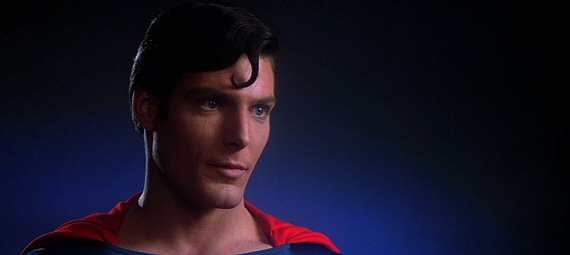
Anyway, if you study some of the tighter shots even in big movies, you'll find that they are not hard to replicate with smaller lights. I mean, look at this nice close-up in "Superman":

superman20.jpg


It's your basic portrait lighting, soft 3/4 frontal key, soft fill, kicker, and a glow on the bottom part of the background. Some diffusion on the lens. But it's nicely executed and it comes at a key moment in a romantic scene.

Or look at this shot from "Apocalypse Now" -- a flickering golden key light from the side, that's about it. But it's one of the more memorable scenes in the movie. But it's not about how complicated or expensive the lighting set-up is, it's about an IDEA, having the right concept for the scene -- in this case, that Kurtz would be revealed slowly in this flickering half-light.
apocalypse3.jpg


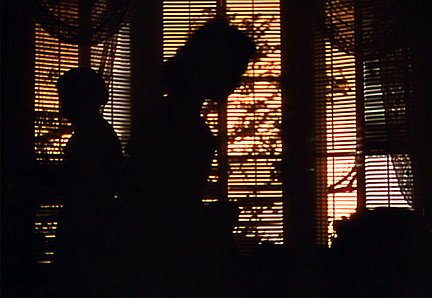
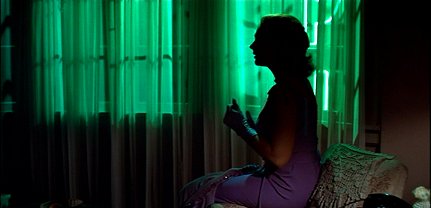
Or look at the use of silhouettes in these shots:

paintinglike7.jpg


paintinglike8.jpg


The lighting isn't complicated but the concept for the lighting is bold and interesting, and appropriate for the story point being made.
 
David,
Nice (though short) article in ICG magazine this month about Manure. There is a photo that really illustrates what you were saying a few posts back regarding art direction, wardrobe, etc. being so important when establishing a palette.
The crew and gear really "pop" from the scene, while the actors, props, etc. "belong" in the scene.
Anyway, nice press. Congratulations!
Cheers,
Harry
 
Motivating Moonlight

Motivating Moonlight

David,

I was reading your post about being unable to rig lights through a 7th story window and, since I'm facing a similar situation in a week or so, hoped you could elaborate slightly.

In my case, we will be shooting a nighttime interior in an office setting. The room is fairly long, and has large windows on three sides which have optional blinds. I'm pretty concerned about lighting for the master shot(s), because we intend to motivate moonlight with tungsten lights gelled 1/2 CTB and WB to 3200K, allowing the desk lamps and other practicals to maintain their native kelvin and augment those with tung. fixtures gelled 1/4 CTO.

Originally I thought about using a large bounced source for the moonlight, but subsequent talks with the director led to an attempt to create harder, sourcier moonlight. We will close most of the blinds in frame, and motivate from a window just off screen. Do you think it would be wise to bounce 2k Fresnels with the lens swung out to maintain some of their hard light quality, or might it be in my best interest to simply position the lights out of frame, close to the wall and focus them directly on the subjects?

Essentially, it will come down to trial and error, but I was hoping to get your advice on the topic. Since we are framing for 2.4:1, it would be relatively easy to hide the bounce material near the ceiling but the affect on quality is the main concern.
 
There's no point in bouncing a fresnel lamp with the fresnel removed, it just means you get less exposure. You'd pull the fresnel when you wanted a dimmer but sharper shadow pattern when shining the light directly.

Soft versus hard moonlight is a creative decision; it's just two different looks. Too soft and it can end up looking more like dusk light.
 
When you shoot at faster ASA speeds does red have related grain structure?

Higher and higher ASA ratings means more noise, and if you are working in tungsten light, particularly more blue channel noise. It's similar in some ways to film grain but in other ways, not at all.
 
David,

Again many thanks for this amazing thread - you're time is much appreciated.

Do you mostly judge the balance between key, fill and background lighting by eye, or are there certain ratios you like to work to? I.e. do you use your light meter just on the main light and then adjust by eye, or meter everything to get more precise ratios?

If by eye, did you always do it that way or has that come with experience?

Thanks

Simon
 
Higher and higher ASA ratings means more noise, and if you are working in tungsten light, particularly more blue channel noise. It's similar in some ways to film grain but in other ways, not at all.

Can you or anyone post images of ASA tests on red? Thanks a million for sharing your time and expertise.
 
frame

frame

Hi david. Great thread. Thank you very much.
I would be interested in your opinion about this frame, shot on red, nikon nokt- nikkor 58 mm f 1.2 wide open. What do you think of the lighting and composition? Thanks alot, ariel weiss.
 
You sir are a goldmine of priceless information. THANK YOU! For your contributions here and elsewhere to the up-and-comings. You're leaving behind a legacy of intelligent well-taught students.
 
Back
Top