Welcome to our community

Be a part of something great, join today!

  • Hey all, just changed over the backend after 15 years I figured time to give it a bit of an update, its probably gonna be a bit weird for most of you and i am sure there is a few bugs to work out but it should kinda work the same as before... hopefully :)

Ask David Mullen ANYTHING

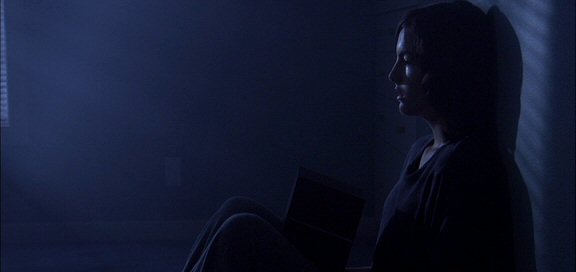
I did a little creepy drama in HD (24P/1080 HDCAM on the F900), an under-1 mil. movie called "The Quiet". I had some minor noise problems in blue light when I boosted the gain to +3db (which is normally mild) -- but the noise was not really visible when I color-corrected it on a 50" CRT HD monitor in a DaVinci suite, but was more visible on the film-out and on LCD screens later. Here are some frames from the DVD:
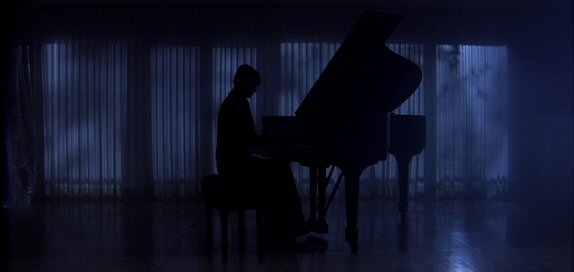
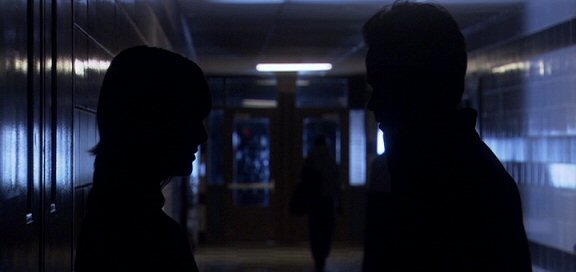
quiet1.jpg


quiet2.jpg


quiet6.jpg


quiet9.jpg


If a camera is noisy, basically you want to shoot at 0 db or -3db, even if this means using more light, and don't go crazy underexposing your night scenes; leave a little final darkening for post.

Blue in particular seems noisy in HDCAM, so in the future, I'll probably avoid boosting the gain when shooting under blue lighting. And probably expose a little more fully then darken in post. This was one of those shoots though where the director really kept wanting me to go darker and darker -- I should have darkened her monitor instead of underexposing more and more.
 
I didn't put my boring shots up...

This shoot was a good example though of what a director contributes - the script was set in a house and a high school, and is a drama about incest and lies, basically. The settings were quite mundane and being such a small shoot, my instinct was to use minimal lighting and go for a semi-documentary style. But the director wanted as much mood as possible to create more of a pyschological state, and wanted many scenes to be very dark, so many times in the house, we had dialogue scenes set in moonlight when in real life, someone would have switched on some lamps. It was an all-white modernist house with a lot of windows, so it wasn't as interesting when it was all lit up. Often instead, I'd light the trees outside the windows and leave the room dark, giving it more of a Grimm's fairy-tale quality.
 
David, do you prefer indoor or outdoor cinematography?
 
I like variety. You do one thing too long and you start wishing for the opposite. Location interiors make you crave for sets you can control, sets make you want to go outside and shoot in natural light, being outside all the time makes you want to go inside and light something...
 
BTW, do you by any chance have a copy of Almendros's book, David? I'd be willing to US post you some great books and DVDs as an exchange for a month or so, all the postage paid by me of course. I'm in OC.
 
Yes, I have the softbound 1984 edition. I once ran into a second edition, 1986, that had a few extra pages.

I have quite a number of cinematography / filmmaking books, some hard to find, some not, like Freddie Young's cinematography textbook, James Wong Howe: Cinematographer by Todd Rainsburger, Haig P. Manoogian's "The Film-Maker's Art".

I have a taped-together paperback copy of Jeremy Agel's book on the making of "2001" which I bought in high school and read until it fell apart...

One of my favorites is a little textbook on early 1970's cinematography written in the U.K. and full of quotes by British cinematographers, Russell Cambell's "Practical Motion Picture Photography". Of course, most would find this one as dull as dishwater and horribly dated, but a lot of my early heroes were U.K. cinematographers of that period.
 
... don't go crazy underexposing your night scenes; leave a little final darkening for post.

This was one of those shoots though where the director really kept wanting me to go darker and darker -- I should have darkened her monitor instead of underexposing more and more.

Pearls.... Thanks David.

Please share more frames with your commentary.

How about some you're really proud of with comments?

This thread ....... Rocks.
 
I think that's hilarious that you'd darken the monitor for the director. I bet that stuff's done more than anyone will admit! Was "The Quiet" released?
 
"The Quiet" on out on DVD. It had a brief theatrical run last August.

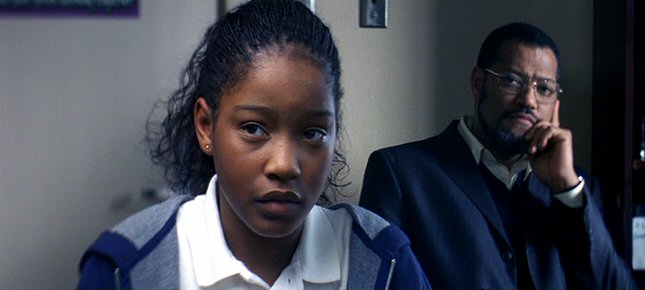
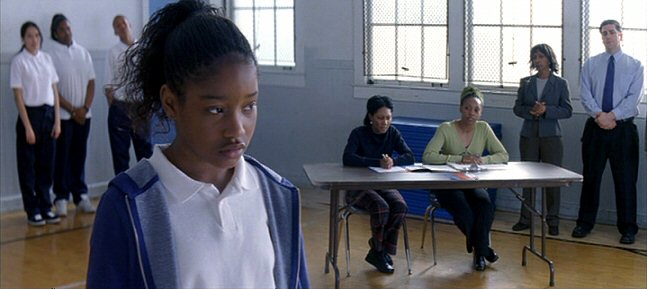
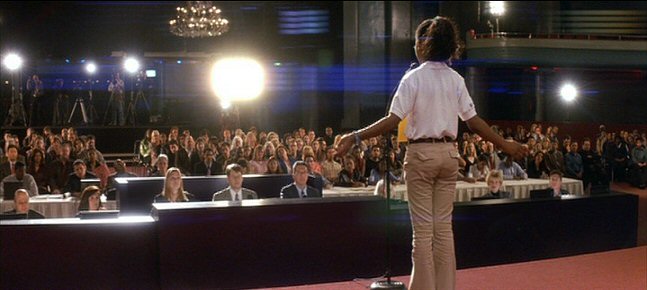
Here are some frames from "Akeelah and the Bee", shot in 35mm anamorphic. The first frame shows the use of a tilt-focus lens to hold split-focus, the second frame shows the use of a split-diopter to hold focus:

akeelah2.jpg


akeelah3.jpg


akeelah6.jpg


akeelah7.jpg
 
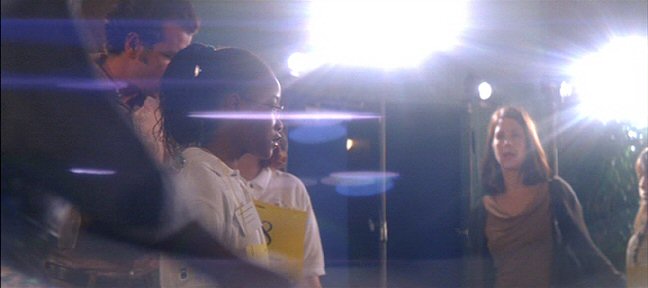
In the final spelling bee, we had some 24P HD material that was shot at a real spelling bee that we needed to use in order to create a montage, so I shot our actors in HD as well on the F900. You can see some comparisons between the 35mm anamorphic footage (shot with GlimmerGlass diffusion) versus the 24P HD footage of the same actors, shot clean, though not intercut in the movie -- the HD footage was kept in one sequence.

aatb351.jpg


aatbhd1.jpg


aatb352.jpg


aatbhd2.jpg
 
Speaking of darkening the monitor, with REDCINE won't we be able to apply a look that can be fed to the monitor? That will help in maintaining a consistent style from shot to shot and scene to scene without compromising the lighting and exposure.

I saw "The Quiet" on DVD a few weeks ago. I think you did a good job of creating the darker mood the director asked for. I also enjoyed the special commentaries/interviews on that DVD. The movie would have taken on a different feel had Thora Birch been available for the role of Dot, but Camilla Belle did a commendable job on short notice.
 
You can see some comparisons between the 35mm anamorphic footage (shot with GlimmerGlass diffusion) versus the 24P HD footage of the same actors, shot clean, though not intercut in the movie -- the HD footage was kept in one sequence.

Thanks for the stills and insight into your process. I've been wanting to see this movie. I'll have to add it to my short list.
 
David this is a purely speculative question but you might have some insights from your onset experience.

Do you see the job of a colorist changing in the coming years as more productions move to a digital meta-data oriented workflow with onset grading? Obviously the need for a post grade will remain as it always has, but who do you see taking over the onset look creation? Will the DIT evolve into an on set grader? Will a new position evolve? Who will "darken the monitor" as directors expect more and more accurate feedback in realtime?
 
thanks for those pictures david

the first of the each pair would be the 35mm film yes?
 
Thanks David.
Since stretching the blacks or raising gamma to get more details in the shadows tend to introduce noise, I thought crushing the blacks would produce a cleaner image, as long as you are sure you won’t need any of the information in the shadows.
So do you feel shooting it bright and darkening in post is the better approach?
I find it pretty trick to do when you going for a low key high contrast look.

Darkening the Director’s monitor is a good trick. I wonder if I should darken my own monitor to prevent me from under exposing all the time when trying to get a dark moody look (LOL)
 
I did a little creepy drama in HD (24P/1080 HDCAM on the F900), an under-1 mil. movie called "The Quiet". I had some minor noise problems in blue light when I boosted the gain to +3db (which is normally mild) -- but the noise was not really visible when I color-corrected it on a 50" CRT HD monitor in a DaVinci suite, but was more visible on the film-out and on LCD screens later...

...Blue in particular seems noisy in HDCAM, so in the future, I'll probably avoid boosting the gain when shooting under blue lighting.

If you don't mind my saying most electronic camera seem to have noise/codec issues with blue. I believe that part of the problem is that the imaging devices have to be really pushed to be sensitive to the colour blue as the semiconductors involved are much more sensitive in the IR/red region of the spectrum. This might be well changing but I still notice blue problems most of the time - often the "what-you-see" resolution drops in the blue range (when compared to red)- esp dark blues.

I think the same applies to LCD screens which have the same issue with blue and are merciless with dark images - I just don't work with them or watch them for just that reason. I'm still a CRT man and I suggest to all a side by side comparison... it can be quite shocking.

JohnF
 
There are DP's who look forward to on-set scene-to-scene coloring, but I'm not one of them -- my time is limited enough on a set. I don't believe that adding post time to shooting time makes sense. I mean, I don't mind doing a little of that for special scenes, like a dream sequence or a day-for-night scene. But then, I tend to shoot 5-pages-a-day dramas, not commercials or music videos, so I can get away with a more straight-forward approach to the look.

And I think it makes more sense when working with a camera recording in linear video gamma / color space for broadcast / monitor display, especially in an 8-bit compressed format -- not a camera recording RAW data in 10-bit Log mode, which is more like a film negative. With a RAW camera, you are more concerning with recording information that can be manipulated later.

Now of course, some people will want to create looks on the set using LUT's so they can get dailies and on-set monitors to look correct; I'd probably go for a halfway approach, create some pre-built general LUT's for the set and for dailies, as opposed to coloring each scene on the set.

---

Yes, the first frames are from the 35mm anamorphic version.

---

I wouldn't go as far as saying "shoot bright" for dark scenes, just that one should resist the temptation of underexposing them too much. You don't want clipped highlights afterall.

I tend to have a "halfway" philosophy in general when it comes to doing things in camera or in post. Get the look halfway down in camera but finish the look in post. This gives you some flexibility in post to correct, but makes sure that you aren't having to make extreme corrections just to get where you want to be.
 
I did a little creepy drama in HD (24P/1080 HDCAM on the F900), an under-1 mil. movie called "The Quiet". I had some minor noise problems in blue light when I boosted the gain to +3db (which is normally mild) -- but the noise was not really visible when I color-corrected it on a 50" CRT HD monitor in a DaVinci suite, but was more visible on the film-out and on LCD screens later. Here are some frames from the DVD:
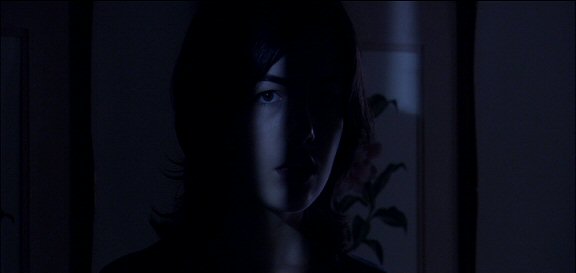
quiet1.jpg


quiet2.jpg


quiet6.jpg


quiet9.jpg


If a camera is noisy, basically you want to shoot at 0 db or -3db, even if this means using more light, and don't go crazy underexposing your night scenes; leave a little final darkening for post.

Blue in particular seems noisy in HDCAM, so in the future, I'll probably avoid boosting the gain when shooting under blue lighting. And probably expose a little more fully then darken in post. This was one of those shoots though where the director really kept wanting me to go darker and darker -- I should have darkened her monitor instead of underexposing more and more.

Hi David,

A great look... thanks for posting.

I'm curious, if lighting for a scene similar to those pictured above, would using a green tone and then grading it to blue in post help alleviate noise? If the overall look is "colorized" to a degree (meaning skin tones, etc. are also colorized), and the camera picks up greens better, could this help, if you then adjust back to the original desired look in post?

(Might have to adjust the phase on the monitor for the Director).

thanks,
 
That would be a good thing to test, although I'm not sure if adding more blue in post is the same thing as pumping up an underexposed blue record. Having some green in the blue light may just help in terms of sharpness more than noise.

In other words, would you get more blue noise if you shot the scene in white light and made it blue in post, versus shooting it in blue light? On the other hand, if the blue-green lighting already had the desired amount of blue in it, so in post all you were doing was subtracting green, would there be any benefits? I don't know.

The solution may be to just make sure you aren't trying to add any more luminence or blue saturation in post because your image is too dark, hence why I think backing-off on the underexposure, maybe shooting at -3db (as they did for all the bluescreen work in "Sky Captain and the World of Tomorrow"), may solve the problem.
 
Back
Top