Welcome to our community

Be a part of something great, join today!

  • Hey all, just changed over the backend after 15 years I figured time to give it a bit of an update, its probably gonna be a bit weird for most of you and i am sure there is a few bugs to work out but it should kinda work the same as before... hopefully :)

Ask David Mullen ANYTHING

David,

thanks for elaborating. Yes, I guess I was thinking along the lines of shooting using green tones in the lighting rather than blue, thus allowing the camera to possibly better pickup the detail in low light, if there were issues with blues.

Then, once the image is digital, shifting the greens back to blues, similar to adjusting hue (not sat.) on a live-camera using a color corrector. It would indeed make an interesting test.

By the way, I like your "meet half way" approach to adjusting during production vs. post. Seems to make a lot of sense.

thanks,
 
David,
Then, once the image is digital, shifting the greens back to blues, similar to adjusting hue (not sat.) on a live-camera using a color corrector. It would indeed make an interesting test.

One problem could be if you had other colored sources in the scene, like a tungsten lamp or a flashlight, etc. It's harder to shift the green to blue without shifting the color of the tungsten towards magenta or something, unless one carefully isolates the moonlight colors from the other colors in the frame before applying a correction.

But I think the question is whether putting some green in your moonlight, then shifting it back to blue in post, would improve sharpness, noise, or both, or neither. Something to test.

It's similar to the idea of shooting a red-lit darkroom scene under magenta lighting instead of red to improve sharpness, then correcting it to red in post.

Ahh, yes. That sounds like a good one too. I just love learning more tricks of the trade. I'm sure you always work a few good tests into your pre-production schedules. Maybe next show, you can find a reason to try this one. ;)

thanks again,
 
Howdy. Do you care to elaborate on the source 4 and 2k bounce techniques you mentioned earlier?
 
The ETC Source-4 is a ellipsoidal lamp like a Leko:
http://www.etcconnect.com/product.overview.asp?ID=20080

It's usually got a 650w globe but is as bright as a 1K. With different lenses, you can create different sized circles and then with the leaves, you cut the circle to whatever shape you want, usually masked to just hit a white card that you've added to some part of the set. So it's a fast way of getting a controlled bounce source with a minimal amount of flags, if any. You can almost shine a Source-4 right at a camera and as long as the beam itself isn't hitting the lens, you shouldn't have flaring problems -- there's very little spill beyond the circle it projects.

There is also a 575w and 800w HMI version that is fairly punchy.

I also use Source-4's to put a little bright square of light across a table top or on a wall, to suggest a little patch of bright sunlight coming through a window.
 
Hi David, I am sure you have been asked this before but please humour me with a simple answer - if there was only one lens you could use for filming TV Commercials, which one would it be. (It could be zoom or prime).

I am not necessarily talking about brand name but if you do have a preference, pray do tell. Thanks.
 
Yes, I'm sure you're right -- 750w, not 650w.

As for one lens for all shooting situations I might come across, it would have to be a zoom then, but the question is whether to go for a big, sharp, fast zoom with a wide range of focal lengths... or something small and handholdable with a limited range and perhaps not necessarily as fast. It sort of depended on whether my directors would get more pissed off at not being able to go longer than 100mm or not being able to use the camera handheld or on a Steadicam...

Otherwise, it would have to be two lenses to cover both situations, probably both of them zooms, like a lightweight Cooke S4 T/2.0 15-40mm and a Ang. Optimo T/2.8 24-290. Not that I could afford either lens...
Thank you David.
 
David, since you've shot both feature and television, I'm wondering how different you approach the cinematography. I got to thinking about it after watching the latest "The Lot" this week. The judges have been critical two or three times that the shooters needed to go wider on shots. Gary Marshall made the remark that if you go wide, they'll give you a few million for a feature but if you stay close they'll give you a few thousand for a soap opera. What interested me was that I thought the framing and comps looked fine but then I realized I'm watching on TV while they're watching a projection.

I recently was editing a straight-to-DVD educational short for which a feature director had been hired (Eric Karson). He commented a couple of times that he felt I was editing to close ups too quickly. Not having edited for the big screen, I was wondering if I was thinking TV while he was thinking big screen.

Thanks for your comments. We should compile all this into a book.
 
I recently was editing a straight-to-DVD educational short for which a feature director had been hired (Eric Karson). He commented a couple of times that he felt I was editing to close ups too quickly. Not having edited for the big screen, I was wondering if I was thinking TV while he was thinking big screen.

Walter Murch has an interesting technique for editing on the small screen, when the film is destined for the large screen. He makes paper figures of a size properly scaled to an audience member in a theater, but based on the size of the video monitor he's using. Then he puts those scaled figures in front of the monitor. And he claims that does it for him, he's suddenly editing for the big screen.

Haven't tried it, but who knows.... In general, it's a commonplace that most editors hold shots for shorter intervals when editing on small screens, than they would if they were constantly screening work print on a large screen. Which can be a problem, when there's no work print and/or large screen projection available.... You finally see it large, and realize the rhythms are off, but it's too late then.
 
You probably should occasionally look at what you're editing on a screen that is similar in size to what you intend the final product to be seen at.

Of course, the problem today is that people are watching things on either their 40" Plasma screens or on their iPods... you can't win.

I do find that if you establish the visual language of a film, that a typical scene will use shots of a certain distance and close-ups will be used sparingly, etc. people get used to that style, hence why watching an old John Ford movie on TV, despite the looser framing, we get used to that language. If you use a lot of close-ups from the beginning, the audience will get used to that style of expression.
 
Hey David, another question for you, this time with a little visual example. Here is a short clip of something I shot today. This is by far, I feel, the best lighting that I have done (coming more from the Camera Op/Editing side of things.) I wanted to see what you thought of the lighting and how I could improve on it. http://www.mediafire.com/?1dgyzdguy4z

Camera was JVC 100u with stock lens.

Matthew
 
It looks very nice, rich, technically spot-on. The exterior shots of the kids are great, especially the end ones when they are drinking the water (looks like an overhead silk or something, judging by the reflection in the glass.)

My only possible comment, if you're looking for ways to improve it, is that the interior shots could indicate the fact that it is daytime better -- right now, it feels a bit "lit" and day interiors, especially in a house, tend to look more like natural window light is illuminating the space. The hard rake on the cabinets, for example, feel more like a movie light is doing that than window light or even kitchen lights. Softer light, a little single-sourcey (more contrast) and a little dimmer, with hot splashes or slashes of light at the bottom of a wall or on the floor, would make it feel more real, less evenly lit.
 
dave mullens what is your agent email? thanks

dave mullens what is your agent email? thanks

www.imdb.com clifford e wright. i am doing feature in st. petersburg russia where i live now and want to get you involved. email me your or your agent email at wrightpict at hotmail.com thanks. cliff
 
Hey David, another question for you, this time with a little visual example. Here is a short clip of something I shot today. This is by far, I feel, the best lighting that I have done (coming more from the Camera Op/Editing side of things.) I wanted to see what you thought of the lighting and how I could improve on it. http://www.mediafire.com/?1dgyzdguy4z

Camera was JVC 100u with stock lens.

Matthew
I love the tracking..very smooth and consistent.

Personally I felt the interiors were lit a bit harsh. I also felt (now that's me) that maybe you could have shot the exteriors a little bit later in the day. The shadows seemed OK but the highlights were washed out.

The slomo turned out pretty good..

The picture quality was nice and I found it a bit difficult to believe it was shot with the JVC100.

I am not familiar with the term 'stock lens', what did you mean by that?

We were planning on shooting later in the day (5 PM or so here in Tennessee) but our talent (friends, aka free!) had to be somewhere so we had to shoot earlier in the afternoon (around 3:30-4:00.) The dynamic range of the camera is not that wide so it's really hard to expose for someone in the shadows and keep the highlights.

Why do you now believe it was shot with the 110? I've been thinking lately that if you don't have a high contrast ratio, the image seems to hold up better. I'm going to to try and start shooting more stuff with big, heavy defused lights to see if it works better with the camera.

Stock lens means the 16.5x lens that came with the camera.

David, when you throw a splash of light to make it look like it's coming through a window, do you do anything special light gelling it blue or anything? I just don't understand how to not make it look like another hard, tungsten light?

Matthew
 
Well, in real life, hard sunlight coming into a room would be very hot and bright, almost uncontrollable. And it probably would come through a window and hit the lower part of the room, the base of the cabinets, etc. You wouldn't get hard light on the top part of a cabinet unless it was really low sunset light beaming right in (and then it would be orange and not too bright) or you had some odd skylight with a clear window in it allowing a beam to come in and hit the upper cabinets in a downward slash.

But again, it would be very sharp and very hot, overexposed. Now, in video, this may look rather clippy so you'd want to keep it confined to small areas in non-distracting places, like across someone's lower half, or at the lower part of a table, chair, wall.

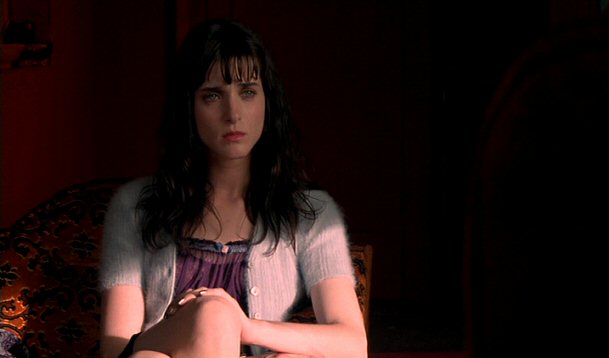
I don't have a good example, but here's a shot that I did in "Twin Falls Idaho" showing the idea of the brighter slash of light at the lower half of someone to suggest sunlight:

tfi7.jpg
 
That is great advice, thanks David! I like that shot, although the bottom is bright it doesn't distract from the top part.

2 questions;
The bright light has slightly soft edges, was that flagged?
What kind of stop difference is there between the two? (Bright and dark)

I'm really interested in the 2nd question as there is a shot in the Gladiator where Russell Crowe's face is half bright lit by (what looks like) sunshine and half in shade and yet both sides are completely visible. I know this is why film is so much better, but I'm interested to know what you can get away with on video too.
 
Back
Top