- Thread starter
- #41

rand thompson
Well-known member
- Joined
- Aug 9, 2011
- Messages
- 18,999
- Reaction score
- 622
- Points
- 113

Follow along with the video below to see how to install our site as a web app on your home screen.

Note: this_feature_currently_requires_accessing_site_using_safari

Looking forward to the full frame version.

Let's see that dynamic range in action! BTW, It looks like an old TV studio camera...
... I think that the larger than S-35 sized image sensor that the ARRI ALEXA 35 has is a great compromise between the aesthetics of a full frame sensor and a S35 sensor image.

You will gain a stop of DR. But you'll also pay more, and require larger lenses. Not a good value proposition. OTOH... more resolution, which is the whole point of V-Raptor. Sensor size per se is meaningless.
And, how would the Alexa 35, hypothetically, compare to a downsampled image from the V-Raptor? Similar DR or what?
Oh, and this camera is terrific because it will do two things: prove again that S35 is the sweet spot for cinema sensors, and kill the stupid idea that larger sensors are 'better' and 'clearer' simply because they are bigger.


Perhaps they can't do that FF sensor with good enough QC? And went for S35 for now...
I can't see how downsampling is related to the DR. Bit depth - yeah, but not the DR, at least not in those values to be conserned of. I'm surprised how long it took Arri to hold out on this camera, it was known that the original plan was to release it in 2020.
17 stops of DR - wow. That's what camera progression should really look like.
No, I think they went for an S35 sensor because that's the area of the Alexa line which needed to be addressed due to it's need to upscale for 4k and the demands of streaming services. They will probably update the large format cameras eventually with this new sensor. After all much like the current cameras, they all use the same sensor just a bigger version of that sensor.
Maybe. But people forget that on initial release it was planned to have a 2k and a 4k version of the Alexa. Arri said they didn't release the 4k version because they were only getting 12 stops from the sensor. It surprised them that the film community embraced the 2.8k Alexa anyway, so they went with it. I don't think Arri will be as wedded to photo site size for iterations of this sensor.
ARRI's Managing Director, Franz Kraus “The Alexa camera family concept had initially included a 4K-plus sensor version to be launched approximately one year after the introduction of the first Alexa. But the outcome of an intensive feasibility study more than two years ago showed that we would sacrifice dynamic range for resolution, so we decided not to proceed,”I don't know where you got that from but it sounds like nonsense to me. Arri put out a 2.8k sensor at the time with the Alexa because they felt that was the best they were able to achieve at the time. It was their way of getting the best possible 1080p image from a bayer sensor. I hardly think they were "surprised" that the Alexa was popular, Arri has always been known for their quality and reliability.
I don't know where you got that from but it sounds like nonsense to me. Arri put out a 2.8k sensor at the time with the Alexa because they felt that was the best they were able to achieve at the time. It was their way of getting the best possible 1080p image from a bayer sensor. I hardly think they were "surprised" that the Alexa was popular, Arri has always been known for their quality and reliability.

Not a good value proposition.
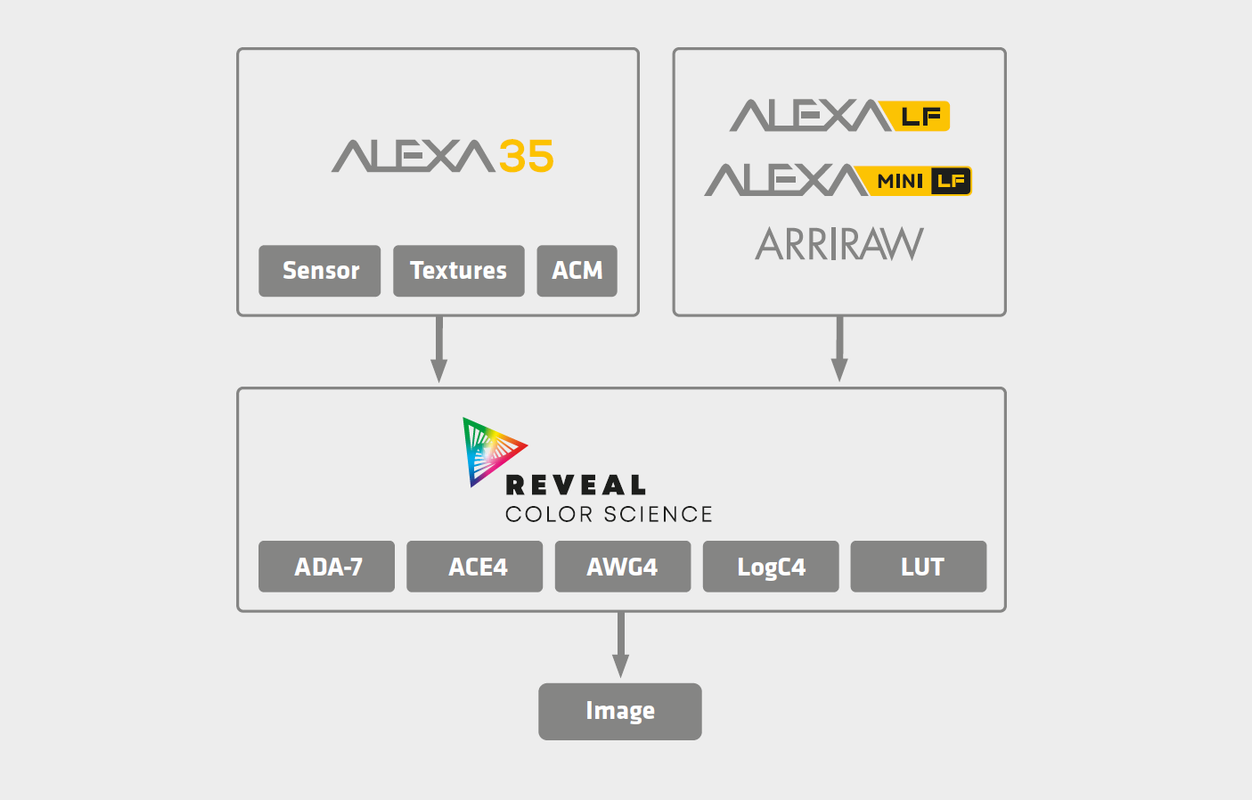
I wonder if the texture thing and the "Enhenced sensitivity mode" is an kind of OFX (or denoise FX) built in after the debayer.
How can you add a texture in RAW when it's not done by the sensor it self (like the noise character of the sensor)?
Patrick
Curious what the logic is with the texture mode; like is it just adding grain in camera? If so, I wonder what the advantage is over doing it in post? (So that it can’t be undone/it’s at the DPs discretion?)