Welcome to our community

Be a part of something great, join today!

  • Hey all, just changed over the backend after 15 years I figured time to give it a bit of an update, its probably gonna be a bit weird for most of you and i am sure there is a few bugs to work out but it should kinda work the same as before... hopefully :)

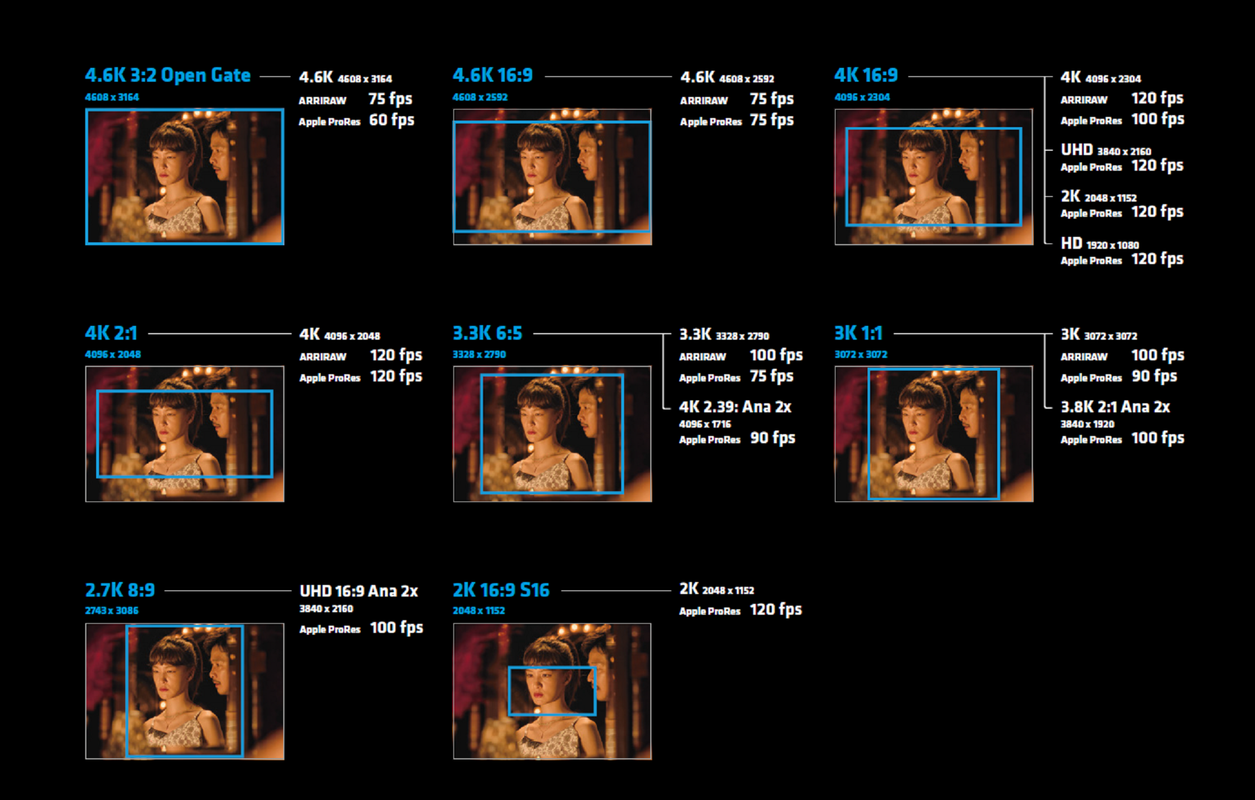
ARRI 4K Super 35 Camera Will be Launched Next Month

Screenshot-4889.png
 
Looking forward to the full frame version.

You will gain a stop of DR. But you'll also pay more, and require larger lenses. Not a good value proposition. OTOH... more resolution, which is the whole point of V-Raptor. Sensor size per se is meaningless.

BTW I have some questions:

Why does Red not use dual gain tech in their sensors? Can you imagine how much DR you would get?

And, how would the Alexa 35, hypothetically, compare to a downsampled image from the V-Raptor? Similar DR or what?

Oh, and this camera is terrific because it will do two things: prove again that S35 is the sweet spot for cinema sensors, and kill the stupid idea that larger sensors are 'better' and 'clearer' simply because they are bigger.
 
Karim,

I sometimes watch this comparison video between the Arri Alexa 65 and the Alexa Mini and I always preferred the Alexa Mini over the ALEXA 65. And Although the Alexa 65 is a much larger sensor than say the Alexa LF/Mini LF, Red Dragon VV/Monstro/Raptor and Sony Venice 1/2, I think this test, atleast for me, shows why I still prefer a S-35 sensored camera image over a Full-Framed sensored camera. I still like some of the image aesthetics that a full frame camera can uniquely offer. However, I think that the larger than S-35 sized image sensor that the ARRI ALEXA 35 has is a great compromise between the aesthetics of a full frame sensor and a S35 sensor image.


Arri Alexa 65 vs. Alexa Mini - Large Format Look Test (s35mm / 65mm)


BY manuelluebbers


Last edited:
You will gain a stop of DR. But you'll also pay more, and require larger lenses. Not a good value proposition. OTOH... more resolution, which is the whole point of V-Raptor. Sensor size per se is meaningless.

Nobody should hold there breath for the FF version of this chip..

For the me the reason to use larger sensors is nothing to do with resolution, DR or confused thinking about ‘large format perspective’

It just opened up the possibility of using different and sometimes more interesting glass.. glass is far more interesting to me than sensors!

And, how would the Alexa 35, hypothetically, compare to a downsampled image from the V-Raptor? Similar DR or what?

ARRI DR and colour repsonce at extremes vs Raptor is difficult to discuss on this forum (even as a Redcamera guy from day one like me) but from what I have seen and the tests I am aware off... this is very impressive class leading stuff and no it will not be very close re DR.

Oh, and this camera is terrific because it will do two things: prove again that S35 is the sweet spot for cinema sensors, and kill the stupid idea that larger sensors are 'better' and 'clearer' simply because they are bigger.

I agree for mainstream work S35 is perhaps a sweet spot but I love my LF Red cameras because they allow me to use the glass I like and over the last 12months I have been very impressed by the work of others produced in S16 and LF ... so let’s hope we all enjoy the choices offered!

Ps I have a TLS canon dream set and TLS Mamiya set that would be wasted on a s35 imager... and there is no real S35 equivalents look wise.. I do agree re modern lenses for example our ARRI Signatures could be for the most part replicated at s35 with lecia sumilux C Lenses ... but I am not sure there is any s35 equivalents of cooke S8s..
 
I can't see how downsampling is related to the DR. Bit depth - yeah, but not the DR, at least not in those values to be conserned of. I'm surprised how long it took Arri to hold out on this camera, it was known that the original plan was to release it in 2020.

17 stops of DR - wow. That's what camera progression should really look like.
 
Perhaps they can't do that FF sensor with good enough QC? And went for S35 for now...

No, I think they went for an S35 sensor because that's the area of the Alexa line which needed to be addressed due to it's need to upscale for 4k and the demands of streaming services. They will probably update the large format cameras eventually with this new sensor. After all much like the current cameras, they all use the same sensor just a bigger version of that sensor.
 
I can't see how downsampling is related to the DR. Bit depth - yeah, but not the DR, at least not in those values to be conserned of. I'm surprised how long it took Arri to hold out on this camera, it was known that the original plan was to release it in 2020.

17 stops of DR - wow. That's what camera progression should really look like.

You gain about a 1/2 stop downsampling 8k to 4k. You would gain 2 stops by binning photo receptor sites of an 8k camera to 4k(4 sites joined to make one). But with binning you start off with just the 4k resolution, and you will get aliasing/moire because the camera's OLPF wouldn't match the lower resolution.
 
No, I think they went for an S35 sensor because that's the area of the Alexa line which needed to be addressed due to it's need to upscale for 4k and the demands of streaming services. They will probably update the large format cameras eventually with this new sensor. After all much like the current cameras, they all use the same sensor just a bigger version of that sensor.

Maybe. But people forget that on initial release it was planned to have a 2k and a 4k version of the Alexa. Arri said they didn't release the 4k version because they were only getting 12 stops from the sensor. It surprised them that the film community embraced the 2.8k Alexa anyway, so they went with it. I don't think Arri will be as wedded to photo site size for iterations of this sensor.
 
Maybe. But people forget that on initial release it was planned to have a 2k and a 4k version of the Alexa. Arri said they didn't release the 4k version because they were only getting 12 stops from the sensor. It surprised them that the film community embraced the 2.8k Alexa anyway, so they went with it. I don't think Arri will be as wedded to photo site size for iterations of this sensor.

I don't know where you got that from but it sounds like nonsense to me. Arri put out a 2.8k sensor at the time with the Alexa because they felt that was the best they were able to achieve at the time. It was their way of getting the best possible 1080p image from a bayer sensor. I hardly think they were "surprised" that the Alexa was popular, Arri has always been known for their quality and reliability.
 
I don't know where you got that from but it sounds like nonsense to me. Arri put out a 2.8k sensor at the time with the Alexa because they felt that was the best they were able to achieve at the time. It was their way of getting the best possible 1080p image from a bayer sensor. I hardly think they were "surprised" that the Alexa was popular, Arri has always been known for their quality and reliability.
ARRI's Managing Director, Franz Kraus “The Alexa camera family concept had initially included a 4K-plus sensor version to be launched approximately one year after the introduction of the first Alexa. But the outcome of an intensive feasibility study more than two years ago showed that we would sacrifice dynamic range for resolution, so we decided not to proceed,”
 
I don't know where you got that from but it sounds like nonsense to me. Arri put out a 2.8k sensor at the time with the Alexa because they felt that was the best they were able to achieve at the time. It was their way of getting the best possible 1080p image from a bayer sensor. I hardly think they were "surprised" that the Alexa was popular, Arri has always been known for their quality and reliability.

I specified that Arri were surprised by the "Film community", not the camera's overall success, Film was still completely dominant in Hollywood at the time and digital had barely made a dent.
 
I wonder if the texture thing and the "Enhenced sensitivity mode" is an kind of OFX (or denoise FX) built in after the debayer.

How can you add a texture in RAW when it's not done by the sensor it self (like the noise character of the sensor)?

Patrick
 
I wonder if the texture thing and the "Enhenced sensitivity mode" is an kind of OFX (or denoise FX) built in after the debayer.

How can you add a texture in RAW when it's not done by the sensor it self (like the noise character of the sensor)?

Patrick

The enhanced sensitivity function is interesting.. I know a little bit about it and it isn't to do with the texture function.

Arri promised many DPs that with their next camera they wouldn't lose anything! No side ways steps. DR was the number one issue. How to use smaller photo sites but have them act like bigger buckets? BUT many DPs loved the texture of the Alexa camera... this texture was, imho, mainly a product of the 2nd 'highlight' AD convertor. So my guess (and it is a guess) is that Arri wants to protect DPs that like and use the noisiness of the old Alexa.. No idea if it will work out but it is very interesting!

If they have found a way to add texture to a image in raw in a really pleasing way I am confident it will win some friends.. It wouldn't make much sense for Red to do this but interesting never the less.
 
I'm still waiting to see a sharp picture from this camera. RAW 4.6k is a no go but seems to be Netflix approoved as the Black magic Ursa Mini 4.6
DR and Color wise they are getting in a nice place. Soo much room to trash infos in post. Because the container will be (at best) P3.
 

Attachments

  • LogC4.png
    LogC4.png
    41.8 KB · Views: 0
If there was supposed to be a 4K version of Alexa Classic, I wouldn’t be surprised if the drop in DR was due to not having the processing power/datarate throughput to do DGA at that resolution circa 2010 (a year into ALEVIII). And seeing how well Alexa with only 2K prores was doing (and in retrospect), it didn’t hurt to scrap it.

Curious what the logic is with the texture mode; like is it just adding grain in camera? If so, I wonder what the advantage is over doing it in post? (So that it can’t be undone/it’s at the DPs discretion?)
 
Curious what the logic is with the texture mode; like is it just adding grain in camera? If so, I wonder what the advantage is over doing it in post? (So that it can’t be undone/it’s at the DPs discretion?)

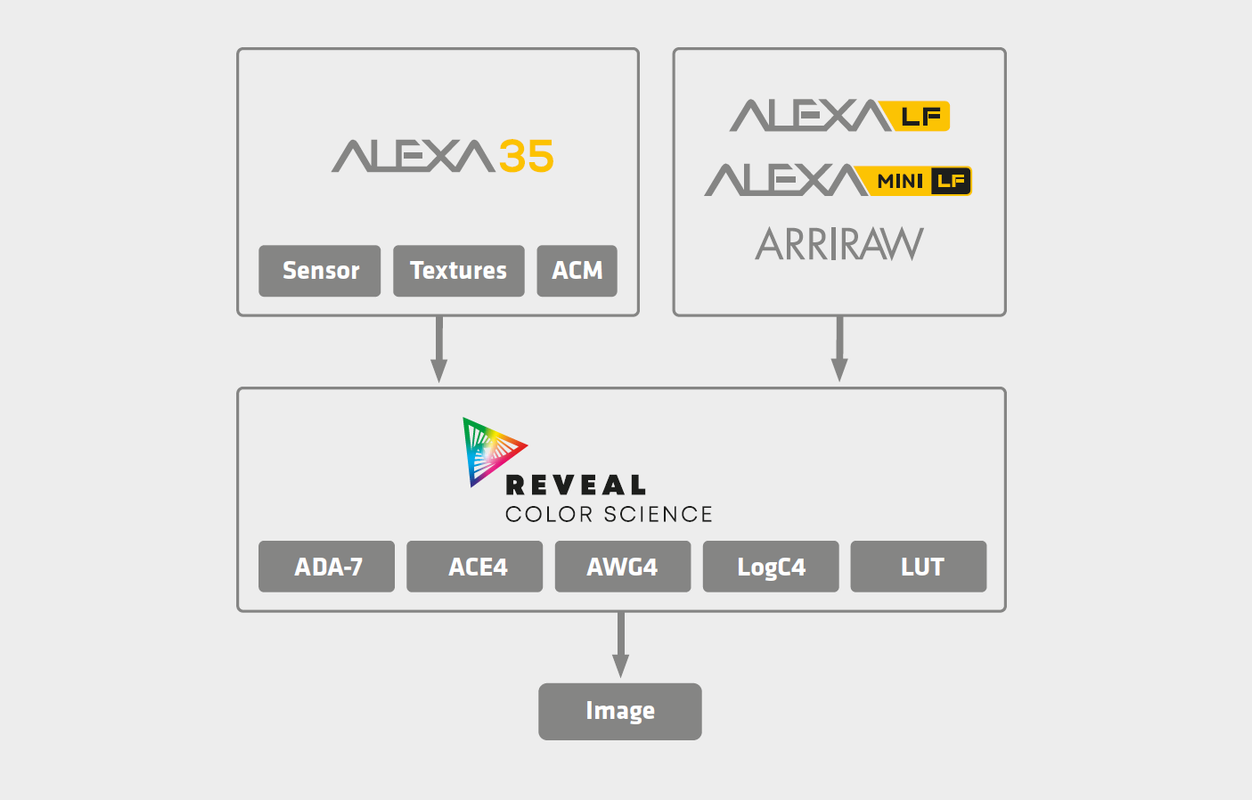
According to the diagram from the Alexa35 brochure, TEXTURES appears to come between the Sensor Data and the Analog Conversion Module(at least I believe that's what ACM stands for)

Screenshot-4892.png
 
Arri is a very conservative company and I think they didn't want to take away anything. The Alexa is an extremely noisy camera and some DPs like the noise that it has.

I wonder if the "textures" are just noise added to the image or if they're noise added to the signal before de-bayering. Regardless, it seems like a dumb feature to me but it also feels in keeping with Arri's conservative "take nothing away" approach. I'm honestly kind of surprised there's no 3.2k mode for workflow continuity.

I feel like this is a stupid feature, yet of all the sample images the one with "texture" added looks best to me. But this is something that should be so easy to do in post, while it would also make post much more difficult working with such a noisy source. For composites Alexa footage requires a lot of Neat Video. I find Red footage can too but mostly because DPs I know like to use the Dragon (noisiest Red sensor) and underexpose to bring up the noise. Dragon also has a great texture though.
 
Last edited:
Back
Top