Welcome to our community

Be a part of something great, join today!

  • Hey all, just changed over the backend after 15 years I figured time to give it a bit of an update, its probably gonna be a bit weird for most of you and i am sure there is a few bugs to work out but it should kinda work the same as before... hopefully :)

Why Bigger is Better (but not much else) S35mm vs. Vistavision Comparison

I've just put abbreviation for focal length.


This is the effect we all know, a combination of focal length, distance and format crop:
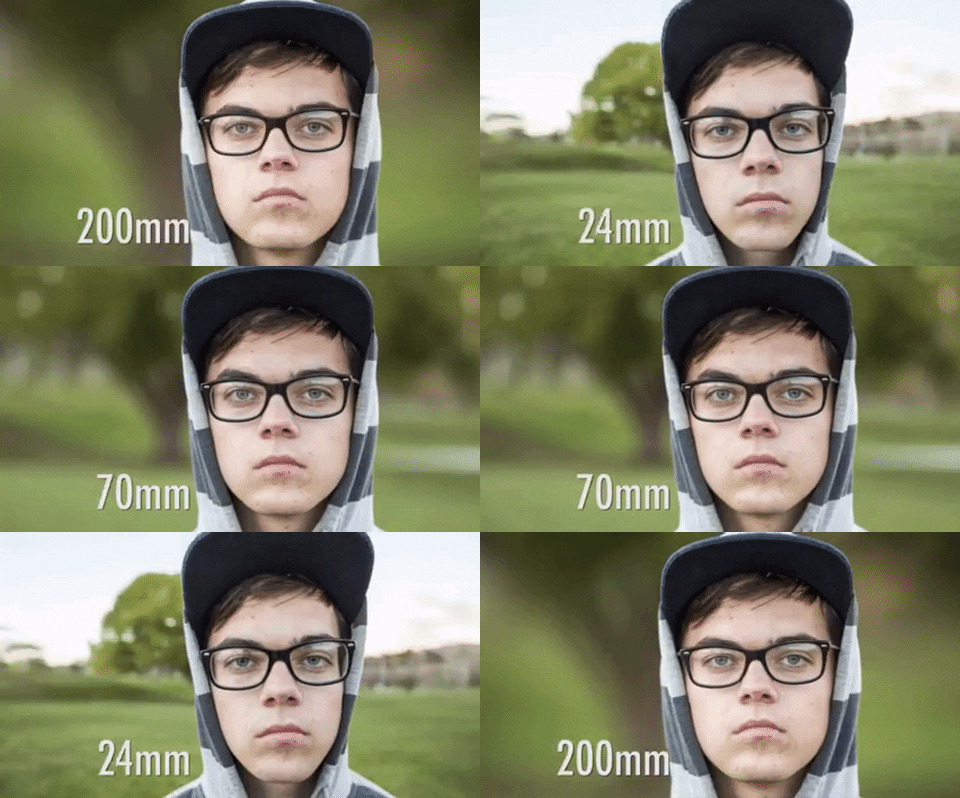

giphy.gif


The video here is the best one I've seen to demonstrate how focal length works. (Did you shoot it Hrvoje?) Usually they are never done with the exact same field of view, but when done right, like here, you can truly see that a longer focal length does NOT have shallower focus. This is an argument I have with directors all the time. Going on a longer focal length does not yield a shallower depth of field if the field of view stays the same. The two things determining depth of field is sensor/film size and aperture. The background might at first appear more shallow on the longer lens due to the magnification of that part of the image, but if you look carefully in a clip like the one here, you see that the amount of blur in the background is consistent between the widest lens and the longest one. On the longer one we just see it larger.

This is probably obvious to all readers here, but even many seasoned filmmakers still won't believe it! It's all those crappy photography course books, claiming you should use a telephoto lens for shallow focus, showing photos with wildly different field of views to demonstrate depth of field, that have confused us all. Alternatively in tabletop, it's often suggested to go to a wider lens for more focus when it's too shallow, but as you move the camera closer to get the same size on the new lens you slowly realize that you're chasing your own tail...

Martin
 
There's a way to convince yourself that focal length changes nothing about the relationship between objects.

The amount of light that reaches the lens from any small surface is reduced by the distance of the object squared. Inverse square law.

The size of the object as it moves away is also reduced, twice as far and it's half as tall, half as wide in frame. Also inverse square law.

The two effects exactly cancel so that the less light which arrives, fills a smaller surface, maintaining illuminance.

If objects didn't render this way, they would get brighter or darker as they moved away from the lens, which they obviously don't. So all lenses must follow this principle.

And since this applies to all lenses, and applies to all points that make it into the image, the lens choice seems to have no effect on perspective.

You can also check this idea with bokeh. A point source in focus might clip, but put it out of focus and its bokeh will likely have color and detail. The further out of focus, the bigger the bokeh, but also the darker the bokeh. So you can see that if the light that hits the lens is spread out, it will be darker.
 
like here, you can truly see that a longer focal length does NOT have shallower focus. This is an argument I have with directors all the time. Going on a longer focal length does not yield a shallower depth of field if the field of view stays the same. The two things determining depth of field is sensor/film size and aperture.

IN YOUR FACE David Mullen! wooo hoo! ;-) I'm kidding, but I have been having this argument with David for literally years. Carry on, good work all ;-)

Nick
 
Alright here is a great article that shows some depth of field format comparisons calculations using actual science. As I am a mathematical bimbo I have not plugged the 46.31 mm diagonal of the Monstro sensor into the supplied formulas. Can anyone give it a go?

https://www.fdtimes.com/2018/03/13/jonathan-maxwell-on-full-format-vs-s35-dof/


The author of the article mixes up the terms Hyper focus and DoF. Dof is not a flat value where things is considered sharp its a exponential curve where things goes more and more to defocus. And its more exponential towards camera from the focus point than away from it.

He also compare big and small sensors with the same focus distance, that gives an error. Naturally the focus distance need to change to keep the same nodal point.
 
Not that it matters a whole lot (but it does a little) but the diagonal /DOF relation is only maintained for the same aspect ratio formats. Same aspect ratio formats will change the object magnification ratio according to the diagonal. Once you change the aspect ratio of the sensor the magnification ratio will not follow the diagonal change any more... since the DOF if a function of the F-stop and magnification ratio, comparing diagonals of different aspect ratio formats will introduce an error.
I hope I'm somewhat clear here...
What a way do make a 3K post (woohooooo!!!)- sorry- could not resist ;-)

Jacek,

Good point and I was wondering this myself. When we did the f stop difference for the ASC test we only used the horizontal sensor measurement thus removing the influence of aspect ratio but I do not know if that stuffs up the maths? The calculations and results shown at the end are based on full gate sensor size so are instructive but I don't think anyone would shoot Alexa LF at 36.70mm wide x 25.54mm high for an aspect ratio of 1.43. I so should have listened at school.
I was pondering on that a bit and came to conclusion that horizontal is the way to go for aspect ratio agnostic calculations.
 
The video here is the best one I've seen to demonstrate how focal length works. (Did you shoot it Hrvoje?)

Nope. Found it online.

Usually they are never done with the exact same field of view, but when done right, like here, you can truly see that a longer focal length does NOT have shallower focus.

You cannot judge lens DoF on this shot alone as we don't know the iris used for each focal length and distance to object differs because the photographer aimed to keep the face the same size.

This is an argument I have with directors all the time. Going on a longer focal length does not yield a shallower depth of field if the field of view stays the same.

If the field of view stays the same for a different focal length on a same format distance to object differs.
Same distance = different DoF per focal length.

Depth of field is not fixed throughout distance, it is logarithmic in nature and increases with distance.
 
Nope. Found it online.


You cannot judge lens DoF on this shot alone as we don't know the iris used for each focal length and distance to object differs because the photographer aimed to keep the face the same size.

True, but although the resolution and compression is poor, it does look like the BG has a remarkably similar blurriness in the wide and long lenses. It's of course possible that a larger aperture was used for the wider lenses, or vice verse, but if so it doesn't appear to be by much. I have no information on who did this test but it's not unreasonable to think that a constant aperture was part of the test as well. Would love to find a higher resolution version of this...!

If the field of view stays the same for a different focal length on a same format distance to object differs.
Same distance = different DoF per focal length.

Exactly. Because the field of view is the same in all shots, the distance has varied. The camera has been moved to accommodate the eyes to be the exact same size and distance in all shots. The new distance on each new lens maintains the field of view and also the amount of blurriness in the objects around the focus point.

Depth of field is not fixed throughout distance, it is logarithmic in nature and increases with distance.

True. The focus point is the eyes and that's the only point that's truly in focus - all other areas are a degree of out of focus. When the camera is moved back for a longer focal length to maintain the field of view in the focus plane (the eyes), it is now further away from the BG by a few feet. At the same time the focus point is set further away from the film plane since the eyes are a few inches further away as well. I believe this makes up for that difference. In this test the BG is so far away that the change in distance is more forgiving for sure, and a true depth of field test would include more objects at different distances in the BG, as well as an object in between the camera and the subject.

However, I was really pleased to see this test being executed so well in terms of maintaining correct field of view (of the eyes), and it really helps you see how remarkably similar in blurriness the BG is on different lenses when you do that.


Martin Ahlgren
Director of Photography
 
Its for sure same IRIS.

Think it´s called "hitchcock zoom" a horror trick. Puling focus and zoom to counterstear track. And yes the blur seams to stay exactly the same and just get scaled with the magnification which is right.
 
Depth of Field describes the distance range where things appear to be IN focus — the reason longer lenses give the appearance (or illusion) of shallower focus is that the background becomes enlarged and the amount that it is out of focus is more apparent. Whereas with wide-angle lenses, there is the appearance of deeper focus, even if the depth of field is not great, because the background details appear smaller and thus their degree of sharpness is harder to judge. Look at how many people describe Kubrick films as being “deep focus” when often they are shot on wide-angle lenses at fairly wide-open apertures.

I’m talking here about perceptions.
 
Now I'm confused:
How can the back ground become enlarged when the field of view is the same? Where would this enlarged back ground fit?
Isn't this thread about the back ground NOT being enlarged?
 
I’m talking about when the subject size remains the same. Obviously if you back up further to get the wide shot but on a longer lens you’re going to get an increase in depth of field from focusing further, but now your foreground subject will be smaller.
 
OK Thanks David. I thought I was losing it. So we are not talking about maintaining perspective on different formats any more (by keeping the same distance while changing the FL and stop)... just making it clear for everyone...;-)
 
It proves exactly what I was saying and shows that "speedbooster" emulates a larger format.

"Speedbooster" changes the APS-C crop to a larger FF crop. It remaps the FF crop image to an S35 plane as if you shot on a larger format. You do actually get a larger format effect. Without it, this image on APS-C would be cropped significantly, with AOV like 75mm on FF. It wasn't. Crop was much closer to 50mm on full frame AOV, but not 100% because the adapter is not exact 0.7.

It is confusing so many misinterpret it as if it simply leaves APS-C crop and you just get more light. It doesn't. You get a larger format lens crop remapped. You are looking it the other way around in this case and starting from the wrong premise. This is not what a S35 crop without the adapter looks like. The adapter gives you a larger chunk of the image squeezing larger AOV onto a smaller plane and the product branding is misleading.

Think of a "speedbooster" as a solution which provides you a larger format lens coverage/extraction.

When I find the time I can shoot a test with and without the adapter if it helps.

I'm not sure that really follows Hrvoje. The speedbooster is simply another optical element, is it not? One that projects a smaller S35mm image-circle from the taking lens.

If the same element were contained within the construction of a new lens that incorporated the same optical design as the original Vistavision lens up-front - you would simply have a S35mm lens, but one that matches the optical properties of the original Vistavision lens almost exactly (as shown in your test) and doesn't cause any changes to spatial geometry in a comparison of the two formats.

Since this is the case (and your own test proves it), how can the argument hold, that spatial geometry is changed by the focal length itself, rather than the specific distortion characteristics of the lens used to capture a particular AOV on a particular format?
 
To be concise: a FLR, assuming it matches the target format precisely, and assuming that aspect ratio is the same between the large and smaller formats, preserves all the characteristics of a lens onto a smaller format. There are in-betweens, of course, so there is a spectrum.

You might get a gain in contrast (TBC, as nobody has given an absolute answer on that), but you'll get all the DOF characteristics, and you might get some extra aberrations depending on the lens.

Larger image planes are often better because of the image plane, not because of the relationship between FL and AOV. That is not a trivial statement, but we don't need to introduce fantasy into it.

I'm not sure why there is some muddled thinking about this. It's fairly easy stuff to understand. Am I being too unfair when I say that cinematographers should be more clear-headed about these things?

Thinking out loud, as if it's going to help.
 
Still waiting for that list of things that happen when you move to a larger imager.

So far these are what we got:

- Increased resolution for the imager it self. Quite self explanatory. If you got the same waffer and cut a bigger part of it you get more pixels and better resolution.

- A loss of light. If you film the same scene with the same FOV but spread it out on the bigger imager you get less light per square area of the surface, if you swap to a sensor that is twice as wide your photosites / pixels are only getting 1/4 of the photon hits from filming the same scene / same FOV.

- Lenses built for larger sensors is in one way easer to make as the precision and the tolerances needed when making them becomes smaller, but they are also slower.
 
Well, I think that the mathematics will give us the more refined conclusion, taking into account the correct CoC etc. But what you say is true (although a scientist would probably use more precise words).

So for example: a 55mm Otus covers VV whereas a Super Speed 35mm covers S35, and they both give roughly the same AOV. But you have to stop down the Otus to get the same DOF, so you reduce the light. Having said that, in many lighting situations you won't have to raise the ISO of the VV sensor.

Of course I am simplifying. But I think I'm just repeating what others have written.

Well the Otus is simply a very high performance lens in the FF range. opens f1.4 where as the super speeds are also very good but not close to the Otus lenses in performance considering their smaller image circles, Even though they are 0.1 faster. The Otus with a FF to S35 booster would simply be faster and better than the super speeds.

But all that is comparing lenses. And yes we gone in full circle doing so quite a few times in this thread.

Regarding ISO. If you compare two sensor sizes one twice as big as the other and you got the same kind of photo sites / same density on the sensors and have focal lengths set to give you the same fov. and you adjusted the stop to get the same CoC then your larger imager would need to lift your light levels / ISO x4. Thats a fact every pixel of that camera would only be fed 1/4 of the light.

Sure doing so maybe does not hurt your final result it depends how far off from the DR of the imager you are and as you also got 4 times the amount of pixels you can cut the noise by the same amount when you compare the two images at a common resolution and as we deal with debayering sensors, more pixels on the same FOV are better than less as it helps the debayer process.

Im no Scientist and english is not my first language and I learned most of this from my dad feeding me with napkin drawings at the breakfast tables to go with my cearials.
 
The Otus with a FF to S35 booster would simply be faster and better than the super speeds.
I think you're right.

Going back to our example, SuperSpeed+S35 vs Otus+VV, let's say that your light levels are T8, ASA 320, 24fps, 180 deg shutter. Both cameras can be set anywhere from wide-open to T8. In that case, the VV sensor has the same ASA as the S35 sensor.
 
I think you're right.

Going back to our example, SuperSpeed+S35 vs Otus+VV, let's say that your light levels are T8, ASA 320, 24fps, 180 deg shutter. Both cameras can be set anywhere from wide-open to T8. In that case, the VV sensor has the same ASA as the S35 sensor.

They can not keep the same ISO if you want to match the CoC. As to get the same dof on both you would need to close down on VV or open up on the s35. So to create the same looking image you need more light, light sensitivity or longer exposure for the larger imager. There is no way around it.

In most books the need for more light is not a positive. So this is not something that can be added to the list of great things happening when shooting with a larger format. That pretty much leaves us with only ”better resolution” on the list. Which is what Mark stated when starting this thread, then here has been talk about prespective changes and all kinds of strange light bending theories that I so far, have not seen proven true here or anywhere else.

So when creating the same image with a larger sensor you get the following:

- A need for more light.
- The possibility to fit more pixels/resolution.


Other differences are due to lens constructions or ill placed nodal points in the comparisions made and not in a direct way related to the size of the backplanes of the camera used.

Speed boosters and extenders are only ways of making one focal length lens into a different focal length by altering the size of the projection circle of the lens. Your 50mm with a x2 extender is no longer a 50mm lens. It´s a 100mm lens with twice the size image circle. And if you put a x2 speed booster on the same lens you got a 25mm lens with half the size image circle and close to double the speed (some is lost in the additional glas).

Different lenses comes with different glass arrays and provide different sized projections, amount distortion, chromatic aberration etc and also different character in CoC falloff. There is no real general assumption that can be made for a lens with larger image circle compared to a lens with a smaller image circle except for the fact that the larger image circle is more difficult to make as fast by the exact same factor as the size increase of the circle.

But all lenses, with no exception, show the same perspective if the nodal points are aligned. Simply no lens can alter the position of things or scale of things infront of the lens. Sure, lenses can be more or less rectlinear but that is just a distortion / character of the lens and it´s different from one lens to the other and is again not directly related the size of the backplane of your camera. Then sure, swing shift lenses are something else but thats another discussion.
 
Back
Top