Welcome to our community

Be a part of something great, join today!

  • Hey all, just changed over the backend after 15 years I figured time to give it a bit of an update, its probably gonna be a bit weird for most of you and i am sure there is a few bugs to work out but it should kinda work the same as before... hopefully :)

The restructuring of the post-production industry ...

Hi, Frank,

I'm very familiar with this particular project, and I don't think it's the best example of what you're referring to. The project you cite was a very niche documentary in which the Executive Producer was actually a principle at one of the facilities mentioned. It does serve as an example of how what post is is evolving.

Any post house with ambitions of staying relevant (and profitable) should be focusing on becoming content owners and not simply service providers. It's not necessarily a race to the bottom to do free work, it's a calculated investment towards owning the content on which you work, and remaining a profit participant long after the project is released. To me, this is the next logical step in the redefinition of what "post" is. It starts well before a frame is shot, and can be a source of revenue long after the work is complete for facilities that make strategic investments in content.

Paul

 
Paul, welcome to reduser!

I will have to disagree to agree with you. A post house is NOT film financing business. A post house may decide to do film financing, but that requires some $ from the post house. I have lost the post of a few films because of this kind of "post deals". I don't mind one bit as those post houses eventually folded or decided to stop that kind of work. A big example would be The Kngs Speech, which was dne under a similar focus, alas, Molinare (the post house) has recently decided that they no longer will participate in that kind of business.

To each his own, but I firmly believe that if u want to own films, financing is the right way. But post isn't financing.It's post.


Paul, I hope you will stick around RU and help us grow this community :)
 
Conforming, grading is one thing... CG / 3d / VFX is another... When you have a job were you need 20 to 30 3d dudes bashing out a few 3d heavy shots for you in a week and then compositing them into live action plates... I'm afraid that process will stay in brick buildings for a while yet. You can do alot of it yourself for sure. But this argument all comes down to the scale of the job.

Post is changing fast, im a huge advocate of change. But post is way more than just grading 5k's in a lap top I'm afraid.

But I get what your saying. I also do a lot from my laptop.

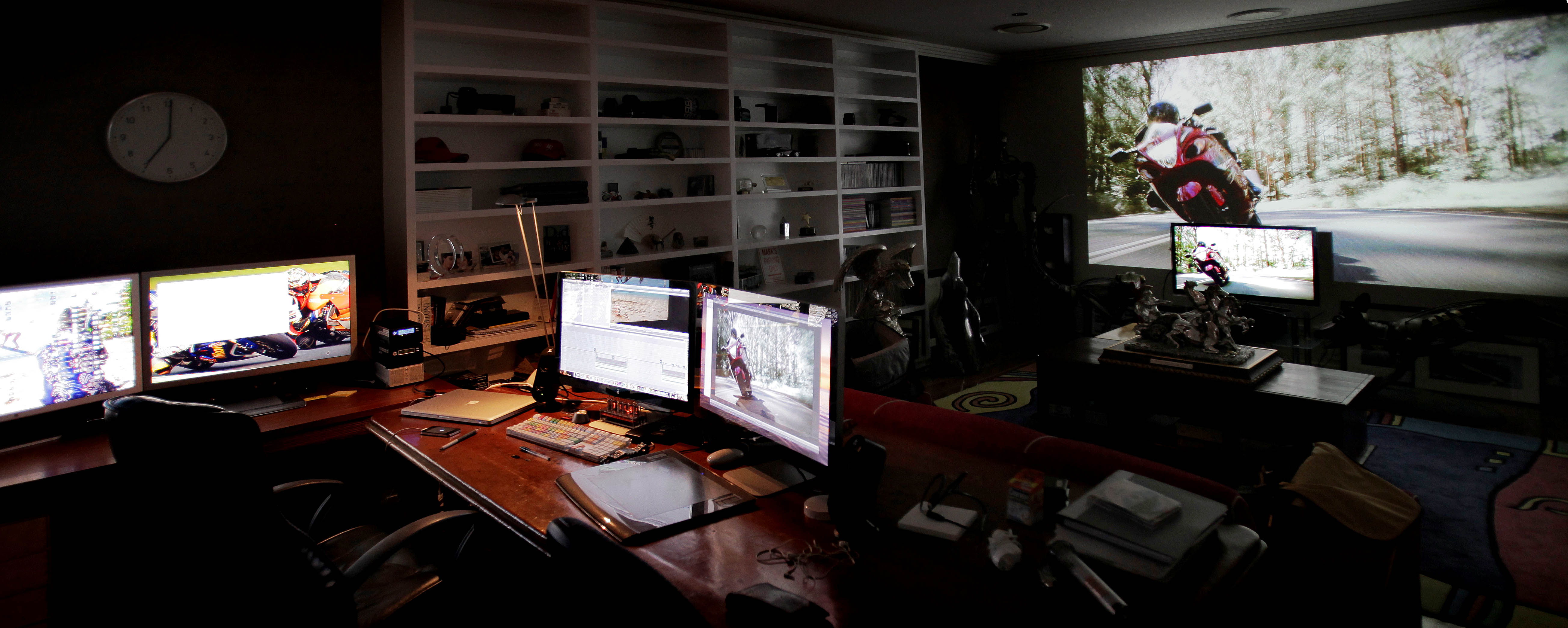
My_office.jpg

100% agree. Also, some things, like editing and even color grading are best done in a calm environment with no distractions - let alone a proper neutrally painted grading environment - not on set next to the craft table over 15 minute breaks while someone is urgently asking you a question about something else. that's just silly. And why would you make your hourly paid actors, crew and location wait while you do what does not really need to be done on set on set? Shouldn't the camera work be focussed on during the production day, and the post later?

A set is typically much more expensive than any "brick building". I say, give me the brick building.
 
I'm directing TVCs and such. I often do the camera as well. I don't have time to evaluate shots on set apart from content, timing and focus. Grading on set is a nightmare. Too many clients around, and obviously no time available to make meaningful decisions. Set is set and post is post. Of course every director is different but I prefer rather to shoot another take, to rehearse a new idea than to sit behind the screen and discuss.

Although we had a massive shift from 35mm to digital the principal workflow did not change at all. Shoot, develop/telecine, edit, CG and finishing. Now you do telecine while you shoot. Nice. One day saved. Is this a revolution?

We do HAVE a revolution in post production regarding the ceasing of big iron systems and the availability of a zero dollar grading software. But for proper post I still need to have my Smoke on a big box with a big screen, tablet, big array and some guys assisting me. I still need my aeron chair and a proper coffee machine (at least my clients).

I've done edits in my hotel room off dv-taped 35mm video-tap footage back in 1998 with FCP1 on my laptop. Clients found that interesting. In the end I did not find it worth the time and hassle. Now I can do hat in online quality. That's a big lap for sure but not a revolution. And I take very rarely the opportunity. I prefer a beer after the wrap, a shower and a nice dinner.

Hans

I am so with you.
 
the difference between On-set and Near-set ...

the difference between On-set and Near-set ...

Great discussion, guys ... keeps the questions and points coming.

One area where we seem to be getting our knickers in a twist (panties in a bunch - for our American cousins) is the difference and importance of what gets done On-set versus Near-set and when it gets done ... in my postings, I always draw a big distinction between On-set and Near-set and see them as quite separate and different operating domains ... there are certain things you might choose to do On-set and there are definitely things you don't want to do On-set ... also, the optimum choice of where to do file-based workflow will change with the kind of content you're working on ... let me clarify:

1) shooting a Feature, TV Episodic or Commercial places different priorities on the demands of dailies processing and look management .... in the features world, next day dailies might be totally acceptable ... in episodic TV having morning's batch of dailies ready for editorial might be appropriate ... and for TVCs you might want the dailies processed in parallel with the shooting.

2) On-set review of footage is a no-no in TV episodic work - too much coverage to get though on a shoot day without having the DP and Director stop to replay what they've just shot, whereas on a Feature where production days cost a fortune you might want to make sure you have all the coverage you need before you strike the set. On commercials seeing exactly what you have with final color as quickly as possible is often desirable ... if you have two days to shoot and cut a 30 second spot you sure as hell want to make sure the client signs off on what you're getting in the can before they leave set.

3) Near-set can mean anything from being in the same sound stage with the camera guys but at the other end of the stage in a video village or DIT cart - you don't have to be tethered to the camera to do efficient data management and look management near-set ... it might mean being in the parking Lot in Blair's truck or up on the third floor with the editors ... and again, it doesn't take much to prepare a light controlled environment with grey walls and a calibrated monitor for accurate grading of dailies and final color ... hell, we took a Dolby PRM-4200 monitor to the DGA Digital Day and people seemed to think the image quality of the dailies we were processing with Express Dailies was pretty damn good .... and that was in the large open atrium of the DGA lobby area.

The main point I'v been making in this discussion of the re-structuring of the post industry is that with new powerful hardware and software tools like Express Dailies and Resolve 9 you can quite literally take the lab to the set, even if the set happens to be out in the African jungle or in the wilds of Burbank! File-based workflow enables geography free processing of digital files to a very high standard wherever you want to do it.

In our 'Dailies in a Box' solution (actually dailies in several boxes - but that doesn't quite have the same marketing ring to it) we offer three levels of service ... DiaB Lite based on an Apple Retina Display MBP and Resolve 9 ... DiaB Medium based on a MacPro Tower and Express Dailies with plasma based grading ... and DiaB Heavy based on MacPro Tower with a PCIe Expansion chassis and real-time look management dailies with a Sony BVM or OLED display ... all three are very capable systems at three different price points for different levels of need.

More details of our 'Dailies in a Box' service are available in a short video on our website ... check out the video to get a better sense of what can be done where at different price points ... click on the 'Workflow that Works' image on the front page - or play this video directly:

http://www.hollywooddi.com/resources/hwdi/DiaB_HDI_Website_v01.mov

Cheers,
Neil
 
"Not difficult at all"?

Honestly Mike, I dont know which IATSE Union you are talking about, maybe you are only talking about Los Angeles DITs joining but In NYC and the entire East Coast its very very difficult.
I can say for Local 52 NYC/East Coast (Grip, Electric, Props, Set Dressing, Sound) and 600 in NYC that Non Union hours are completely unacceptable.
For Local 52 it takes much more than a payment of initiation.

You need to sign up for the test,
Pay an application fee, have your application approved,
Get "Permitted" to work on a Union Job,
Collect 100s of union hours
Take the test,
pass the test(which has a huge failure rate),
Go to a Union Vote which is only twice a year, hope that there is over 200 members to make a legal Quorum,
Have 2 members stand up for you and address the meeting on why you should be a member,
Get voted in,
Then Pay initiation fees.

In addition you need to take an Osha Articulating lift Class followed by written and practical test where you take a 90' Condor to Maximum height with any warning beeps, and I didn't get any stipend for it, and out of curiosity, who and why would would they pay for this?

For Local 600 in NYC, you need to be hired by a producer of a Union Job that will represent you joining through their job (Good luck with that, Its about the last thing a producer wants to do), and then get letter's of recommendation from Local 600 members, then pay 25% of $10,000 and pay off the rest in 6 months.

Ive never understood in what is promoted to be the most free and open country in the world where there are so many restrictions around the ability to work. Why so much union restriction and why is it so expensive ?
 
I can think of only three factors that can insure just compensation and a safe workplace; government regulation, collective bargaining, and the concern for the welfare of the workers on the part of capital.

Where you put your trust is up to you, but history is not replete with stories of the kindness of the corporate heart. Doubtless there are companies that recognize the value of a prosperous workforce, but I suspect there are many more of the other kind, the sort that see asbestos exposure or black lung as just another cost of doing business. The early days of the industrial revolution was a horror show and we still have major players doing quite wicked things to the environment and people.

Good shooting and best regards,

Leo
 
Ive never understood in what is promoted to be the most free and open country in the world where there are so many restrictions around the ability to work. Why so much union restriction and why is it so expensive ?

Dave, I think you are focusing on too narrow a slice of the business.

Software, hardware, Red cameras... these are solutions to being excluded from certain arenas of work. Taking the country as a whole, there are so many places (right-to-work states) where an individual or group of individuals can band together and create content with few or no restrictions. This really is the land of the free and is becoming free-er all the time.

The Old Guard (unions) will probably continue to hold sway in their current domains as long as Hollywood and New York remain content creation centers, but there are so many other avenues open to those who are not in the "clubs" that I don't see their memberships continuing to grow much in future.
 
I can think of only three factors that can insure just compensation and a safe workplace; government regulation, collective bargaining, and the concern for the welfare of the workers on the part of capital.

Where you put your trust is up to you, but history is not replete with stories of the kindness of the corporate heart. Doubtless there are companies that recognize the value of a prosperous workforce, but I suspect there are many more of the other kind, the sort that see asbestos exposure or black lung as just another cost of doing business. The early days of the industrial revolution was a horror show and we still have major players doing quite wicked things to the environment and people.

Good shooting and best regards,

Leo

Leo, don't forget lawyers. Companies probably fear them more than they fear unions. Unions can be (according to past history) bought off. Lawyers are a little harder to control.
 
Great discussion, guys ... keeps the questions and points coming.

One area where we seem to be getting our knickers in a twist (panties in a bunch - for our American cousins) is the difference and importance of what gets done On-set versus Near-set and when it gets done ... in my postings, I always draw a big distinction between On-set and Near-set and see them as quite separate and different operating domains ... there are certain things you might choose to do On-set and there are definitely things you don't want to do On-set ... also, the optimum choice of where to do file-based workflow will change with the kind of content you're working on ... let me clarify:

1) shooting a Feature, TV Episodic or Commercial places different priorities on the demands of dailies processing and look management .... in the features world, next day dailies might be totally acceptable ... in episodic TV having morning's batch of dailies ready for editorial might be appropriate ... and for TVCs you might want the dailies processed in parallel with the shooting.

2) On-set review of footage is a no-no in TV episodic work - too much coverage to get though on a shoot day without having the DP and Director stop to replay what they've just shot, whereas on a Feature where production days cost a fortune you might want to make sure you have all the coverage you need before you strike the set. On commercials seeing exactly what you have with final color as quickly as possible is often desirable ... if you have two days to shoot and cut a 30 second spot you sure as hell want to make sure the client signs off on what you're getting in the can before they leave set.

3) Near-set can mean anything from being in the same sound stage with the camera guys but at the other end of the stage in a video village or DIT cart - you don't have to be tethered to the camera to do efficient data management and look management near-set ... it might mean being in the parking Lot in Blair's truck or up on the third floor with the editors ... and again, it doesn't take much to prepare a light controlled environment with grey walls and a calibrated monitor for accurate grading of dailies and final color ... hell, we took a Dolby PRM-4200 monitor to the DGA Digital Day and people seemed to think the image quality of the dailies we were processing with Express Dailies was pretty damn good .... and that was in the large open atrium of the DGA lobby area.

The main point I'v been making in this discussion of the re-structuring of the post industry is that with new powerful hardware and software tools like Express Dailies and Resolve 9 you can quite literally take the lab to the set, even if the set happens to be out in the African jungle or in the wilds of Burbank! File-based workflow enables geography free processing of digital files to a very high standard wherever you want to do it.

In our 'Dailies in a Box' solution (actually dailies in several boxes - but that doesn't quite have the same marketing ring to it) we offer three levels of service ... DiaB Lite based on an Apple Retina Display MBP and Resolve 9 ... DiaB Medium based on a MacPro Tower and Express Dailies with plasma based grading ... and DiaB Heavy based on MacPro Tower with a PCIe Expansion chassis and real-time look management dailies with a Sony BVM or OLED display ... all three are very capable systems at three different price points for different levels of need.

More details of our 'Dailies in a Box' service are available in a short video on our website ... check out the video to get a better sense of what can be done where at different price points ... click on the 'Workflow that Works' image on the front page - or play this video directly:

http://www.hollywooddi.com/resources/hwdi/DiaB_HDI_Website_v01.mov

Cheers,
Neil

A few misconceptions here: firstly, in TVC world the client is in attendance in post. Any good DP knows what can or cannot be done later and the director and producer can explain this to the client/agency- and it should be done later. Agency discussions involve many people and can be very lengthy. A final grade on set would likely mean a 20 hour shooting day running way over budget. It's just like another poster said - just because you can does not mean you should.
 
Dave, I think you are focusing on too narrow a slice of the business.

Software, hardware, Red cameras... these are solutions to being excluded from certain arenas of work. Taking the country as a whole, there are so many places (right-to-work states) where an individual or group of individuals can band together and create content with few or no restrictions. This really is the land of the free and is becoming free-er all the time.

The Old Guard (unions) will probably continue to hold sway in their current domains as long as Hollywood and New York remain content creation centers, but there are so many other avenues open to those who are not in the "clubs" that I don't see their memberships continuing to grow much in future.

Yes, land of the free to make less than minimum wage. These "Old Guards" protect many of us from having the lifestyles of Walmart greeters. I don't understand how Americans define freedom. Here in Canada, anyone is free to go to University, even an Ivy League University, because the government pays for it. Same goes for Western Europe. In the U.S., only children of very rich people have that "freedom", and so most people have rather constricted choices in life. To me, constricted life options for 90% of the population is not "freedom", and will not embolden people to take risks and innovate. I would not have started my own business, which generates jobs and revenue, if my government did not provide a safety net of free healthcare, housing assistance f ever I needed it, etc.
 
Yes, land of the free to make less than minimum wage. These "Old Guards" protect many of us from having the lifestyles of Walmart greeters. I don't understand how Americans define freedom. Here in Canada, anyone is free to go to University, even an Ivy League University, because the government pays for it. Same goes for Western Europe. In the U.S., only children of very rich people have that "freedom", and so most people have rather constricted choices in life. To me, constricted life options for 90% of the population is not "freedom", and will not embolden people to take risks and innovate. I would not have started my own business, which generates jobs and revenue, if my government did not provide a safety net of free healthcare, housing assistance f ever I needed it, etc.
Rob, your view of America is probably just as inaccurate as my view of Canada and Western Europe... which is that the population is capped at how high it can rise. Sure you have a few millionaires and even billionaires, but I see those two places as holding down the cream so it mixes with the milk a little more. I also see this country (America) as a place where cream can rise to the top. I think that is why Red Digital Cinema and Oakley came to be in America and not some other country.

But to keep this on topic, I think the post options being introduced in this thread show just how innovation can create change since creation of these ideas are not capped.

I certainly agree with Rob here and the ethos mentioned for the support of state for Education health care and safety and Id also add public service broadcasting which provides for relatively unbiased information in our country atleast. I too would not run my own business to innovate, invent do new things and I hope prosper, with out all these things being in place. I do actually support unions in moderation, just what I find odd is the strength of them in USA. Appoligies for hijacking the thread.
 
Social and economic mobility across generations is lower in the United States than most of Western Europe. This is not USA bashing, it's just the facts, as pesky as they may be.

Good shooting and best regards,

Leo
 
I certainly agree with Rob here and the ethos mentioned for the support of state for Education health care and safety and Id also add public service broadcasting which provides for relatively unbiased information in our country atleast. I too would not run my own business to innovate, invent do new things and I hope prosper, with out all these things being in place. I do actually support unions in moderation, just what I find odd is the strength of them in USA. Appoligies for hijacking the thread.

The production business in the US is different than a lot of other US industries in that it is primarily a freelance business, and it is a so-called "glamor" business, one in which a lot of people want to work in to the point of offering to do it for no compensation at all. Since, as you point out, the US has no national health care, the only way for those in a freelance business to get basic benefits is through an employer or a union. The only way it can be obtained through an employer is to be a full time employee. In the production end of our business, that doesn't exist.

It is absolutely true that for the most part, state and federal labor laws in this country wouldn't exist if it hadn't been for the establishment of trade unions back in the 20's and 30's, and it is equally true that crew abuse would be even more outrageous than it currently is if not for the continued presence of the unions in our business. But I think it's fair to say that at this point in time, the likely primary reason for the continued existence and strength of the IATSE locals in the US production industry is the ability to have benefits that follow you from employer to employer. Without that, I don't know how anyone in this business can obtain health insurance, among other things.

I would also state that outside of the film industry, union membership and strength in the US is appallingly low, lower than it's been in many decades.
 
While I am a firm believer and supporter of the union, there are other ways for health coverage. Currently I am paying out of pocket for private insurance, it makes sense for us who aren't yet in the union, just starting out so to speak.


If you're young, have no pre-existing conditions, and willing to pay a reasonably high premium, what you say is correct. If any of those conditions are not the case, well..........
 
please 'cease and desist' from thread hi-jacking ...

please 'cease and desist' from thread hi-jacking ...

Guys, would you mind NOT hi-jacking this thread for a general discussion on politics and macro-economic social issues which, while riveting and relevant to the few, are tedious and boring to the many.

Also Mike Most, I thought you were going to include your official job title and the Corporation you work for on your posts relating to the post-production industry and workflow ... it's kinda important that RU members realize that you work for one of the largest post-houses in LA (if not the world) and that you have a horse in the Digital Dailies race we're both competing in.

Mods, is there anyway to stop and delete thread hi-jacking postings?

Neil
 
Also Mike Most, I thought you were going to include your official job title and the Corporation you work for on your posts relating to the post-production industry and workflow ... it's kinda important that RU members realize that you work for one of the largest post-houses in LA (if not the world) and that you have a horse in the Digital Dailies race we're both competing in.


Neil

OK, I forgot, I posted in the middle of a work day, so what? The comments I made were my own and had nothing to do with digital dailies, they were in response to a post that, as you say, was a bit off topic. And, if anything, my comments - which were essentially pro-union, as I am a member of two different locals - go against what my current employer probably thinks.

I think I still retain the right to speak here as an individual with my own working brain regardless of who I might be employed by. You happen to own the company you work for, so essentially everything you say is being said by that company. I don't have any ownership stake in the company that employs me, so I don't speak for them, even though I might be influenced by them. But that would impact the things I don't say far more than the things I do say.

Mike Most
On Location Services Director
Technicolor Hollywood (there, happy now????)
 
Neil, please stop prompting the mods to do their job the way you think it should be done - I've made them promise not to tell you how to run Hollywood DI ;-)

Yes, Mike should indicate who he works for - that said, Mike has been a contributor to Red User for some time now while working for 3 different employers and from my perspective he has consistently presented his personal views regardless of who was signing his paycheck. Moreover, Mike has injected much needed reality checks into threads that sorely needed them.

FWIW I think Neil has brought up some salient issues and he deserves credit for his intelligence and foresight in pursuing new modalities in the post business. I think Neil is spot on that new technologies are changing the rate at which one must evolve or perish in the marketplace.

I agree with Neil that this thread is not about unions, healthcare or any number of ancillary issues. That said, a thread about the power of producers and the lot of freelancers in the industry would be one I would read.

In any case, as one of the pioneers in the new generation of on-set/near-set services with my Road Grader van rig I have a few observations. (Yes Mike, I know they put a film lab in a railroad car decades ago, that Brian Gaffney et al built out the Creative Bridge MDL in a semi trailer, etc - tip of the hat to all).

1) There are a number of substantive benefits to doing some traditional post operations on or near set, particularly for certain projects. There are also some potholes. Figuring out the best profile for each project requires a level of understanding that some producers have, but many do not. The rapidity of the evolution of the toolsets exacerbates the confusion.

2) Technology can leverage talent and experience, but without the right people at the controls technology is like the flashing lights on the bridge of the 60's era Enterprise on Star Trek.

3) The industry (in all venues) is often the biggest impediment to rapid evolution. Entrenched entities focused on their own survival, veteran craftspeople looking to extend the viability of existing skill sets, siloing of production and post, etc. Neil's example of Kodak may fail on some specifics but I think the object lesson is spot on.

Cheers - #19
 
Back
Top