Welcome to our community

Be a part of something great, join today!

  • Hey all, just changed over the backend after 15 years I figured time to give it a bit of an update, its probably gonna be a bit weird for most of you and i am sure there is a few bugs to work out but it should kinda work the same as before... hopefully :)

The Gentleman's Underwater Bubble Blower Thread

That sucks tom about the weight....

This is video of my first 3 months using my Red. I hope you enjoy it :)

All the new footage has no vignetting, newer footage also is much cleaner.

Hey Greg did you shoot that footage in hawaii and if so off which Island. I would love to dive with those hammers over there. Looks a bit like the area around the Cathedrals off Lanai?
 
Ross,

By using compressed air on salt water, you actually forcing salt water into tiny spots. But, more importantly, you are drying salt water, producing (sharp) salt crystals and very effectively create micro scratches. You probably would not notice the surface deterioration until some time, but you are causing micro scratches and lots of them.

The best practice is to use clean (as in distilled or rain) water as it does not contin any dissolved salts or minerals.

Using solvents can be problematic. For example, citra-clean (the one you use to clean your rebreather oxygen-exposed parts with) or similar detergent cleaning products dissolve some plastics. So, unless it is approved by the manufacturer, I would recommend using only clean water and soak the housing fully submerged in a tub.

No need to be scared to ask. I never shoot down a genuine question, no matter how basic. Still, better to have slightly bruised ego than bruised expensive housing ;-)

Best Fishes from sunny Tassie.
 
Pawel if you have ever worked on a big shoot or feature film with fast turn around times between shots you would understand you need to get back in the water to shoot the next scene quickly. The compressed air is mainly used to blow off the sealing crack so no water goes into the housing when opened. Every idiot knows you wash the gear in fresh water at the end of the days shooting after which I usually blow any unwanted water away from the housing ready for the next day or for shipping.
 
Everyone here should take a deep breath and back off a little -- you all clearly are experienced underwater people with different opinions, which is fine, but just show a little more respect for each other and agree to disagree without making it personal. I don't care who is right or wrong here, or who "started it", but if you want this thread to continue, then stop with the personal comments.
 
Hey Greg did you shoot that footage in hawaii and if so off which Island. I would love to dive with those hammers over there. Looks a bit like the area around the Cathedrals off Lanai?

Molokai Ross, if you message me some phone number I will call and discuss :)
 
That sucks tom about the weight....

This is video of my first 3 months using my Red. I hope you enjoy it :)

All the new footage has no vignetting, newer footage also is much cleaner.

thanks for sharing your video, Greg.

Nice selection of sharks, I must say. I know you are just starting, so your footage looks quite good for someone just getting into the deep end of the pool. If I can make some critical suggestions to improve upon is the camera stability, framing and movement.

I know, it is easier said than done, so let me offer some suggestions that worked for me.

1. Firstly, balance your rig perfectly in the water. You should be able to point the camera on a subject, let it go, and the housing should continue to point in the same direction on its own. Camera trim and balance is something you need to fine tune yourself, but it is worth gold later!

2. When you see an interesting subject, try to design the shot with a "beginning", "middle" and the "end" in mind. The "middle" is where the peek interest should be. When narked underwater this is the most challanging part. It will come with experience. For now just try to roll longer takes and cut it later. You are getting there.

3. When framing, you should avoid controlling camera movements by firmly gripping the housing handles. Instead, relax, let the camera go and aim it with feather touch of your fingertips. Let the camera almost float on its own. It will make huge difference to the stability of your shots.

On another note, I wanted to draw everyone's attention on the last clip in particular: a lot of grey-magenta cast with low contrast. Nearly all blue water shots suffer from it on Gregs video, but it is very prominent on the last one. Not your fault, Greg.

Interestingly, as we have researched this phenomenon in depth, it's not the sensor or camera's "fault" as such either. Ironically, as we found out, this problem is caused by the sensor being much better than most other cameras! On land! Unfortunately, in certain underwater conditions, it is very undesirable behaviour and is causing us grief. I expect same or possibly "worse" behaviour from the Dragon. But, again, this is because the sensor is actually superior in other, most common, lighting conditions.

Again, well done Greg and thanks for sharing. Look forward to see more.

edit: PS. thanks David for your response
 
First frame grabs from the Caribbean Cup in Roatan, pic 1 is World champ William Truebridge, bested his own record yesterday with a dive to 120 meters. Fascinating stuff, these folks are amazing athletes.
 

Attachments

  • image.jpg
    image.jpg
    80.3 KB · Views: 0
  • image.jpg
    image.jpg
    30.4 KB · Views: 0
  • image.jpg
    image.jpg
    90.1 KB · Views: 0
...if the sensor is superior to many others on land, but behaves so unevenly and even undesirably underwater, then it is not much good to us. Again, this problem was far less noticeable on the RED ONE, where in fact, in shallow water with good light the results were magnificent, but even under such conditions, the Epic doesn't always deliver. For my money, the culprit is Redcode, not the sensor, but let's wait and see what Dragon brings.
 
Rudi,

Yes, I agree that in the current form the problem can be quite severe in most underwater lighting conditions.

However, I disagree it has anything to do with Redcode. In fact, I strongly believe that there is absolutely nothing you can do once the footage was recorded.

We will be announcing a solution shortly. However, it not simple or easy to implement.... :)
 
Rudi,
have you seen some of the IR tests with ND's? oddly enough many of those land based tests produce magenta coloring in the blacks. There seems to be an issue with Red's OLPF and how it works with IR. Well, each camera seems to have it's own peculiar way of working with their OLPFs...and Canon and the c500 seem to produce best results. But i'm merely thinking out loud here, and with light penetrating the water column, you have water adding some ND and then you have a certain amount of IR waves hitting the sensor and thus or possibly producing the magenta coloring. Seems a way to test this is by using a hot mirror which seems to work well on the epic. I won't be able to try this for a while, but i seem to run across this magenta coloring anytime i'm in blue water with lots of light penetrating the water. It is certainly a deal breaker with the magenta cast and i also doubt dragon will cure this.
I'll be trying some ND tests later in June to see if i can produce more magenta's and if so, then move on to the hot mirror test. For now, it's all about working the images in post.
 
Molokai Ross, if you message me some phone number I will call and discuss :)
Oh I have filmed Humpback whales on the backside of Molokai near where they filmed Jurassic Park....fabulous location. People rarely dive there..... I was shooting my film 'Humpbacks-from fire to ice' which took 6 years and 16 expeditions to Maui and South east Alaska. I have many fond memories working with research groups off Maui. I even got to work with David Attenborough who narrated my film.
http://www.fromfiretoice.com
 
Last edited:
Rudi,
have you seen some of the IR tests with ND's? oddly enough many of those land based tests produce magenta coloring in the blacks. There seems to be an issue with Red's OLPF and how it works with IR. Well, each camera seems to have it's own peculiar way of working with their OLPFs...and Canon and the c500 seem to produce best results. But i'm merely thinking out loud here, and with light penetrating the water column, you have water adding some ND and then you have a certain amount of IR waves hitting the sensor and thus or possibly producing the magenta coloring. Seems a way to test this is by using a hot mirror which seems to work well on the epic. I won't be able to try this for a while, but i seem to run across this magenta coloring anytime i'm in blue water with lots of light penetrating the water. It is certainly a deal breaker with the magenta cast and i also doubt dragon will cure this.
I'll be trying some ND tests later in June to see if i can produce more magenta's and if so, then move on to the hot mirror test. For now, it's all about working the images in post.


to quote an article on underwater optics:

"Ultraviolet rays reach farthest, whereas infrared ones are absorbed literally centimeters under the surface of the water."

Seems unlikely that IR would be the culprit.
 
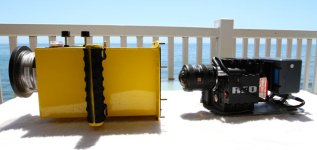
Epic in custom Aluminum 'Surf' housing. Shot is at 150fps at 5k with Sigma 8-16mm lens.
Had to delicately hacksaw off the lens shade on this Sigma to make it fit close to the dome.
Whole rig weighs in at 23 lbs. with 190w battery and it's just a bit positively buoyant.
Housing is okay to 15'.
 

Attachments

  • IMG_5245.jpg
    IMG_5245.jpg
    33.8 KB · Views: 0
  • IMG_5250.jpg
    IMG_5250.jpg
    52.1 KB · Views: 0
  • IMG_5252.jpg
    IMG_5252.jpg
    65.8 KB · Views: 0
thanks for sharing your video, Greg.

Nice selection of sharks, I must say. I know you are just starting, so your footage looks quite good for someone just getting into the deep end of the pool. If I can make some critical suggestions to improve upon is the camera stability, framing and movement.

I know, it is easier said than done, so let me offer some suggestions that worked for me.

I am just starting with a RED that is, I have been using a DSLR for quite a while and spend incredible amounts of time underwater.

1. Firstly, balance your rig perfectly in the water. You should be able to point the camera on a subject, let it go, and the housing should continue to point in the same direction on its own. Camera trim and balance is something you need to fine tune yourself, but it is worth gold later!

Its balanced so well my buddy has filmed it as if it was some alien creature floating LOL

2. When you see an interesting subject, try to design the shot with a "beginning", "middle" and the "end" in mind. The "middle" is where the peek interest should be. When narked underwater this is the most challanging part. It will come with experience. For now just try to roll longer takes and cut it later. You are getting there.

Kinda hard sometimes if you saw some of my footage I was struggling in current. The currents get ripping out there and I am doing what I can with what I have for energy/stability/safety.

3. When framing, you should avoid controlling camera movements by firmly gripping the housing handles. Instead, relax, let the camera go and aim it with feather touch of your fingertips. Let the camera almost float on its own. It will make huge difference to the stability of your shots.

I rarely grip them hard unless I get hit by a surge hard.. but usually it knocks me over so I just trash the shot on those anyway. Bear in mind that the surge can be felt there at over 100ft its not uncommon.. also as mentioned above current can be a serious obstacle. Today was a pretty ripping current day and it took me about 15 mins to move about 50ft up current LOL... The camera turns into a major source of drag at that point.

On another note, I wanted to draw everyone's attention on the last clip in particular: a lot of grey-magenta cast with low contrast. Nearly all blue water shots suffer from it on Gregs video, but it is very prominent on the last one. Not your fault, Greg.

Bluer the water the worse it seems to behave. I should book a trip out to Molokini and go around the reefs end side and get in 300ft viz and test that out.

Again, well done Greg and thanks for sharing. Look forward to see more.

edit: PS. thanks David for your response

Thanks for liking the video clips. I never stop learning but I do have some serious factors working against me some of the time :)

I will also do everything I can to do better of course learning how to position myself in the water to get what I want. Thanks for the advice I appreciate it.


Oh I have filmed Humpback whales on the backside of Molokai near where they filmed Jurassic Park....fabulous location. People rarely dive there..... I was shooting my film 'Humpbacks-from fire to ice' which took 6 years and 16 expeditions to Maui and South east Alaska. I have many fond memories working with research groups off Maui. I even got to work with David Attenborough who narrated my film.
http://www.fromfiretoice.com

Yikes thats a good long time to do.. I am hoping this summer will prove to be good for sharks. Never can tell of course what you will see but I will be out there twice a week as always with my buddy.

I do not work with any research groups though. I just do my own thing out there my buddy and I are not that "Normal" heh.. That is cool you got to work with David Attenborough.


won't be able to try this for a while, but i seem to run across this magenta coloring anytime i'm in blue water with lots of light penetrating the water.

As noted above to Pawel I will let you know my experiences when I go to what is insane visibility at Molokini.
 
Last edited:
to quote an article on underwater optics:

"Ultraviolet rays reach farthest, whereas infrared ones are absorbed literally centimeters under the surface of the water."

Seems unlikely that IR would be the culprit.

Michael, what article and what year written. Obviously much has changed in only a few years. But my experience is that this has occurred to me in shallow, very clear water. So, i don't think i would count this out just yet. Also of note are many tests using ND filters at .9 and above topside that cause this magenta effect. And the only way to counter it is with a hot mirror filter. So, maybe it is coincidence or maybe not, but it sure is a "coincidence" and seeing that there currently are no solutions for us underwater, i'd say for me it is a start. I'll certainly give this a test when i figure out how to mount my hot mirror filter to my lens.
 
Johnny, I have seen this at 30m... the Magenta..

I would love to have it be something simple though!
 
Michael, what article and what year written. Obviously much has changed in only a few years....

Hehehe I think it is the first time we agree on something! LOL

edit: that article that Michel found does not seem to be worth the paper (or disk space) it is written on.

Not that anything else you said makes any sense to me ...:rolleyes:

too funny!
 
Michael, what article and what year written. Obviously much has changed in only a few years. But my experience is that this has occurred to me in shallow, very clear water. So, i don't think i would count this out just yet. Also of note are many tests using ND filters at .9 and above topside that cause this magenta effect. And the only way to counter it is with a hot mirror filter. So, maybe it is coincidence or maybe not, but it sure is a "coincidence" and seeing that there currently are no solutions for us underwater, i'd say for me it is a start. I'll certainly give this a test when i figure out how to mount my hot mirror filter to my lens.

I wasn't aware that the laws of physics had changed much recently.:) I haven't done any quantification tests (and don't intend to) but I thought it was (correct) general knowledge that the RED end of the spectrum was rapidly and progressively filtered out by water. And intuitively one would expect it to be stronger for infrared, and the quote seemed to confirm. Sorry if I quoted bad info. Seems like you could confirm it with some simple pool tests. I don't have an IR cut filter and my camera is out of the country, so probably won't be doing that test any time soon.

My point was that generally speaking IR is a problem abovewater when drastically cutting back the visible light with ND filters which don't cut the IR so the percentage of IR contamination becomes quite high (i.e. it's a problem because IR focuses on a slightly different plane as well as possibly creating color issues) . It is my understanding that regardless of the exact quantification - IR is cut quite rapidly when passing through water . And further, since heavy ND isn't normally as necessary in underwater shooting, that sort of percentage difference wouldn't be very likely. The other part of the quote was just as interesting to me as it suggests that since we always have the reverse of that topside heavy ND scenario (i.e. water is fairly strongly and progressively filtering the overall light level - and more on the RED end) you might consider UV sensitivity or "contamination" as a possibility.

Hehehe I think it is the first time we agree on something! LOL

edit: that article that Michel found does not seem to be worth the paper (or disk space) it is written on.

Not that anything else you said makes any sense to me ...:rolleyes:

too funny!


But this is just dumb ol' Mike speculating from general knowledge. I'll go back to working and let you guys duke it out.
 
No argument there Mike....but water acting as a strong ND was my point here....Since nobody seems to have a clear answer except for maybe Pawel, we can only speculate. I'd not disagree about water cutting IR but again given the right conditions i was trying to see how water would act as an ND and then we would see a lot of IR contamination not to mention RED's OLPF is "red" unlike others that are green. So mere speculation on my part and I seem to run across this in places where water is clear, sun is blazing and usually in shallow water. I'm also only taking a wild guess since it's what i have experienced and there has been enough talk about IR contamination with red and seeing magenta effects of it....of course i can be wrong as well, but that's the closest thing i've come up with to one day take a look at.

oh...and i do appreciate your input whenever you have something to say regardless of what others may have to say with their childish remarks and constant heckling.
 
Back
Top