Welcome to our community

Be a part of something great, join today!

  • Hey all, just changed over the backend after 15 years I figured time to give it a bit of an update, its probably gonna be a bit weird for most of you and i am sure there is a few bugs to work out but it should kinda work the same as before... hopefully :)

Sony A7S III - Supreme Compact 4K

Equally interesting to see fully sponsored shooters getting cameras X, Y, or Z during this time frame and then releasing somewhat anti-marketing against other brands they just developed a somewhat new relationship with.

Who are those? Are newsshooter guys sponsored by Sony?
 
Ah, haven't used a Micro 4/3 camera in ages... why do you still use it? I'm interested!

BTW, what's your bet that inside this is a 48mp quad bayer hard-wired to 12mp mode? Would explain the latitude if some of the pixels were at different sensitivities similar to Alexa / Canon dual-gain.

I'm not sure that dual-gain has anything to do with the Bayer filter. I think its has to do with duplicating the output of the sensor before it is debayered, then amplifying one dataset, then merging them together, preserving the highlight data of the non-amplified dataset. Or some shit.

As the for the Quad Bayer pattern - it could be the case. I don't know if anyone has said anything about it yet.
Micro 4/3 as a whole is a terrific system. Smaller lenses (not always); very small telephotos; small bodies (though not the smallest); terrific IBIS; nice features that eliminate the need for post-processing; fast operation; amazing macro. I also like Sony and Fuji S35, though.

I have a theory that says that the wider the AOV, the larger the sensor should be, and the narrower the AOV, the smaller the sensor should be. Ideally you'd shoot, say, a Leica S for interiors and an E-M1 for birds. Actually I might post a separate thread about that, even though it applies more to photography.
 
Last edited:
I'm not sure that dual-gain has anything to do with the Bayer filter. I think its has to do with duplicating the output of the sensor before it is debayered, then amplifying one dataset, then merging them together, preserving the highlight data of the non-amplified dataset. Or some shit.

As the for the Quad Bayer pattern - it could be the case. I don't know if anyone has said anything about it yet.

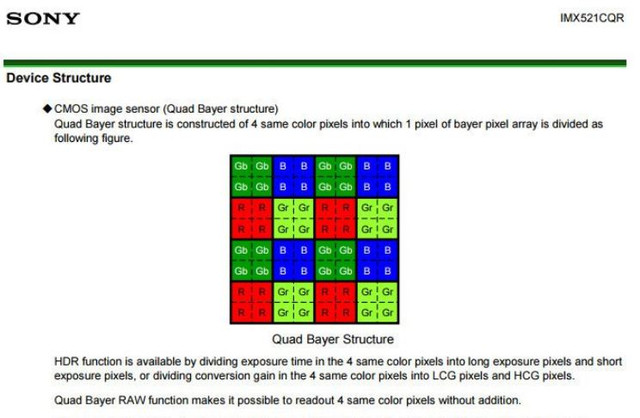
This is not the sensor in the a7s3 but from the datasheet of a similar Sony sensor (for a full frame consumer DSLR that hasn't been released yet) - take a look at how they do the "HDR" readout RE: conversion gain. The Quad Bayer setup makes it easier to output the combined result as one "RAW, HDR" sample.

Quad-Bayer-HDR.jpg


I suspect (but could be wrong!) that the a7s3 has a 12mp / 48mp quad bayer variant of this sensor design, hardwired to 12mp.

Will we see future Sony DSLRs with higher res sensors and Quad Bayer high res stills too? Seems like a logical a9 mark 3 to me because then you can sell the Associated Press a high-speed sports camera that can also shoot great latitude video AND can pop off high-res stills too if you switch modes.

I am sitting out the a7s3 unless the right project comes up - but future a9 or a7 cameras with that nice EVF, high speed cards (which will be cheaper in the future anyway) and new sensors could be tasty!

Bruce Allen
www.bruceallen.tv
 
This is an old misconception. The finished resolution of a 4k Bayer image that is processed to RGB is still 4K. If it is processed to 4:4:4 RGB color space fully sampled, it will still be a full pixel for pixel 4K image with every pixel a fully defined RGB color pixel. There may be very slight loss of red/blue channel spatial density which is perceived as a blur, but nowhere near the loss of 4:2:2 or 4:2:0 sub sampled video.
Sophisticated Bayer color filters all have some overlap in filter values such that a red pixel is not pure red but has some blue and green value. Green has blue and red values, and Blue has red and green values. Modern Debayer algorithms and advanced color science can accurately interpolate those value differences for full luminance resolution and nearly full color resolution.

The brilliance of the Bayer pattern is that it closely mimics the spatial color sensitivity of human vision. We don't perceive red and blue values with the same density as green either.

those are some pretty words, but don't you lose like 25% resolution?
 
those are some pretty words, but don't you lose like 25% resolution?

Optical resolution of any format at the Nyquist limit is less than the pixel resolution, oversampled or not. Oversampling gains a little bit , but nothing like 25%, more like 5%. The difference would be less aliasing and better chroma resolution along edges.
 
Bayer pattern is brilliant but not THAT brilliant. You can debate overlapping filter values but let's be clear - you're only capturing one value per pixel. It's not as bad as 3:1:1 but it's not exactly 4:4:4 either. And if you have too much of an overlap in filter values, you get into some very wonky color issues because you're subtracting colors from each other to get "pure" values.

The other thing you're overlooking is that the OLPF has to be tuned to not produce horrid color moire... so the OLPF for a 4K Bayer sensor movie-optimized camera will be pretty soft.

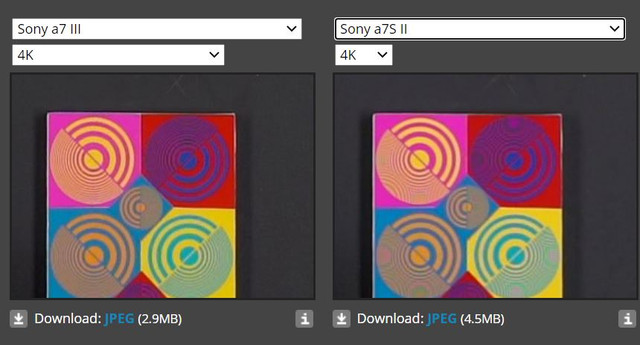
If you compare a7 mark 3 (6K bayer downsampled to 4K) vs a7s2 (4K bayer to 4K) for video mode... a7 mark 3 has more real detail, a7s2 is a bit either soft or oversharpened.

Scroll down, - the tests are pretty clear:
https://www.dpreview.com/reviews/sony-a7-iii-review/10

a7m3-a7s2-pt2.jpg


a7m3-a7s2.jpg


Another good way of comparing is take a look at the Sony a7r3 which has two modes:

- normal Bayer mode
- and pixel shift mode where it shifts so you're sampling a color every pixel so it doesn't have to debayer.

Really seriously big real-world difference:
https://www.dpreview.com/news/5645755619/sony-a7r-iii-pixel-shift-lifts-a-veil-off-your-landscapes
https://petapixel.com/2017/11/18/testing-sonys-new-pixel-shift-feature-a7r-iii/

Bruce Allen
www.bruceallen.tv

I don't dispute the advantages of oversampling, it does produce a more resolved image. But the differences are not nearly as great as people think. And a 4k image is still 4k, with minor differences in aliasing and chroma resolution if the debayer process is high quality. Something not typical of video cameras because it has to be done in real time. Processing raw images in post is different. With video the resolution loss from 4:2:2 subsampling is much worse.
 
Optical resolution of any format at the Nyquist limit is less than the pixel resolution, oversampled or not. Oversampling gains a little bit , but nothing like 25%, more like 5%. The difference would be less aliasing and better chroma resolution along edges.

I always understood that OLPF combined with debayering of a CMOS sensor means you need to shoot at least 25% more resolution than what you finish in... isn't that a requirement for more production companies that have theatrical releases? (this is stuff I've heard 1st hand from Producers, DITs and DoPs...)

I'm not talking about oversampling, like what the Panasonic EVA-1, Sony FX9, and A73... I was referring to shooting 5K+ to finish in 4K
 
is there any a7siii vs komodo tests? there are like few hundreds of komodo owners out there and its so suprising nobody did a comparison test.

will Sony let them? [joking]

not sure who has a Sony A7siii, I think it's only brand ambassadors... it would be an interesting test, as Komodo is Red's sports camera... Sony a7siii big selling point is broadcast quality + autofocus... from what I hear on these boards, Red is working on the autofocus and then it can be run by a single operator in professional settings

still you going to have to consider

Red=6K RAW [theatrical]
Sony=4K 4:2:2 [television]

the high-speed aspects of Sony add a lot of versatility to the camera, but overcranked shots usually take a lot of planning and that means money and expectations of more than 4k resolution
 
will Sony let them?
the high-speed aspects of Sony add a lot of versatility to the camera, but overcranked shots usually take a lot of planning and that means money and expectations of more than 4k resolution

I was using the slowmotion with the A7mk3 (max frame size 1920x1080) and aliasing was problematic. Wonder how they do it? Entire sensor read out?
 
I was using the slowmotion with the A7mk3 (max frame size 1920x1080) and aliasing was problematic. Wonder how they do it? Entire sensor read out?

I would guess with new “video” sensor and new processor new A7s3 should be more forgiving. Nice tool for everyday simple jobs. I just hope it does have Venice picture profiles.
 
I wonder why anyone would even consider buying a Red Komodo after this announcement. Theres no way Red can compete with this.
 
I wonder why anyone would even consider buying a Red Komodo after this announcement. Theres no way Red can compete with this.

Tell me the differences between these two cameras.
 
I wonder why anyone would even consider buying a Red Komodo after this announcement. Theres no way Red can compete with this.

I don't agree with this at all. They both have compelling features that don't exist on the other camera.

Komodo: S35, 6K, global shutter.

A7SIII: Low light, 4K120, FE mount, AF.

Those are not paper specs. They are real and they have value.
 
Sony A7S III Video Test | Sample Video Test


Sony A7S III Cinematic 4k Video Footage


α7S III:映像作家 江夏由洋「Siúil A Rún」【ソニー公式】


Last edited:
I don't agree with this at all. They both have compelling features that don't exist on the other camera.

Komodo: S35, 6K, global shutter.

A7SIII: Low light, 4K120, FE mount, AF.

Those are not paper specs. They are real and they have value.

Well, those features are my point. Who cares for 6K and Global Shutter when the images produced by the A7siii show very little rolling shutter and plenty of sharpness in the first place?
Seems like a very niche market for Red. VFX people maybe? People who own S35 lenses? I thought this was supposed to be Reds prosumer camera.

+ Price...
+ Full frame in a smaller package than Komodo. Red would probably charge double for a FF sensor.
+ True 16bit linear raw output
+ Dynamic range of 15+ stops
+ Image quality so far seems to be superior to that of Komodo
 
Last edited:
Back
Top