Welcome to our community

Be a part of something great, join today!

  • Hey all, just changed over the backend after 15 years I figured time to give it a bit of an update, its probably gonna be a bit weird for most of you and i am sure there is a few bugs to work out but it should kinda work the same as before... hopefully :)

Resolution

Graeme Nattress

RED Problem Solver
Joined
Dec 28, 2006
Messages
6,496
Reaction score
16
Points
38
Website
www.nattress.com
I've had the conversation on resolution a few times recently. It's a topic we visited many times in the Red One days and it's just as important today....

The problem is that resolution is multi-factorial and nuanced. If you ignore the nuances you don't achieve understanding. Let's go for some understanding.

First, it's not even resolution we need to think about but MTF. Smaller pixels will lead to a higher MTF even at lower spatial frequencies and thus better contrast handling of the image even when viewed on lower resolution displays.

Aliasing is an issue we want to avoid. Not only does aliasing look bad but it confuses the kind of compression used to broadcast your work making that compression look worse. Nobody wants that. Best way to avoid aliasing is high resolution and a good optical low pass filter.

And all that makes any argument about bayer patterns mostly (or practically) irrelevant as they work more effectively at higher resolutions, and they don't loose you any much more real visible image detail because of that necessary optical low pass filter.

What does low resolution get you? Bigger pixels give you a lower MTF even at low spatial frequencies, and you still need that OLPF because the real world and lenses have much much more detail than your sensor can respond to. Because you are low resolution you will need to / want to sharpen. Electronic sharpening looks bad. That's why there was lots of issues with early HD as it was low enough resolution to need sharpening but not high enough resolution to have real detail without sharpening. And that's one of the reasons diffusion was really popular.

Low resolution means you have little or no downsampling in the creation of that viewing image. Any noise you see (unless you're seeing ghastly plastic skin through over-the-top NR) will be the size of a pixel and even if at a low level will stand out due to its size. On the other hand when you're more massively downsample noise turns to a much more aesthetically pleasing grain.

So yes, the measured resolution of an image will (or should be to avoid aliasing) always less than that of the resolution of the sensor. But this is not something to be used as an argument that resolution is "nonsense" but that resolution is beneficial as downsampling always looks better than upsampling and gives benefits to the image over above and beyond the headline figure of fine detail.

Graeme
 
I have not had to up sample since 2007. :)

That's a kinda good feeling.
 
Absolutely David!!
 
Thanks Graeme -- At least for me that is a very useful and helpful explanation. One question I have recently had is when I compare capturing an R3D (6k or 8k) and then downsampling using Redcine X Pro to ProRes 2k (or 4k) it looks fantastic. When I compare that to in camera ProRes recording of 2k or 4k from the 8 k sensor, it looks good but not as good side by side as the RedCine X transformation. This is using the same new pipeline for the data in the latest beta build. Is there a significant difference from a pixel down resolution perspective between these two methods, or is it just that RCX is better at such a task? [To keep the comparison I have used the new beta software which allows ProRes 444 at 2k with the LUT applied to the new pipeline vs the same settings in RCX for export.] Also you make the comment about diffusion being popular with low resolution ("And that's one of the reasons diffusion was really popular") so is that saying that using something like a black magic or promist filter is really not necessary when one is recording at high resolutions such as 8k?

Thanks again for your insights.

Respectfully,

Jon
 
In RC-X we can use much more powerful downsampling filters and demosaic than we can in camera.

When I talk about diffusion being popular, it's because the final image was being made from a too-low resolution source. When you're making 2k or 4k in camera from the 8k sensor, that's not the case. Of course, you might like the diffusion aesthetic, but that's different than doing it because the edge sharpening looked awful!

Graeme
 
Got it, and I have to say that I love the way RC-X looks with the new pipeline, truly amazing and so nice to be able to change the settings such as roll off and instantly see the impact.
 
resolution

From the feature film perspective, upsampling has always been a no no. From the mid-90s to date we still are scanning motion picture film at higher resolution and downsampling to the final resolution, with the only concession there ever being budget and workflow.

I've found at NAB in particular during the last few years a lot of "crazy talk" surrounding resolution. Luckily less so as of late as the industry has migrated forward in general.

The key thing is understanding the differences between resolution, sharpness, mtf and their effect on detail.

Over-sharpening hindered a great deal of the evolution of digital cinema for many. Many didn't even know what was bad and tied it to resolution.

For most who ever experienced a film workflow RED's made a hell of a lot of sense.

Still does to this day.
 
Nicely put Graeme!

And yes, I absolutely could not agree more, and no matter the program used, trying to add pixels or stretch them it's never going to give the best results, while downsampling always gives a much crispier not just sharper image after you are done doing the work "Before" Downsampling.
 
Graeme,

Sounds a lot like the conversation we were having at the Red Party before CineGear. I couldn't agree more. 8K is not about pixel bragging rights or even finishing/displaying those images in 8K. It's about the very items you so clearly list out. Higher sampling raises MTF over the whole range of spatial frequencies... Yes we gain details above 4K, 5K, 6K, ect, tapering to zero by 8K, but more importantly, we raise the MTF curve at the low band and mid band frequencies as well. This is the MOST important aspect no one seems to understand about the need to shoot higher resolutions.

Great topic. And I always learn more from every time you post.
 
Last edited:
Thanks Chris! Great to talk to you at the RED Party. This conversation came up time and again over this week and was brought to mind today so I thought it best to put some good words together on it.

Graeme
 
I can sympathise with eliminating the low-pass filter for photography. Sometimes you'll get aliasing and you can often ignore that frame, or fix it if you really need to. The old Leica Monochrom with 18Mpx out-resolves the Nikon D800 with 36Mpx for b&w images, and matches the D800E. That's also because there is no Bayer filter in the Leica.

However, for the moving image, it is a different story. No way would I risk shooting without a low-pass filter.
 
If you're shooting in situations where you're diffraction or lens limited, then removing the OLPF will be of benefit as it will allow a bit more of that lens MTF through. But for general photography and especially motion imagery it's just not safe to do so.

Graeme
 
When Jim said "Resolution matters" and made that a cornerstone of RED's mantra, he was right. It mattered then and it matters now. I remember the "HD is not Good enough" threads and he was right about that as well.

AS one example, I heard that IMAX is accepting 8K Helium SUPER 35, but not 6K Dragon (which has a slightly larger frame size over the Helium)

Pixels. We are in a pixel game. Pixels matter. I am not going to get into a more pixels are better discussion, but it roughly equates to 16mm, 35mm, 65mm, 70mm etc.

I don't know, but I feel better about having shot at least 4K for the last 10 years because 2K does not really cut it.

David
 
hahaha. Shit. It's 10 years+ ??

(Checking Wikipedia to confirm that I actually had mine in the not-recalled early beta stage of early 2008)

Pixels are nice.
 
Last edited:
As always Graeme, thank you for taking time to explain things like this.

I am still an idiot when it comes to color science but you are always patient with me in trying to educate me.

Cheers,

Peter
 
Why is it for a Netflix original, I can't shoot 10:1 redcode on 8k Helium or DXL, but I can shoot xavc 4k on an fs-7.
 
Why is it for a Netflix original, I can't shoot 10:1 redcode on 8k Helium or DXL, but I can shoot xavc 4k on an fs-7.

Interestingly, I had pretty much the same conversation with a couple of Netflix acquisitions team members. They didn't seem to understand 8k image acquisition or large pixel density to a workable image conversion factors, that much. After the first 2 ~ 3 minutes of conversation, they go south on established image capture, science/engineering, codecs, compression ratios and camera tech data and bring up wired hodge-podge of obnoxious made up list of limitations and imaginations of their own, in to the mix.

3 years ago, I remember having similar discussion with them about the availability of 4k material in their line-up. Same thing. They put me on hold for 5 ~ 6 minutes, did back and forth dialogs with some tech people and ended up with a high level executive who did not have much of an idea why 4k was going to be a dominant factor in future moving image acquisition & distribution.
 
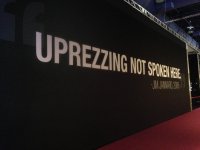
NAB booth 2015, quote from 2006...

attachment.php
 

Attachments

  • IMG_2417.jpg
    IMG_2417.jpg
    97.2 KB · Views: 0
Back
Top