Welcome to our community

Be a part of something great, join today!

  • Hey all, just changed over the backend after 15 years I figured time to give it a bit of an update, its probably gonna be a bit weird for most of you and i am sure there is a few bugs to work out but it should kinda work the same as before... hopefully :)

RED Monstro 645 Speed Booster Experiment

Nope.

It would only have the same FOV with differing perspective relations.

There is no 2x speed booster, it's about one stop with 0.7 FL ratio.
Actually there is a .53x speed booster and it is two stops gain and almost half the FL. It was designed for S16/1" sensor size with FF lenses.
Works great on 16:9 4/3" sensor and the field of view is very close to FF for the same lens sans SB. That's where the similarities end however. Definitely not the same perspective.
As you noted yourself and than contradicted in the following post. Which one is it?
 
You absolutely could. But in that example you'd need a 3.5mm, 4.6mm, 6.7mm, 9.6mm, 16.4mm all at f/0.54 to mimic a typical 18-85 S35 set at f/2.8. And you'd need a damn good 1/3" sensor to boot.

The point is that larger formats give sensor designers more room for light gathering, either with more photosites or larger ones. It's a shortcut to a cleaner image, since there's only so much we can do as far as technology is concened at a certain point in time. Same thing with film. More area = less grain to muddy up your image. Easier to do this than try and develop a superior film stock. So in this regard, a larger format will always be superior to a smaller one because we can always throw more/larger photosites at the problem.

It also means that lens designers don't have to struggle by designing super fast, super wide lenses. They're letting the format handle those things. Again, it's a shortcut to solving the problem instead of pushing the limits of lens design.

But again, as far as perspective compression or anything like that, there isn't an inherent "look" to any sensor size. So yes, your 24 f/1.4 on Helium example to 35 f/2 VV is spot on. The difference between the two images will come down to sensor design, not because one sensor is bigger than the other.

A 50mm on FF @ f/5.6
A 35mm on APS-C @ f/4
A 25mm on m4/3 @ f/2.8
A 17mm on S16 @ f/1.8

All will look the same as far as field of view, perspective distortion and depth of field is concerned. So what is the large format "look"?
Are you saying that DPs that pay big money for VV RED are full of it? Other than better low light performance that could be had with Sony, Canon or Panasonic for fraction of the cost?
 
Actually there is a .53x speed booster and it is two stops gain and almost half the FL.
Works great on 16:9 4/3" sensor and the field of view is very close to FF for the same lens sans SB. That's where the similarities end however. Definitely not the same perspective.
As you noted yourself and than contradicted in the following post. Which one is it?

No contradictions, I just wasn't aware of the 2x focal reducer for 4/3" as I don't use that format so mea culpa on that one.
 
In some ways possibly, but no it does not. Speed boosters mimics a wider faste lens with more narrow projection. It does not mimic a larger sensor.

What does a larger sensor do differently?

It would only have the same FOV with differing perspective relations (object distance/size).

No, all objects on rectilinear lenses are half as tall and half as wide at twice the distance.

So why bother with a speed booster:
Shoot 24mm f1.4 on Helium and just say:
I shot it with a 35mm f2 on VV.

Not a single human or theoretical algorithm could tell the difference, because there isn't one.


Of course there are specific differences in lens and sensor design, but there is no general difference between two format sizes when you scale focal length and aperture with the sensor/film (except diffraction).

I worked in TV with 20x zooms daily and I can tell you I understand focal length and perspective quite well. I have looked endlessly for this 'large format compression' and I have never once seen it demonstrated nor saw it in my own work.

I think that's why I get a bit pedantic when I see things like phil posted brushed aside.
 
Last edited:
No contradictions, I just wasn't aware of the 2x focal reducer for 4/3" as I don't use that format so mea culpa on that one.
sorry I combined two posts with different topics. the contradiction was not about the SB. It was your statement about the 80mm proportions and the following post saying that it's all the same if you adjust the FL and f-stop.
That is a contradiction AFAIK..
 
DSC_3196-3198-edit_1700px.jpg


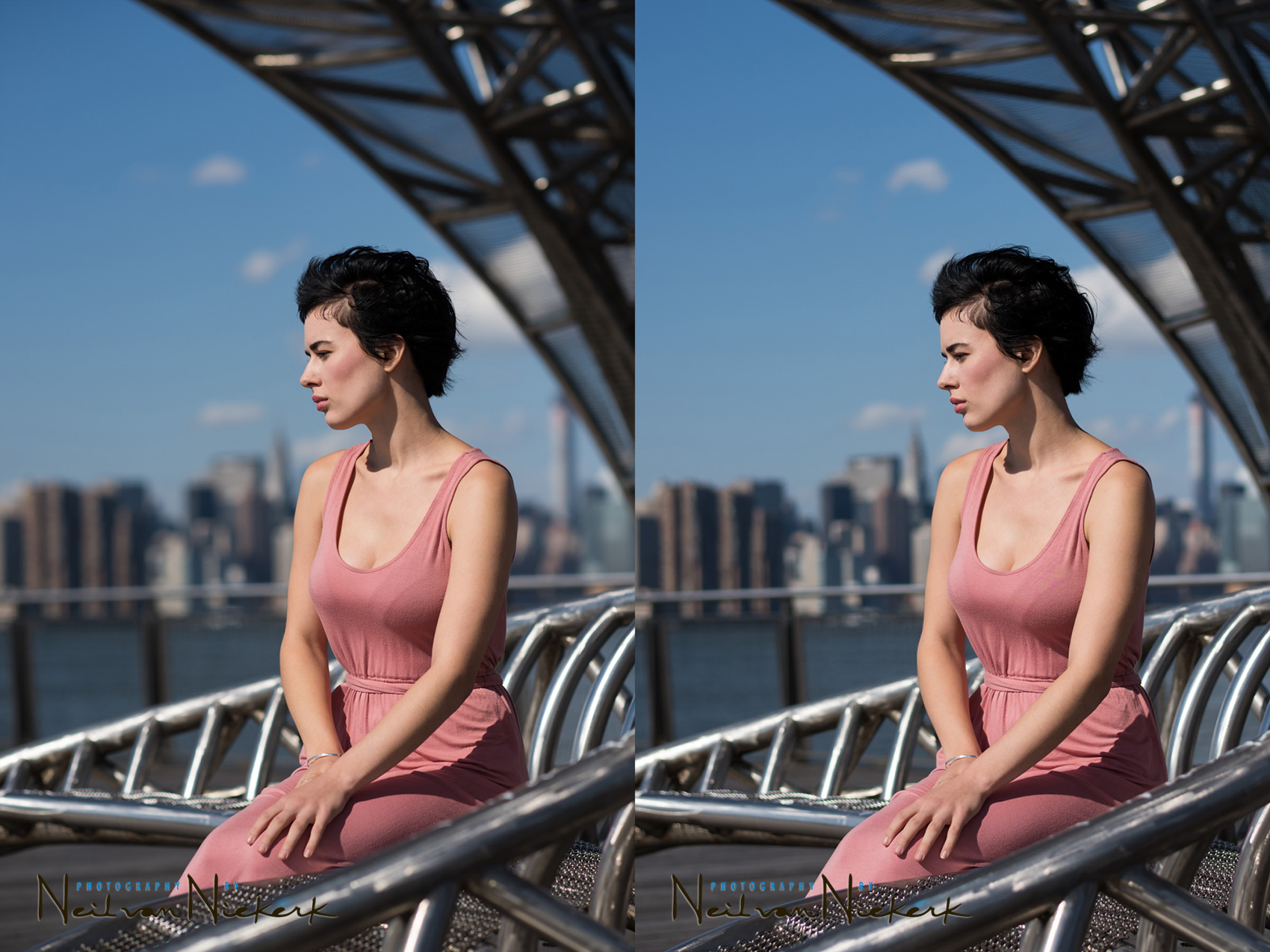
Here's two photos, one shot on APS-C and one on full frame. Depth of field is not the same (left is shallower). Which was shot on which?

I can add that these were shot with the two cameras in the exact same point in space, with focal length changed to counter the crop factor, but the f number left the same which is why one image is shallower. Of course there are minute differences between lenses and sensors but the perspective is identical, while I would expect to see 'compression' moving between APS-C and full frame.

So what a speedbooster like Phil's is doing is nearly exactly giving you what scaling up the sensor and using the same lens would give you. As far as any audience member could possibly see, it is a larger format camera and lets you use the larger format lenses as they were intended.
 
What does a larger sensor do differently?


No, all objects on rectilinear lenses are half as tall and half as wide at twice the distance.


Not a single human or theoretical algorithm could tell the difference, because there isn't one.


Of course there are specific differences in lens and sensor design, but there is no general difference between them when you scale focal length and aperture with the sensor (except diffraction).

I worked in TV with 20x zooms daily and I can tell you I understand focal length and perspective quite well. I have looked endlessly for this 'large format compression' and I have never once seen it demonstrated nor saw it in my own work.
From that point of view (and I'm not saying it's wrong) what Phil is doing makes no sense.... may as well shoot with wider lens faster aperture on Helium and bypass the shenanigans with SB glass..... and have the exact same result as with VV sensor... probably with better IQ since the path is unaltered...
Now what about the RED VV advantage?
 
My opinion on 'why this makes sense': speed boosters let you use more of those specific lenses on different sensors, or more specific sensors with those lenses, and speed boosters also gather more light allowing more options for exposure.

Imagine getting the full Primo 70 look on a smaller sensor. Primo 70's widest lens is a 24mm, but with a booster that can be plenty wide even on a dragon 6k. You also can use a lower ISO for the same f number than shooting say dragon 8k. I think that's a huge reason to research this.
There will be no primo "look" (which by the way is attributed to the large format-something being denied here) since the optical design has been altered with the SB glass. That ship has sailed...
 
Fair enough, but I wonder how many could spot the difference. (I estimate 0, including myself, you, and whoever performs the test)
 
sorry I combined two posts with different topics. the contradiction was not about the SB. It was your statement about the 80mm proportions and the following post saying that it's all the same if you adjust the FL and f-stop.
That is a contradiction AFAIK..

Please read back that second post again.

No, all objects on rectilinear lenses are half as tall and half as wide at twice the distance.

We've been through this before.

If you use 55 mm and 80 with a speed booster on a same sensor you'll get the same FOV but not the same perspective.


2pr7hpc.png
 
I apologize for mucking up this thread so I won't post anymore on the topic. But, quite clearly in your image the 24mm portrait was shot ~twice as close to the woman as the 50mm, ~4x as close as the 200mm. This accounts for the change of perspective, in total. The camera's distance from the subject, not the lens.

I suggest you take a camera out sometime and try for yourself. I have.

http://www.reduser.net/forum/showth...-Drity-Crop-Factor-Test&p=1735297#post1735297
 
Last edited:
From that point of view (and I'm not saying it's wrong) what Phil is doing makes no sense.... may as well shoot with wider lens faster aperture on Helium and bypass the shenanigans with SB glass..... and have the exact same result as with VV sensor... probably with better IQ since the path is unaltered...
Now what about the RED VV advantage?

Speedboosters/focal reducers are an incredibly cost effective way to get way faster glass, way wider glass, and the same large sensor properties on smaller/cheaper sensors (Weapon VV being a prime example; basically twice the cost of Epic-W + focal reducer).

Again, my example is that a 14mm f1.0 with s35 coverage/fov *does not exist* without a focal reducer, and can be had for as little as ~$1200 new (~$800 lens for a FF35 20mm f1.4, ~$400 for speed booster).

Phil is just taking it a step further by starting with VV and going to full ~MF/70mm equivalent (which doesn't exist otherwise). Hell, even the MF lenses equivalents he's getting probably don't exist, so even if there was a MF/70mm digital cinema camera out there (that could shoot 8k/75fps), you couldn't find glass as wide or as fast.
 
Last edited:
But, quite clearly in your image the 24mm portrait was shot ~twice as close to the woman as the 50mm, ~4x as close as the 200mm.

Yes.

To compensate for the field of view difference.

Which the speed booster makes with the same lens.
 
  • Thread starter
  • Moderator
  • #76
From that point of view (and I'm not saying it's wrong) what Phil is doing makes no sense.... may as well shoot with wider lens faster aperture on Helium and bypass the shenanigans with SB glass..... and have the exact same result as with VV sensor... probably with better IQ since the path is unaltered...
Now what about the RED VV advantage?

First, this is shot on the RED Weapon Dragon 8K VV.

Second, you are discounting exploring lenses for various reasons. Meaning if you are in love with say your Pentax 105mm f/2.4 (which some folks are) you now can see more of what that lens is designed to do while using a speed booster.

And while I understand your reasons for arguing against it, do know that speed boosters are a product that sells well, which I'm sure you're aware of.

Personally, I'm just exploring the format size and what's possible when taking optics into account with it for creative purposes.
 
Speedboosters/focal reducers are an incredibly cost effective way to get way faster glass, way wider glass, and the same large sensor properties on smaller/cheaper sensors (Weapon VV being a prime example; basically twice the cost of Epic-W + focal reducer).

Again, my example is that a 14mm f1.0 with s35 coverage/fov *does not exist* without a focal reducer, and can be had for as little as ~$1200 new (~$800 lens for a FF35 20mm f1.4, ~$400 for speed booster).

Phil is just taking it a step further by starting with VV and going to full ~MF/70mm equivalent (which doesn't exist otherwise). Hell, even the MF lenses equivalents he's getting probably don't exist, so even if there was a MF/70mm digital cinema camera out there (that could shoot 8k/75fps), you couldn't find glass as wide or as fast.
No he doesn't - he starts with the 80mm f2.8 MF lens and he makes 55mm f2 FF lens out of it. Which clearly exists in FF55mm F1.2 form from Canon- about 150% faster for that matter...
Or 105 f2.4 Pentax and makes 75mm F1.8 FF lens out of it. Which clearly exists. It may but probably will not retain the optical properties since the optical design has changed with the SB glass
 
Are you saying that DPs that pay big money for VV RED are full of it? Other than better low light performance that could be had with Sony, Canon or Panasonic for fraction of the cost?

Not "full of it", no. DP's are artists before anything else. Larger formats might evoke a certain emotional response, so they go for it. That's still a legitimate concern when picking a camera system, even if it is technically incorrect. A painter doesn't have to know how the bristles in his brush work, he just has to know what he likes.

What they think they're seeing: large format "mojo."
What they're actually seeing: shallower DoF at wider FoVs, cleaner images and more resolution.

In a vacuum, a theoretically perfect X-size sensor A vs. a theoretically perfect Y-size sensor B. With perfect glass on either one, then it is theoretically possible to speedboost B for an exact match of A. Now, you and I both know these imaginary sensors don't exist, so we can only use what's readily available -- that's what Phil is doing.

What Phil is doing is using lenses that would otherwise be quite cropped on available video formats and un-cropping them. Yeah, you can probably get similar FoV and DoF using a wider lens with a faster aperture, but what you're not getting is the inherent character of those specific 645 format lenses.
 
I have been waiting for this for quite some time. I think its amazing that some is finally doing it.

Does it allow you to control the iris of the new digital medium forma lenses?
As there has not been even a simple adapters on the market that seem to bother implementing that.
A speed booster is so much more of course. : )

I hope it works with Mamiya 645 lenses, for very personal reasons.
 
I have already shot an award winning short with my Mamiyas on Dragon 6k but the speed (low light and depth) was an issue, not to mention the widest is their 24mm which is a fisheye on 645 body and still very warped on Dragon 6k. Next in the lineup is the 35mm f3.5. Phils speedbooster for these particular lenses and Hassys as well might be a welcome sight for those of us who have these lenses and would like to have them look as they did on the 645 format they were designed for.
Phil, please keep us posted with any other images you take with this thing and what you might think it would do with Dragon 6k size, as some of us will never get a VV sensor damn it.
 
Back
Top