Welcome to our community

Be a part of something great, join today!

  • Hey all, just changed over the backend after 15 years I figured time to give it a bit of an update, its probably gonna be a bit weird for most of you and i am sure there is a few bugs to work out but it should kinda work the same as before... hopefully :)

Phil Holland Weapon Test

Banging on his Weapon? Am I the only one who went there? Hee hee... Nice job, Phil! And, thanks again for your help the other day...

Errr... not all Weapons are guns. '-)
 
Looking at the Weapon with the STD in this thread, and on the Latitude thread - It seems (to my eyes) the STD OLPF makes the use of LLO unnecessary (as the noise characteristics are so close)

Now I am wondering if skin tones on the Weapon + STD are in the same ball park as the Epic + STH ?

Do you think that skin tones images taken with a STD (standard) are closer to LLO (Low Light Optimised) or STH (skin-tone highlight) on the Weapon?

Do you feel there is still something special about the texture of STH on the Weapon that is more filmlike than that STD - or that the STD also has this 'quality'?

AJ

Yeah I'd like to know that as well. My main concern with the Standard is the red orb pattern and if that's gone now, I'm leaving standard in all the time.
 
Charles Bergquist said:
Yeah I'd like to know that as well. My main concern with the Standard is the red orb pattern and if that's gone now, I'm leaving standard in all the time.

There are two different types of orbs that people seem to talk about.
1. Point into the sun and stop down and you get the grid of orbs
2. A light source in the dark, which results in a magenta orb around it.

1. Per Phil's example, present on LLO, reduced on STD and gone on STH.
2. Seems to be mostly gone on Weapon for all of them.

The STD seems to be closer to LLO than STH. Maybe it has something to do with the STH being more optimized around tungsten.
 
Looking at the Weapon with the STD in this thread, and on the Latitude thread - It seems (to my eyes) the STD OLPF makes the use of LLO unnecessary (as the noise characteristics are so close)

Now I am wondering if skin tones on the Weapon + STD are in the same ball park as the Epic + STH ?

Do you think that skin tones images taken with a STD (standard) are closer to LLO (Low Light Optimised) or STH (skin-tone highlight) on the Weapon?

Do you feel there is still something special about the texture of STH on the Weapon that is more filmlike than that STD - or that the STD also has this 'quality'?

I wouldn't say unnecessary. I would say all three are valid choices, just depends on your needs.

My general perspective is:

Skin Tone - Highlight OLPF
Best overall color response. nicest Highlight Roll-Off, has the most texture/noise/grain at higher ISO ratings, and eliminates the Red Orb/Small Aperture/Point Source Dot Pattern.

I would recommend staying within the Recommended ISO Range of ISO 250-2000 when working with the Skin Tone - Highlight OLPF. Personally I like this OLPF in the ISO 250-1280 range for 6K-5K for a 4K finish shoots. It's been my main OLPF for most shoots. To me the STH is the most "film-like" right down to the noise character really.


Standard OLPF
Slightly better color response than the Low Light Optimized OLPF, and is approximately the middle ground when it comes to texture/noise/grain between the three OLPFs. Still exhibits the Red Orb/Small Aperture/Point Source Dot Pattern, though slightly less than the Low Light Optimized OLPF.

This is the newest OLPF in the trio and I'm still figuring out where and when I'm using it. Right now, at least from my perspective, it makes a lot of sense being the "Standard" because it provides a smidge better color and Highlight Roll-Off compared to the LLO and slightly cleaner images compared to the STH.


Low Light Optimized OLPF

Produces the cleanest possible image at all ISO Ratings. Still a good color response, does have the "quickest" Highlight Roll-Off of the three OLPFs. Exhibits the Red Orb/Small Aperture/Point Source Dot Pattern.

If you find yourself shooting in low light conditions or stretching beyond the Recommended ISO Range of ISO 250-2000, the Low Light Optimized OLPF really shows it's strength. Also, very useful for high frame rate work.
 
Is the CMO smear (highlight horizontal pixel pollution) bound to OLPF or is it only an Epic Dragon VS Weapon Dragon thing?
If it's CMO related could you (Phil) add this point to your "general perspective" post?

Thanks
Pat
 
http://www.ibe-optics.com/S35xFF_Expander

Kind of unrelated but kind of related to the use of s35 glass on larger sensor in the very near future.
Phil? Anyone?
Thoughts?

The IB/E expander is similar to a traditional PL to PL extender in that not all lenses will be able to mount to it if they have a protruding rear element. Which lenses, and just how far elements can extend into the expander will have to be determined but I do know that the IB/E expander seats it's optical elements deeper back than most traditional extenders which allows it to work with more lenses than older style extenders.
 
The IB/E expander is similar to a traditional PL to PL extender in that not all lenses will be able to mount to it if they have a protruding rear element. Which lenses, and just how far elements can extend into the expander will have to be determined but I do know that the IB/E expander seats it's optical elements deeper back than most traditional extenders which allows it to work with more lenses than older style extenders.
I use both the current IB/E extenders since I don't have a full set of MP Anamorphics(i have the 35 and the 50), but since the extenders are T stop limited I was wondering if I needed to add a T stop to the IB/E recommended T stop values for Master Prime Anamorphics(i.e. Even though the 50mm MPA says 1.9T, is that really a 1.4T stop with an adjust T value based on the light reduction of the anamorphic lens element) ? I.E. with the IB/E 1.4 I'm finding I need to be around T4 on the MPA 35mm.
 
Is the CMO smear (highlight horizontal pixel pollution) bound to OLPF or is it only an Epic Dragon VS Weapon Dragon thing?
If it's CMO related could you (Phil) add this point to your "general perspective" post?

The CMOS Smear was most apparent at higher ISOs with both the Skin Tone - Highlight OLPF and even the Low Light Optimized OLPF on Epic Dragon. They popped up a bit differently on each OLPF due to how the internal individual color profile effects the linear tonal and color response of the image.

What appears to have changed with Weapon, and perhaps all upcoming DSMC2 bodies, is a few things. 1. The sensor technology has been further tuned or tweaked to minimize the artifact greatly. 2. There could be additional internal hardware that helps tame these extremely excited pixels in the camera itself. 3. The optical path in Weapon is much more efficient, which might result in some additional improvements. 4. There even could be internal Color Science relating to squashing the smear with additional processing power that would wouldn't be privy to truly "seeing". All of this could effect what happens at the top end near and at clipping. It's hard to put a finger on why it's better, but RED certainly put effort in on this front big time. I suspect it's a combination of things that produce the better performance.

How much better is it? Love to know!
 
How much better is it? Love to know!

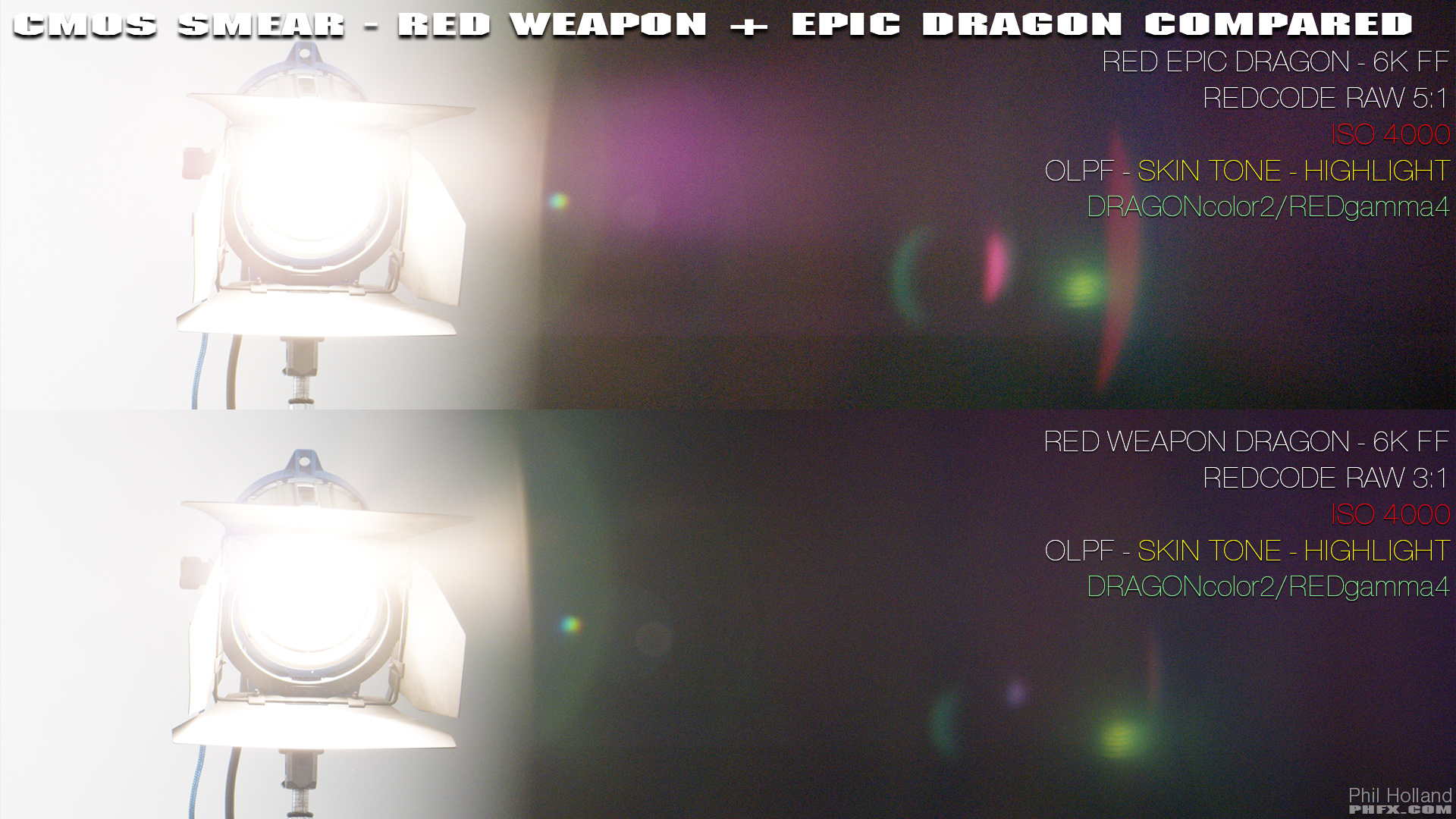
This much, and do remember that's ISO 4000:

Whelp, here's the other thing that I can officially classify as useful information. Specifically in regards to comparing RED Epic Dragon to RED Weapon.

I spent the first half of my day at Camtec with Christopher Probst going over our Weapon notes and shooting a few tests. We had 3 Weapons and 2 Epic Dragons on hand.

My focus today was on a specific stress test. CMOS Smearing. Like I said earlier RED Weapon has an improved optical path and some other voodoo that has changed things for the better on this front in a few ways. Here's a sample image:

[URL="http://www.artbyphil.com/phfx/cinematography/2015_REDWeaponCameraTest/bigs/phfx_REDWeaponTest2015_CMOSSMEARCompare.jpg"]
[/URL]
A few things to take note of here:
- This is a stress test and I'm doing my best to make an ugly image, the key light in frame is +6 Stops over exposed.
- This example is of the Skin Tone - Highlight OLPF, which does indeed exhibit CMOS Smear easier than the other OLPFs due to it's profile/calibration.
- To show the "extremes" this is ISO 4000, DRAGONcolor2/REDgamma4.
- CMOS Smear is indeed significantly improved on RED Weapon compared to RED Epic Dragon.
- IR Blocking and/or Cutting has also been improved.

I'm seeing less IR contamination in the crushed shadow, which is also lending it's hand to create a slightly cleaner image. Something that is harder to describe is that I was seeing more colorful and solid lens flares on this deep end of the exposure. If you look at the Weapon image you can see more of the greenish flare not getting washed out by IR. And on a more subtle note a bit more contrast seems to be held in the image with more color purity in the highlight clip and roll-off. Which made me want to compare the top end Highlight Roll-Off at the clipping point.

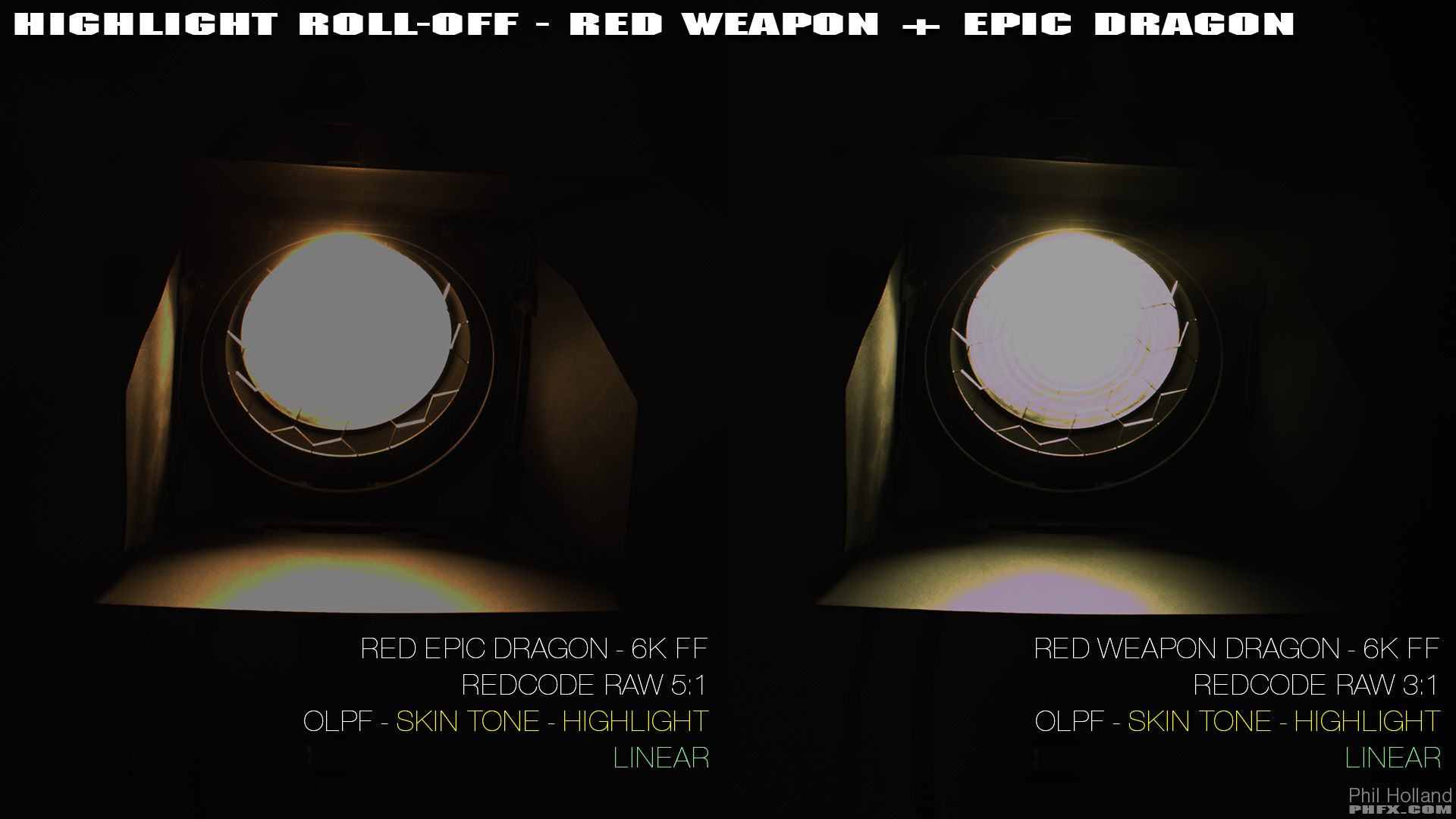
I was seeing something "different feeling" on the Weapon images. Like a smidge more Dynamic Range was in there. So let's inspect the linear light at T8 from both cameras:


There appears to be some tweaking done somewhere. Could be within the camera's signal processing, internal color science, sensor tweaking. Hell, it could be anywhere. But that is indeed more retained highlight information there in the Weapon image. Which, right when I thought I was done with testing, makes me want to test total captured DR again. That takes a long time to do effectively, but if that's the case, it's got me curious enough to inspect it closer. I measured 19 visible stops in the "total range" previously, which nets about 16/17 usable stops. Somebody or somebodies at RED has been tweaking something. The noise floor is visibly lower and now there's more highlight detail right at clip. This is news to me. If I had to guess we might be looking at somewhere between 17-20 stops of "total captured" Dynamic Range because I know exactly what's in Epic Dragon and that's at least a couple stops in the highlights. Thinking of the positive effects of this I imagine this is going to be rad for HDR display shoots and certainly will add a bit more meat to the highlight roll-off. It's the top end of things, so hard to fully define, but it's there.
 
Back
Top