Welcome to our community

Be a part of something great, join today!

  • Hey all, just changed over the backend after 15 years I figured time to give it a bit of an update, its probably gonna be a bit weird for most of you and i am sure there is a few bugs to work out but it should kinda work the same as before... hopefully :)

New MacPro predictions? Hopes? Fears?

Is this relevant to the MacPro at all?

http://wccftech.com/intel-lga-3647-socket-skylake-ex-knights-landing/

Intel-LGA-3647-Socket-vs-LGA-2011-3.jpg
 
Not sure, but most likely not. Theoretically that could offer a large number of cores and lots of fast RAM at a steep price. I can't wait to get my hands on some of these, but they are trying to push Purley into the larger server and virtualization markets. This is more where the E7 Xeons currently fall. However, there is some indication that they may be ultimately taking the Xeon this direction and downsizing the product line in terms of the number of offerings. Leave the Core i7's at the high end of the desktop market and then offer the Xeon platform above that which can be configured with 1, 2, 4 or 8 CPUs all within the same family. 10 cores not enough with i7? Fine, grab a 16-core Xeon.

Intel has not finalized pricing and a lot of details about this larger Xeon platform just yet. I don't expect to see it in the high-end workstation market right off the bat. But who knows...
 
L. Langer is right. iOS has been Darwin-based, like OS X/macOS, since day one. Someone at Apple (Steve Jobs or an engineer, I forget exactly who) said so at MacWorld in 2007 when they first announced the iPhone. You can also read the specifics about the Darwin version used in each release of iOS here: https://en.wikipedia.org/wiki/IOS#Kernel

OK Mike.
 
26-32 cores in a bigger MacPro with sli support and under blades, yes please Jarek. Just think about it, even doubling the volume of the Can could free up some space for more processing.
 
Now, let's think of a solution to this multiprocessoring core limitation issue.

Is there any software that supports upgradable functions/plugins and drivers for it. So that somebody could sell such code customised for more than 12 cores? That would allow a fix for the unsupported cores issue, especially if the original software has a license on formats like prores etc, or license system that extends to these plug-ins? Most of the time it comes down to developers only doing so much. It also gives application companies a chance to shop for code and good developers to hire.
 
Joel, fyi, I have a recording studio, based around Logic Pro. We bought the latest 5K iMac. The Fusion Drive (combos SSD and standard HD) has caused some weirdness. If you go iMac for audio, I'd suggest doing what we are doing now and using the SSD as an SSD and the standard HD as an HD... no fusion of the two.
 
Lol, that's funny. How can they expect the two to marry up smoothly. Yep, recording studio level and not too high video.

I'd better go and check if there is a new HP z series coming with an E7 :)
 
In 2005 the two teams that competed internally were lead by Forstall (who wanted to base iOS on a shrunken down OSX) & Fadell (who wanted to base it on the iPod OS) ... Scott won the battle.

AJ

L. Langer is right. iOS has been Darwin-based, like OS X/macOS, since day one. Someone at Apple (Steve Jobs or an engineer, I forget exactly who) said so at MacWorld in 2007 when they first announced the iPhone. You can also read the specifics about the Darwin version used in each release of iOS here: https://en.wikipedia.org/wiki/IOS#Kernel
 
I think the original XEON Phi as a co-processor - necessitating another 'main' X86 CPU - a hardersell to software delopers who wanted something less complex to develope on, pushing Intel to get it working as a stand-alone.

I don't think we will see the Knights Hill (which has impressive vector processing) outside super-computer space. Intel 'rushed out' Knights Mill for machine learning (automotive & AI) - again not ideal for a Mac Pro.

The Knights Hill tries to solve the Bottleneck of having 2D Mesh Network between the 72 cores. A step in the right direction cf XEONs with rings. However, 6xMemory controllers seems less than impressive. The 500GB/sec internal bandwidth is a good start - but not good enough for 2018. They probably need more memory at each NODE in the mesh to enable highly tuned code operating on local memory.

Not sure why Intel is not agressivly moving into better packaging solutions - as these give circa 20% better performance (less heat expended in the wiring). They might even be able to lock out AMD if they adopt some of their own (Intel) advances packages.

Will we find any of this tech in a new Mac Pro ..... no idea.. JK is the man with real insight!

AJ

 
He's not talking much. The things that Intel is always waving something around. Which is enough to get people like Apple to hold off on a change of platform. But, as you say, the realities aren't that ideal. But, it s still something for Intel to sell and Aplke to implement.
The people I was with modelled a mesh network solution, but it overwhelmed some performance metrics by the look of it. It overwhelmed it is far from ideal. My alternative design answers much of this, and you don't loose much. However, you have to customise code to get performance on the Intel machine. The issue with lazzy deadening brained programmers, is they expect to do what they like with the minimum effort. So stuff the rest of us. Seen this trend in computing for decades, one reason why I was trying to design the most balanced programming solution. So, to get best performance you have to program what works best for the model, and make the best model. Hence forth, maybe 99%+, instead of 1%, of desktop and mobile projects are just "wrong".
 
Joel, fyi, I have a recording studio, based around Logic Pro. We bought the latest 5K iMac. The Fusion Drive (combos SSD and standard HD) has caused some weirdness. If you go iMac for audio, I'd suggest doing what we are doing now and using the SSD as an SSD and the standard HD as an HD... no fusion of the two.

Thanks Andy! I will stay away from the fusion drive.
 
Adding to random thoughts :

Even though Project Purple (Apple team that built & designed the hw & sw of the 1st iPhone) stole engineers from the PowerPC -> OS X (x86) porting team, and there was a steep learning curve to solve all the big-endian (byte order of number representation) issues - Apple still completed the port inside two years.

Apple have put Hooks in Sierra for their next big core (Hurricane) ... already. I am now thinking the ARM port of MacOS will be completed before next version of MacOS (i.e. Before October 2017).

Intel announced they are going to be acting a Foundary for ARM ISA designs. Intel will desire designs that will keep their 10nm ovens at full capacity, that sell in the millions, and that NEED huge transistor counts on their new 10nm process (which give an impressive jump in density). Intel have already announced they will also be offering SoC with ARM IP (like ARMs high performance mesh fabric that supppors CCIX).

Intel are not particularly experienced in creating high power GPUs.

I am now thinking that TSMC will create the A10x on 'TSMC 10nm' destined for Exisitng moioe devices like iPad Pro, but that Intel will be building Thunderbolt 3 CCIX extensions & 802.11 Wireless CCIX into an Apple 64 CPU Hurricane core, baked in a Intels 10nm ovens in 2017 H2.

+) This would keep Intel happy (10nm ovens at full capacity)
+) It would keep Apple happy (Intel 10nm will have better yield for super large wafer size)
+) Intel clock frequency will be leading edge.
+) Apple Instructions per clock will be leading edge
+) The ARM mesh memory interface is 8 x super fast stacked memory.
+) Apple can create a 20 - 30 Bilion transistor wiith the GPU built into it - great for low latency GPU work (8k screen manipulation in Metal).
+) And still have CCIX hooks for external GPUs (AI training + an high latentency heavy lifting)

AJ
 
Last edited:
Still waiting for those 10 GHz AMD chips promised 15 or 18 years ago :( Maybe Intel can achieve this.

Have a thread about a new 1nm transistor to write.
 
...Not so sure that Samsung thing is legit. OTOH, it may be just another attempt at copying Apple's successes. And while the Mac Pro trash can doesn't get a lot of love around here, it's been the best selling Mac Pro. Ever. It is very highly regarded in many pro environments.

I had three of them at one point, down to my last one and it's actually up for auction on eBay right now. I'm probably being premature in letting it go, but maybe we'll get some new Mac Pro love soon. Actually it hasn't been fitting my needs lately since I don't use it for R3D workflow anymore. I do need an Apple desktop for app development work. Same with a notebook. I plan to buy the new Macbook Pro once available and probably an iMac on its next update. But I have uses for them beyond the tasks and workflows discussed here. And yes, I would really like a new powerful Mac Pro that can handle serious 8K R3D workflow... I'm not expecting such a thing to be released.
 
Time for me to buy a $13 stainless steel trash can and install a sli system in it for fun. But not going to waste the time on it at the moment though.
 
Intels plan of killing off PC bandwidth increases by:
+) Not offering it themselves (Why would they? People likely to pay for small incremental changes..)
+) Buying up Intellectual property and not licensing it out ...
+) Buying up companies who might threaten the status quo ....

Is coming to an monopolistic end!

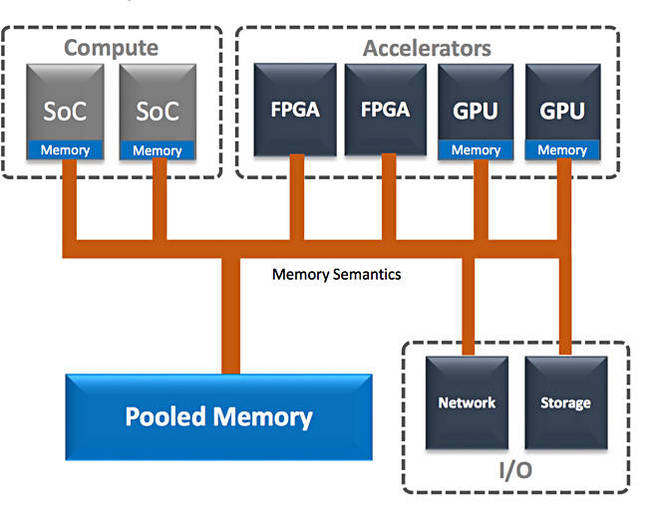
It looks like everyone on the planet is ganging up on Intel with a design that looks a bit like this:

gen_z_pooled_memory_idea.jpg


I guess Intel not buying (and killing off!) Mellenox means that we will get performant systems that are not bandwidth strangled:

http://genzconsortium.org/news-type/press-release/

Recipe for greatness

+) Software that splits complex processing into progressive functioning NODES that use finite local memory
+) Multi processing point system which receives data over HIGH BANDWIDTH mesh and performs NODAL function before passes it on to the next Node.
+) PROCESSING Requirement dictates the time allowed processing at each node -> and therefore the total number of nodes.
+) Increasing the nodes would not reduce Frame rate, just the latency. Which could mean just buying more CPU to ADD to what you have already got ... rather than the Intel way of throwing away your old 12 core x86 and buying a new one that goes 10% faster.

I wonder how long it will take before consumers will be able to make use of this? My guess is that Cray (who have been augmenting the Vector capabilities of ARM V8-SVE), will be competing with Fujitsu (backed by the Japanese Gov) to get this working ... and that coherent magic expertise of the 128 node ARM mesh will see the light of day first.

AJ
 
Last edited:
I'm doing some of this in my system Antony.
 
Back
Top