Welcome to our community

Be a part of something great, join today!

  • Hey all, just changed over the backend after 15 years I figured time to give it a bit of an update, its probably gonna be a bit weird for most of you and i am sure there is a few bugs to work out but it should kinda work the same as before... hopefully :)

Meaning of 16.5 stops of Dynamic Range

24 pages is apparently my limit for giving a f^ck about this.
 
I agree 100% that real life shooting / testing is more important than any chart. However most of the time I shoot with Redlogfilm in the monitoring path then use a LUT processor / LUT based workflow - thus my interest in how closely Dragon resembled my Alexa LUT based workflow for lighting / exposure / live grading decisions. This chart helps me establish a common baseline starting point for each camera, that's it. It doesn't help me after moving on to the next scene and offloading mags to then go into RCX and dig around for extra detail that is likely there beyond what I saw live. At least in network series land, Directors and Producers get justifiably nervous when you tell them that what they're looking at live will look better and/or different in post.

Yup, got it. I saw a few of your other tests before and understand and respect your methodology.
Thank you for sharing your findings, Corey.
 
I've been right through this thread but can't seem to find any clear consensus. Has anyone agreed how the Dragon's DR is distributed in overexposure and underexposure latitude yet?Do we know how many stops above and below middle grey it will hold?
While this answer is certainly no consensus, I believe that the charts/scope shots a previous user put up show pretty clearly where the dynamic range of the sensor is mapped. If you look at the attached you will see that the Dragon sensor maps grayscale values almost the exact same from 55 IRE down as the Epic, the difference being that the Dragon is mapping one stop DARKER values than the Epic. I think it can do this because it has one stop greater overexposure latitude than the Epic. This test does not show what f-stop the user used, but it would be my guess that the Dragon was opened one stop more than the Epic, thus having the one stop offset in the low end between chips and the extra stop of brightness latitude. Starting from about 42 IRE (mid gray) you can count up about 6.5 stops to clip. That number matches CML tests and also a sekonic meter test by John Marchand. (note: I believe that the number 8 chip is overexposed by about 1/2 stop on the scope. The person that has put up this image has put up 4 different camera scope shots and they all have this extra bright chip at number 8. I've put my yellow line where I think a chip with the proper transmissive brightness would be for both cameras.) Counting down I count about 6.5 stops down to chip 14. How much detail you can pull out of remaining chips is subject to endless debate on this forum, so you can extrapolate on your own from there.
 

Attachments

  • Epic:Dragon Scope Comparison.jpg
    Epic:Dragon Scope Comparison.jpg
    97 KB · Views: 0
Last edited:
One "fun" thing (and by fun I mean about a 16 hour day) I did when measuring the Dynamic Range on Dragon was basing my testing methods around reading the "chips" in a variety of ways. Mid IRE value, moment of clip down, and visibility of shadow information then up. Measuring this across the various ISOs from 200-2000 gives a fairly clear picture of how much more Dragon sees into the dark and how much more can be protected in the highlights. Measuring several chips accurately and changing various light intensities to match precise 1 stop increments helped where certain charts "topped out" and it also was fun to measure way out of range both in overexposure and underexposure. Similar to how we've measured exactly what various stocks of Kodak and Fuji negs could see. Interestingly enough we did test film a long while ago pushing prints at +1 (typical), +2 (stress), and +3 (very stressed).

I've already posted my thoughts on this matter and more or less have been able to show to others exactly what it can do versus film and digital systems.

Dragon has a boat load of usable and dense dynamic range. That extra dynamic range leads to a few things in my mind.

1. A more organic, analog feel to the highlight roll-off
2. A denser, thicker digital negative
3. A broad workable latitude

We can talk about the specific number and I know what I've measured now 3 times. But in reality those items listed above and having access to the massive dynamic range is visible and practical. It's what you notice. It's the first thing experienced Mysterium-X shooters feel and witness as well. You see it everywhere in the general image quality.
 
It's just kind of sad that Red needs to fumble around with numbers rather being upfront about their specs. Are they really that insecure about their market position?

I'm not saying this to bash Red. i'm saying this because Red's reputation isn't too good with alot of people i meet, which can be frustrating.

I would say they are insecure ..and they cant seem to make their minds up. there is a better way, they're not quite there

some of us have asked for upgradeable sensors for a while around here. red have promised nothing beyond dragon upgrade wise.. meanwhile I saw at nab blackmagic' rep getting asked if the ursa will have the processing power to handle "future sensor data" and he hinted it has A LOT EXTRA..and that he's not allowed to disclose just how much more exactly.. (search on google etc)

..hopefully this will catch on as the modular system is crap ..ie, the red way: want more DR?.. certainly sir, just swop out our brain module for $30k+ etc and use the same batteries? ..

im sick of this disposable world, but I think the red modular system around here is a marketing gimmick, so im waiting for someone to really "get it".. ie, L.T.S ..
 
One "fun" thing (and by fun I mean about a 16 hour day) I did when measuring the Dynamic Range on Dragon was basing my testing methods around reading the "chips" in a variety of ways. Mid IRE value, moment of clip down, and visibility of shadow information then up. Measuring this across the various ISOs from 200-2000 gives a fairly clear picture of how much more Dragon sees into the dark and how much more can be protected in the highlights. Measuring several chips accurately and changing various light intensities to match precise 1 stop increments helped where certain charts "topped out" and it also was fun to measure way out of range both in overexposure and underexposure. Similar to how we've measured exactly what various stocks of Kodak and Fuji negs could see. Interestingly enough we did test film a long while ago pushing prints at +1 (typical), +2 (stress), and +3 (very stressed).

I've already posted my thoughts on this matter and more or less have been able to show to others exactly what it can do versus film and digital systems.

Dragon has a boat load of usable and dense dynamic range. That extra dynamic range leads to a few things in my mind.

1. A more organic, analog feel to the highlight roll-off
2. A denser, thicker digital negative
3. A broad workable latitude

We can talk about the specific number and I know what I've measured now 3 times. But in reality those items listed above and having access to the massive dynamic range is visible and practical. It's what you notice. It's the first thing experienced Mysterium-X shooters feel and witness as well. You see it everywhere in the general image quality.

Hey Phil, you're doing great and you're very much appreciated around here, that's for sure. The negative comments regarding DN aren't really about how good the Dragon is, but more about why the specs of the camera don't match the specs of the camera, know what I mean? So while your tests are proving how nice Dragon is, they don't address RED's announcement, which is what I think the OP is questioning. Imagine if the Dragon was something you could buy of the shelves and on its box it had written in big red letters "Modular Design, 6K resolution, 16-bit RAW, 16.5 stops of Dynamic Range", next to it's price tag. But then, when the customer got home, he/she realized that there was actually LESS than 16.5 stops of dynamic range. Or imagine he or she got their new Scarlet home and realized that it only recorded 3.2K of actual resolution, no 4K? This sort of thing is what I think people are upset about....not the camera itself.
 
I would say they are insecure ..and they cant seem to make their minds up. there is a better way, they're not quite there

some of us have asked for upgradeable sensors for a while around here. red have promised nothing beyond dragon upgrade wise.. meanwhile I saw at nab blackmagic' rep getting asked if the ursa will have the processing power to handle "future sensor data" and he hinted it has A LOT EXTRA..and that he's not allowed to disclose just how much more exactly.. (search on google etc)

..hopefully this will catch on as the modular system is crap ..ie, the red way: want more DR?.. certainly sir, just swop out our brain module for $30k+ etc and use the same batteries? ..

im sick of this disposable world, but I think the red modular system around here is a marketing gimmick, so im waiting for someone to really "get it".. ie, L.T.S ..

I really have no idea what this post means. My Epic is at Red right now getting upgraded into a new camera for $9500, and I paid only $4500 to upgrade my original Red One to MX, so I don't know what you're referring to with the $30K statement.

If Black Magic makes cameras that are good enough for your needs, then maybe this website really isn't for you.
 
Hey Phil, you're doing great and you're very much appreciated around here, that's for sure. The negative comments regarding DN aren't really about how good the Dragon is, but more about why the specs of the camera don't match the specs of the camera, know what I mean? So while your tests are proving how nice Dragon is, they don't address RED's announcement, which is what I think the OP is questioning. Imagine if the Dragon was something you could buy of the shelves and on its box it had written in big red letters "Modular Design, 6K resolution, 16-bit RAW, 16.5 stops of Dynamic Range", next to it's price tag. But then, when the customer got home, he/she realized that there was actually LESS than 16.5 stops of dynamic range. Or imagine he or she got their new Scarlet home and realized that it only recorded 3.2K of actual resolution, no 4K? This sort of thing is what I think people are upset about....not the camera itself.

I honestly don't think they are pulling wool over anybody's eyes here.

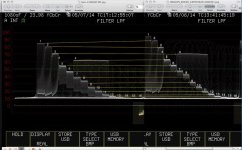
More or less and others have shown the same I've measured over 16 stops of Dynamic Range, with a "proper" gamma curve applied you are getting somewhere between 16 and 17 stops. My images and test patches are here. Reflective charts through scopes aren't exactly the best way to make a precise measurement, though a 16 stop chart will show what is posted above and that is a practical answer. A 21 and/or 34 step chart is what is truly desired. The difficulty here is that this is pretty much outside of the territory of a reflective chart with standard and/or gloss coatings. At least all the ones I read. Even the highest end chart which is self illuminated needs to be properly flagged per patch as ambiance begins to interfere with the measurement (i.e. value bleed).

If I recall correctly, Jim or Jarred stated that the DR was very hard to measure on Dragon and I did it "the normal routes" first. I found similar issues in my initial tests some time ago. However, measuring tonal levels per patch, per stop, via all of the ISOs (tracking that is fun btw) reveals what you want to see. It's imperative to now test REDgamma4, REDlogFilm, and Linear. It's even more important to test in exact 1 stop increments below and above range.

In the near future I'll do this via a flagged self illuminated chart. I'm working with somebody right now to produce a 34 step chart (oddly for something else entirely, though pretty much what you'd want to see here), similar to our old Kodak Control Strips yet in a measurable form using a balanced source.

In the waveform captures posted you can count 16 distinct steps down to the noise floor. Opening up one stop on the lens or beefing up the source would reveal something interesting in this particular case.

Mark's post above is fairly dead on. The key to understanding what Dragon can do can be found within how you choose to utilize the dynamic range for a given exposure and then the eventual color grade. For instance my last shoot was lit to not contain anything that hit the noise floor, yet was above it. Midtones were exposed properly, highlights were free to clip. This resulted in a very freely gradable file, minus maximum highlight (which should burn out if in frame).
 
I think it is important to note that talk of 21-steps is NOT 21 STOPS... A typical 21-step Stouffer wedge for example is laid out in 1/2 stop increments. It's for that reason I think the main issue here is that many people confuse 1/2 stop exposure wedges with full stops of dynamic range.

With all of the talk about 16 stops here, 18 stops there... Let me stress that is is VERY difficult to light a scene or a chart to 16 or 18 stops of range! Using a reflected meter, you would need to have an f.3 on the low end in shot and then go upto an f128 on the high end to get 17 stops of range! (18 visible densities, you don't count the first since it takes 2 patches to create a "range")... So basically in the same shot you'd need a pitch-black velvet lined tunnel next to a 12K Fresnel pointed right at camera! And you'd want to see the lines of the Frensel glass on the edges of the glass (meaning detail) and then still see a hotter point in the middle of the glass!

Go out and try to measure 16 stops in reality. I bet you can't easily find a scene representing that broad a range.

It's also worth mentioning that there is no current display medium exhibiting 16 stops of range to exhibit this broad range on too, so anything captured higher than the end display medium will have to be squeezed down to fit within that range.
 
Yes. The newer 34 step is a 2/3rd of a stop increment creating a 22.44 stop range which is nice to graph.
 
That will need a pretty damn bright light source or several sources...
 
That will need a pretty damn bright light source or several sources...

Well yes. And much of the practicalities of having a system capture this much DR comes from "in practice use" and not just "number talk".

One thing that is extremely clear to me is that Red spent much more time tuning Dragon to create a very organic looking image. This is currently what really separates Dragon from the rest of the pack at the moment to me.

In terms of the latitude, yes on a controlled set traditionally speaking lighting outside of 16 stops is tricky. In uncontrolled situations it's much easier to go way outside that range. For instance a back lit subject in broad daylight being exposed for proper midtones with blue sky and highlight gradient from the sun will yield a fairly insane dynamic range in that given scene (essentially shooting into shadow and exposing it as a midtone).

However, the question isn't to me "can we get all of that", it's more about how the image looks when handling such an extreme situation. And it's far less technical really. The important question there is does it look good? Does it feel good? Does it feel digital?

This is where Dragon is showing a lot of it's strength. I've started using the term "density" again with Dragon, which isn't very common with digital capture, but that's exactly what I'm experiencing. A thicker, denser image.
 
Hello Phil and Chris,

Can either of you say at this point what the Dragon currently has for overexposure latitude
when shooting and exposing it at 800 ISO?

I keep thinking that the new OLPF and Color Science put the Dragon at 7 stops to clip
from mid gray at 800 ISO.

I have been blown away by the DR and color fidelity of the new Dragon.
It produces the best looking digital images I have ever experienced.

Depending on your gamma curve at ISO 800 I'd say it's between 7 and 8 stops.

The DR and especially the color are vastly improved. The color for me was/is the most pleasing surprise so far.
 
Depending on your gamma curve at ISO 800 I'd say it's between 7 and 8 stops.

The DR and especially the color are vastly improved. The color for me was/is the most pleasing surprise so far.

Thanks Phil.

I guess I should have asked for the overexposure latitude when the Dragon is set to ISO 800 and viewing with RLF.

However, I'm sure the answer would still be about 7.5 stops.
 
Yes. The newer 34 step is a 2/3rd of a stop increment creating a 22.44 stop range which is nice to graph.

If an 18 stop range would go from 0.5 to 256 - someone please explain how you could get a 22 stop range without shooting directly at the sun from outer space or with some kind of ultra sensitive super secret scientific light meter inside a black box?

Phil, can you provide a link to that chart or something? I could only find 31 step 1/3 increment charts on their site.
 
Christopher Probst said:
I think it is important to note that talk of 21-steps is NOT 21 STOPS... A typical 21-step Stouffer wedge for example is laid out in 1/2 stop increments.

Isn't the Xyla-21 chart using 1-stop steps? The claim is it can measure 20-stops of dynamic range. I have not used one yet, but I do have one on order.
 
Phil, can you provide a link to that chart or something? I could only find 31 step 1/3 increment charts on their site.

I am having it made.


Isn't the Xyla-21 chart using 1-stop steps? The claim is it can measure 20-stops of dynamic range. I have not used one yet, but I do have one on order.

The Xyla-21 is "the right thing".
 
Oh yes. Also this. Relevant to this discussion:


I don't know this guy, but he and I are pretty much on the same page in terms of what we are getting out of Dragon.
 
Last edited:
Back
Top