Welcome to our community

Be a part of something great, join today!

  • Hey all, just changed over the backend after 15 years I figured time to give it a bit of an update, its probably gonna be a bit weird for most of you and i am sure there is a few bugs to work out but it should kinda work the same as before... hopefully :)

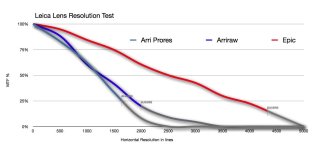
Leica Lens Resolution test...

I'm asking myself how RED would respond if Sony (let's say tomorrow) put the same sort of graph on the internet that could show how much F65 8K has more resolution than Epic 5K.

That means RED Dragon new sensor should be minimum the same resolution size as a F65 that is 8K if RED want to continue this kind of a resolution race!!!???

According to that I will soon open a new tread titled Alexa-The New German Pragmatism just to open discussion about how Arri is doing things and what RED is still missing...
 
I'm asking myself how RED would respond if Sony (let's say tomorrow) put the same sort of graph on the internet that could show how much F65 8K has more resolution than Epic 5K.

That means RED Dragon new sensor should be minimum the same resolution size as a F65 that is 8K if RED want to continue this kind of a resolution race!!!???

According to that I will soon open a new tread titled Alexa-The New German Pragmatism just to open discussion about how Arri is doing things and what RED is still missing...

As I posted in another thread, because of the rotated bayer, the effective horizontal count is really more like 5.7k from the 17.7Mpixels in their active area.
 
I'm asking myself how RED would respond if Sony (let's say tomorrow) put the same sort of graph on the internet that could show how much F65 8K has more resolution than Epic 5K.

That means RED Dragon new sensor should be minimum the same resolution size as a F65 that is 8K if RED want to continue this kind of a resolution race!!!???

According to that I will soon open a new tread titled Alexa-The New German Pragmatism just to open discussion about how Arri is doing things and what RED is still missing...

From what I understand... Arri are putting out misleading specs. If Sony came out with specs that were higher than Epic then as long as they could be proven I'm sure it would be welcomed. Arri are stating one thing but the tests are showing another. Big difference.

Sanjin, I don't know you and Im sure you're a good guy, but you come across as very antagonistic here. Maybe you're trying to be, maybe English is not your native tongue and something gets lost in translation.... I don't know. But I'm unsure as to what it is you're trying to achieve here.
 
The whole system is a very delicate balance, in particular between the number and size of photocells and the OLPF. There is no such thing as a brick-wall OLPF, it's an optical filter. Some manufacturers are biasing that balance in favor of resolution and risk some aliasing, others are more conservative and loose some resolution but get moiré-free images. IMHO RED hit a very sweet spot in the R1 already and I don't doubt they'll do it again in the EPIC.

But even if the sweet spot is very well chosen in the Alexa too, it will never reach where a sensor with more cells can reach.

There used to be a pretty good explanation in some videos on the Panavision site (albeit a bit biased at the time against the R1 when they were still favoring the Genesis/F35), but I'm afraid they pulled it down.
 
From what I understand... Arri are putting out misleading specs. If Sony came out with specs that were higher than Epic then as long as they could be proven I'm sure it would be welcomed. Arri are stating one thing but the tests are showing another. Big difference.

Sanjin, I don't know you and Im sure you're a good guy, but you come across as very antagonistic here. Maybe you're trying to be, maybe English is not your native tongue and something gets lost in translation.... I don't know. But I'm unsure as to what it is you're trying to achieve here.

Sanjin posts lots of very large pictures of his urban garden, and girls around Vienna, for reasons I seldom understand.
 
The whole system is a very delicate balance, in particular between the number and size of photocells and the OLPF. There is no such thing as a brick-wall OLPF, it's an optical filter. Some manufacturers are biasing that balance in favor of resolution and risk some aliasing, others are more conservative and loose some resolution but get moiré-free images. IMHO RED hit a very sweet spot in the R1 already and I don't doubt they'll do it again in the EPIC.

But even if the sweet spot is very well chosen in the Alexa too, it will never reach where a sensor with more cells can reach.

There used to be a pretty good explanation in some videos on the Panavision site (albeit a bit biased at the time against the R1 when they were still favoring the Genesis/F35), but I'm afraid they pulled it down.
This is a technical question not an artistic choice one. All that chatter about "delicate balance in Universe " and "sweet spot" hardly qualifies as tech the engineers use when designing specs for components.:001_cool:
 
This is a technical question not an artistic choice one. All that chatter about "delicate balance in Universe " and "sweet spot" hardly qualifies as tech the engineers use when designing specs for components.:001_cool:

The setting of the OLPF is technical indeed (based on pixel size, fill factor, demosaic algorithm), but based on artistic requirements balancing aliasing and resolution. When Uli says we hit "the sweet spot", he means we chose the OLPF such that it balanced the resolution / aliasing requirement in a way that suits his needs and aesthetics. The spec for any component must be such that it meets the needs of the camera, which are generally, when it all comes down to it, predominantly aesthetic. Everything serves the image.

Graeme
 
MTF and aliasing.jpg
I've produced from Jim's data an MTF% graph that makes the data easier to understand. On the Y-axis we have %MTF normalized to the MTF at zero resolution, and I've also marked in the resolutions at where Jim noticed the aliasing. What's interesting is either shooting RAW or ProRes doesn't alter the MTF50% point at around 1100 lines, whereas the MTF50 on the Epic is way out at 2500. MTF50 is a very good guide to the overall perception of sharpness. You can see how going for a greater maximum resolution not only leads to lower aliasing, but also greater perceived resolution due to much better MTF50 performance. If you think that the MTF50 governs what you see on any size or resolution screen, and the detail beyond MTF50 is what you'd see on image projected at full detail, you can gain benefits not just with optimum projection, but all type of projection or display.

Graeme
 
Graeme, it's thoughtful posts like this that make all the noise on this forum worth it.

Thank you for helping us sell your magic :)

+1
100% agreed.
Thanks
 
Does any one know what is the Penelope Delta Resolution? Both spec and mesured?
 
The setting of the OLPF is technical indeed (based on pixel size, fill factor, demosaic algorithm), but based on artistic requirements balancing aliasing and resolution. When Uli says we hit "the sweet spot", he means we chose the OLPF such that it balanced the resolution / aliasing requirement in a way that suits his needs and aesthetics. The spec for any component must be such that it meets the needs of the camera, which are generally, when it all comes down to it, predominantly aesthetic. Everything serves the image.

Graeme

It's great that you were able to find that "sweet spot" where the sharpness is preserved at ultra high resolution and the aliasing is controlled so well.

My limited understanding of this issue was that camera manufacturers often preserved sharpness at the risk of a slightly aliased image, or they sacrificed some sharpness to control it most effectively. The Alexa is often described to me as having a slightly softer image, and it obviously lacks the high resolution of the Epic. One might expect that they would have performed better than they did.

Am I correct that Epic's internal filter choices (seen at NAB 2011) will vary in their ability to control aliasing?
 
Peter, the internal filters shown at NAB were varying degrees of ND built into the OLPF/IR stack. By building them in, there's less glass reflections and no back-focus change.

The answer to the conundrum of resolution / aliasing is not to alter the OLPF, but to put enough pixels on the chip to achieve the resolution you need, and more pixels will also, with a good OLPF, lead to lower aliasing too.

Graeme
 
Peter, the internal filters shown at NAB were varying degrees of ND built into the OLPF/IR stack. By building them in, there's less glass reflections and no back-focus change.

The answer to the conundrum of resolution / aliasing is not to alter the OLPF, but to put enough pixels on the chip to achieve the resolution you need, and more pixels will also, with a good OLPF, lead to lower aliasing too.

Graeme

Thanks Graeme.

I thought that they were completely different OLPF choices.

Now I better understand one of the reasons for the great pixel race.
 
Graeme (or anyother left brain type who knows how to talk to right brainers), I'm still not quite ready to give you a gold star yet. First, what does "MTF" stand for and why do we care?
Modulation Transfer Function. It's both a measure of resolution and contrast. Obviously very important. Explanations abound, but here are a couple:
http://www.edmundoptics.com/technical-support/optics/modulation-transfer-function/
http://www.youtube.com/watch?v=1VgqsMqBpKc&feature=related (The title slide says zoom lenses, but the video lesson is about MTF).
Next, I follow your line about the swing of the lines, but what about the distance between the verticle lines? Red is much closer (or is that an illusion?). Is that because they are being measured differently, a change in axis (I can't read mine too well), or what?
Distance along the x-axis between data points is unimportant and I believe just has to do with how often a reading was taken. The important thing is the vertical distance. If you understood the info in the links you'll realize MTF at any particular "distance" (actually lines - explained below) equals the vertical distance from peak to trough divided by the maximum vertical distance (which is at the left).
The red line shown as "alasing" means what? That Alasing starts here and throughout the rest of the chart or at this point only? If at this point only, so what is the significance? What's the signifance of the large fall off on the Red at the end? No such fall off on the other charts.
Aliasing (check your spelling) in this context means, in plain English - the sensor has reached the limit of what it can resolve without degrading the image due to its own limits and the design of the OLPF (see Graeme's post below and all the references to OLPF - Optical Low Pass Filter - above). As Graeme explained in other posts, MTF 50 is a better measure of where an image loses significant contrast - such that it interferes with our perception of sharpness, i.e. how real or clean an image appears. Anything to the right the marked aliasing point is so affected by artifacts that it doesn't add to image quality (and may detract). So from that point on aliasing has taken over and any variation is meaningless. I'm guessing the falloff at the end is just the light source in the machine being turned off - in any case it's unimportant.
Does the bottom axis say "distance"? If so, distance from what to where?
Yes, it does say distance. Calling it distance is not helpful, so if you look at Graeme's re-done chart a few posts back he changed the units to horizontal resolution in lines. (The distance was probably distance from the center of the zone plate - more accurately described as lines at a particular distance.). Here's a picture of a zone plate so you get an idea of what the machine was measuring: http://www.xs4all.nl/~bvdwolf/main/foto/down_sample/down_sample_files/Rings1.gif (The extra non-centered grey rings you probably see are not part of the plate - they are moire patterns - inteference with the pixels that comprise the image on your screen, due to the spacing between the pixels. One of the purposes of an OLPF is to prevent - or mitigate - this type of interference between patterns in the object and patterns in the sensor.)

I'm not an expert, but I am a professional "explainer." Corrections welcome.

And since when do students award gold stars to teachers? In any case, I hope this was helpful.
 
Last edited:
Steve, the "aliasing" mark is the point at which Jim noticed that the zone plate was aliasing. You can tell this from a plot (an inflection point where the black/white pattern changes, or a null where you get no contrast, then contrast rises again), but it's much easier to see on the image itself as moire. We want aliasing to be as high a resolution as possible, and lowest in contrast as possible, as seen by the negligible aliasing magnitude and high resolution on the Epic plot.

Graeme
 
OK. Sorry, I thought it meant something different in this context. I'll fix my post.
 
How do they MTF ? When compared with Master Primes etc...

If the chart looks this good on Leicas, I am pretty sure it will look exactly the same on Master Primes, as they are still the absolute Sharpest and best Cine Lenses ever made,
if the new Cine Leicas were to be any sharper then the Master Primes, then I must say that they have done nothing short of an insane Miracle a la RED... ;)
 
Jim and Graeme,

First of all: Ouch! Impressive.


1. You specified the codec on the Arri (raw, prores) but not for the Epic. Obviously it's REDcode but what compresion ratio did you use? I suspect you used the 2:1

2. It would be interresting to see a chart of only Epic with different REDcode compression ratios from 2:1 to 18:1

3. Just for the kick, I'd like to see a chart from Epic without any REDcode compression (just to compare with Arriraw). I'm sure you have a way, on the bench, to bypass the compression and get the raw data from the sensor.

Finally, I'm surprised that on the Arri side we don't see more difference between Arriraw and Arri Prores.
 
Back
Top