
Jeremy Torrie
Well-known member
Here's a Camo version
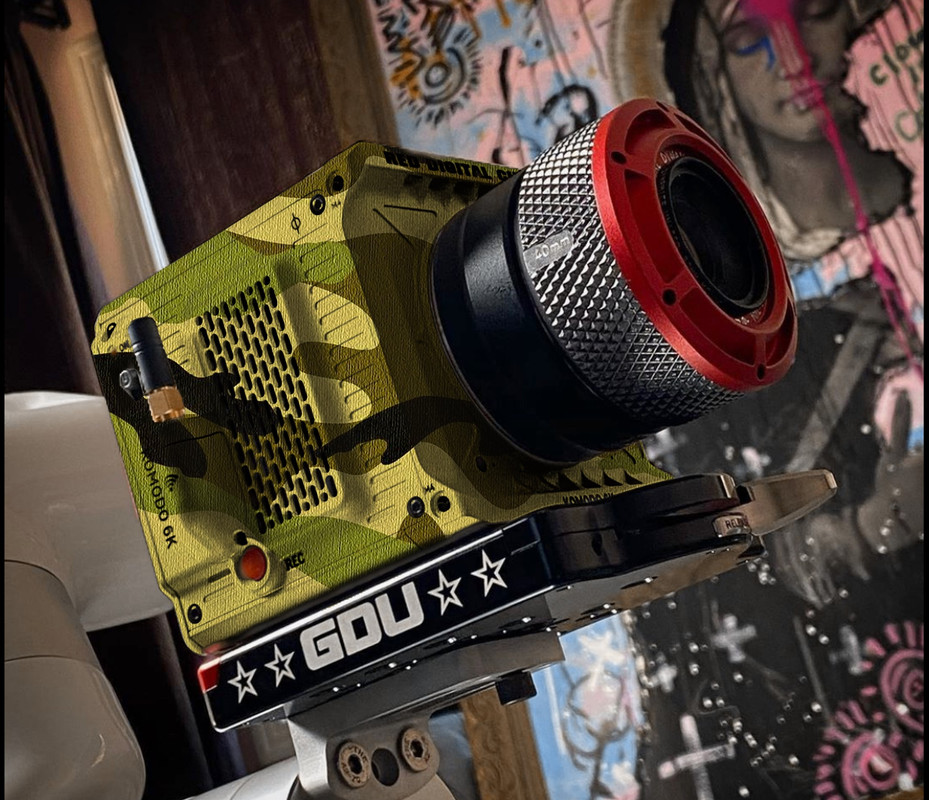
Super cool Rand!

Follow along with the video below to see how to install our site as a web app on your home screen.

Note: this_feature_currently_requires_accessing_site_using_safari
Here's a Camo version


Super cool Rand!
Sorry for a stupid question but is anyone knows 120 fps will be in crop or scaled form 6K to 2K
thx


A question that hurts to think about, but necessary, have any drop tests been preformed? What is the drop height?
Any word on Speedbooster and Komodo or what are you able to share about this combination?I won't be dropping mine, knock on wood, but Jarred has mentioned a bunch and it's plain to see Komodo has been built to take a beating. More than likely your lens will snap off and batteries will bounce out. Media will be contained in the body as there is a door there, which is a big thumbs up from me.
One unspoken good thing about REDCODE RAW is generally if the camera loses power for some reason your R3D take usually records and creates a good end of file. I've seen that happen over the years due to cranes and junk pulling power and shockingly the takes are there.
I suspect we'll see this camera being used as a crash cam/stunt cam a bunch honestly. That somewhat breaks my heart, but you know, you can't make an omelette without breaking a few eggs.

One unspoken good thing about REDCODE RAW is generally if the camera loses power for some reason your R3D take usually records and creates a good end of file. I've seen that happen over the years due to cranes and junk pulling power and shockingly the takes are there.

Any word on Speedbooster and Komodo or what are you able to share about this combination?
I won't be dropping mine, knock on wood, but Jarred has mentioned a bunch and it's plain to see Komodo has been built to take a beating. More than likely your lens will snap off and batteries will bounce out. Media will be contained in the body as there is a door there, which is a big thumbs up from me.
One unspoken good thing about REDCODE RAW is generally if the camera loses power for some reason your R3D take usually records and creates a good end of file. I've seen that happen over the years due to cranes and junk pulling power and shockingly the takes are there.
I suspect we'll see this camera being used as a crash cam/stunt cam a bunch honestly. That somewhat breaks my heart, but you know, you can't make an omelette without breaking a few eggs.
Really dig the Gunmetal and Hydrogen TI, would kill for a Forged Carbon, yet that may place it out of spec Komodo class camera. Jarred what level would you say auto focus is at with Komodo at this stage, have you passed Panasonic so to speak? The Black Komodo can we speak about that, any plans on anything other than Aluminum? I'm still interested in what you are cooking up @GDU for Komodo, mounts, baseplates and so on? Will there be a production kit and has the official process for H1 discount been put in place?
Dig it, I was aware, just wondering if it had been fully flushed out with links and such.... All good, still a bit off.Jarred answered the following about the H1 process:
“yeah hydrogen owners will type in their [S/N] into when its time to order the normal black komodos for the discount. That’s a ways away so no rush, don’t need the pre list to happen“
I looked at the FAQ and seems that the SB takes Komodo to FF, I'm interested in your take on the aesthetic, does the SB add anything special or not?Made a whole F.A.Q. about lens mounts, adapters, and boosters stuff here:
http://www.reduser.net/forum/showthread.php?180836-Phil-s-Cine-RF-Mount-amp-Adapter-F-A-Q
I looked at the FAQ and seems that the SB takes Komodo to FF, I'm interested in your take on the aesthetic, does the SB add anything special or not?
Dig it, thanks again Phil!Notable paths with Komodo and lens mounts.
Mount Adapters (two flavors):
Simple mechanical mounts are essentially just tubes with the adapted to mount on them that give you the correct flange focal distance. There are "dumb" and "smart" mounts, smart ones have electronics in them. Particularly if you are going from things like Canon RF (Komodo's native mount) to Canon EF and still want electronic control over iris and focus, the smart mounts are what you want.
As for Speedboosters (focal reducers). They have pros and cons. And seemingly I am very literally the only person on the internet who ever calls out the cons of these things. And I even use them. I'm just letting people know it's not all daisies and rainbows.
Pros:
- You traditionally gain about 1 stop of light (and T2.8 lens is now as sensitive as an T2 lens for instance as the light is amplified)
- You also get the wider field of view that comes with the reducers magnification ratio (generally approximately designed to get you to a specific format like S35 to F35)
- Will absolutely produce a higher MTF than a bare lens (for example a F35 center frame will be sharper with the focal reducer than just the bare lens due to reduction)
Cons:
- You will likely see added distortion when using a Speedbooster than compared to filming on the native format you are trying to get to.
- You will likely see enhanced vignetting than just the bare lens, though in some cases it can even reduce vignetting, which is a fun optical physics versus optical path dance
- While sharper often center frame, image performance commonly falls off towards the edges compared to the bare lens
- You also might see enhanced image artifacts, aberrations, towards the edge of frame
- You are still adding more glass into the mix and that might have an impact on lens flare and even glare, i.e. more internal reflections
No free lunch with optics. Reducers are tools and you just need to know what you're getting into with them. A lot is dependent on the lenses themselves you are pairing them with. Some designs will inherently work better when projecting light onto a reducer's element than others. In terms of increasing sharpness overall, yes in theory and certain increasing telecentricity, but at the same time optical coverage comes into play when you start getting to the edge of the reducer and that's where the rub is.
For me reducers are most useful when trying to get that extra stop or increasing the FOV. But it is important to know where issues may arise. And yes, I'll be using them with Komodo a fair bit. Equally though, I'm into some of that good old fashioned bare lens action, whether that's Super 35mm or anything for a larger format as well. Can't been that naked glass if you are really after the purist mentality as well as image quality.

Notable paths with Komodo and lens mounts.
Mount Adapters (two flavors):
Simple mechanical mounts are essentially just tubes with the adapted to mount on them that give you the correct flange focal distance. There are "dumb" and "smart" mounts, smart ones have electronics in them. Particularly if you are going from things like Canon RF (Komodo's native mount) to Canon EF and still want electronic control over iris and focus, the smart mounts are what you want.
As for Speedboosters (focal reducers). They have pros and cons. And seemingly I am very literally the only person on the internet who ever calls out the cons of these things. And I even use them. I'm just letting people know it's not all daisies and rainbows.
Pros:
- You traditionally gain about 1 stop of light (and T2.8 lens is now as sensitive as an T2 lens for instance as the light is amplified)
- You also get the wider field of view that comes with the reducers magnification ratio (generally approximately designed to get you to a specific format like S35 to F35)
- Will absolutely produce a higher MTF than a bare lens (for example a F35 center frame will be sharper with the focal reducer than just the bare lens due to reduction)
Cons:
- You will likely see added distortion when using a Speedbooster than compared to filming on the native format you are trying to get to.
- You will likely see enhanced vignetting than just the bare lens, though in some cases it can even reduce vignetting, which is a fun optical physics versus optical path dance
- While sharper often center frame, image performance commonly falls off towards the edges compared to the bare lens
- You also might see enhanced image artifacts, aberrations, towards the edge of frame
- You are still adding more glass into the mix and that might have an impact on lens flare and even glare, i.e. more internal reflections
No free lunch with optics. Reducers are tools and you just need to know what you're getting into with them. A lot is dependent on the lenses themselves you are pairing them with. Some designs will inherently work better when projecting light onto a reducer's element than others. In terms of increasing sharpness overall, yes in theory and certain increasing telecentricity, but at the same time optical coverage comes into play when you start getting to the edge of the reducer and that's where the rub is.
For me reducers are most useful when trying to get that extra stop or increasing the FOV. But it is important to know where issues may arise. And yes, I'll be using them with Komodo a fair bit. Equally though, I'm into some of that good old fashioned bare lens action, whether that's Super 35mm or anything for a larger format as well. Can't been that naked glass if you are really after the purist mentality as well as image quality.


I was originally going to just quote this to emphasise how important this kind of feature is. But I noticed something else: this is very film-like. If the battery dies on a film camera, or if the film just runs out, you don't lose your footage.One unspoken good thing about REDCODE RAW is generally if the camera loses power for some reason your R3D take usually records and creates a good end of file. I've seen that happen over the years due to cranes and junk pulling power and shockingly the takes are there.