Mike P.
Well-known member
If RED makes a wireless control app for Komodo, I hope it’s compatible with their other cameras. That’d be a nice little ancillary bonus for existing RED Users.

Follow along with the video below to see how to install our site as a web app on your home screen.

Note: this_feature_currently_requires_accessing_site_using_safari

So, while not actually disagreeing with how you see it or looking for an argument, here's a different interpretation/opinion -
The RED sensor and colour-science development is actually more in line with the history and intent of photo-chemical film advancements than its competitors.
While the ARRI sensor and colour-science development is more of an attempt to replicate in the digital format where photo-chemical film was at a particular stage of its development. It's more of a caricature of film than a progression for or advancement of it, compared to RED.
What-you-see-is-what-you-get was the aim of photo-chemical film. Kodak hit a wall that could have been pushed further back with nano-technology, but the money ran out, digital technology became more viable and most of the world moved on.
RED picked up the image-quality-advancement 'ball' and started running with it, while ARRI put their effort into keeping the ********* and wanna-be-********* safe and happy with their cherry-picked, low-res, sugar-coated digital caricature of what 'film' should look like.
Seeing it that way, I'd prefer it if RED keep going in the direction they've been going by aiming for something that hasn't been done before, rather than start painting themselves into a corner imitating something else.
Which it looks like RED is doing anyway, by pushing the boundaries with the Komodo, while the competitors keep cutting corners to get in front or keep up, or maintaining the pretense they're above it all and don't even have to.
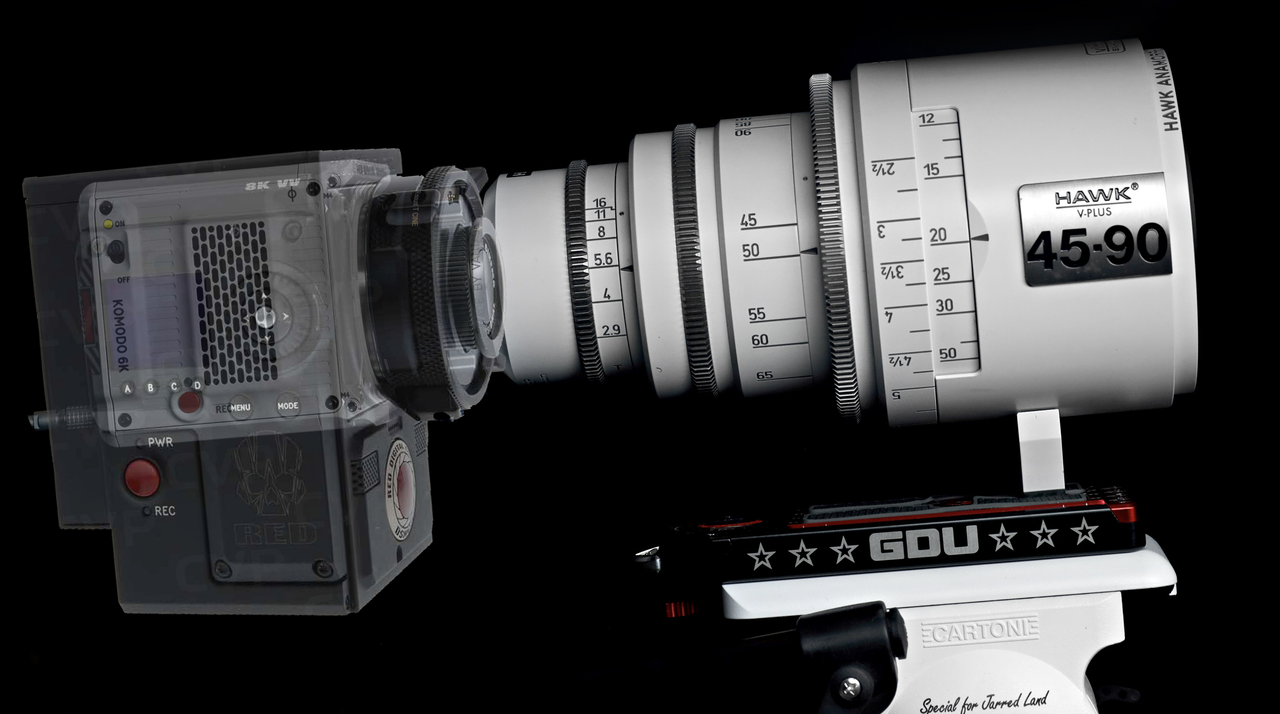
BTW, as the question keeps coming up, looking at the Komodo in terms of where it fits into the DSMC3 line-up might help with understanding where it fits into the market-place.

YUP, I thought is was closer too, slightly taller and deeper. Who has the exact dimensions for DSMC2Are you sure that's accurate? I measured my RED and found it to be smaller than I thought-- close to Komodo in some dimensions.
YUP, I thought is was closer too, slightly taller and deeper. Who has the exact dimensions for DSMC2
...A global shutter in a wide dynamic range HDR capable high resolution camera is a significant step forward in this respect...

Depends on the gain structure applied to the sensor data, it would also modify the metadata associated with the file.
So, while not actually disagreeing with how you see it or looking for an argument, here's a different interpretation/opinion -
The RED sensor and colour-science development is actually more in line with the history and intent of photo-chemical film advancements than its competitors.
While the ARRI sensor and colour-science development is more of an attempt to replicate in the digital format where photo-chemical film was at a particular stage of its development. It's more of a caricature of film than a progression for or advancement of it, compared to RED.
Digital cinema cameras can certainly mimic the aesthetic characteristics of film in most meaningful ways. But I don't think that should prevent exploring and inventing new aesthetic techniques that are unique to the digital medium. We can pay homage to the past without being constrained by it.
A global shutter in a wide dynamic range HDR capable high resolution camera is a significant step forward in this respect.

I Just thought about Red's partnership announcement with Atomos which I believe was around January of this year. Will that factor into encoding into additional New/Other Raw Codecs from the 4K SDI output of Komodo into an Atomos external recorder?

Sorry but Im not so technical some times

We need an accurate overlay. There are some very slim red batteries. Slim 3rd party PL mounts, and a very slim Canon mount. 4in monitor is tiny as well.


Sorry but Im not so technical some times. But could you record via the 4K SDI our 120fps externally via the Atoms?
Russ, You and me both, I'm not to sure myself.
Ryan, Thanks!

Odds we will see 120fps at 1080p?


Killer. If the sensor is Full-Frame I will be over the moon and will no longer purchase the C500 MKII. If they had an RF Mount and REDCODE it would be my perfect camera...until someone makes a Medium Format Cinema Camera I can purchase
This camera could disrupt the industry.
