Welcome to our community

Be a part of something great, join today!

  • Hey all, just changed over the backend after 15 years I figured time to give it a bit of an update, its probably gonna be a bit weird for most of you and i am sure there is a few bugs to work out but it should kinda work the same as before... hopefully :)

iMac Pro

Leave him alone. A bit of passion, does it matter if it isn't 100% perfect.

Ironically, Apple is the sort of hippie executive fusion company. I think it extends from Steve's issues trying to get financing in the very early days, and he eventually went professional and got the suites into Apple to run it (though that could be his early investors).
 
Just saying'

Just saying'

Putting aside the recycling/transport issues for the moment; I'd like to promote the design and construction of devices with long useful lifespans. Maybe the well equipped iMacPro that can provide a viable workstation for RedUsers, VFX/VR/Color/etc will cost $12K. If it can still meet the needs of the intended user(s) for 6 years, without crimping the productivity metrics of the wetware, $12K is a bargain. I have to believe that slowing the replacement cycle can only help the environmental impact issues that come from current manufacturing/transportation/recycle/waste practices. Not claiming it's a solution, just a step in the right direction.

Back to the value question, and markups, it all comes back to the divisor - how many years of solid service per $. If Apple can actually get the cooling piece right, yes - BIG IF - then the iMacPro could be worth that kind of coin to many of us. It might fall well short of that, but now we're speculating...

Cheers - #19
 
I respect Apple's vision and professionalism. But that combination of professionalism to serve creativity and practicality. But that was then, and it was slanted towards the high end.

If you want to be environmentally friendly get together and crowd fund the development of technology that is many times more than powerful enough for your purposes that lasts for decades at least, and is still good power. Then recycle. There are alternative technological paths than what companies use. They choose what suites them, not what is best. If you choose magnetic computing you could pack a thousand times more processing density and may have it work for decades, maybe even centuries (I haven't research the practicalities of this). If you choose optical, it maybe more powerful, or cheap enough to be disposable.

The present silicon technology can be increased in processing density up to 1000 times compared to normal 5nm projections, and maybe ten times in aspect of performance to pure present speed (GHz and performance per cycle).

Now, what is a present issue. Apart from practice inertia (which many seem to have around here, pursuing only what they know and do) and the present investment in doing it this way, if it costs more to produce per consumer unit of performance it may not be a priority. To make a consumer product last a lifetime, may not be such a priority.

However, crowd funding research may produce a costly but very long lasting high performance product. Once designed, the crowd funding organisation licenses it to manufacturers to recover money. They license on terms that suites us. If big firms won't do it in quantity, reliability, durability and price we want, license to smaller and smaller firms. However, initial runs can be done in large quantity at near cost direct to diners, cutting a lot of cost off the price compared to retail (maybe over 60%).

This is a much better model than paying companies a lot of money, waiting for them to invest a little towards advancing technology for you while living the life of a hog off the rest. Its about people, not just fascist some people.
 
Conceptually it is fine.

IMO, Apple almost hit the bullseye on this one. They missed a bit due to three issues: no i9 CPU option. no nVidia GPU option. their pricing is almost certainly going to suck.

Yes. The IMP will find a market and - even - be a 'perfect' fit. For some.

Guess where we're all bummed out is lack of CUDA, OpenGL et al.

How much of the development budget would it be to add better support for the above? (With considerably more sales)

Nearly there, Apple.
 
Guess where we're all bummed out is lack of CUDA, OpenGL et al.

I don't think this is a super huge issue. If you want serious GPU power you're probably looking at multiple GPUs anyway, and that means external solution via eGPU.

A good thing then, that strictly computational tasks like 3D rendering or image processing in Resolve only takes a negligible hit, if any, when using an external setup. And what ever small percentage hit you'd theoretically take would be EASILY outweighed by the fact that you could throw a LOT less money where you don't need it and re-invest that money where it best serves you.

Now, the following is admittedly speculation, but one can imagine that Nvidia took note of the promised eGPU support and that should intensify they're already new driver support commitment.

A 10-core iMac Pro with an external dual GPU box should be able to handle MANY scenarios. Once you get up to 18 cores I suspect the price will be at a level where one should consider putting that money into a more long term solution like the coming Mac Pro.
 
But, one of the limitations on high data rate, high processing application like top end video, is memory and storage sub systems to the GPU card. Restricting the lanes further through tb is not helpful, and needs special programming to do more on card and limit data transfer. So, a card that has large internal memory and storage interfaces programmed to take advantage of it, are going to maximise performance. So, the right software, and right GPU feature support, will maximise this. So, testing different cards would reveal suitability. Now, there are GPU features for direct access to system memory that help if programmed for and enough band with. X16 is a narrow pipe, so input and result output are best uses, and processing in between solely on the card, but complex processing cash require more than a simple stream. This us very much as program optimisation issue
 
Without deep diving into technicalities, it has been tested many times in various comparisons how bandwidth influences performance. One example might have a CUDA card in the x16 slot giving 34 fps playback while an external card over TB2 gives you 32 fps. Just going outside the to the eGPU might have some overhead accounting for that small drop in performance, but it is in no way reflecting the massive difference in bandwidth between internal x16 and TB2. With the current gen TB3 things improve greatly too.

Most of the hard work is performed locally on the card(s) and there is no need to ship huge streams of information between the external case and the computer.

I actually don't care much for theoretical scenarios, so let's just wait and see what becomes available this fall. But my guess is that a dual GPU TB3 case will provide lots of power at a very good price/performance ratio.
 
I'm not talking about theoretical Andree, and your avoiding actual avoiding talking about what I am talking about. Heavy processing of the image, not mere simple playback.
 
... CUDA card in the x16 slot giving 34 fps playback while an external card over TB2 gives you 32 fps.

Most of the hard work is performed locally on the card(s) and there is no need to ship huge streams of information between the external case and the computer.

Andree. Not trying to be contrarian for the heck of it. Have followed, and respect, your efforts and support of MacOS in the 'pro' space, on some of the other forums.

Have been down the eGPU for GPGPU route, a few times. (Rabbit hole or three) You're correct on performance for GPGPU.

But. I never want to do it again. Even if they get 100% driver support for red and green. Its a messy kludge. (for me).

Hoping against hope the Vega card is on an MXM daughterboard.

In three years (off lease) an MXM option - Volta? - would be expensive compared to "standard" desktop GPU, but at least AN OPTION. And, of course, then there will be the modular Mac Pro too.
 
I'm not talking about theoretical Andree, and your avoiding actual avoiding talking about what I am talking about. Heavy processing of the image, not mere simple playback.

When I say 'playback' above, I mean playback as in DaVinci Resolve or something similar where the playback is at the end of a [complex] image processing chain, with 'on the fly' calculations. But apart from debayering, most of the calculations take place locally on the graphics card and isn't meaningfully hindered by an interface like TB3.

I'm not talking about playing back a video someone rented in iTunes.

Have been down the eGPU for GPGPU route, a few times. (Rabbit hole or three) You're correct on performance for GPGPU.

But. I never want to do it again. Even if they get 100% driver support for red and green. Its a messy kludge. (for me).

Yes, I'm sitting here with a rapidly ageing, and heavily modded, Mac Pro myself. Waiting for better times. I think we agree on what the 'proper' solution looks like. I don't mean to say external GPUs will replace or make proper workstations obsolete. It's more that it's a small comfort for people who don't have a choice, knowing that it can be money well spent by adding an external GPU to a notebook or all-i-one. Especially now that there seems to be a push to make things work.
 
I'm meaning playing back redcode. Bubhen you work it a lot more is going on. I hate to do it, but maybe we should ask Marc for his opinion on using external gpu compated to card for heavy processing in his work. I suppose if you load up enough on card memory (but then I hear a lot of software is not so well written).

Anyway, let's summon Marc "I feel like "filming" something with my "video" phone.. :smiley:
 
I'm meaning playing back redcode.

OK, so debayering Redcode would be a task for the CPU.

This is how I think about it:

High res footage with high quality debayering in combination with low timeline resolution: heavy on CPU, light on GPU

High res footage with low quality, quarter res debayering in combination with high timeline resolution (4k+): light on CPU, heavy on GPU

High res footage with high quality debayering in combination with high timeline resolution: heavy on CPU and heavy on GPU.

Footage in an intermediate codec that doesn't need debayering will scale well with increased GPU power – especially if you want to work at 4k. This is a scenario where I'd estimate a midrange computer with fast SSD drives and dual external GPU would perform "well".

It's not "black or white". Of course the whole 'system' will work as a unit at some level or another. But adding a second GPU to my Mac Pro doubles my playback performance, for instance, in DaVinci Resolve.
 
Still, I perceive we are looking at two differing things.
 
OK, so debayering Redcode would be a task for the CPU.

This is how I think about it:

High res footage with high quality debayering in combination with low timeline resolution: heavy on CPU, light on GPU

High res footage with low quality, quarter res debayering in combination with high timeline resolution (4k+): light on CPU, heavy on GPU

High res footage with high quality debayering in combination with high timeline resolution: heavy on CPU and heavy on GPU.

Footage in an intermediate codec that doesn't need debayering will scale well with increased GPU power – especially if you want to work at 4k. This is a scenario where I'd estimate a midrange computer with fast SSD drives and dual external GPU would perform "well".

It's not "black or white". Of course the whole 'system' will work as a unit at some level or another. But adding a second GPU to my Mac Pro doubles my playback performance, for instance, in DaVinci Resolve.


Debayering happens on the GPU these days, its the decompressing that still takes place on the CPU, so you really need both to be up to spec.
 
Courage - hahaha.

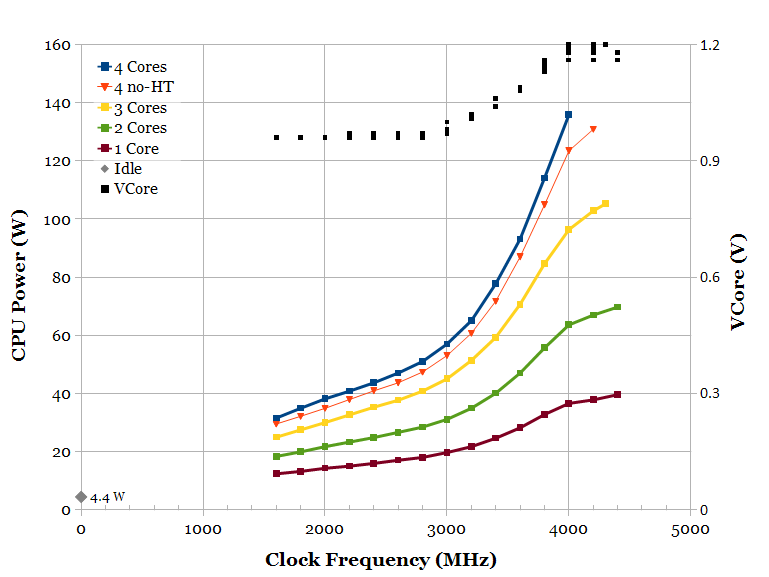
“How is that tiny exhaust hole in the middle going to help cool an 18 core cpu??”

Apple could allow bursts of 4.3GHz when cold / low core count and clamp down to <2.3GHz when running flat out (or lower for AVX 512).
At the higher frequencies - the XEON W turns into a desktop heater - and so Backing it down a notch is all that’s needed to get it to work in the required TDP (example of this given for a different chip below)

I think Intel’s 14+nm process produces less heat at the same GHz cf 14nm - and so there is hope the 18C will be able to spend at least some of its time above its base frequency.

It’s a shame that Intel decided that HVM (high volume manufacturing) of 10nm could get pushed into 2018 ... as this same 18core chip would probably run at 4GHz without the need for throttling (accept for AVX 512 due to the architectural limitations the IP blocks).

ivb_power.png


With Intel dragging its heels on the next process node ... I wonder what Apple will do for the ‘scalable’ Mac Pro?
It would be pretty crazy ... but I wonder if they will follow Crays lead .. but replace the Vulcan with a home-grown Apple affair (dreaming).

AJ
 
Back
Top