Welcome to our community

Be a part of something great, join today!

  • Hey all, just changed over the backend after 15 years I figured time to give it a bit of an update, its probably gonna be a bit weird for most of you and i am sure there is a few bugs to work out but it should kinda work the same as before... hopefully :)

iMac Pro

There's a couple of interesting points.

1 is that it's supporting 10gbe ethernet - this IMHO is a huge leap in the right direction. Built in 10gbe - about time.

2. That display is P3 and 500 nits. Whilst maybe not HDR, it's a screen that can be calibrated nicely and Apple are usually pretty good at consistency.

Conversely i'm running dual 16 core xeons with 128gb and PCI SSD for half the cost of that iMac if you build yourself, but that's always the way. You can't be two physical CPUs for running lots of stuff at the same time...

cheers
Paul

You bought dual 16 core Xeons for $2500?..
 
http://nofilmschool.com/2017/06/hac...guide-to-building-your-own-4k-editing-machine

I'm not so much for a hackintos, but believe that requirements not to make one should be made illegal as anti competitive monopolization, particularly concerning the closure of the official clone market giving justification for its continuation.

Frankly, just build a machine with windows or Linux. It may not look as fancy on the OS end, but there is lots of up side

There's lots of downside too. For me, personally, the lack of ProRes rendering in Resolve, Premiere Pro, and many other apps in Windows makes Windows a non-option. Yes, there are some unofficial options for workarounds, but they are workarounds and the resulting files don't conform perfectly to the ProRes spec and some apps don't see them as ProRes files. When you're creating media for deliverables and masters, and even intermediate, you need official ProRes support, and that means MacOS. I can't tell a client that even though their deliverables specs says "ProRes 422 HQ" or "ProRes 4444", or if they are asking me for ProRes, that I have to give them DNxHD or DNxHR because I can't render ProRes. They'll find someone else running a Mac system that can.

More and more editors are using FCPX, so MacOS is needed for that. And if I was running Windows and had Premiere Pro installed, but someone comes to me with a Premiere Pro project from a Mac, they'll want whatever I might need to render out for them in ProRes.
 
So a bm product that doesn't support prores camera output, incredible. It doesn't matter so much for me, as I want to concentrate on personal projects for a while. But the thought of doubling hardware expense just to go Mac to support a few locked down features is just incredible. I didn't realise prores was so regressive.
 
Apple / ProRes is not regressive. It’s FREE to license. Apple however does not do it for you or supply an SDK on platforms other than the Mac. So on Windows, it is one of the most difficult codecs to implement and support as it falls onto each developer to do it for themselves. Installing ProRes for Windows will give read only / playback support into Windows’ standard codec library. The licensing has also been a recent change – for a while, it was fully allowed by Apple to incorporate ProRes encoding support into non-PC devices, so cameras and video recorders or whatnot. There were a couple attempts to bring ProRes software encoding to Windows through unauthorized tools and Apple did not take kindly to this. And the licensing is still very restrictive in this manner. Apple only wants to license the use of ProRes into specific applications. So some, like Scratch, support it on Windows/Linux.

I think a lot of developers are not willing to implement ProRes on Apple’s terms as it’s a bit silly and draconian at times. However, I think by thumbing their nose at Apple’s licensing policies, they’re doing far more harm to their own sales and customer base than they realize. No [good] reason BMD/DaVinci has not rolled full ProRes support directly into Resolve on Windows.

As for buying the Mac over a PC for certain features or OS preference and all that, it makes a ton of sense when we have multiple client parameters and project requirements. Sure, I can assemble more powerful PC’s for less money. And I do just that. Sometimes I still want the iMac or the MacBook Pro to fit a certain niche. I accomplish far more and earn more by putting tools in place and working them than I save by trying to be overly practical and avoid paying too much [in a relative sense] for specific components or configurations.

That said, the entry level iMac Pro is priced rather aggressively for this sort of system. It’s a heck of a lot more computer for about the same money vs. the top tier Surface Studio. Yeah, we don’t get the cool touch and stylus abilities that the Studio has, but it’s superior in every other way. Microsoft totally botched their I/O offerings on the Studio and the shipment timing is FUBAR.

Sure we could build a more powerful PC for less, but then it’s not an AIO system. And no PC offering out there is going to match the Apple SSD speeds for internal storage (without spending a ton more). It’s going to be interesting to see what the new Mac Pro brings to the table. Apple seems re-committed to this market segment and I think we have Microsoft to thank for this. The latest Surface offerings have been a wake up call for Apple. I’m hoping the new Mac Pro will do the same to the pro workstation/ server market. HP, Dell, etc.. need a real kick in the ass here. The PC market in general is so stagnant in terms of innovation that it’s hard not to get depressed every time I assemble a new PC. Not all of it is stagnant – GPUs are kicking ass right now. Everything else is pretty much ‘meh’....

And for a corporate purchasing environment that still requires Xeon CPUs and ECC memory, the iMac Pro is very attractive. By the time I spec out an 8-core Xeon with 64GB ECC 2666MHz RAM and an AMD VEGA GPU with PCIe SSD storage, TB3, 10GE and a 5K display, I might be able to save enough to go to a nice dinner with the wife. In a business world where the man hours to assemble the components into a functional PC come into play, no one is beating the iMac Pro on price/specs. Now it remains to be seen what upgraded configs of the iMac Pro will cost. I’m assuming they get very expensive in a hurry.
 
Last edited:
http://nofilmschool.com/2017/06/hac...guide-to-building-your-own-4k-editing-machine

I'm not so much for a hackintos, but believe that requirements not to make one should be made illegal as anti competitive monopolization, particularly concerning the closure of the official clone market giving justification for its continuation.

Frankly, just build a machine with windows or Linux. It may not look as fancy on the OS end, but there is lots of up side

Its relatively easy to boot the MacOS on a mainstream i7 (Z170/270 etc) and some boards are much easier to tame OOB (Out Of the Box). TMx86 has guides.

The 'tricky' part is getting the last level of "finesse", getting to grips with the ACPI spec and how/why/what you need to do for, say, proper sleep/wakeup behaviour, USB power to, say, an external hard drive vs an iPad.

The folks at TM have done The Heavy Lifting for you and have made the "DSDT's (part of the 'glue' in between the Mac OS and the Motherboard Bios).

ie, It would take a novice with gumption maybe 4 to 5 hours to follow the TM guides, on their first build, and maybe an hour on subsequent builds. (For a 4 core system, and say an nVidia GPU).

It is better, though, if you have at least a basic understanding of the ACPI framework, all the "kext" files etc make a lot more sense when you do. But that take a LOT MORE time.

When Apple release the iMac Pro (and the next modular Pro) there will be proper chipset support for multi, multi core Hackintoshes.
 
Last edited:
You bought dual 16 core Xeons for $2500?..

Yep. The sweet spot for xeons are E5-2687W, a few versions ago (these are original, not v2, v3 or v5). The W is workstation and they're clocked at 3.1 and boost to 3.8 i think. Picked mine up off eBay in fact, about $700 a pop.

Being original xeons, the motherboards are cheaper too.

And performance compared to modern ones? I think they're around the same. 32 cores total, i can max them out in things like Nuke but even so interactive performance is generally always good. I can be rendering on 16 cores and not even notice.

To be honest i see HP workstations with these in being offloaded quite a bit.

There just hasn't been much real performance increases for the past few years. My MBP from 2015 is basically the same benchmark speed as the one from last year. I would *love* to upgrade, but there's no reason.

cheers
Paul
 
There just hasn't been much real performance increases for the past few years.

Cinebench r15 scores for single CPU E5-2687 series:

v4 2043 (released Q1, 2016)
v3 1752 (released Q3, 2014)
v2 1132 (released Q3, 2013)
v1 1000 (released Q1, 2012)

A doubling in 4 years seems pretty decent to me.
 
Cinebench r15 scores for single CPU E5-2687 series:

v4 2043 (released Q1, 2016)
v3 1752 (released Q3, 2014)
v2 1132 (released Q3, 2013)
v1 1000 (released Q1, 2012)

A doubling in 4 years seems pretty decent to me.

Intel traded cores for clock speed to keep TDP reasonable. That W has pretty high clocks for application usage (with turbo), pretty high wattage as well, whereas the newer versions are generally lower. I did extensive R&D and just couldn't find *that* much difference, at least for that level of cores and obviously taking cost into account.

A new 2687 is around £2.5k ea
on passmark that is around 20100 score

The older ones cost me £500ea
with a passmark score of 14400 score

A newer one is 5 times the cost, so as i mentioned 'the sweet spot' is that version and model...

The cinebench stuff is a bit of an artificial test in that it really leans into what the multi core cpus are best at, i'm talking more general usage.

And what i was getting to is that i would like to know how responsive a single cpu with 18 cores is vs two physical cpus. I came from many single cpu workstations and a dual set up is lightyears ahead...

cheers
Paul
 
Heavy lifting if you mostly do what they prefer and until they decide to cook themselves/shut down/mess up renders/crash/freeze...

Because, as we all know, thinness is and always was a priority for a heavy lifting targeted computer and makes up for having to restart renders while the clients await.

Especially when you had 2 hrs of sleep after 16 hr shift with another 14 hrs to go.
You just look how thin it is and aesthetic preference drawn smile wipes off all the troubles away...[/QUOte

Well, there is that slowness in rendering from raw, but to be honest background translations work very well with the current imacs. There will obviously always be 3D heavy and efx heavy projects desktop PCs won't be able to hand on their own. You will always need a server farm in that regards. But to shoot edit, do some cleanup, some compositing, stabilising, tracking, reframing, sound, grading, motion graphics, 3d object placement, animation, etc all up to 4k which is what 99.999% of the world can be accomplished using this iMac pro. For under $20k you can you can build a good freelance studio using an 18core and an 8 core iMac. Assuming like me you already have the accessories and peripherals like monitors etc.
 
Apple / ProRes is not regressive. It’s FREE to license. Apple however does not do it for you or supply an SDK on platforms other than the Mac. So on Windows, it is one of the most difficult codecs to implement and support as it falls onto each developer to do it for themselves. Installing ProRes for Windows will give read only / playback support into Windows’ standard codec library. The licensing has also been a recent change – for a while, it was fully allowed by Apple to incorporate ProRes encoding support into non-PC devices, so cameras and video recorders or whatnot. There were a couple attempts to bring ProRes software encoding to Windows through unauthorized tools and Apple did not take kindly to this. And the licensing is still very restrictive in this manner. Apple only wants to license the use of ProRes into specific applications. So some, like Scratch, support it on Windows/Linux.

I think a lot of developers are not willing to implement ProRes on Apple’s terms as it’s a bit silly and draconian at times. However, I think by thumbing their nose at Apple’s licensing policies, they’re doing far more harm to their own sales and customer base than they realize. No [good] reason BMD/DaVinci has not rolled full ProRes support directly into Resolve on Windows.

As for buying the Mac over a PC for certain features or OS preference and all that, it makes a ton of sense when we have multiple client parameters and project requirements. Sure, I can assemble more powerful PC’s for less money. And I do just that. Sometimes I still want the iMac or the MacBook Pro to fit a certain niche. I accomplish far more and earn more by putting tools in place and working them than I save by trying to be overly practical and avoid paying too much [in a relative sense] for specific components or configurations.

That said, the entry level iMac Pro is priced rather aggressively for this sort of system. It’s a heck of a lot more computer for about the same money vs. the top tier Surface Studio. Yeah, we don’t get the cool touch and stylus abilities that the Studio has, but it’s superior in every other way. Microsoft totally botched their I/O offerings on the Studio and the shipment timing is FUBAR.

Sure we could build a more powerful PC for less, but then it’s not an AIO system. And no PC offering out there is going to match the Apple SSD speeds for internal storage (without spending a ton more). It’s going to be interesting to see what the new Mac Pro brings to the table. Apple seems re-committed to this market segment and I think we have Microsoft to thank for this. The latest Surface offerings have been a wake up call for Apple. I’m hoping the new Mac Pro will do the same to the pro workstation/ server market. HP, Dell, etc.. need a real kick in the ass here. The PC market in general is so stagnant in terms of innovation that it’s hard not to get depressed every time I assemble a new PC. Not all of it is stagnant – GPUs are kicking ass right now. Everything else is pretty much ‘meh’....

And for a corporate purchasing environment that still requires Xeon CPUs and ECC memory, the iMac Pro is very attractive. By the time I spec out an 8-core Xeon with 64GB ECC 2666MHz RAM and an AMD VEGA GPU with PCIe SSD storage, TB3, 10GE and a 5K display, I might be able to save enough to go to a nice dinner with the wife. In a business world where the man hours to assemble the components into a functional PC come into play, no one is beating the iMac Pro on price/specs. Now it remains to be seen what upgraded configs of the iMac Pro will cost. I’m assuming they get very expensive in a hurry.

It's late, and I'm tired, but I'll give a stab at one thing Jeff. Comparing against studio is not so relevant. If you want a fashion item, yes, but as for real workstation, the AIO thinness is extremely extremely optional. So, it should be compared to tower systems, custom build AIO platforms I mentioned Intel put out, and the HP z1 series, otherwise I think you would agree, we end up in the Mac Pro cute, but not so useful realm. It is Apple's idea not to have an i9 model, or an AMD many core model. Frankly, I'm interested in high core count as well as high speed, so the base model will probably not do. Now, frankly, its more expensive then a base model Mac pro, and the advantage narrows. I can understand why some people nerd a Mac in their business, but I don't desire to have one of everything for my own use. Frankly, I'm still looking at doing a customised AIO like PC with dual high end GPU's, even 4x, and maybe the highest end high core count AMD, whatever that is. But if HO, or other, get real about their Z1's, I would like to get o e of them. I was t an AIO with best display for color accurate graphics and video work at 30+ inch, 2 high end gpu's, and GHz and core numbers. If old style software is constrained to 1-2 cores, I would like to see workstation chips that has at least 2 highest speed cores in the array independently clockable. That would solve a few issues.

I've been curious though, is it possible to have a two CPU socket mainboard system, where one chip is highest performance, and one highest core count?
 
It's late, and I'm tired, but I'll give a stab at one thing ... If old style software is constrained to 1-2 cores, I would like to see workstation chips that has at least 2 highest speed cores in the array independently clockable. That would solve a few issues.

I've been curious though, is it possible to have a two CPU socket mainboard system, where one chip is highest performance, and one highest core count?

This guy breaks it down pretty well (sorry for thread diversion). Thematically broad, but you should find pertinent answers.

https://www.youtube.com/watch?v=L3l9vZD7h_8&t=348s

IMHO. I reckon "Coffee Lake" (Covfefe?) 6 core mainstream CPU's at 4.5ghz+ will better fit the "Prosumer" (with a nice gpu) than the IMP.
 
Baby steps in the right direction. Not holding my breath for actual innovation ... but I am getting a little less sarcastic towards the fruit company. Emphasis on little.

Having had overheating with Retina iMac, Retina MBP13 and Retina MBP15 costing me time, sleep and nerves, I'm keeping the sarcasm until the teething phase ends. Perhaps when the pile grows to $300B the competence to build a reliable media production tool re-emerges. So far a high school kid with an internet access, screwdriver and a summer job savings has the upper hand.

Looking forward to check how the grapefruit sized cooler and shoebox sized volume can be compensated by a fruit shaped logo carrier to cool 16 Cores in cigarette pack sized space. While rendering hours of UHD footage in Resolve. Without a vacuum cleaner noise, another fan sitting close or room air conditioning compensation. Hopefully this time some students get hired to press "render" before mass production and fluff parade start.
 
The HP Z1 isn’t even in the same realm as the regular iMac any more. The current offerings are on par with the just obsoleted 24” iMac model, that’s it. HP tried to make it a real workstation for the first two generations, but they couldn’t make it work. Terribly inefficient design, poor I/O options, and a laundry list of other problems so they scaled it back to using mobile class dual and quad core CPUs as that fit the needs of most of their customers.

As for the iMac Pro, there are situations where a powerful AIO makes a lot of sense. It is going to excel in these situations. For those who need the most power they can get in terms of what can be assembled and at what price, it’s not going to be the best solution. obviously.

I've been curious though, is it possible to have a two CPU socket mainboard system, where one chip is highest performance, and one highest core count?

On some levels that may be possible, but Intel (and AMD) are not designing their host chipsets and CPUs to work that way. Ultimately there would be little to no advantage with current CPU offerings anyway. Clock speeds ramp up to the maximum turbo speed as fewer cores are used. Most current offering will operate two cores at the full turbo clock and speeds drop for every couple cores that kick in.

AMD is pretty much doing the same thing. What we’re seeing with Ryzen is that the cores themselves are about 20~30% less powerful than the equivalent cores from Intel. Ryzen is giving us more cores for less money. Although Intel has been adjusting prices since the Ryzen release. The AMD 18-core ThreadRipper really offers nothing over the Intel 18-core i9. Motherboards and other components are the same price regardless of CPU choice. We can save a bit of money by going AMD, but lose a bit of performance potential too. Then again many are moving to AMD here to help foster competition and simply because there is a realistic option now that isn’t Intel.
 
IMHO. I reckon "Coffee Lake" (Covfefe?) 6 core mainstream CPU's at 4.5ghz+ will better fit the "Prosumer" (with a nice gpu) than the IMP.

From what I’ve seen of the Coffee Lake samples, we can expect a really nice boost. Like 25% pretty much across the board for CPU operations. Looking forward to 6-core Coffee lake with 64GB DDR4 in a notebook.
 
The HP Z1 isn’t even in the same realm as the regular iMac any more. The current offerings are on par with the just obsoleted 24” iMac model, that’s it. HP tried to make it a real workstation for the first two generations, but they couldn’t make it work. Terribly inefficient design, poor I/O options, and a laundry list of other problems so they scaled it back to using mobile class dual and quad core CPUs as that fit the needs of most of their customers.

As for the iMac Pro, there are situations where a powerful AIO makes a lot of sense. It is going to excel in these situations. For those who need the most power they can get in terms of what can be assembled and at what price, it’s not going to be the best solution. obviously.


On some levels that may be possible, but Intel (and AMD) are not designing their host chipsets and CPUs to work that way. Ultimately there would be little to no advantage with current CPU offerings anyway. Clock speeds ramp up to the maximum turbo speed as fewer cores are used. Most current offering will operate two cores at the full turbo clock and speeds drop for every couple cores that kick in.

AMD is pretty much doing the same thing. What we’re seeing with Ryzen is that the cores themselves are about 20~30% less powerful than the equivalent cores from Intel. Ryzen is giving us more cores for less money. Although Intel has been adjusting prices since the Ryzen release. The AMD 18-core ThreadRipper really offers nothing over the Intel 18-core i9. Motherboards and other components are the same price regardless of CPU choice. We can save a bit of money by going AMD, but lose a bit of performance potential too. Then again many are moving to AMD here to help foster competition and simply because there is a realistic option now that isn’t Intel.

Yes, that is my hope too, but if they can't cut my minimum 5 year spec, they cant cut it.

So, somebody was saying how AMD performed the same a while back. That wasn't you?

The thing about the first two cores going the full speed, is what I'm talking about. Good. But 4.5ghz is nothing. Like over ten years ago there was a 5ghz extreme version, and they gave gone past that with overclocking. So, we should be able to get 10ghz overclock by now. So a chip like that, even two core, would be handy. So, a two socket, one extreme and one many would suite many occasions.

I'm interested in the 32 core amd, and the super computing version they are working on. By the time I'm ready to buy they might be out. But the datarate constrictions in the system are two big issues.

So, you have changed your opinion on the z1. I merely meant, that you could pop the good and replace things, like the gpu and have more options in a bigger chassis. HP has to upgrade it, I haven't bought one for that sole reason. Now, if Apple had suck a design with their cooling, they could go further is what I'm really saying. Instead of the locked down too thin Apple ability which us not so good for workstation high performance. The extent of io options on the z1 was superior but obviously in need of more modern options.


@ People.

Am AIO is not necessarily a bad thing for hpc. You have a large back surface where heat can be ported straight to the atmosphere, you could make the entire back one big heat sink even, lits of liquid options. Plus on the top you have a beautiful place to port hot sir straight out of. The only issue is that the aio design tends to tilt in the wrong direction for back heat transfer, requiring fans. So, like the new Nvidia thin notebook gtx1080 cooling solution that pops out the side, there is stuff you can do with thin aio, if you do them, before going to more drastic solutions. However, unlike a surface or iMac, bulk gives you design options for more performance. However, one must think, that this area would benefit from oled, as long as you can keep it cool.

Now, Looking at design options. If you look st the whole thing, venting out the back requires high volume if you was t to avoid the hot air rising up along the back surface. Which means you should vent higher. But you go so high you could put the exit ports along the top side of the unit.

Now, power supply, hard drive, memory, CPU/chipset and GPU are main heating items. If the screen is big enough they can all be placed along the top of it to vent straight out to the atmosphere, the rest of the heat (depending on screen technology) can be drawn up to here and out, as these are a lot lower heat. Now, depending on heat concentration some of these items can be put in line vertically with others, or vertically rotated, reducing the horizontal space, but as you can see this still requires a lot of horizontal space, hence a bigger screen is better to give enough room to house, even a two of three screen ultra wide solution with at least 2160 depth (a common failing is not enough resolution depth to match 4k). But as you can see this 'advanced' concept requires a new main board format, and that is the problem. Its been something I thought of a long time ago. Going a step further you could make the stand with depth and host the power supply and even drives, you could even put a card in it. The fkexibility of this design, is that on lower powered models you could mount more things vertically and in line, and use narrower card formats, for smaller models. There are also other things I have not mentioned. As you can see, there are way more things that can be done than either Apple or HP are dreaming of.

What do you think Jeff?
 
Most PC manufacturers do not have the requisite acoustic experience to optimise internal space for high airflow without psychoacousticlly annoying wind noise. The 'slot' exit port at the bottom of the monitor is a great step in minimising noise. If forcing of air though (what looks like an aperiodic cavity formed by) the fins of the heatsink - shifts enough air, they can provide almost any desired cooling.

(Speculation) Intel 2.4GHz baseFreq 18 core vs AMD 3.4 GHz (baseFreq) 16 core
(Speculation) Intel 4 - 6 memory channels vs AMD 8 channels

I wonder what Intel had to do to stop Apple contemplating AMD - Especially using AMDs own high speed (Infinity) fabric to Vega would (very likely) give a step up in GPU / system performance?

Intel & Nvidia are both hitting a Yield vs Die size (just like our own VV).
Intel's top bin 18core chips are $9000 - because at this size, most (95%+?) have defects preventing them operating at speed.
Nvidia Volta single massive monolithic (TSMC 12nm) die is likely maxed out (and probably crazy low yields).

With AMDs Infinity fabric allowing gluing 8 x (small) Zeppelin wafers (each with 8 cores) together with 'linear scaling' on GF 14nm - Something wonderful is going to start to the price of high core high performance CPUs.

At the end of 2018 - for the same thermal footprint that the 18core Intel, Apple could switch to a 48core AMD 'Starship'.

And with IBM engineers cash injection from Samsung, sharing license information with GF ... AMD chips based on 7nm Nano-sheets are not going to have the transistor (current) drive issues from FinFet scaling (miniaturisation) that Intel is facing at (Intel) 10nm; i.e. Less dark silicon.

Exciting times ahead.

AJ
 
Yes, AMD stitching together smaller cores results in a lot lower costs. But the speculation is that all the new AMD chips up to a certain size, use the same chip with cores turned off. So the actual price to AMD us even lower. Now, Intel is said to profit greatly on its core monsters, and maybe this is a far cheaper 18 core chip than the $9000 price. Do you feel like giving Intel thousands in free profit and have one of your kids go without food for half a year (I know, overblown, but that's the reality of pricing).

But Antony, you keep up with these things note than I do in my old age. What happened to Naples, the supercomputer chip, and doesn't the Naples chip have something like 128 or 264 pcie lines? I hope somebody can deliver a few full speed units (I mean over 5-7 GHz) along with support cores, and even apu.

I hope workstation manufacturers can see to giving a better systems that are not perfectly quiet.

Which Main board manufacturers produce boards covered by basically a big heat sink? Now, there is a solution.

I suggest Intel has been showing the normalised Xeon phi design that runs normal software, with whatever fancy chip process they have.
 
I think that the industries big mistake, is not big enough sockets. You know I hate big sockets, they are often just a waste, and I purpose different methods to get the pin count down, but how could a big socket be useful. Firstly higher speed edge memory. The hpc processors get way hot, so stacking memory with it, is problematic. But joining memory cores next to each die allows large high speed memory to be accommodated under the Same heat sink. Other configurations intermixed with CPU dies are also possible. Now, while pushing communications off die is an issue that slows it down, with stitched dies, it is not such an issue. But the advantage is that also, memory and CPU chip processes are often different, leading to compromises, but with stitching the densest, cheapest, or fastest options can be selected for less compromise. I also advocate grounding handling in package and the use of optical break out links as soon as possible. I also have ways to stack memory and increase the thermal envelope greatly. Also remember in a previous discussion making a vertical structure that is both heat sink, main board, and CPU.
 
Wayne.

CPU Frequency
+) For current Intel 10nm / 14nm FinFet transistor designs - increasing Ghz from (eg) 4 - 5 Ghz can double the power consumed.
+) 4 cores at 4 Ghz is often preferable to 2 core at 5 Ghz, or 1 core at 6 GHz
+) If you had a monster sized SoC - it is possible to architect it so that 'duff' / 'bad' CPUs are clocked slower / switched off.
+) Intel keeps the 'best' ones -> sells them to the Data Centre
+) For the 'worst ones' -> they might be core disabled -> have the Memory Channels HALVED and sold as 'Consumer'

Multi SoC
+) Intercore (on chip) latency does have an impact, as does (usually a few times larger) inter (close proximity) Soc latency on performance.
+) However - it is the Bandwidth that I believe is the upper limit on multi CPUs working effectively together.
+) As the number of cores grows - the MEMORY bandwidth starts bottlenecking (if there is information Flowing through the system).
+) Intel is a quandary right now ... as to compete with AMD's CONSUMER chip, they might have to 'Allow' more memory channels.
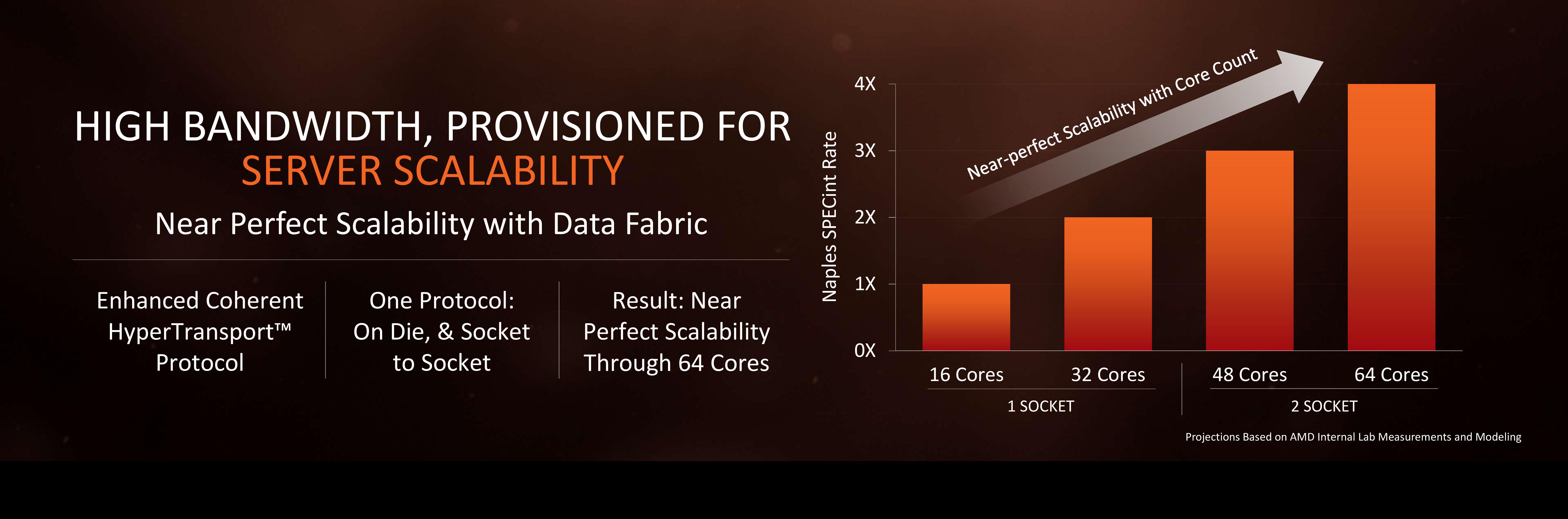
+) The AMD fabric (on GF 14nm) scales almost linearly to 64 cores (intercore & intersoc - excluding memory access)

AMD_Ryzen_Mark_Papermaster_Final-page-013.jpg


AMD
+) Didn't have the resources or technology to have separate Data Centre & Consumer products. That may change when they release EPYC or (7nm) STARSHIP.
+) Zen / Ryzen / Naples / Threadripper : My understanding is that at 14nm - they will all use the 8 x CPU core bits of 'lego' to make 8,16 or 32 core single socket chip. The 128 x PCIe 3 per 8 x CPU SoC is Mostly used to provide inter-soc / or CPU <-> GPU comms.
+) If by some magic AMD implement PCIe 5 on 7nm (I would amazed if they did) - 2020 could well quadruple the scalability of their fabric.

AJ

Edit 1 : Amended date that AMD will upgrade to PCIe to 2020
 
Last edited:
Back
Top