Welcome to our community

Be a part of something great, join today!

  • Hey all, just changed over the backend after 15 years I figured time to give it a bit of an update, its probably gonna be a bit weird for most of you and i am sure there is a few bugs to work out but it should kinda work the same as before... hopefully :)

Dragon with no OLPF

Why? Neither Film nor still cameras have OLPFs. If anything RED's OLPF should be throwing old lenses out of focus no?

Well...YesAndNo. The PL spec says 52mm from flange to image plane. The RED OLPF + Sensor should, as a system, honor the 52mm convergence cone and produce a perfectly sharp result according to the lens markings and object distances. If the sensor happens to be 52mm from flange to surface, then indeed one should expect a perfectly sharp result from a properly adjusted lens and no back-focus issues. But if the sensor is 53mm or 54mm back from the flange because the optical properties of the OLPF extend the convergence cone by 1mm or 2mm, then removing the OLPF is going to requires a 1-2mm sensor position adjustment, which may or may not be within the range of what the manual adjustment screw can manage.
 
Am I wrong in thinking that IR contamination is only from Sun rays? and solved by using source lighting?
 
>>Perhaps RED can be convinced to make a swappable OLPF that's really just a bit of clear glass with an anti-reflective coating as an option.


That will make the RED waaaay better at night shots. I experimented with no olpf at night and telephotos and in some ranges you can get amazing results, something like over 3 f stops!
 
Am I wrong in thinking that IR contamination is only from Sun rays? and solved by using source lighting?

Yes. IR is essentially heat and if you touch a tungsten bulb... well... you can see where this is going. ;)
 
Well...YesAndNo. The PL spec says 52mm from flange to image plane. The RED OLPF + Sensor should, as a system, honor the 52mm convergence cone and produce a perfectly sharp result according to the lens markings and object distances. If the sensor happens to be 52mm from flange to surface, then indeed one should expect a perfectly sharp result from a properly adjusted lens and no back-focus issues. But if the sensor is 53mm or 54mm back from the flange because the optical properties of the OLPF extend the convergence cone by 1mm or 2mm, then removing the OLPF is going to requires a 1-2mm sensor position adjustment, which may or may not be within the range of what the manual adjustment screw can manage.

Yes, but how much is the offset of the focus scale. My guess is not too much. So it might be possible to rip out the olpf and just get a slightly offset of the backfocus. As it is the olpf is not changing the backfocus with it´s thickness but with the index of the glass used, which I assume is not a whole lot. (I might be completely mistaken, my camera is stolen so no chance to try it out). The different indexes of the different glass used in the different olpfs are I assume compensated with thickness of the glass to all give the same light braking index so backfocus can stay the same no matter what olpf we put in. So yes a clear glass should do.

I really hope RED starts selling the olpf plastic frames for a low cost. My dad is retired now but back when he was working he was an optrician and specialized in quite obscure working glasses, everything from laser protection to deep see welding, super high contrast for military purposes, etc. He still has a storage room filled with the most crazy bits of glass and CNC kind of mill to cut it / make it fit in the frame. Would love to be able to make a RayBan OLPF for example :)
 
Yes. IR is essentially heat and if you touch a tungsten bulb... well... you can see where this is going. ;)

Are some lights worse for IR?

i.e. do LEDs or Florescent provide truer color, than Tungsten bulbs, for Digital Sensors?
 
...

I really hope RED starts selling the olpf plastic frames for a low cost. My dad is retired now but back when he was working he was an optrician and specialized in quite obscure working glasses, everything from laser protection to deep see welding, super high contrast for military purposes, etc. He still has a storage room filled with the most crazy bits of glass and CNC kind of mill to cut it / make it fit in the frame. Would love to be able to make a RayBan OLPF for example :)

Wooohooooh! ... sounds like a creative playground ... :-))

so much to explore!
loving the FS from kippertie
 
Are some lights worse for IR?

i.e. do LEDs or Florescent provide truer color, than Tungsten bulbs, for Digital Sensors?

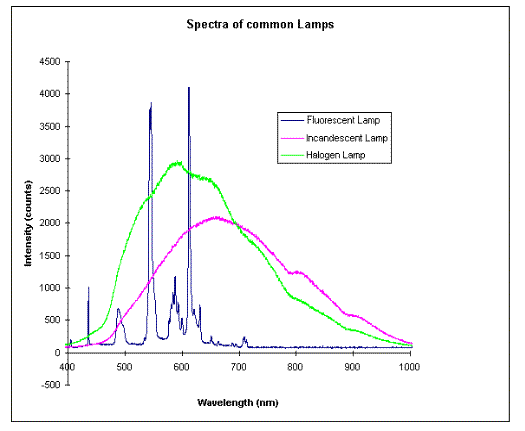
Some are worse than others but it varies not just between types but also between individual models. That's especially true of LEDs and Fluorescents which are usually pretty narrow in their frequency output. So you can buy LEDs that are nearly 100% IR (Remote Control transmitters) or nearly 100% UV (Black Lights). Fluorescents work by creating a great deal of UV light and then exciting a phosophorous material which then creates the visible spectrum. LEDs can work the same way. So it would depend on the phorsphorous material that is being excited. In the case of LED it would be a "Remote Phosphor" LED>

Ignoring LEDs because they are so unpredictable, the worst is Tungsten. It's a "warm" light so it is weighted towards the IR spectrum. In fact some tungsten bulbs output half of their energy into IR. HMIs are a cooler light and lean more towards the UV end of the spectrum so they have less IR contamination.

LampSpectra.gif
 
Yes, but how much is the offset of the focus scale. My guess is not too much. So it might be possible to rip out the olpf and just get a slightly offset of the backfocus.

For paraxial rays and a flat plate of glass inserted the change in focal position is derived pretty simply.

f = t(1-1/n)

where f is the change in focal plane, t is the plate thickness and n is the refractive index.

So for the Red OLPF where t= ~2.8mm and n is ~ 1.52, the focal position is shifted by 0.96mm

The nominal backfocus travel from centre is +/- 0.75mm

Dependent on the degree to which the lens focusses past infinity you may get away with winding the backfocus all the way to its endstop, but that's not a great idea... and all things being equal, you're still unlikely to hit infinity.

Yes understood, I'm not talking about a perfectly calibrated / collimated / working setup. Just something that can focus on any distance like a few meters away or such. That would be more than enough for the ones interested to see what a "no olpf" setup would look like in terms of sharpness, light sensitivity and colors. So not something to go to work with.

So what I'm saying is, to just getting a no olpf picture should be pretty easy if you have a swapable olpf system, just take out the olpf and put on the mount and lens and try focus and shoot, focus markings will be off and according to the above focus on infinite is not really possible if the lens collimation is not altered but adjusting the backfocus could help o sort it a bit, or about 3/4 of the offset.
 
I received today the FS IR from http://kippertie.com/ and after spending some time with it on the Dragon and several lenses I must say that I'm very impressed. John did an amazing job with this product and I hope his company will produce other useful olpfs like this soon. I said about 10 times "holly s***" with the first minute I saw the results! 2 thumbs up!!
 
Last edited:
Back
Top