Welcome to our community

Be a part of something great, join today!

  • Hey all, just changed over the backend after 15 years I figured time to give it a bit of an update, its probably gonna be a bit weird for most of you and i am sure there is a few bugs to work out but it should kinda work the same as before... hopefully :)

Dragon??? So after nearly 10months what do we think? NATIVE 2000ASA no 18stops no ..

38pages and 372 posts later and am i to understand that the windup is a system of glues and tapes? metaphorically speaking. 250asa,interchanging optical filters, post algorithmic patchwork. Please dont think im ungreateful but this does not sound anything like the original Dragon Plan.
 
38pages and 372 posts later and am i to understand that the windup is a system of glues and tapes? metaphorically speaking. 250asa,interchanging optical filters, post algorithmic patchwork. Please dont think im ungreateful but this does not sound anything like the original Dragon Plan.

Sounds like you'll love the GOLDLOCKS OLPF.

Higher ISO than the NEW OLPF, and presumably...none of the RED specks.
 
Nope. New OLPF. The key is it's not underexposed.


Apologies if I'm coming off any specific way. I'm more or less saying that none of this is apples to apples and when saying that something is "clean" at a specific ISO can be confusing. I'll try to shoot a side by side maybe next week to clearly show the comparison.


These are 100% Crops from an ISO 2000 exposed image, 6K HD, REDCODE 5:1 material with the various methods of effecting noise in the SDK. You can click all of these to open in a new window or tab to view the full size image.

Nothing done.

On the left is the original, no denoise, ADD or DEB. On the right is with ADD + DEB. I'm noticing throughout the whole image that the midtones have been tinted magenta, with this area seeming to change the color of the whole object.
 

Attachments

  • Compare.jpg
    Compare.jpg
    58 KB · Views: 0
38pages and 372 posts later and am i to understand that the windup is a system of glues and tapes? metaphorically speaking. 250asa,interchanging optical filters, post algorithmic patchwork. Please dont think im ungreateful but this does not sound anything like the original Dragon Plan.

I sincerely think that the sensor is a winner. I'm getting the low light OLPF and it should get me the advertised low light performance. I think most of the issues people had with this OLPF I can work around in my type of shooting.

I get what you mean with "glues and tapes" . But I have to trust RED in this. It does open possibilities for custom made looks and different performance attributes for the sensor. The Dragon sensor is an improvement from MX, I think this is out of anyone's doubt. Now its just the phase to harness its full potential. Can't wait to grab my camera upgraded and shoot some test footage like I did with MX. I remember when I shot this people where complaining about the low light performance of the MX sensor: https://vimeo.com/38020250

I was someone that was coming from the 1/3 CCD 2/3 CCD DV/ Betacam DVCPRO HD era, so I was more than aquatinted with poor low light performance cameras. I love my Epic MX. I have no problem whatsoever with its DR and, like I said previously, would just like a stop more of sensibility over it. Love the colours, the frame rate, the rolloff... Then why upgrade? Because the Dragon really elevates the EPIC to become the first fully realised DSMC. I am extremely excited about the 19MP sensor to pull stills from my work. It is a revolution for the artist, for the DOP, the Photographer. That is something the competition cannot offer and is really far from it. And it does everything the EPIC MX did, but better (excluding possibly a 15 seconds longer boot time). I will shoot my first, with a significant budget (for a local film) feature with it.

All in all, I am confident on the Dragon. I think everyone should be. The question everyone should be asking right now is: is the Epic Dragon better than the MX Epic? The answer is yes. So what is all this discussion about? In my view, what we are doing here is what we regularly do in red user: talking, communicating, and with this improving and taking the already superior Dragon to its full potential. Suggestions, issues, findings, all these can contribute for the evolution of the system, sensor and camera. The difference between RED and ARRI, for example, is that RED is open to the WORLD here on the internet. All the issues, as well as advantages and word of mouth can be accessed here, openly. And we are talking directly to the TEAM. They are listening. The other companies don't do this. This has pros and Cons. I personally am grateful and prefer RED's attitude and communication. I find the other companies extremely elitist. I think it should all be about the artist, the art, and open communication, and not about lobbies, about "who matters and who does not", about the "Haves vs the Have nots". That's why my heart is always here. This is also important, in a certain way, at least for me. A Red user / owner is often a passionate fellow: and that should reflect on his work. This is something I can attest from the many red users I know from around the world, some that have extremely big budgets working in big commercial films, others owner operators, "artists". Does this sound unprofessional? I don't think so. How much of our profession is connected to Passion? I think having passion for the tools we use is also an important and integral part of the joy of it. And finding in the company that makes these tools the same passion and openness is, at least for me, a major plus.

Lets just keep this on a positive, constructive criticism note and not on personal bashing. Lets not forget: We are all on the same side, and that side is to take the camera/system/workflow/company we have invested in and love to the place it belongs. These "issues" should in no way harm or create fear in future purchasers of the sensor. Again, the Dragon is doing something no other camera in the market- some 5x more expensive than it- are doing. Its a top product, and I can't wait for mine to finally be upgraded!
 
Sounds like you'll love the GOLDLOCKS OLPF.

Higher ISO than the NEW OLPF, and presumably...none of the RED specks.
There is no confirmation that this will exist. Only that Jarred said they would "work on" something and aim for "in between" the current two OLPFs. Could happen and be great, could happen and have its own issues, could also never happen.
 
Obviously this was not the plan for Dragon but at least Red is trying to take care of these issues.

Easily the oddest release of a product meant for high end production and professional environments that I have ever seen in my 20 years of doing production and dealing with all the big vendors. I have learned to accept Red is a different thing, the price of admission is much lower but there are obviously trade offs. I couldn't imagine another camera company having a launch on a new sensor like this. But the camera also only cost 32k (although we all know its much more than that to get it up and running).

Im still happy with my Dragon upgrade though I just wish as a company Red wouldn't let things like this happen. It creates an aura of uncertainty which is perceived as unprofessional which I feel undermines all that Red has done so right.


38pages and 372 posts later and am i to understand that the windup is a system of glues and tapes? metaphorically speaking. 250asa,interchanging optical filters, post algorithmic patchwork. Please dont think im ungreateful but this does not sound anything like the original Dragon Plan.
 
Last edited:
There is no confirmation that this will exist. Only that Jarred said they would "work on" something and aim for "in between" the current two OLPFs. Could happen and be great, could happen and have its own issues, could also never happen.

If Jarred says its going to happen, it will happen. They've made both a HIGH LIGHT and a LOWLIGHT olpf. See no reason to believe they can't make a MID LIGHT olpf. The tech is clearly there.
 
If Jarred says its going to happen, it will happen. They've made both a HIGH LIGHT and a LOWLIGHT olpf. See no reason to believe they can't make a MID LIGHT olpf. The tech is clearly there.

I think so as well. The swappable olpf is (I think) a calcualted best way forward for RED to get a later version, lowlight olpf without flair, onto the cameras without us having to send the cameras back and forth to LA. The new OLPF eats light but does not flare. To me it does not have any other benefits except for "do not flare" compared to the old / lowlight olpf. So a lowlight olpf without flare with the same wide DR is whats wanted. Then we just ND down for those situations where we actually have more than enough light.
 
On the left is the original, no denoise, ADD or DEB. On the right is with ADD + DEB. I'm noticing throughout the whole image that the midtones have been tinted magenta, with this area seeming to change the color of the whole object.

Anton, do you have an .R3D of this? I'd love to take a look at it closer.
 
I think we will see a clear OLPF as well and probably a few just for the monochrome dragon.

But in terms of right this minute. I am extremely happy with this highlight OLPF. I did not ever have the LOWLIGHT OLPF, but I have many available light situations where I can not control the lighting or alter it. In these instances red flares and OLPF bouncback, etc on EPIC MX and LOWLIGHT dragon OLPF would be problematic. That is ELIMINATED now, just as if I was photographing with a DSLR. I am probably going back on old statements I have made, but I really prefer having room in the top.

In all seriousness the microscope that is Reduser over these "issues" is about .05% of my concern when I put the camera up because Dragon makes really nice pictures in diverse conditions. Sometimes REDuser is it's own worst enemy and I really believe people post shit here to overblow problems and sell other systems. IE: If I owned a sony or a Canon and someone wanted RED, I could cut and paste three or four links here, email them to a producer and BOOM, the FUD train begins.

I'm all for "healthy" discussion but I am not sure everyone here has the same motives.

Positive vibe, help each other out, make constructive suggestions.


Battistella
 
38pages and 372 posts later and am i to understand that the windup is a system of glues and tapes? metaphorically speaking. 250asa,interchanging optical filters, post algorithmic patchwork. Please dont think im ungreateful but this does not sound anything like the original Dragon Plan.



One man's bandaid is another man's solution. If you want to look at it as glue and tape that is up to you, but actual people are working day and night at this stuff to improve the quality of the image.

This thread is good and it has evolved, but this last comment by you is kind of "petting with one hand" and "slapping in the face" with the other.

Red is using glue and tape as a patchwork to fix this.
I am not ungrateful.
It's not what you promised.

Do you get how that can be read the wrong way and somewhat passive agressive?

Man, if Deanan was still at RED he might be all over this kind of comment and probably not in a kind way :)

Battistella
 
Couple things I need to clarify apparently as I'm feeling the jabs lately.

Is DEB right for every type of shot? Likely not. Is it useful for a every type of shot? Maybe.

Much of this is up to you.

Quick rap about luminance and chromatic noise.

Luma/tonal information is more or less enhanced by DEB. Haven't found much that's not improved by it in terms of tonal resolving power.

Chromatic noise is improved by DEB. However, finer resolved details can be subtly effected by it's use.

A note on noise reduction. Yes. Post noise and on board noise reduction techniques are technically destructive. It's what they do. Yes. You can carve into it and as mentioned temporal techniques and other adaptive methods produce better images.

Better images at the cost of processing time, which DEB seems to not suffer from. This is interesting.

A note on film response. You may notice or if you have experience shooting film there is a lot of chromatic "character" to the grain pattern. Without DEB you get a more "filmy" image. With DEB you get something a bit more chromatically cleaner overall. Again, this is a choice you have to make.

There are some where leaving DEB on all the time works. There are some who won't use DEB at all. There are some who may only want to utilize DEB at higher ISO ratings. None of these are wrong positions in my mind.

At the end of the day you need to make decisions on what your material looks like.

There are currently several methods in REDCINE-X Pro that can effect noise.

Denoise - In the SDK, doesn't add to processing time. Useful particularly at lower color temperatures, especially on MX.
DEB - Adaptive demosiacing algorithm. Doesn't add to processing time. Is coming to the SDK. Removes "red specks" and does what I've mentioned elsewhere.
ADD - Advanced Dragon Debayer. Adds greatly to processing time and looks at current, next, and previous frames to come up with an overall cleaner image.

A note on texture. It's a funny thing. Up to everybody how much or how little they actually want and how they actually want to render it.

I only done some DEB testings... But to me it's quite clear that all those posts about the loss of detail when using DEB is done at a very closup pixel peeping kind of level not really relevant to what the cameras are built for. It's very important to remember that that the whole CMOS debayering process and all olpf solutions is actually just a big smear over red green and blue photosites. The DEB on/off function lets us use and look at whats underneath part of that process. To call the DEB solution patch work or hackwack solution is not right as the whole debayering and use of a Cmos sensor is just that, a half ass solution... But hey, it all works pretty good, far better than most options out there... So RED gives us the option of choosing how the blacks will be processed, while most other cameras does not, most of them just give you their version of DEB baked into the image and do not let you see their none deb version... So simply RED lets you choose how to process things some images will benefit, very few will not.

As the level of detail loss (according to my testings) is so low it's pretty much gone when dowsampling to 4k. And yes we can shoot 6k and produce 6k content but most stuff but these cameras are actually made for 4k. And the extra 2k are again something you can call a hackwack solution around the Cmos issues.

So zooming into the 6k image and see a small loss of detail when the DEB is at work is not so much to complain about is it? If RED would just have choosen to not make a DEB toggle switch and instead just used it on all dragon files most of us would all just be happy to have lost the noise, not many would be able to spot the difference in lost detail without being able to click back and forth or have side by side comparison in 1:1. Again most camera manufacturers would not give you the opportunity to see those options.. Mostly because too many options usually cause confusion and rejection among the less informed... So personally I'm happy that RED does not have to much of that type of DNA, instead they toss things out there for us to experiment with and giving us options. I find that as a very nice gesture and it has to take quite a bit of balls to do so over and over again, especially when everytime they do it, their own forum gets flooded with negative threads about what they do. But then again I think they tackle also that part pretty well.
 
One man's bandaid is another man's solution. If you want to look at it as glue and tape that is up to you, but actual people are working day and night at this stuff to improve the quality of the image.

This thread is good and it has evolved, but this last comment by you is kind of "petting with one hand" and "slapping in the face" with the other.

Red is using glue and tape as a patchwork to fix this.
I am not ungrateful.
It's not what you promised.

Do you get how that can be read the wrong way and somewhat passive agressive?

Man, if Deanan was still at RED he might be all over this kind of comment and probably not in a kind way :)

Battistella

Why are you speaking for anybody but yourself? If you think the comment is passive aggressive then say it! If you dont I will. it is, but at least i have the ball to say it...
we have spent in the millions at RED since 2007 and so i feel ive earned that right to speak from a valued customer perspective. So if constructive critic is what you want it to be
how do you propose we go about it? sugarcoat it ...oh 250 asa is great although i expected 800 or 2000? or perhaps the new shallow end noise floor etc cmon David don't come at me
because honesty towards a camera company we all happen to admire and relish, and at the same time fear, scares you.Im friends with alot of the people over at RED and say this
with that in mind. Do I think I will lose my friendships NO, but I have to say what I honestly feel. Patches and workarounds sounds a bit like microsoft, and not a overall solution.
It won't compete in the professional environment. its just my opinion and that all...nothing that should threaten anybody to any extent!!!
 
Anton, do you have an .R3D of this? I'd love to take a look at it closer.
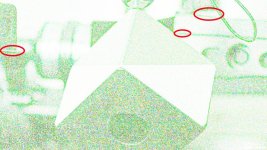
I was only responding to your post, check the image I posted. It's a screencap from the top left side of your own image. Throughout the whole image there are subtly bands of magenta and green appearing that aren't there in the normal debayer image, at least on my screen.

Edit:

I've brought the "2000 iso" image on top of the "ADD+DEB" image in photoshop and used the 'divide' blending setting. When colors are the same, divide will make white pixels. This is an easy way to see how ADD+DEB is changing the image. There's a lot of green because most of the noise was red, but there are some areas of magenta and green which I think are erroneously adding color where they shouldn't be. Check the areas I circled in this image in your "ADD+DEB" image and compare with the 2000 iso one, and you'll see what I mean. You'll notice that the same problem is going on throughout the image.
 

Attachments

  • divide.jpg
    divide.jpg
    93.9 KB · Views: 0
Last edited:
There are currently several methods in REDCINE-X Pro that can effect noise.

Denoise - In the SDK, doesn't add to processing time. Useful particularly at lower color temperatures, especially on MX.
DEB - Adaptive demosiacing algorithm. Doesn't add to processing time. Is coming to the SDK. Removes "red specks" and does what I've mentioned elsewhere.
ADD - Advanced Dragon Debayer. Adds greatly to processing time and looks at current, next, and previous frames to come up with an overall cleaner image.

A note on texture. It's a funny thing. Up to everybody how much or how little they actually want and how they actually want to render it.

Phil,
And now that Red has opened up the new SDK to reach the uncompressed image in it's true RAW state ( not debayered but decompressed ), we will be seeing more advanced debayer methods from outside of RED.
This is huge.
For years people have asked to be allowed to process the images in their own way, but Red kept the door closed.
Thanks Red! This , along with the new RedLink SDK, shows that Red is opening up to allow 3rd parties to help make the camera better and that's a good thing.
 
Phil,
And now that Red has opened up the new SDK to reach the uncompressed image in it's true RAW state ( not debayered but decompressed ), we will be seeing more advanced debayer methods from outside of RED.
Hold up. RED has opened up the RAW bayer pattern image to the SDK now?
 
Back
Top