Welcome to our community

Be a part of something great, join today!

  • Hey all, just changed over the backend after 15 years I figured time to give it a bit of an update, its probably gonna be a bit weird for most of you and i am sure there is a few bugs to work out but it should kinda work the same as before... hopefully :)

DRAGON size comparison - some help needed

Neil W. Smith

Well-known member
Joined
Mar 16, 2008
Messages
542
Reaction score
0
Points
0
Location
Los Angeles
Website
www.hollywooddi.com
So guys, I need some help here ... never been very good at maths ... words and images are more my thing ... the other day I was trying to explain to a Producer (who happens to be very good with numbers but hopeless with technology) why DRAGON is such a cool camera and why a 6K sensor is a good thing .... when he asked me to explain the size difference I got my knickers in a twist around the percentage increases over HD and UHDTV .... after fumbling around trying to explain the difference in vertical and horizontal resolution he got pissed off and essentially said 'yer, whatever'.

What I'm looking for is a simple and straightforward way to explain the percentage differential to a Producer type who's not very technical ... then explain the significance of Nyquist sampling theory and then the benefits of shooting with a 6K camera.

Here's a chart I typically use to show the differences in size between HD, UHDTV and now DRAGON .... it's easy to say that UHDTV is four times more resolution than HD - even Producers get that one ... but not so easy to say what the equivalents are for DRAGON.

Would appreciate if the math geniuses amongst you could provide some simple way of explaining the size comparisons which is fairly accurate but doesn't require a degree in calculus and being accurate to five decimal places.

The chart I use is attached below for ease of reference.

Thanks,
Neil
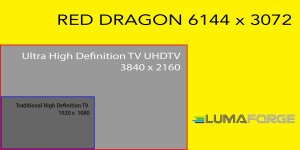
 

Attachments

  • 6K_DRAGON.jpg
    6K_DRAGON.jpg
    85.1 KB · Views: 0
Better to have the tools to calculate the difference than posting the % difference here (if you are a cameraman, you should have some basic math, geometry and algebra in your arsenal):

the math for pixel count is the same as calculating the area of a rectangle. multiply the height by the width and that is the total area...or # of pixels. (forgive me if that is obvious)

Here's the formula to calculate a difference in percentage:

First number is A second number is B

percentage difference is (B/A-1)*100

So what is the percentage difference between 60 and 80

percentage difference is (80/60-1)*100= 33.33

This is the same as saying 80 is 33.33% more than 60.
 
Heh. I wonder if we're talking to the same folks:

Today I was asked what exactly 6K was. Which led to a conversation about visual quality and the potential 6K could hold during capture and in post.

Dragon is coming. And like a few of you out there I'm also fond of high resolution imaging.

But what is 6K?


  • 6K is the maximum resolution of Epic Dragon. 6144x3160 or 19.4 megapixels at a 1.94:1 aspect ratio.
  • 6K is 9.36x more pixels than 1080p.
  • 6K is 8.78x more pixels than 2K.
  • 6K is 2.2x more pixels than 4K.
  • 6K is 1.4x more pixels than 5K.
  • At 300 DPI you can make a 20.48x10.53 inch print from a full 6K Dragon image.
  • At 150 DPI you can make a 40.96x21.067 inch print from a full 6K Dragon image.
  • 6K is 14% more resolution than 5K for a pristine full debayer down to 4K. Meaning it's a 66.7% down sample/debayer to 4K.

If we're thinking about a 4K finish, having more resolution effects color and luminance in a good way. It also gives a bit more freedom for creative re-framing, cropping, or leveling. Fine and high frequency details will actually down sample into 4K and benefit from that extra resolution. There are many ways to work with and finish REDCODE for screen and print use. Over sampling and the use of a debayer pattern help eliminate aliasing artifacts. If you want crisp and detailed images there's options. If you want a smoother feel there's options. Just depends on what you're after and the workflow you choose.

6K holds relevance in the film scanning arena in both S35 and VistaVision scanning. However, per pixel resolution in relation to format size Dragon out resolves and has more captured dynamic range than motion picture stock.

So on several fronts, we're in some new exciting territory.

Just some food for thought this evening.
 
Neil, just worked up a quick table in Numbers to compare frame size pixels as percentages.
Hope this helps.

-Harry

[table="width: 500, class: grid, align: center"]
[tr]
[td][/td]
[td]Width[/td]
[td]Height[/td]
[td]Number of Pixels[/td]
[td]Percentage vs. HD[/td]
[td]Percentage vs. UHD[/td]
[/tr]
[tr]
[td]HD[/td]
[td]1920[/td]
[td]1080[/td]
[td]2,073,600[/td]
[td]100.0%[/td]
[td]25.0%[/td]
[/tr]
[tr]
[td]UHD[/td]
[td]3840[/td]
[td]2160[/td]
[td]8,294,400[/td]
[td]400.0%[/td]
[td]100.0%[/td]
[/tr]
[tr]
[td]RED 4K[/td]
[td]4096[/td]
[td]2160[/td]
[td]8,847,360[/td]
[td]426.7%[/td]
[td]106.7%[/td]
[/tr]
[tr]
[td]RED 5K[/td]
[td]5120[/td]
[td]2700[/td]
[td]13,824,000[/td]
[td]666.7%[/td]
[td]166.7%[/td]
[/tr]
[tr]
[td]RED 6K[/td]
[td]6144[/td]
[td]3072[/td]
[td]18,874,368[/td]
[td]910.2%[/td]
[td]227.6%[/td]
[/tr]
[/table]
 
explaining complicated things in simple terms ...

explaining complicated things in simple terms ...

Heh. I wonder if we're talking to the same folks:

Very cool, Phil .... knew there had to be a math genius somewhere here on RU .... now, I have to say this, your chart and comparison numbers might still be way too complicated for your average Producer type ... I try and keep things as simple as poss when talking to Suits, so maybe we need to lead with my simple chart first .... then once they get the hang of that, we pull out your spiffing chart.

The other tricky thing that we need to address in the '6K is better than HD' discussion is the storage question ... and by that I mean this ... during the conversation with said Producer I mentioned that the Dragon sensor is roughly nine times larger than HD ... immediately his 'bean counting' alarm bell went off ... "Oh no, that means you need nine time more disk storage! ... I'm going to stick with Alexa."

Try explaining the wonders of .r3d compression technology to a non techie Producer and see how far you get ... but we do need to be able to explain SIMPLY how a nine fold increase in resolution doesn't equate to a nine fold increase in storage requirements and costs ... your thoughts on that matter would be greatly appreciated, Phil.

Cheers,
Neil
 
You'd also have to explain to him that RGB is 3X the amount of data compared to raw, assuming same pixel dimensions and compression. And I assume that compressed 6K raw from the Dragon is less data than uncompressed 2.88K Arriraw, though Arriraw is 12-bit log data and I'm not sure what a Dragon file is -- 16-bit?

Simplest thing would be to give the producer some actual figures for data for each of these formats/cameras, maybe in Mbit/sec or how many gigs is 10 minutes of footage at 24 fps.
 
real 4K versus UHDTV "4K"

real 4K versus UHDTV "4K"

Very nice, Harry - like it ... could I ask a favor of you - could you add a seventh column with the percentage vs. DCI 4K?

Another challenge we have is making sure everyone clearly understands the difference between DCI Theatrical 4K and UHDTV "4K" which of course isn't 4K .... but don't let that stop the marketing guys.

Thanks,
Neil
 
cost benefit analysis

cost benefit analysis

You'd also have to explain to him that RGB is 3X the amount of data compared to raw, assuming same pixel dimensions and compression. And I assume that compressed 6K raw from the Dragon is less data than uncompressed 2.88K Arriraw, though Arriraw is 12-bit log data and I'm not sure what a Dragon file is -- 16-bit?

Simplest thing would be to give the producer some actual figures for data for each of these formats/cameras, maybe in Mbit/sec or how many gigs is 10 minutes of footage at 24 fps.

Great point, David ... however, what may seem simple and straight forward to a smart chap like you isn't always obvious to a Producer .... they're used to counting feet of film and multiplying that number by some cents value to get a ball park number of the total costs of shooting their projects.

I think that one of the big challenges we all face as we move into the digital acquisition and file-based workflow world is how to compare 'apples to apples' when there aren't really 'apples and apples' but a whole plethora of data types, compression codecs, files types as well as RAW vs. RGB options that informed (and intelligent) DPs like yourself can assess but seem to be well beyond the ken of your average Producer.

I think this challenge will become more pressing as DRAGON starts to roll out ... Producers are more and more involved in making camera choices based on economic motivations rather than DPs for artistic and esthetic reasons.

I'm looking for a way to make it easy for Producers to understand the technical and financial benefits of choosing DRAGON ... from a purely image quality point of view there is absolutely no doubt that DRAGON is going to be a game changer in our industry ... but we all know that image quality alone will not always ensure that the best camera is chosen for the job.

So how do we go about running a 'cost/benefit' analysis for DRAGON that makes it easy for Producers to choose the best camera for the job?

Neil
 
Bigger is better isn't enough?

Bigger is better isn't enough?

I like David's notion of quantifying storage requirements of various formats in easily relatable terms. While he makes a cogent point about the 3:1 difference between an RGB data file and a RAW one, it may land in Neil's "too technical for suits" bucket.

Ultimately I am not sure it's really about the 6K spec unless one is planning to pull stills. My shorthand would be to refer to super sampling theory and how it can capture details/texture that will persist even in lower resolution distribution formats. Moreover, I'd suggest a seeing is believing approach - Neil has a nice 2K Barco at HollywoodDI that should show off the advantages of 6K Dragon originated images vs other options at an industry standard resolution (1080 is only 6% less so I'd consider it a fair representation of HD as well).

Deep discussions of Bayer CFA algorithms and other details of how the technology works are the antithesis of what Neil is seeking in terms of exciting non technical folk about Dragon 6K benefits. That said, I do think there is some currency in citing technical improvements that result in the potential for more nuanced presentation of artistic intent.

Perhaps the next PGA CAS needs to be agnostic enough to give producers the chance to fairly assess their options in the way that matters most - with their eyes. Just my 2 cents.

Cheers - #19

Full disclosure - I do some work with Neil at LumaForge.
 
Perhaps one experiment to run once the Dragon color science is in the wild is to compare 6K at various compression levels. If it turns out that 6K at 12:1 for example, looks better than 4K at 4:1, then the equation changes a bit. On the Alexa side most producers couldn't justify the extra cost of ARRIRAW vs ProRes in image quality comparisons - many of the shows that did go ARRIRAW had heavy VFX, green screen or compositing needs.

Once we "technical" folk have some tested metrics then we can work with producers to find cameras, formats, codecs and post pipelines (including storage requirements) that balance budgetary imperatives with image quality appropriate to the target deliverable.

Cheers - #19
 
Basically, if the population of Los Angeles is 6K, Philadelphia would be a little smaller than UHD and Raleigh, North Carolina would be HD.
 
pixel counting

pixel counting

Heh. I wonder if we're talking to the same folks:

" ... 6K is the maximum resolution of Epic Dragon. 6144x3160 or 19.4 megapixels at a 1.94:1 aspect ratio."

Phil,

I've just noticed that you quote DRAGON image size as 6144x3160 but according to RedCine-X Pro, the .r3ds we were grading for Ketch's 'Red Dress' project are 6144 x 3072 which gives 18.87 Mpixels ... just wondering where and how the difference arose? ... will double check when I get into the Lab this afternoon but I think my numbers are correct.

Not that it matters in the grand scheme of things but just want to make sure I'm not making a mistake.

Neil
 
Very interesting thread...

And a situation which I ma very fortunate not to have to deal with, since i am and always will be also the Producer (one of them at list) in any and every project I'll be part of, but I completely agree the seriousness of the discussion, were one is placed almost against a wall when trying to make understand other Producers what matters and what does not, also how it is easy and advantageous to the production it self to work with a certain tool vs. and other, and or a different workflow vs. an other.

BTW. Neil, what we have seen on our Editing Grading session on Dragon material and SF, is the given output in settings presets for Exports, but we can key in our own to match, but when exporting Tif images they do export in the native full sensor size of 6144 x 3160.
 
Why do producer's concern themselves with numbers and technical specs? And why is it necessary for a cameraman to be able to explain the math that compares the dragon sensor to other sensor sizes? I guess I'm from the school of thought that all that really matters to me about a camera is the image it creates and the way it operates. Obviously it works for many camermen to be very technically proficient but I'm wondering why a producer would care.
 
Why do producer's concern themselves with numbers and technical specs? And why is it necessary for a cameraman to be able to explain the math that compares the dragon sensor to other sensor sizes? I guess I'm from the school of thought that all that really matters to me about a camera is the image it creates and the way it operates. Obviously it works for many camermen to be very technically proficient but I'm wondering why a producer would care.

$$$ and what you get and do not get for said $$$
 
Why do producer's concern themselves with numbers and technical specs? And why is it necessary for a cameraman to be able to explain the math that compares the dragon sensor to other sensor sizes? I guess I'm from the school of thought that all that really matters to me about a camera is the image it creates and the way it operates. Obviously it works for many camermen to be very technically proficient but I'm wondering why a producer would care.

Welcome to 2013.... Producers have to be sold on everything now because of budget cut backs and new technology.
 
Back
Top