Welcome to our community

Be a part of something great, join today!

  • Hey all, just changed over the backend after 15 years I figured time to give it a bit of an update, its probably gonna be a bit weird for most of you and i am sure there is a few bugs to work out but it should kinda work the same as before... hopefully :)

Double Dragon....

That sounds quite unbelievable! I wonder how it can do it so fast?
My new beefy Intel i7 system spits out a 3-4 minute video - with effects and all the goodies applied in around 7-10 hours with the CPU at 100 % workload at all time.

I have the last generation of the 17" MBP, with 8GB of RAM, Thunderbolt drives. It takes about 1-3 hours for it to spit out a 3-5 minute video. But I still could use a Rocket to decrease down time, and I just foud out it can be expanded to 16GB of RAM. The 16GB will probably make a significant difference in editing and hopefully exporting. So I think I'm going to need to get on that ASAP. lol
 
Per definition the chip is an ASIC, which you just can't easily replace with a CPU or GPU.
There is not just a re-labeled mainstream-gpu-core on that rocket as some people might think.

I guess its closer to reality to assume there is partially the chipset of a RED One on that PCI-card, to say it the easy way. I'm sure its a bit more complicated than that. ;)

Thanks for the explanation. That helps me appreciate the Rocket and its price tag a little more.
 
The Optimo DP's are another example of how modern lens designs have produced restrictions going the other way. Several of these "digital oriented" lens designs are very restrictive. The Optimo DP's can't be used on any camera with a mechanical shutter mechanism because of how far they extend back toward the image plane. That means no use on any film camera, no use on an F65 if the rotary shutter option is installed... Compromises abound in this industry.

Not to discount any of the rest of your thoughtful answer, but an unmodified Optimo DP does work on a rotary shutter F65, I just tried it. Just FYI.


When you look at the Dragon's sensor size, 6K is ideal for anamorphic. It effectively gives you the height for an anamorphic image (when cropped to 4:3) that you can then de-squeeze. A common complaint of the current Epic 5K anamorphic setting is that it is heavily cropped, losing one of the benefits of shooting anamorphic.

Hey Wey hows it going? I actually saw you the other day at Starbucks but you looked like you were having a meeting so I didn't bother you. Anyway also not to discount the rest of your assertions but I think that even the Dragon is not totally ideal for anamorphic. I can't test it because We don't carry any anamorphic lenses (or a dragon sensor Epic) but I think it would work fine for 1.3x anamorphic lenses but not for 2x anamorphic because 2x is made for full frame which the Dragon isn't that big. It needs to be 4:3 like the 4:3 Alexa. I mean, you could use a 2x lens much in the same way you could use a S35 lens on a S16 camera but you will drastically change your field of view and throw out a lot of resolution off the sides to make it 2.40. So just saying that it's not entirely ideal for anamorphic as far as my understanding of anamorphic goes.
 
Indeed Jeff, well stated.

Additionally, the issue is not just wavelet decode. The resulting RAW data must then be debayered to RGB as well. And then looks applied, etc... Depending on the applicability of that, you may have to incur roundtrip time to/from GPU land back to the CPU for further processing, and then ultimately back out to the video card for display.

Although debayer and de-mosaic algorithms are actually things that GPUs can assist with. However, given the compute abilities of GPUs up until very recently, mostly due to precision and consistency across different GPU platforms, it didn't make much sense. RED has to walk a fine line of providing acceptable performance while also ensuring that their processing algorithms remain the same across multiple platforms. If we start throwing in whatever random GPU is the bees knees for this quarter, it gets really difficult to ensure that consistency.

In many cases, relatively "slow" trips over the I/O bus to-and-from the GPU can be far slower than simply doing the operations on-CPU and then only traversing the bus once for final look application and rendering to the monitor.

Absolutely. This is where the Rocket works well -- we can feed it compressed R3D frames and it spits back full quality images scaled to our desired size with our desired color LUT applied. The amount of on-offs on the PCIe bus is minimal and output from the card can be huge if we're pulling back 4K and 5K frames, so it's mostly the output stream to be concerned with. If we're having GPUs try and do wavelet decoding and they have to push huge streams of data back like the Rocket does, that can be an issue too. GPU cards are notoriously bad at feeding large data back onto the PCIe bus. That's not what their designed to do.

Had someone PM me to bring up the performance of SGO Mistika -- it can do full res realtime 5KFF without a Rocket. True, but so can any other software that is well-written and running on proper hardware. SGO uses the same R3D SDK programming libraries that everyone else has access to. So this is also a nice reminder that not all the performance issues are on RED's shoulders. In fact, seeing what some applications are capable of, makes me wonder why others suck so bad at performing, when RED handles all the down and dirty for you.
 
Red Rocket

Red Rocket

I wonder how much the rocket card costs to manufacture nowadays. Has to be a nice profit margin at this point. I also would like to see what a new card using today's best technology could do in comparison. 3x the performance? 5x? and then put 5 of those in an enclosure... Please make that and take my money, RED.
 
Anyway also not to discount the rest of your assertions but I think that even the Dragon is not totally ideal for anamorphic. I can't test it because We don't carry any anamorphic lenses (or a dragon sensor Epic) but I think it would work fine for 1.3x anamorphic lenses but not for 2x anamorphic because 2x is made for full frame which the Dragon isn't that big. It needs to be 4:3 like the 4:3 Alexa. I mean, you could use a 2x lens much in the same way you could use a S35 lens on a S16 camera but you will drastically change your field of view and throw out a lot of resolution off the sides to make it 2.40. So just saying that it's not entirely ideal for anamorphic as far as my understanding of anamorphic goes.

Sorry, I meant RED designed 6K to better suit Anamorphic, even if it's a bit smaller than 35 4-perf FA. Dragon has a vertical sensor size of 15.8mm and the Alexa Studio/M has a vertical sensor size of 18.15mm. 35mm 4-perf FA has a vertical height of 18.67mm. As you can see, the popular options are still just short of matching the size of 35mm 4-perf FA.

The fact that the sensor itself is not 4:3 is not really an issue because you can just crop the excess from the sides. When shooting anamorphic, the important consideration is the vertical height. Shooting 2x anamorphic on a 16x9 sensor effectively gives you an aspect ratio of 3.55:1. Which is an interesting choice, which can be seen in the Taylor Swift music video "I Knew You Were Trouble".

And yes, to maximize the resolution on a 16x9 sensor, 1.3x anamorphic would be the better choice.

Edit: Corrected vertical height of 35mm 4-perf FA
 
Last edited:
Not to discount any of the rest of your thoughtful answer, but an unmodified Optimo DP does work on a rotary shutter F65, I just tried it. Just FYI.

That is interesting. I have not tried it myself, but based on the depth of the rear element design and Sony's technical specs, it shouldn't work. I was also taking the word of a Sony rep who wouldn't let me put a 16-42 on the F65 when they were hosting a demo, said they had the shutter option installed and we couldn't use the DP's. That's the only time I've had my hands on the F65 though. I've worked with footage from a couple F65 shoots since, but not with the camera itself. I suppose it makes sense because the rotary shutter is very thin. It's not a traditional mirror shutter driving an OVF.

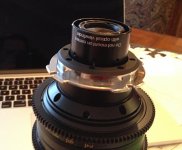
The updated Optimo DP lenses are the same length at the rear of the mount, that doesn't change. It's just a change to the protrusion profile, or diameter of it, beyond the mount flange. Here's a pic of the rear on the current 16-42 for comparison. It's been a while since I've worked with the original version, so I can't recall the exact difference. Shaky iPhone shot, sorry.
 

Attachments

  • 1642mount.jpg
    1642mount.jpg
    96.6 KB · Views: 0
Dragon shot on Prototype Dragon 6K 2:1 @ 86FPS 180 Shutter.

click for full compressed unsharpened JPG.


work in progress...
Nice, has latitude, but if this is proto what is coming for Nab.

Cool. Don't you guys know anybody with a dog or a cat?

Yep, we could call the Scarlet version Kitty :)
 
Hi Jarred, just for fun can you show us the size of SD
 
I wonder how much the rocket card costs to manufacture nowadays. Has to be a nice profit margin at this point. I also would like to see what a new card using today's best technology could do in comparison. 3x the performance? 5x? and then put 5 of those in an enclosure... Please make that and take my money, RED.

It's an interesting question. One thing that may be a factor is that I believe the card is actually either based on, licensed from, or OEM'd from DVS. Thus the overall cost may not be something completely within RED's control.

-sc
 
That sounds quite unbelievable! I wonder how it can do it so fast?
My new beefy Intel i7 system spits out a 3-4 minute video - with effects and all the goodies applied in around 7-10 hours with the CPU at 100 % workload at all time.

Sorry Viktor you're getting not so good results. Premiere Pro has done wonders for me. And it's not unbelievable, because I've done it with every project I've shot since I received my EPIC in October of 2011.
 
I wouldn't equate editing at 1/8th resolution a system that "eats R3Ds for breakfast".... it's pretty painless to edit the footage even at 1/2 resolution...the problem is with exporting and rendering out.... that is when it takes a very long time without a rocket...especially when you are outputting at maximum quality with FULL debayering on your 5k footage....add the smallest little effect on that footage and the process of rendering out is even longer.

A few people were complaining about their systems, so I chimed in with what I'm doing...a 5 year old MBP has no problem knocking out a 3 minute 5K video (to 1080p) in 45 minutes. I do it all the time. And what effects are you all adding to your footage that make it render out so long? Premiere usually kicks ass at all this.
 
A few people were complaining about their systems, so I chimed in with what I'm doing...a 5 year old MBP has no problem knocking out a 3 minute 5K video (to 1080p) in 45 minutes. I do it all the time. And what effects are you all adding to your footage that make it render out so long? Premiere usually kicks ass at all this.

At full debayer? Really? Anybody else have the same experience?
 
It looks to real to be true, Love it! : )
What would Louis Le Prince say?
 
Last edited:
Back
Top