Welcome to our community

Be a part of something great, join today!

  • Hey all, just changed over the backend after 15 years I figured time to give it a bit of an update, its probably gonna be a bit weird for most of you and i am sure there is a few bugs to work out but it should kinda work the same as before... hopefully :)

Cutting through the hype surrounding Light Emitting Plasma (LEP) lamps

Joined
Sep 20, 2009
Messages
149
Reaction score
0
Points
0
The other new lighting technology is plasma lighting. More efficient than LEDs.

Light emitting Plasma, or LEP, is getting a lot of press lately. However, you have to be wary of all the claims made by head manufacturers. Whenever a new lighting technology comes on the market, the manufacturers put a little spin on the scientific data (LED manufacturers do this still), which has a tendency to cloud issues. For this reason, to pick the right LEP luminary for a particular job it helps to have a little knowledge of the technology. For our company newsletter I have put together an overview of the technology and what products are available for motion picture lighting (available at http://www.screenlightandgrip.com/html/emailnewsletter_generators.html#anchorHigh%20Output%20LEPs.) In this newsletter article I have tried to cut through some of the hype. Here is a quick summary of a few of the issues.
Plasma_STA40_Features.jpg

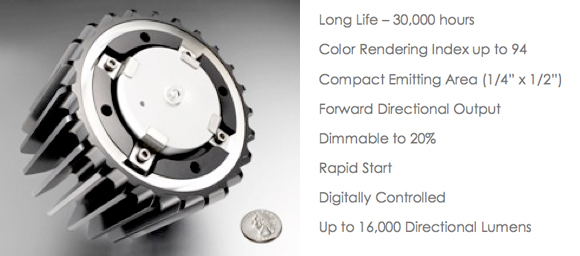
Yes, LEP bulbs are capable of intense light output. One manufacturer, Luxim, claims their technology can produce 144 lumens per watt. In contrast, Tungsten Halogen bulbs produce 15 lumens per watt, LED emitters produce between 65 to 85 lumens per watt (in practical applications), and HMI bulbs produce 90 Lumens per watt. While there is truth in this claim as it pertains to an LEP bulb in isolation, as with LEDs, manufacturers have not realized anything close to that kind of lumen efficiency within the framework of a practical light that will burn in all lamp orientations.

Plasma_Helio270LG.jpg

The Helio 270 LEP

When the pill sized LEP bulb in mounted in the “puck” so that it will burn in all head orientations, the emitting area is no more than 1/4" x ¼." In this configuration, the 273W LEP bulb will deliver 16000 lumens or 57 lumens per watt. While much less than the 37’000 lumens the bulb will generate fully exposed in a horizontal position, it cannot be tilted up in that orientation. On the plus side, mounted so that it will burn in all orientations, all of its’ output is forward directed within a 60 degree angle so it doesn’t require a reflector. Such a highly localized forward directed light is ideal for Fresnel type instruments. As close an approximation to the ideal point source that exists today, its light output favors the central portion of the Fresnel lens. Since, this part of the lens has greater transmittance, LEPs are a more efficient source for Fresnel type heads than tungsten filaments, LED arrays, and even HMI arcs. For this reason you get more of those lumens transmitted through the lens in a highly collimated light that is very clean and crisp making it great for cutting shadows or gobo effects. The 273W LEP bulb in a Fresnel type instrument has an output comparable to a 575W HMI Fresnel.

Plasma_Forward_Projection.jpg

Forward directed output of Helios 270 LEP

LEP head manufacturers also claim that LEP lamps provide a CRI of 94+. While impressive, CRI ratings published by manufacturers can be misleading. Where the CRI index indicates the ability of a light source to reproduce to the eye only 8 colors faithfully (a different 8 colors are used in Europe) they should be taken with a certain amount of skeptism. In the case of LED luminary manufacturers, for instance, it is possible to tune their output to the limited color range of the CRI color scale and deliver good color rendering to the eye while delivering generally poor color reproduction on the screen.

Plasma_vs_Mole_LED.jpg

More important than their high CRI ratings, is the fact that LEP lamps generate light with a continuous color spectrum. If you compare the spectral power distribution graphs (above) of natural daylight and LEP lamps (available at http://www.screenlightandgrip.com/html/emailnewsletter_generators.html#anchorHigh%20Output%20LEPs) you see that, except for very brief drop outs at approximately 425 nm and again at 475 nm, the light output of LEP lamps is almost identical to natural daylight.

And, as also can be seen in their spectral distribution graphs above, Plasma lamps have a much more continuous color spectrum than even the best LED luminaries on the market today. For instance, LEP lamps, unlike LED lamps, generate light at wavelengths shorter than 425nm - which means that violet colors will render better. And, unlike LED lamps, LEP lamps also output in the medium blue-cyan-turquoise range from about 465-510nm so aqua-type colors render well by comparison. Skin tones and warm, amber-yellow colors stand out better under LEP lamps because of the strong presence of their complementary colors. And, since the output of LEP lamps extend all the way out on the long-wavelength end (well beyond the 600 nm cutoff of LEDs), pinks, reds, oranges, and other long wave-length colors look vibrant under LEP light where they tend to look a little dull under LEDs. As a continuous spectrum source, colors not only appear more natural and vibrant under LEP lamps than under LED lamps, they also reproduce more accurately on the screen since, as is also evident by their spectral distribution graph, the output of LEP lamps is almost an exact match to the spectral sensitivity of daylight film emulsions and digital sensors. Plasma lights will deliver the same true-to-life color rendition previously achievable only with full-spectrum Daylight or HMI sources. As an added bonus, color meters, like the Minolta III F, that make their calculations of the Color Temperature (CT) based on a light sources continuous spectrum, are able to generate accurate reading of the CT and Green/Magenta of LEP lamps where they are almost completely useless with LEDs.

Another feature of LEPs that has been overblown is their purported 20-30’000 hr lamp life. But, where I am out of space here, I will pick up with that issue in my next post.

Guy Holt, Gaffer, ScreenLight & Grip, Lighting Rental & Sales in Boston
 
  • Thread starter
  • Banned
  • #2
Another feature of LEPs that has been overblown is their purported 20-30’000 hr lamp life. But, where I am out of space here, I will pick up with that issue in my next post.

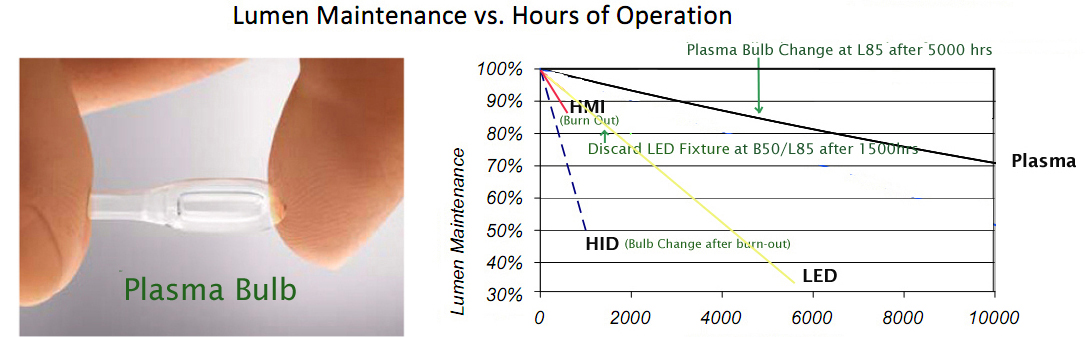
What is the “lamp life” of an LEP bulb is up for debate. Peter Daffarn of Photo Beard wrote in the Cinematographer’s Mailing List (CML): “Lamp life as quoted by Luxim is 30,000 hours but we are saying 20,000 to be sure.” Such claims of 20'000 – 30’000 hr lamp life made by manufacturers like Photon Beard should be taken, I think, as nothing more than marketing hyperbole. Determining the "life" of an LEP, like that of an LED, is a very complex matter because LEPs have no filament or electrodes to burn out and thus will keep on producing light, although at declining levels and with a gradual shift in color, beyond their useful life. And, since a LEP (like an LED) has a comparatively very long life (as conventionally defined), over which its' lumen output drops continuously, it also has an appreciatively greater lumen depreciation over that life than does an HMI lamp. Given their continuous lumen depreciation and color shift over time, it is clear that there comes a time when a LEP bulb has surpassed its’ working life and should be retired. Since it won't burn out in its' prime, like an HMI lamp, how do we determine when a LEP has surpassed its' useable life.

Plasma_Color_Shift_Alt.jpg


Clearly, this new technology requires a new approach to determining useable "lamp life" than that used for conventional lamps like HMIs. For instance, how useful is Photon Beard’s "lamp life" of 20'000 hours when according to Luxim’s specifications the bulb’s lumen output will depreciate as much as 60% with a color shift of 1000K (from 5300K to 4300K) in that time. Whatever the stated lifetime of any emitter technology, it must reflect a meaningful statistical measure of the performance of it in a given fixture design for a specific application. Clearly, in the case of LEP luminaries to be meaningful "lamp life" must be defined as the point of unacceptable lumen depreciation and color shift for our particular application rather than complete failure to light. And, whatever level of lumen depreciation is chosen for “low-light failure”, to be meaningful to it's users, it should be in line with existing lamp technologies used in that industry.

Plasma_Decay_Alt.jpg

In the case of motion picture lighting, I would argue that nothing short of a L85 criteria would be appropriate and meaningful, since that has been our experience with both HMI and Tungsten Lamps (where the “rated life” is the interval in which 50% of lamps fail and with an average lumen depreciation of 80-85%.) If we adopt this criteria for motion picture lighting applications of LEPs, their rated lamp life would still be an unparalleled 5000 hrs (compared to 500-750 hrs for HMIs and approximately 1500 hrs for LED fixtures.) In other words, the interval in which the output of an LEP drops-off of to 85 percent of its’ original value (L85) is 5000 hrs. Unlike an LED fixture that has no replaceable parts, the bulb of an LEP can be replaced after reaching this “low-light failure”, so the fixture does not have to be thrown away as is often the case with LEDS (see newsletter article for details.)

Where we are a long way off from having a single-die LED with sufficient output and correlated color temperature to match HMIs, LEP lamps are a cost effective alternative to expensive HMI Fresnel systems when it comes to generating daylight balanced light. In fact there is one LEP head that we are looking at (not the Photon Beard Nova 270 – it’s too expensive) because it has a Power Factor of .99 making it a near linear load. As a result, it uses power more efficiently, minimizes return current, and generates virtually no line noise. Where, it is as much the Harmonic Noise that non-PFC HMI, Fluorescent, and LED power supplies kick back into the power stream, as it is their higher Apparent Power, that limits the total number of them that can be reliably operated on conventional portable generators; the efficiency and near unity Power Factor of this LEP head means that you can operate more of them on portable gas generators. For instance, you can operate four 575W HMIs on a 6500W portable AVR generator, where you should be able to operate 23 of these 270W LEP heads (each with an output comparable to a 575W HMI).

Plasma_PowerWaveform.jpg

Oscilloscope shots comparing the current and voltage waveforms of the PFC Helio 270 with an equivalent wattage of non-PFC LEDs

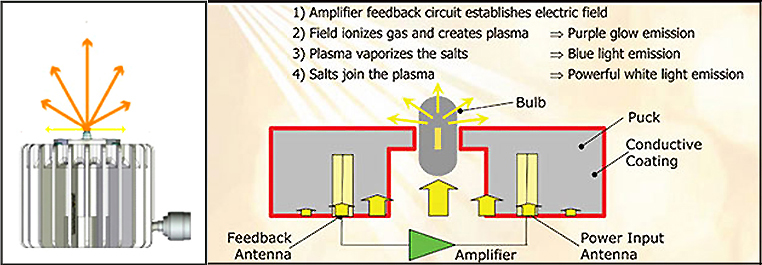
Where LEP is radically new technology there is a lot to get your head around. One way to think of a LEP bulb is as a tiny discharge lamp. But, unlike an HMI bulb it does not have electrodes. Instead of applying a voltage and drawing a current through the lamp to create light as does an HMI, the energy that creates light in an LEP comes via a high frequency RF transmitter. The RF waves heat the materials inside the lamp and bring those materials to a plasma state so that the lamp emits a "flicker-free" light. Besides better color rendering, light quality, and lamp life, this different method of transforming electricity into light has other benefits as well. For more details about LEPs see our newsletter article at http://www.screenlightandgrip.com/html/emailnewsletter_generators.html#anchorHigh%20Output%20LEPs.

Guy Holt, Gaffer, ScreenLight & Grip, Lighting Rental & Sales in Boston
 
Once again ... great article.

So the fixture you are looking at ... the Helio 270? Will you be selling that?

It seems that these fixtures are still daylight only ... so they replace HMI sources.

So, LED sources like the ARRI L7-C are still the most flexible options out there, assuming they throw enough light for the task, right?

As a small owner operator I've been thinking more and more about adding L7C location fixtures to my kit. Do you think that makes sense ... or would you look to rentals first?
 
Thanks Guy, I learned a lot from this article!
 
Thanks for the great article, Guy.

I've googled "Helio 270" and didn't get any related results.
Could you please give us a link to the manufacturers or any European distributors website?
Do you know if they will be at IBC this year?
 
Here is a link to some information that may show this product to have to limitations on film sets? warmup times, cool down times, UV cautions?
Oh and edited because I forgot about the possible RF emissions. I do hope these things can be overcome as I would very much like to be able to use them.

http://www.luxim.com/pdfs/demokitinstr.pdf
 
Last edited:

Thanks Frank. So, if you read the full article on Guy's newsletter, you can acertain that the Helio 270 will cost around $2200-2300 and the Photon Beard will be about $4400. Not sure that the Photon Beard will be much of a savings over a new 575 HMI, and definitely not a savings over a used 575.

However, if I can buy a DIY kit for $700 and get a used tungsten fresnel with about a 7" lens, I bet I can gut it and install the LEP for less than a grand and a weekend of work. Not sure if the extra $1,000 to $1300 is worth it the more "professional" look of a manufactured fixture. This could be very interesting.

What's even more intriguing is that this technology may be able to recreate the beautiful light coming from carbon arc sources, due to its small "arc" length. Can't wait to see if Lumix coumes out with different sized lamps/RF drivers.
By my calcs, and using Guy's example of 27 Helio 270's on the modded Honda 6500 gennie, or a household dryer plug, I could power a large LEP fresnel equal to a 15.5K HMI.
 
In addition, it looks like the manufacturer has already improved on the emitter design. The new emitter LIFI-STA-41-02, outputs at 5600K and has 17,000 lumens, compared to 14,000 for teh emitter in the Helios 270 (which is at 5300K)
 

As with LEDs, the suitability of a new light source like LEP for motion picture production comes down to the implementation of that technology to a specific application in a specific form factor (ie head.) While there is a lot of information on Luxim’s websites and other websites on the web, not all of it applies to how the technology is being implemented in motion picture lighting instruments. For example, as I mentioned in my original post, head manufacturers have not realized anything close to the kind of lumen efficiency achieved in other applications (street lighting) within the framework of a practical light that will burn in all lamp orientations. In other words, do not take random information found on the web out of context.

However, if I can buy a DIY kit for $700 and get a used tungsten fresnel with about a 7" lens, I bet I can gut it and install the LEP for less than a grand and a weekend of work. Not sure if the extra $1,000 to $1300 is worth it the more "professional" look of a manufactured fixture.

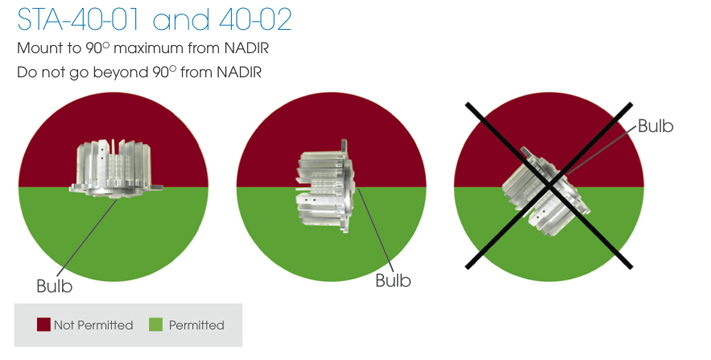
According to the manufacturer’s developer’s kit instructions the emitter featured in the kit from diyprojectorkits.com (cited above) will not burn in a tilted up position (see illustration below Luxim’s developer’s kit instructions.) While this specific Luxim emitter is suitable for applications such as street lighting or aquarium lighting (a straight down burn position) or projector (horizontal burn position) it is not suitable for motion picture lighting instruments – what good is a light that you can’t tilt up?

Plasma_Bulb_Orientation.jpg

Here is a link to some information that may show this product to have to limitations on film sets? warmup times, cool down times, UV cautions? Oh and edited because I forgot about the possible RF emissions. I do hope these things can be overcome as I would very much like to be able to use them.
http://www.luxim.com/pdfs/demokitinstr.pdf

In regard to UV emissions. Plasma lamps emit some light in the UV part of the spectrum. Enough that designers need to incorporate UV filtration into the safety glass of street lights and aquarium lights (the lenses of projectors provide sufficient UV filtration.) But, since a greater proportion of the light they generate, in comparison to an HMI, is not UV they do not require the elaborate safety precautions that you see in HMI lamp heads. For instance, there are no safety circuits that a switch will interrupt if the lens door is opened or if the Fresnel lens breaks - LEP bulbs do not generate that much UV. As I describe in my newsletter article the ignition process of an LEP is very similar to an HMI, but only takes about 20 seconds. Like an HMI they do require time to come up to color temperature and will not always hot re-strike. But, that is a fact of life that we have lived with for a long time with HMI lighting instruments. In my limited experience with these heads, they are more similar (if not better) in this regard to HMIs lamps than they are to CDM (Ceramic Discharge Metal Halide) lamps like Cool Lights’ CDM Fresnels.

Plasma_Cycle.jpg

While it is true that LEP lamps use high frequency RF to excite the gases within the bulb to a plasma state, it is done in such a fashion as not to cause RF interference. For instance there would be no market for LEP aquarium lights if it interfered with home Wi-fi systems. It does not cause RF interference because the drivers are RF shielded and the “emitter” acts as a resonant cavity (or wave guide) that focuses and contains the RF energy (see illustrations above.) Lamps similar to these have been used in the semiconductor industry for photoresist ashing for over 15 years, and they have been used in event/stage/tour lighting applications for a number of years (see samples below.) You can be certain that they do not cause RF interference if they are being used in event/stage/tour lighting applications.

Plasma_Theatrical_Hds.jpg

As far as I can tell, the head manufacturers of LEP lamps for motion picture lighting applications have addressed the issues of lamp orientation, UV emissions, RF interference, ignition time and restrike within the framework of a light that makes practical sense for motion picture production . At present there are two motion picture LEP lamp heads on the market: The Photon Beard Nova 270 and the Helio 270. As mentioned Photon Beard is going to be at Cinegear, but as far as I know Helio will not. Both lamp heads use the same Luxim Plasma Emitter behind a 145mm and 175 mm Fresnel lens respectively. The Photon Beard Nova 270 can be operated on batteries at 28 Volts or off a separate Universal AC power supply (90-305Vac, 50/60Hz), and is dimmable from 20-100%. The Helio 270, by comparison is a stripped down, more robust location production instrument that offers a built-in 120V/60Hz AC power supply (no DC option) with near unity (.99) Power Factor. As such, the Helio 270 is nearly half the price of the Photon Beard Nova 270. Where it is a 60Hz/120V head, it is not likely that you will see Helio at a European trade show like IBC.

Besides better color rendering, light quality, and lamp life, this different method of transforming electricity into light has other benefits as well. For more details about LEPs see our newsletter article at http://www.screenlightandgrip.com/html/emailnewsletter_generators.html#anchorHigh%20Output%20LEPs.

Guy Holt, Gaffer, ScreenLight & Grip, Lighting Rental & Sales in Boston
 
In addition, it looks like the manufacturer has already improved on the emitter design. The new emitter LIFI-STA-41-02, outputs at 5600K and has 17,000 lumens, compared to 14,000 for teh emitter in the Helios 270 (which is at 5300K)

The LIFI-STA-41-02 emitter also does not burn in a tilted up position. As I said what use is a motion picture light that can not operate tilted up? As you can see there are a lot of design considerations that go into building a LEP lamp for motion picture applications. While there are DIY LEP projector kits (that are unsuitable for motion picture applications), I doubt that it is something you can do on your workbench with an old $700 quartz fresnel. As far as I can tell, the head manufacturers of LEP lamps for motion picture lighting applications have been able to address the issues of lamp orientation, UV emissions, RF interference, ignition time and restrike within the framework of a light that makes practical sense for motion picture production because they can manufacture custom components (given the benefits of manufacturing economies of scale) not available to the average user. It reminds me of a story I heard on public radio about a bike enthusiast who set out to build from scratch his ideal bike for everyday riding (not racing). In the end it cost him $7000.00 for something very similar, but not exactly the same, as he could have bought off the shelf for $1500.

- Guy Holt, Gaffer, ScreenLight & Grip, Lighting Rental & Sales in Boston
 
Last edited:
Where it is a 60Hz/120V head, it is not likely that you will see Helio at a European trade show like IBC.
Hopefully they will make a 50Hz/220V version...
Any info about the manufacturer of Helio 270, such as origin, website...?

Thanks,
Petter
 
Once again ... great article. ... It seems that these fixtures are still daylight only ... so they replace HMI sources.
So, LED sources like the ARRI L7-C are still the most flexible options out there, assuming they throw enough light for the task, right?

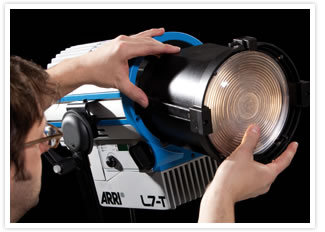
At this point in time there are only daylight balanced LEP emitters, so if you want a single Fresnel type head that will generate both daylight and tungsten balanced light, your best option (really only option) is the new Arri L7C. While expensive (they will sell for about $3200.00 USD), Arri has incorporated some features that guarantee that you will receive a return on your investment. To assure that they are not quickly rendered obsolete by the rapid advances being made in LED chip efficiency, the Arri L-Series LED Fresels are designed to be an expansible platform, with replaceable parts, that can incorporate future developments in LED technology. Not only, do the heads allow for the incorporation of more efficient LED chips when they become available (or when the lumnen output of the original ones drop), but the light engine is also fully upgradeable, ensuring that the fixtures can take advantage of technology advances as they happen.

ArriL7_upgrade.jpg

To extend its’ usable life, the new Arri L7C LED Fresnels also incorporate a color-feedback system of self-monitoring sensors to ensure that it LED array generates stable color across a range of output levels, as well as correcting changes in performance caused by ambient temperature and component aging. Able to compensate for the inevitable lumen depreciation and color shift of the LEDs in its array, the Arri L7C ensures consistent color temperature through out its’ life (see my newsletter article for details .) Able to both compensate for aging components and incorporate future developments in LED technology, the L7C assures that you will see a return on your investment in them. Given the rapid pace of LED Chip development, I can't think of another LED fixture that won't be obsolete in a year or two.

LED_Comp_Sprectrum.jpg

The drawback to the Arri L7C is that they are expensive (they require micro-processers) and their spectral distribution is still discontinuous. Even though they emit additional wavelengths to create a closer match to, say, tungsten lighting, as we can see by the spectral power distribution graph above, the curve of multi-emitter LEDs like the Arri L7C is very "spiky". This has the same noticeable side effects in color reproduction as discussed in my posts above. Like remote phosphor LEDs, tunable multi-emitter designs like the Arri L7C, simply by the nature of their discontinuous spectral distribution, still cannot reproduce colors on screen with complete accuracy.

Where we are a long way off from having a single-die LED with sufficient output and correlated color temperature to match daylight, LEP lamps like the Helio 270 are really the only cost effective alternative to expensive HMI Fresnel systems when it comes to generating full spectrum daylight balanced light. This feature of LEPs benefits Red users, as well as users of DSLRs, in particular.

One downside to lighting for the 5000K native color balance of CMOS sensors in the past has been that it requires an all 5000K balanced lighting package and HMIs are considerably more expensive to buy or rent than other light sources. Kino Flo fixtures, particularly the Parabeams, are a cost effective alternative to HMIs because they can use either 3200K or 5500K tubes. But, the drawback to fluorescent fixtures (like LED fixtures) is that they generally have a very broad soft light output that drops off rapidly which means the units need to be positioned close to the subject they are lighting. This characteristic has always made them better suited to lighting documentary interviews than dramatic scenes.

With a 5300K output comparable to that of a 575 HMI Fresnel, the Helio 270 in particular offers the same benefit of being a less expensive alternative to HMIs, but also offers the added benefit of being more versatile than a Kino Flo or LED fixture. Not only does it offer the capacity of traditional Tungsten/HMI Fresnels to throw and control its light output (making it a more suitable Key and Backlight source for lighting dramatic scenes), but it also has sufficient output to bounce it or waste some output to diffusion material to make it softer (existing LEDs put out barely enough, with none to waste.) It’s capacity to provide both hard crisp light that will throw a distance and is easily controlled, as well as offer soft light with diffusion, makes the Helio 270 much more versatile than any Fluorescent light or LED array presently available. It also offers a number of benefits that the new LED Fresnels and traditional HMI Fresnel do not.

For instance, LEPs do not require the active microprocessor color control that is required to assure consistent color rendition in LEDs like the new Arri L7s. Absent such microprocessor based color management systems, LEPs are less expensive and more robust than LED Fresnels like the Arri L7s whose color management system is surely not full proof (its sensors and controls may themselves shift over time and affect color.) An added benefit to LEPs is that color meters, like the Minolta III F, that make their calculations of the Color Temperature (CT) based on a light sources continuous spectrum, are able to generate accurate reading of the CT and Green/Magenta of LEP lamps. Color meters are completely useless reading the “spiky” discontinuous color spectrum of LEDs (see my newsletter article for details .)

The biggest benefit to LEPs in comparison to HMIs has got to be the cost savings in not having to replace lamps every 500 - 750 hrs as is the case with HMIs (or an entire LED light panel when its' emitters reach low light failure.) Where a 575w HMI globe typically retails for approximately $150.00, the 5000 hr L85 lamp life of an LEP bulb is equal to seven HMI globes, which amounts to a savings of $1050.00, or nearly half the cost of the Helio 270 Plasma lamp head.

Plasma_Helio270LG.jpg

The Helio 270 LEP

Plasma emitters use solid state, hardened components that improve their reliability under harsh location production. Plasma bulbs are rugged and vibration resistant, and so will not break or explode inside expensive lighting heads. Since the LEP emitter is extremely compact, in the case of the Helio 270 at least the emitter, driver, and power supply all fit in the lamp head (the Photon Beard Nova 270 uses a separate AC power supply), eliminating the need for a separate ballast connected by header cables (the acknowledged Achilles heel of HMI systems.) Finally, with much lower UV emissions, LEPs do not require elaborate and ultimately finicky safety switches. In total, LEPs have an order of magnitude better reliability than conventional HMI lamp heads while offering the intense beam and the colorful spectrum needed for motion picture production.

For more details about LEPs see our newsletter article at http://www.screenlightandgrip.com/html/emailnewsletter_generators.html#anchorHigh%20Output%20LEPs.

Guy Holt, Gaffer, ScreenLight & Grip, Lighting Rental & Sales in Boston
 
Guy,

Thanks for this post! Some great info on Plasma lighting. Have you had a chance to check out Hive Lighting's ( http://www.hivelighting.com/ ) new lamp heads. Hive debuted part of its product line at CineGear 2011 in LA. Here is the info on Hive's fresnel head the HORNET 180 http://www.hivelight...180Fresnel.pdf. A pretty different form factor than either the Helio or Photon Beard's Nova, the hexagon shaped housing is designed to link together. Also Hive has a spacelight model which may be of interest to you as well, the BUMBLEBEE 540 http://hivelighting....0Spacelight.pdf uses 3 emitters and gives the equivalent output of a 6,000W tungsten spacelight.

There is a write up on Hive Lightings booth here: http://provideocoali...r_expo_la_2011/ as well as SeaChangers theatrical lamp and Multiquips fuel cell light tower.

I agree with you on the potential for Plasma and on the overblown lamp life that is being promoted by the bulb manufacturers. I recommend no more than a 10,000 hour bulb life expectation since the .08 degree color shift over those 10,000 hours will take the bulb from the 5300K to 6100K which keeps it in the usable daylight range during that period for film and television production. But at the 20,000 or 30,000 range the loss of output and color shift just aren't practical.

To be clear, I started Hive because of the potential I think plasma has for film and television, so I am excited to see the conversation on these forums as the word gets out.

In fact here is a video of me explaining more about Hive and Plasma lighting: http://wideopencamera.com/cine-gear-...hive-lighting/ so you can all put a face to my name.


Jon Edward Miller
Director of Photography
www.jonedwardmiller.com
 
Thanks for adding an alternative Jon. I went to your web site. It doesn't say anything about dimming. It also says its a 180 watt lamp in a 275 watt system. Can you expiian that? Are you overdriving the lamp? How does that compare to the other two systems?

There are no prices, either for the products or for the retrofit program. In fact, I've only been able to infer pricing on the other two LEP fixtures vicariously. Is this all vaporware, or has production, sales, and shipping actually started? If so, what are the prices?

EDIT: OK, I found your video and see that the price is $5600. I have to say that I disagree with both your and Guy's math on why these are a better value. I'll also note that both you and Guy are in the business of selling new gear. I am a consumer and have no vested interest.

Over the last 5 months I have purchased about a dozen used HMIs through Ebay. All were purchased complete with ballasts, heads, cables, and a lamp. All were under $1,000, save for two Joker Bugs, which have a pretty high resale value due to their unique abilities and popularity. Some were as low as $165. I can buy a new 575 watt HMI lamp on Ebay for $100 any day of the year. So, under Guy's 7 HMI lamps = 1 5000 Hr LEP model, the replacement lamps savings are $700 and under Jon's 14 lamp hMI = 1 LEP model, the replacement lamp savings are $1,400.

So let's say I buy a $1000 used name brand 575 HMI (or a new 575 Chinese HMIs that are ubiquitous on Ebay and the same $1,000 price), I am saving at least $1,000 and up to $4,000 on the buy-in cost plus 7-14 replacement lamps, depending on the which fixture I buy and whether its a 5K or a 10K LEP lamp life that proves itself. Moreover, the replacement lamps will last a combined 5,000 to 14,000 hours. That's roughly 400 to 1200 12-hour filming days with the lights left on for the full 12 hours. How many lifetimes is that for an indie filmmaker. I will never recover my initial costs. This product's price point makes sense only for institutional buyers like very busy rental houses who are building out or upgrading inventory with new low wattage (575 or less) HMI fixtures.

I think I will wait until increased competition or large scale production economics bring down the high initial cost.

I do think though that there is great promise in this technology. Soilid state is a plus. High CRI is a plus. Small arc is a plus and if larger systems are developed, it may be an acceptable replacement for te beautiful light produced by the old carbon arcs.

You will also need more flexibility, such as a PAR form factor, a Bug form factor, both lower and much higher wattage systems. I hope this will pan out in those directions.
 
I doubt that it is something you can do on your workbench with an old $700 quartz fresnel.

Seems like Hive's Apiary Retrofit Program does just that.

http://www.hivelighting.com/PDFs/ApiaryRetrofitProgram.pdf

And I can buy a used 2K or 1K quartz fixture for less than $100 on Ebay almost anyday of the week:

http://cgi.ebay.com/BARDWELL-MCALIS...233?pt=LH_DefaultDomain_0&hash=item588e27f0a9

I'm curious as to what the pricing is on the Retrofit program, given that I can buy a DIY LEP kit and a used 2K fresnel for less than $1,000, even as low as $800 and build my own in an afternoon.
 
According to the manufacturer’s developer’s kit instructions the emitter featured in the kit from diyprojectorkits.com (cited above) will not burn in a tilted up position (see illustration below Luxim’s developer’s kit instructions.) While this specific Luxim emitter is suitable for applications such as street lighting or aquarium lighting (a straight down burn position) or projector (horizontal burn position) it is not suitable for motion picture lighting instruments – what good is a light that you can’t tilt up?

Plasma_Bulb_Orientation.jpg

And as far as not being able to point the DIY lamp upwards.... first its probably just a cooling issue, nothing that a heat sink or a drill can't fix - if one found the need to overcome this. That capability may not be necessary for most film applications. Almost all film lighting is pointed downward or level, not upward. Upward lighting on the face is not flattering. Look at pix of a film set. The lights are in the ceiling pointed down or on tall stands pointed down. All within the operating positions in the chart above. You can even point it perfectly level.

Its very rare that a light is pointed upward and, if so, its usually on a set piece. Something that can be easliy worked around by bouncing.
 
So let's say I buy a $1000 used name brand 575 HMI (or a new 575 Chinese HMIs that are ubiquitous on Ebay and the same $1,000 price), I am saving at least $1,000 and up to $4,000 on the buy-in cost plus 7-14 replacement lamps, depending on the which fixture I buy and whether its a 5K or a 10K LEP lamp life that proves itself. Moreover, the replacement lamps will last a combined 5,000 to 14,000 hours. That's roughly 400 to 1200 12-hour filming days with the lights left on for the full 12 hours. How many lifetimes is that for an indie filmmaker. I will never recover my initial costs. This product's price point makes sense only for institutional buyers like very busy rental houses who are building out or upgrading inventory with new low wattage (575 or less) HMI fixtures.

If you buy 575 MSR lamps (as opposed to HMI lamps) on ebay at a discount, then the cost savings to the extended life of LEP lamps is less but still appreciable. And, I agree that at the price points of the Photon Beard Nova 270s and Hive Hornet 180, Plasma lamps are not cost effective for indie filmmakers, but at roughly half the price of the other two, the Helio 270 may very well be. As a reseller of lights, I am in a very similar situation to end consumers in that I have to choose between competing product lines. In the case of the Helio 270, I do think it offers enough advantages over used HMIs that you would buy on ebay to make it worth spending the little extra money.

Plasma_Helio270LG.jpg

The Helio 270 LEP

Plasma emitters use solid state, hardened components that improve their reliability under harsh location production. Plasma bulbs are rugged and vibration resistant, and so will not break or explode the way HMIs bulbs do. Since the LEP emitter is extremely compact, in the case of the Helio 270 at least the emitter, driver, and power supply all fit in the lamp head (the Photon Beard Nova 270 uses a separate AC power supply), eliminating the need for a separate ballast connected by header cables (the acknowledged Achilles heel of HMI systems.) Finally, with much lower UV emissions, LEPs do not require elaborate and ultimately finicky safety switches. In total, LEPs have an order of magnitude better reliability than conventional HMI lamp heads while offering the same full color spectrum needed for motion picture production.

Since their light output is not a function of the AC line frequency as it is with HMIs, LEP lamps are flicker free at all shutter angles and all frame rates (even extreme high speed frame rates.) Finally, Power Factor Correction (PFC) is standard in LEP lamp heads where it is not in HMI ballasts. In fact, the Helio 270 has a Power Factor of .99 making it a near linear load. As a result, it uses power more efficiently than the used magnetic HMI ballasts that you get on ebay; and, unlike the used electronic or Chinese ballasts that you get on ebay, they generate virtually no line noise.

Plasma_PowerWaveform.jpg

Oscilloscope shots comparing the current and voltage waveforms of the PFC Helio 270 with an equivalent wattage of non-PFC LEDs which would be similar to the effect of a non-PFC Electronic HMI Ballast

Where, it is as much the Harmonic Noise that non-PFC electronic HMI ballasts kick back into the power stream, as it is the higher Apparent Power of both electronic and magnetic HMI ballasts, that limits the total number of them that can be reliably operated on conventional portable generators; the efficiency and near unity Power Factor of LEP heads means that you can operate more of them on portable gas generators. For instance, you can only safely operate four 575W HMIs with non-PFC electronic ballasts on a 6500W portable AVR generator, where you should be able to operate 23 of the Helio 270W LEP heads (each with an output comparable to a 575W HMI) on the enhanced 7500W output of our modified Honda EU6500is. That is a major increase in production capability with portable gas generators that is possible with LEP heads that is not possible with used magnetic or electronic HMI ballasts ( use this link for details.) At roughly half the cost of the Photon Beard Nova 270 and Hive Hornet 180, the cost of the Helio 270 is not much more than what a used Joker 400 or a Compact Arri 575 with electronic ballast sells for used and neither of those heads are Power Factor Corrected. For these reasons we are contemplating including the Helio 270 in our HD Plug-n-Play Pkg. ( the Photon Beard Nova 270 and Hive Hornet 180 are too expensive.)

Where LEP is radically new technology there is a lot to get your head around. One way to think of a LEP bulb is as a tiny discharge lamp. But, unlike an HMI bulb it does not have electrodes. Instead of applying a voltage and drawing a current through the lamp to create light as does an HMI, the energy that creates light in an LEP comes via a high frequency RF transmitter. The RF waves heat the materials inside the lamp and bring those materials to a plasma state so that the lamp emits a "flicker-free" light. Besides better color rendering, light quality, and lamp life, this different method of transforming electricity into light has other benefits as well. For more details about LEPs see our newsletter article at http://www.screenlightandgrip.com/html/emailnewsletter_generators.html#anchorHigh Output LEPs.

Guy Holt, Gaffer, ScreenLight & Grip, Lighting Rental & Sales in Boston
 
Back
Top