Welcome to our community

Be a part of something great, join today!

  • Hey all, just changed over the backend after 15 years I figured time to give it a bit of an update, its probably gonna be a bit weird for most of you and i am sure there is a few bugs to work out but it should kinda work the same as before... hopefully :)

Cinematography of 2030s: Ultra HFR! I have witnessed realtime 1000fps on real 1000Hz.

Mark Rejhon

Well-known member
Joined
Jun 14, 2013
Messages
45
Reaction score
0
Points
0
Hello,

I'm the founder of Blur Busters -- and author of TestUFO Motion Tests. I consider myself an expert in displays and of low-persistence. I'm the co-author (along with NIST.gov, NOKIA, Keltek) of a peer reviewed conference paper on a display motion-blur testing technique, and am also the world's first mainstream reviewer to test a true-480Hz display and have also seen 1000Hz+ displays in the laboratory now. I have consequently written Blur Busters Law: The Amazing Journey To Future 1000 Hz Displays. I am more well known by gaming monitor manufacturers and eSports players, but since Blur Busters is slowly expanding news coverage into HFR (120fps, and even true-240fps+) content. I'm also a invited guest moderators of /r/hfr on Reddit now. I have had a few contracts with gaming monitor manufacturers to reduce display motion blur.

I'm one of the few people in the world to be able to do a good "Plain English" job of explaining display persistence (causes of display motion blur), which is explained in the 1000 Hz article. I'm the inventor of several optical illusions that is intentionally generated by display motion blur: TestUFO Eye Tracking and TestUFO Persistence Of Vision.

Also, resulting motion blur (seen by the human eye) is the sum of the source persistence (camera shutter length) and destination display persistence (pixel visibility time).

Meaning, a camera with 1/300sec shutter speed, displayed on a sample-and-hold display of 1/60sec frame visibility time, creates (1/300sec + 1/60sec) = (6/300sec) = 1/50sec of motion blurring for on-screen moving objects. A film that is filmed with a camera of 1/120sec shutter displayed on a 24Hz flickerfree DLP (E-Cinema), creates (1/120sec + 1/24sec) = (1/120sec + 5/120sec) = 1/20sec of motion blurring. (Assumption is frame rate matching refresh rate, of course -- there are many variables -- but once you've got a match, the mathematics is simple.)

Display Persistence is the destination-side equivalent of the camera shutter -- it is also known as MPRT (Moving Picture Response Time) in scientific papers) -- and reducing persistence is usually done via flicker (strobing, BFI, CRT impulsing, etc) but can also be done via a higher frame rate. At the end of the day, display motion blur is linearly proportional to pixel visibility time, and it's easily demonstrated in the motion test links above, and already well-documented by papers well outside the filming industry. Virtual reality needed to reduce motion blur because motion blur causes nausea (extra blur above-and-beyond natural human vision limits) in a Holodeck-like environment, so intense research is occuring to eliminate blur (both source-side and destination-side). Now, today, I am increasingly crossing-over between the source-side equation and the destination-side equation. And HFR cinematography, sometimes reaches into virtual reality (360 degrees). So my writings is slowly increasing into HFR too.

Intentional motion blurring is often added to frames to prevent stroboscopic and wagonwheel effects. Unfortuantely, adding camera blur or artifical blur is also a cause of nausea for some in virtual reality (VR). So you need to eliminate both motion blur and stroboscopic effects. The only way to do both simultaneously (can't add blur, can't have stroboscopic effect) is keep raising frame rates. That means things like true 1000fps at true 1000Hz. VR scientists have now agreed that going to at least quadruple-digit framerates, is necessary to pass a Holodeck Turing Test (unable to tell apart VR from real life). We still even get stroboscopic effects even on my true-480Hz display. While resolutions have gone Retina, true genuine frame rates + refresh rates are very far away from reaching Retina (e.g. achieving high enough framerates & Hz that it's not necessary to add motion blur to individual frames) by more than an order of magnitude.

From my true-480Hz tests:
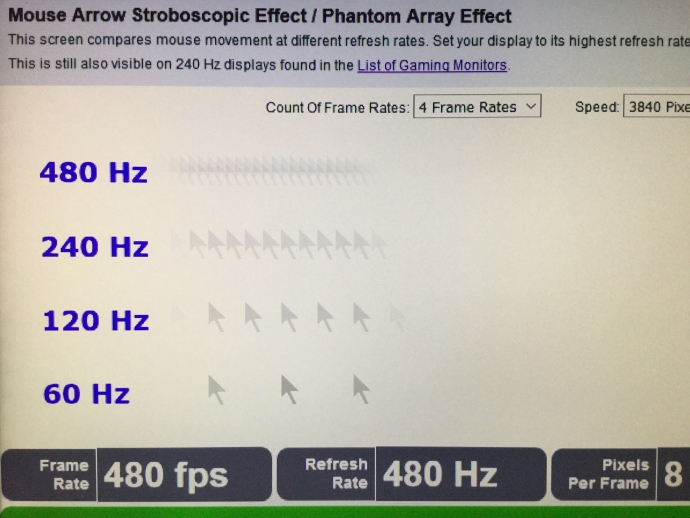
(One of the several artifacts forced by refresh rate granularity)

Early canary tests show promise in ultra-HFR video (e.g. true realtime 1000fps video!) which are successfully simultaneously blurless & stroboscopicless. This is a distant vision of what is to come (~2050) especially if 1000fps / 1000Hz becomes cheap. Today, in the lab with actual displays, it's much easier to tell apart 240fps@240Hz and 1000fps@1000Hz than it is to tell apart 4K and 8K. I love 8K as much as all of you, but it is surprising of the little focus on providing cinematographers further additional options. It can be increasingly important (e.g. blurfree+strobefree 360 degree videos for VR) to avoid viewer nausea for a bigger-sigma percentage of human population. Currently, VR headsets use 90Hz pulsing, but future VR is expected to go even further in frame rates in the decades to come to reduce the need for strobing/flicker as the blur-reduction technique, and migrate to sheer framerates as the blur-reduction technique. Research is also being done on frame rate amplification technologies for video games (Oculus can convert 45fps to 90fps laglessly, in a 3D-aware manner, without rerendering the intermediate frames) and tomorrow's tech may convert 100fps to 1000fps with less need of full re-renders between frames -- due to anything different from real life (e.g. flicker, blur, stroboscopic, etc) causing nausea in virtual reality environments. But this is also human-visible on a stationary display too, including experimental displays too, so the VR innovations may spinoff to future ultra-HFR.

Nobody talks about it yet, but what we see in the lab, means 120fps HFR is not the final frontier when we predict outwards to 2030s-2040s, we see ultra-HFR now becoming a more mainstream topic (then) within our lifetimes given the incredible rapidity of VR innovations occuring (and actually feasting my eyes on real 480Hz+ and 1000Hz+ laboratory displays myself -- essentially flickerless and strobeless with uncannily CRT-quality motion with zero stepping artifacts). After resolutions have maxed out to Retina leagues, we now believe frame rates and refresh rates is one of the new racees that will continue outwards to the end of the 21st century, especially with the mother-of-necessity VR pushes.

Motion blur is lovely when we want it. It is very cinematic. But sometime, certain situations, we want to understand how to control it & eliminate it. Since virtual reality often requires elimination of motion blur to prevent motion sickness (avoid extra blur forced on eyes, above-and-beyond human vision) -- the well known VR sickness. Now technology is arriving that makes this increasingly easier, for those specific kinds of situations where the Director's Intent is minimum-possible motion blur, or at least a fuller understanding of controlling motion blur via understanding source/destination-side in a deeper way.

I'm about to write a simplified HFR article on how source persistence and destination persistence combines into a final amount of perceived display motion blur. This article is of extreme great interest to 120fps HFR videographers who are trying to figure out how predict resulting motion blur that viewers will see, in order to best present their HFR material (Especially when they are allowed to choose a specific display for their HFR presentation). I'm the display-side expert, but with a good understanding of the interactions with source-side (camera blur) so this subject is a crossover for me. I'm now reaching out to a few HFR experts.

My questions to readers are as follows:

(1) Has there been any recent innovations in Ultra HFR? Video of frame rates above 120fps outside the laboratory, played realtime, not slomo?
e.g. Presentation of true-240fps video (non-slomo) on now currently-shipping true-240Hz eSports gaming monitors (more than one dozen models are now on the market).

(2) Are there any pre-existing articles in the HFR community, that accurately explain in a simple way:
e.g. How source persistence & destination persistence interact to create, a final human perceived display motion blur.


I am researching this, before I write about this.
I'd be happy to team-up with a known source-side expert (e.g. HFR expert) if you want to help me coauthor a flagship motion blur article for the HFR community worldwide.

Cheers,
Mark Rejhon
Founder, BlurBusters.com
 
Last edited:
Crossposting a reply to David Mullen:

Mark Rejhon said:
Thank you!
I am trying to research the state of HFR in the "ultra high framerate" sphere; there is little on realtime HFR above 120fps.

All I recall are the old tests that Douglas Trumbull did for his Showscan process. He felt that at really high frame rates, over 100, the ability for the audience to perceive a difference was too small to offset the practical issues of shooting and projecting at those rates.
From what I am (faintly) aware of the old tests of Douglas, he was unable to push the frame rates on an exponential curve necessary to make it worthwhile.

What we discovered is you have to double in order to have a really noticeable effect.
e.g. 120fps -> 240fps -> 480fps -> 960fps

Basically, these steps halve motion blur. The diminishing points of returns continue, but doesn't quite stop, because it is equivalent to display motion blur of:
1/120sec blur -> 1/240sec blur -> 1/480sec blur -> 1/960sec blur

With experimential ultrahigh-refreshrate headroom now available for scientists/researchers/experimenters to experiment with, it has been observed that display persistence (refresh cycle length, for sample-and-hold displays) has the same behaviour as camera shutter speed. 480fps@480Hz on a flickerless display (like a 360-degree shutter), has exactly the same display motion blur, as a photograph taken with a 1/480sec shutter speed, for the same equivalent physical angular motionspeed for the display plane relative to the human eye.

Which is indeed noticeable. The jump from 120fps HFR->1000fps HFR is roughly as noticeable as the jump from 60fps HFR ->120fps HFR Yes, it's a much, much bigger jump that becomes mandatory to punch the diminishing points of return curve -- but we're comparing 1/60 versus 1/120 versus 1/1000 which is 16.67ms versus 8.33ms versus 1.0ms -- that's nearly the same apart (8.3ms delta versus 7.3ms delta). But it clearly outlines that overlooked "diminishing points of returns" headroom, you need a massively ginormous jump up in frame rates to be really noticeable. But it's quite useful for VR and Holodecks to try to achieve near-zero-persistence -- something 120fps HFR can't even do without strobing or blur side effects, for the aboveformentioned reasons.

Today, it's more pratical to just (about) experiment -- current off-the-shelf DLP chips can be attached to a custom firmware to actually display a monochrome image at a true-1000Hz refresh rate, thanks to the DMD's ultrarapid pixel switching speed. Several scientific suppliers now sell 500Hz and 1440Hz DLP projectors (albiet at often 5 figure prices) -- e.g. ViewPixx. My prediction is that ultrahigh refresh rates will eventually be a minor cost-add within 20 years to future displays. But right now I'm researching the source-side of the equation.

4K is cheap now, tomorrow, 1000Hz may be too.

Keep in mind that 1000 fps is over a 5-stop exposure loss compared to 24 fps, though you can gain one-stop by not using a shutter at those rates. But even if it's just a 4-stop loss, your 800 ASA camera just became a 50 ASA camera.
I'm certainly aware! Past high speed cameras need to utilize a ton of light.

Several private brainstorms have privately been discussed amongst us about what will be needed in 20 years from now, to try to film for a VR or Holodeck environment in much more truer manner:
-- One theoretical camera being imagined, is a photon camera. After you recorded the video (essentially timecoded photons), you can play back the video file at any frame rate you want, whether 37fps or 24fps or 1000fps. Post-processing would allow full-brightness at low framerates to be multiplexed with the temporal resolution of ultrahigh framerates
-- One can convert a 1000fps video into a much-brighter 25fps video simply by stacking 40 frames into 1 each. It's still the same number of photons, so with a proper sensor & proper tech, with a good high-efficiency sensor, this can in theory work as perfectly in brightening 1000fps videos to the same brightness as a 25fps video. But when objects move, denoising algorithms are REALLY bad. However, natural learning has shown some shocking improvements -- artificial intelligence denoising algorithms can in theory re-brighten 1000fps videos, while keeping temporal artifacts at bay. Artificial-intelligence denoising algorithms would solve the problem of denoising artifacts.

I saw some really good artificial-intelligence scalers at CES 2018 that actually converted 1080p into 4K and 8K material in a really fantastic way -- it was as if it knew that blurry house and windows and tree leaves were actually the real thing, and artistically (in realtime!) put in real sharp wood, real sharp leaves, etc, creating detail whereas there wasn't before. In 20 years from now, AI algorithms can probably realtime convert a VHS videotape into a retina-sharp Holodeck environment, by automatically recognizing objects and using its own library of 3D objects and material, to replace the blurry stuff with the real thing. Pretty much a supercomputerful of realtime processing.

Some of us have commented, that the the exact same kind of process, could be used to apply AI-based denoising/deblurring to framestacked-brightened 960fps videos (which could theoretically also output 480fps, 240fps, 120fps, 60fps, 24fps, as divisors of 960 -- and these multiple source files of multiple different brightnesses (lower framerate being brighter and lower noise) by the AI algorithm -- to successfully ultra-brighten 960fps video without the darkness and noise.)

Back in 1930s and 1940s, you really needed bright light to expose color film even at just a mere 24 frames per second (e.g. Wizard Of Oz) -- far more light back then than for today's 1000fps. Tomorrow's breakthroughs, in a couple of decades, could make practical much-brighter 1000fps filming, or some other framerateless method necessary for VR realism without the side effects of using a frame rate (aka static imagery to represent moving images).

At those high rates, the screen becomes essentially flicker less and seems like a clear window, assuming there is sufficient resolution.
At ultrahigh framerates, flicker doesn't need to be involved to eliminate motion blur.

Blurless sample-and-hold. Blurless 360-degree.

The ultra-high framerates make low-persistence possible without the need of black periods.

Which is better (for VR / Holodecks) because real life doesn't strobe and doesn't enforce a motionblur above-and-beyond human vision.

Real life has no frame rate either, and a frame rate has many side effects (stroboscopic effects, wagonwheel effects, stepping effects, persistence motion blur from eye-tracking across static frames) which affects passing a theoretical Holodeck Turing Test (unable to tell apart VR and real life). But since we can't go framerateless or analog-motion, ultra HFR is the next best thing.

But I also think you run into a variant of the uncanny valley phenomenon when shooting narrative fiction -- the more "real" the process becomes, the more artificial the techniques of moviemaking appear -- costumes, lighting, make-up, etc. Which is one reason why this sort of approach works better in nature documentaries, for example, because everything in front of the camera IS real.
Yes, this is a consideration.

That said, virtual reality literally requires the realism factor or you get nausea/headaches. In a "Holodeck" situation, this is a very different phenomenon from just staring at a flat screen: You're unable to do things like depth of field, defocus, motionblur, etc -- the human eye needs to do that instead if you're in a virtual environment. Even motion blur (beyond human vision) creates major nausea in VR. This can become important when designing virtual reality movie, or a movie that you can eventually walk in.

Most of the time, this is computer generated graphics, but can also include 360-degree movies (currently often looks like a flat plane, and has lots of problems) -- but eventually when 360 VR movies becomes true 6dof stereoscopic 3D in one way or another (intense research is occuring as we speak) there is a lot of technological progress needed.

Some of this is futurist stuff, obviously, however, I'm fascinated by the topic of HFR beyond 120fps. Humankind will certainly definitely need to plan a path for eventual ultra-HFR for virtual reality purposes -- e.g. 360-degree 6dof films that actually look like being immersed into a Holodeck like the real thing instead of looking inside a hollow projection sphere.

All fascinating areas of study, and I'd be happy to collaborate ideas with a few bleeding-edge HFR people into "push beyond 120fps HFR". As a display-side guy, I have to reach across the universe to the source-side people, and work on long-term solutions that successfully solve the "Holodeck Turing Test" problem of successfully matching real-life even for fast motions like downhill skiing, racing, speedboating, etc -- where all motion blur needs to be naturally from the human eye rather any existing than in the source/display.

VR is growing leaps and bounds, but the ultimate test is when VR stops looking fake and looking identical to real life: I believe that the Holodeck Turing Test experiment is achievable within 1 to 2 human generation (ultrahigh-Hz retina-resolution VR headset + ultrahigh-framerate video) to successfully trick a person that VR is a transparent ski goggles and that they're staring into real life (even for fast motions). Yet it is actually virtual reality -- a Holodeck per se. But is going to require a lot of future co-operation between the displayside experts and the sourceside experts. Still, this is real "Within our kid's life" stuff!
 
Last edited:
Personally, I don't think you'll find a lot of support for HFR among cinematographers. Nowadays a lot of TV panels push for HFR, online players such as MEGOGO push HFR into their player by default and have no possible way to cut it off in the app. Sports channels also push for HFR.

The thing is - any film or a movie should be projected at the speed it was shot, otherways you're changing the way you precieve the basics of the motion in the film. There is absolutely no need in "BLURLESS" image, more to say - I personally find a blurless or a HFR image distracting and repulsive. Speaking of the thing's I've tested - 60 fps/hz look awful, 120 fps/hz look even more distracting. It literally thows you away from the story into the rushing image.

The only film I've watched in HFR was The Hobbit, and there was an experimental reason to go for HFR - because of the way 3D was and is projected in the theaters.

There's a lot of reasons to push for HFR in gaming, but I don't see any to push for it in the film industry.
 
Last edited:
Alex Lubensky said:
Personally, I don't think you'll find a lot of support for HFR among cinematographers. Nowadays a lot of TV panels push for HFR, online players such as MEGOGO push HFR into their player by default and have no possible way to cut it off in the app. Sports channels also push for HFR.

The thing is - any film or a movie should be projected at the speed it was shot, otherways you're changing the way you precieve the basics of the motion in the film. There is absolutely no need in "BLURLESS" image, more to say - I personally find a blurless or a HFR image distracting and repulsive. Speaking of the thing's I've tested - 60 fps/hz look awful, 120 fps/hz look even more distracting. It literally thows you away from the story into the rushing image.

The only film I've watched in HFR was The Hobbit, and there was an experimental reason to go for HFR - because of the way 3D was and is projected in the theaters.

There's a lot of reasons to push for HFR in gaming, but I don't see any to push for it in the film industry.
I pretty much agree: Today.

Being the age, I prefer the good old fashioned 24fps look when staring at a big screen.

But what about some the kids who want to be cinematographers for virtual reality? A lot of the young cinematographers I talk to (millenials) have increased interest in things like VR, the blending between games and cinematography, and also don't mind HFR nearly as much as the older generation.

The hard questions may be asked: What are the best ways of cinematography for VR, when the goal is full immersion?

VR can straddle the game + cinematography universe. Essentially, a game you can walk in. There's early Wright Brothers experiments that converts a video into an explorable 3D environment (Try it now: True 3D, not stereoscopic) that you can walk in -- many glitches now, and rough, but one day will eventually someday become Retina, with the help of AI. So tomorrow (one or two decade from now) -- YOUR film might be given to a computer, that then converts it into a walkable, explorable 3D world. "...Please create a Holodeck environment matching the one in this video..." -- this is already being done (in a very, very rough Wright Brothers way). Something like this is already being done in a Wright Brothers way as you notice, and it will take a decade or two, but it's something in our kid's lifetime now: Making movies/documentaries/films/videos/etc designed to be explored by tomorrow's audiences.

This also, ironically, may be one of the ways to avoid adding extra framerate -- simply tell a computer to convert it to a 3D environment, and let the computer render it at a higher framerate than the original material. Problem solved. Cinematographers wouldn't need ultra HFR, to supply material for that. This may be what happens instead of direct ultra-HFR -- basically the intermediate step. But there may also be best-practices, like using the highest "good" framerate available to your camera, etc -- the extra temporal resolution helps the conversion process.

For games, but as it becomes comforable (e.g. imagine future theoretical Apple-Oakley sunshades of 2040s, rather than bulky ugly VR headsets), there will be a bigger market for virtual movies and such. And as it all expands beyond this -- if you're trying to create a Holodeck-like environment (e.g. film something that you can eventually walk in), the whole ball of wax changes.

Also, there are many cases, that this is still useful on a flat display: e.g. fast-action sports look really good in ultra HFR. 4K60 decoders are capable of realtime 1080p240fps in realtime, and 4K120 video decoders are capable of realtime 1080p480fps -- these are sub-$1000 graphics cards now that can play 480fps HFR today, if such a display existed.

There is now 1000fps in some smartphones (e.g. in one Sony Experia phone) although only for 5-second slomo bursts due to lack of bandwidth - but tomorrow, 1000fps may be continuous recording on a smartphone. Due to its ultra-sensitive sensor, its 1000fps is much brighter than even a large 5-year old 1000fps camera -- I was impressed that you could get that 1000fps high speed slomo quality from a smartphone-size camera sensor! If progress goes well, the darkness/noise problem will eventually become a nonissue within ten or twenty years, especially with additional AI algorithms to allow blur-free exposures longer than a frame per frame (e.g. 1/1000sec with the brightness and low noise of of 1/25sec).

Now, if ultra-HFR became cheap in displays too within ten years, then the whole chain is available: Cheap 1000fps, cheap 1000Hz, etc. When that happens, there will be temptations.

60fps to 120fps HFR is NOT always a big enough jump (only 50% less motion blur for sample-and-hold displays) and not tempting enough for many cinematographers, but 60fps to 960fps (94% reduction in motion blur on sample-hold displays such as LCD or OLED) is a much larger jump that may make it "worth the dazzle" for some special cases.

e.g. special features, amusement rides, Holodeck Experiences as well as say, special editions of Imax "vacation" films where immersion is a bigger goal.

The 24fps jump to 48fps or 60fps or 120fps doesn't jump over the uncanny valley enough, but the 24fps jump to 1000fps does (with proper cinematography technique). Some of the ultra-HFR tech is already here today in pieces and bits -- sometimes in your pocket too -- but is not glued together yet in a complete realtime chain yet.

The uncanny-valley effect is leapable, and only a few people in the world (like me) has seen this happen, refreshrate-wise, and it is extraordinarily, extraordinarily tough requiring the quadruple digit refresh rates. The effect is broken by other flaws (e.g. camera blur, weird motions) but it's quite useful in many applications. 3D was a fad, but this is a lurking even-bigger thing: real retina-quality Holodeck experiences, or true 'window effect with no uncanny valley' -- never achieved before.

Thus, why my topic is "Cinematography of 2030s" -- including future career choices, etc.

Traditional cinematography will still exist. But it'll not be the only cinematography applicable. Soe cinematographers will want to expand career choices, or be prepared to cater to additional markets, like working with game companies, or filming with settings intentionally for a Holodeck-like environments, etc.

That said, experimentation continues. What's being seen now is absolutely incredible, and should be shared to more HFR cinematographers. As the tech becomes feasible and the extra bruteforce (in Hz, framerates, reality, immersion solutions, etc) slowly leaps over the uncanny-valley problems, many questions are being asked, especially in the what-ifs department.
 
Last edited:
The ASC article on Billy Lynn's Long Halftime Walk (Dec. 2016 issue) may have some interesting information for you.

Something that caught my attention was the fact that they were starting to experiment with dynamically changing the displayed frame rate in shot.

Since they were starting with a HFR source, they could start a shot at "24FPS" but then when a bomb goes off, they could change to "120FPS", to give a heightened sense of realism, all without cutting.

They were also talking about using masks to create "24FPS" motion blur on some sections, but "120FPS" motion blur on a different part of the frame.

I could see that being a creative tool that other DP's could get behind. But I don't really see other DP's getting behind HFR for the sake of killing off motion blur completely.
 
The ASC article on Billy Lynn's Long Halftime Walk (Dec. 2016 issue) may have some interesting information for you.

Something that caught my attention was the fact that they were starting to experiment with dynamically changing the displayed frame rate in shot.

Since they were starting with a HFR source, they could start a shot at "24FPS" but then when a bomb goes off, they could change to "120FPS", to give a heightened sense of realism, all without cutting.
Yes, a seamless 120Hz change.

On a related topic, there's been a concurrent development of variable refresh displays for games (G-SYNC, FreeSync) -- the same thing works with VRR-compatible video players such as SMPlayer that can transition between any infinite number of framerates (from say 30fps to 240fps of any decimal point, such as 56.12312456fps) within a display's variable refresh rate range. Variable refresh rate displays make this possible instantaneous transitions between frame rates. In theory, you could have a random-framerate video (frametimes varying 100 times a second -- every single frame having their unique frame display time) and it'd play seamlessly smooth like the demonstration animation at www.testufo.com/vrr ... But there's not much purpose in having random-length frame display times (as beautifully stutter-reduced it can become) -- it's mainly useful for 3D graphics where the time to generate frames is hugely variable -- so variable refresh rates are more useful for games. That said, the tech is useful for completely eliminating refresh-rate transitions (no mode-change blackouts) so it's useful for the 24fps -> 120fps -> 24fps HFR seamlessness too.

That said, the capability built-into a display makes possible instant (seamless) refresh rate changes, which is very good for embedding HFR sequences in ordinary-framerate videos.

NOTE: 120fps HFR is certainly 5x clearer (on sample-hold flickerfree -- digital projectors with no shutter), so a fairly dramatic transition from 24fps -- but still not 100% blurfree for the perfect-retina "Holodeck Experience" target capable of tricking (Star Trek Morarity style) a person into not knowing they're inside a virtual world -- that still requires quad-digit HFR (zero blur, zero stroboscopic), possibly full-focal-depth (on human eye demand) retina-resolution lightfields (so people can focus their eyes themselves), and other special techniques.

(Yep -- certainly this whole thread is beyond-scope for today's cinematographers, but the topics in this thread are early canarybird glimpses of future ultra-HFR for various kinds of upcoming 'special' cinematic-related applications of the 2030s+!)
 
I have to do a lot of testing with having a 8 to 30 fps acquisition embedded in a 60 to 240 fps distribution, the 24 fps at 180 shutter holds up amazing well in most cases. There's another thread where Michael Cioni of Panavision is talking, if you read between the lines on that there's a lot of theory going into shooting at 24 fps acquisition but distributing at much higher rates.

A pretty good example of this is the moon program VR experience, where it starts off with some ancient 1960 film but your watching it in vr at a much higher fps rate. So at least for the finance guys and the high end film people, that are seeing where mobile is going and trying to provide high quality viewing experience on mobile (even RED is now in this space), they are putting a lot of energy into higher fps at least from a mobile perspective.
 
I have to do a lot of testing with having a 8 to 30 fps acquisition embedded in a 60 to 240 fps distribution, the 24 fps at 180 shutter holds up amazing well in most cases. There's another thread where Michael Cioni of Panavision is talking, if you read between the lines on that there's a lot of theory going into shooting at 24 fps acquisition but distributing at much higher rates.

Interpolation?

Yes, clever interpolation techniques can be done to increase frame rates. That will probably be a necessary piece of the jigsaw puzzle, too.

In the past, interpolation was a really evil thing with lots of artifacts (soap opera effects). But the art of interpolation is rapidly improving, especially if you give it "all the information" possible. Parallax backgrounds, positional information, other missing info to avoid artifacts from guessing logic, etc.

One subcategory of SOE artifact (of many) is ultrasmoothness without reduced blur: The camera exposure length should be really short for low-framerate video intended to be converted to ultra-HFR. 24fps video with 1/48sec motion blur doesn't always "look right" when converted to a 120fps HFR video, unless there's a method of de-blurring (of which research now exists).

Source-based awareness also helps avoid a lot of interpolation problems. Video compression standards are heavily interpolation based (H.264 and H.EVC) so even Netflix, 4K Blu-Rays and E-Cinema is practically >99% mathematically based on predictive math arts found in interpolation -- the I-Frames, P-Frames, B-Frames, and the similar equivalents. It avoids problems because the codec 'knows' the original uncompressed. But an intermediate interpolator (e.g. Sony motionflow) is missing this, along with temporal/positional info, so it has to do a ton of 'guessing'. And the problem is compounded when you're doing 3 dimensions (holographically, true voxels or polygons, not stereoscopically).

Likewise, Oculus Asynchronous Spacewarp (virtual reality) converts 45fps into 90fps virtually laglessly without rerenders, by virtue of high-resolution positional knowledge (mouse trackers, head trackers, etc are available at ultra-high-Hz today -- many gaming mice already operate at 1000Hz now).

Some future HFR video may be recorded with ultra-precise gyroscopic/accelerator/positional information, to aid a computer in converting the video to a 3D environment, with less guessing. Smartphones have all the sensors needed, and is already being used to "scan" real world objects into 3D (and things like ARKit etc) so naturally all this happening already. However, this extrapolates into helping theoretical future cinematography techniques needed for ultra-HFR techniques and Holodeck-like environments.

Reducing the mandatory need for tracking points (e.g. pingpong balls) of traditional motion capture, not practical for things like recording documentaries and real-life, cameras (e.g. RED) might end up record ultra-precise telemetry too (e.g. gyroscope, accelerometer, AR data, synchronized with one, two, three, or other other recording angles of different cameras, etc) -- I imagine this is already being done by some of you guys for certain kinds of cinematography. (Whether it's for greenscreen help, or help with CGI overlays) -- but it looks for future HFR framerate-upconversion assist will also (additionally) eventually greatly benefit from improving-accuracy that's occuring in this telemetry data in the coming years (decades).

The more telemetry data recorded alongside the video, the more accurately and perfectly future algorithms are able to convert films into framerate-independence or convert films into true-3D environments with less man-hours of human help.

It's a massive amount of processing work and manpower, but rapidly falling. Retina 3D environments (Holdecks) capable of tricking a human, generated from a video, are currently still a figurative Olympus Mons on a faraway planet, compared to the Mount Everest challenges on this planet we're only barely scaling today ...but the light is at the end of the tunnel within a couple human generations (or even within maybe one, given an Apollo Mission push -- but there isn't one occuring -- so I give it two human generations to successfully pass the Holodeck Turing Test on an 'any-material' basis).

Mark Rejhon
Founder, Blur Busters
 
Last edited:
Yes for VR, yes for 3D, yes for viewfinders, on-board monitors etc. But it doesn't relate to actual world of today's cinematography overall. Once Avatar appeared on the corner - there was a lot of buzz about 3D, lots of heads were talking about destroying the world of 2D cinema and so on. Look where 3D is now, where's all the buzz?

I wouldn't call VR movie a movie at all - it's a whole another story, a new page with a totally different rules of the game. I don't state it's wrong, it's just too different - from the way you create it, to the way you percieve it. Nowadays you percieve the creative vision of a whole bunch of people, and the only way you can interact as a viewer - is by using your imagination. The VR thing creates a ton of new ways to interact, and raises a lot of questions for the upcoming directors, cinematographers, editors etc. It's more like theatre, than cinema - bacause of the ways you as a viewer relate to the story.

And after all, you'll still have a whole century of beautiful cinematography done in 24p and established to be viewed in 24p. Only this can last the world of 24p for another half of a century.

The technology itself is a beautiful thing, but sometimes we're overhyped about it. Personally, I don't see almost any benefit of shooting HFR for viewing HFR for today's perception of the word "cinema".
 
It is interesting, although obviously not ideal for every application. Using occasional increases in frame rate is interesting hypothetically (I did think about it once, but only as a whim, and I personally see it as a trick rather than a tool).

But HFR has its applications for sure. I agree with David that it probably is best used for documentary work, if not for narrative work.

My vision for the future of cinema is IMAX productions with smaller budgets, tighter scripts, etc. No need for space battles to impress the audience, when you can just stand over the Grand Canyon and point the camera down. :-)
 
Interpolation?

Yes, clever interpolation techniques can be done to increase frame rates. That will probably be a necessary piece of the jigsaw puzzle, too.

In the past, interpolation was a really evil thing with lots of artifacts (soap opera effects). But the art of interpolation is rapidly improving, especially if you give it "all the information" possible. Parallax backgrounds, positional information, other missing info to avoid artifacts from guessing logic, etc.

One subcategory of SOE artifact (of many) is ultrasmoothness without reduced blur: The camera exposure length should be really short for low-framerate video intended to be converted to ultra-HFR. 24fps video with 1/48sec motion blur doesn't always "look right" when converted to a 120fps HFR video, unless there's a method of de-blurring (of which research now exists).

Source-based awareness also helps avoid a lot of interpolation problems. Video compression standards are heavily interpolation based (H.264 and H.EVC) so even Netflix, 4K Blu-Rays and E-Cinema is practically >99% mathematically based on predictive math arts found in interpolation -- the I-Frames, P-Frames, B-Frames, and the similar equivalents. It avoids problems because the codec 'knows' the original uncompressed. But an intermediate interpolator (e.g. Sony motionflow) is missing this, along with temporal/positional info, so it has to do a ton of 'guessing'. And the problem is compounded when you're doing 3 dimensions (holographically, true voxels or polygons, not stereoscopically).

Likewise, Oculus Asynchronous Spacewarp (virtual reality) converts 45fps into 90fps virtually laglessly without rerenders, by virtue of high-resolution positional knowledge (mouse trackers, head trackers, etc are available at ultra-high-Hz today -- many gaming mice already operate at 1000Hz now).

Some future HFR video may be recorded with ultra-precise gyroscopic/accelerator/positional information, to aid a computer in converting the video to a 3D environment, with less guessing. Smartphones have all the sensors needed, and is already being used to "scan" real world objects into 3D (and things like ARKit etc) so naturally all this happening already. However, this extrapolates into helping theoretical future cinematography techniques needed for ultra-HFR techniques and Holodeck-like environments.

Reducing the mandatory need for tracking points (e.g. pingpong balls) of traditional motion capture, not practical for things like recording documentaries and real-life, cameras (e.g. RED) might end up record ultra-precise telemetry too (e.g. gyroscope, accelerometer, AR data, synchronized with one, two, three, or other other recording angles of different cameras, etc) -- I imagine this is already being done by some of you guys for certain kinds of cinematography. (Whether it's for greenscreen help, or help with CGI overlays) -- but it looks for future HFR framerate-upconversion assist will also (additionally) eventually greatly benefit from improving-accuracy that's occuring in this telemetry data in the coming years (decades).

The more telemetry data recorded alongside the video, the more accurately and perfectly future algorithms are able to convert films into framerate-independence or convert films into true-3D environments with less man-hours of human help.

It's a massive amount of processing work and manpower, but rapidly falling. Retina 3D environments (Holdecks) capable of tricking a human, generated from a video, are currently still a figurative Olympus Mons on a faraway planet, compared to the Mount Everest challenges on this planet we're only barely scaling today ...but the light is at the end of the tunnel within a couple human generations (or even within maybe one, given an Apollo Mission push -- but there isn't one occuring -- so I give it two human generations to successfully pass the Holodeck Turing Test on an 'any-material' basis).

Mark Rejhon
Founder, Blur Busters
Yep, agreed. On the stuff I see the frames are normally mapped to a mesh, then a virtual camera ray traces the mesh at whatever speed is desired (with the virtual camera set at 360 shutter and also motion blur is applied via the meshes velocity vector). Recently though, an app was doing fine, but then this version "felt" like bad/jerky credits - so there are a lot of little tricks to this.

My assumption is RED hydrogen probably is doing something fancy on this too, for example if I watch a film in the "3d" mode that is at 24 fps, I bet it converts it to way faster then that so as you move the phone around it "feels" right.
 
...

My questions to readers are as follows:

(1) Has there been any recent innovations in Ultra HFR? Video of frame rates above 120fps outside the laboratory, played realtime, not slomo?
e.g. Presentation of true-240fps video (non-slomo) on now currently-shipping true-240Hz eSports gaming monitors (more than one dozen models are now on the market).

(2) Are there any pre-existing articles in the HFR community, that accurately explain in a simple way:
e.g. How source persistence & destination persistence interact to create, a final human perceived display motion blur.


...


Not aware of any recent innovations in Ultra HFR recording capabilities.

When shooting at a cropped resolution of 2K FF (2048 x 1080), RED camera's using the 8K resolution 'Helium' sensor can shoot 240 fps with an almost visually lossless data compression ratio of 4:1.

The Phantom Flex 4K camera from Vision Research can record 1977 fps @ 2048x1080 & 1000fps @ 4096x2160.

Haven't seen anyone presenting 240fps non-slomo footage though, but I'm not a HFR expert myself, so maybe it's happening and I'm just not aware of it.

Likewise, not aware of any articles explaining "How source persistence & destination persistence interact to create, a final human perceived display motion blur.", but am also curious as to where such developments might be at.
 
Last edited:
Haven't seen anyone presenting 240fps non-slomo footage though, but I'm not a HFR expert myself, so maybe it's happening and I'm just not aware of it.
It's already happening in the laboratory.

You can do it too! It's easy and cost under $2000 now.

Since 2017, it has become possible for only $1500-$2000 to begin experimenting with 240fps HFR. The instructions are relatively simple, but produces interesting results, and costs only about $2000 to experiment with 240fps HFR in the laboratory. Derived from Ultra HFR instructions.

Instructions: How to create & view 240fps HFR for under $2000


  1. ~$500+ - Get your favourite slo-mo camera. Begin with a cheap 1080p 240fps camera.
  2. ~$500 - Get a GPU capable of 4K60 playback = enough GPU power for 1080p 240fps.
    For 480fps 1080p HFR, get a GPU capable of 8K 30fps
    For 960fps 1080p HFR, get a GPU capable of 8K 60fps
  3. ~$500 - Get a true-240Hz gaming monitor (e.g. Viewsonic XG2530, ASUS ROG PG258Q, Acer XB252Q). There's now a dozen models that came out in last 12 months. Google "list of 240Hz monitors".
  4. Film something at 240fps, for one-eighth speed playback at 30fps. Save as .mp4 file.
  5. Install open source ffpmpeg. Run this ffmpeg command line to speed up slo-mo to realtime:
    ffmpeg -i slowmo240.mp4 -r 240 -vf "setpts=(1/8)*PTS" -an realtime240.mp4
  6. Play back on your monitor. 240fps HFR!

For Future cheap 480Hz and 960Hz:
For 480fps and 960fps HFR, the command lines are (for speeding up 30fps slo-mo to realtime)

ffmpeg -i slowmo480.mp4 -r 480 -vf "setpts=(1/16)*PTS" -an realtime480.mp4
ffmpeg -i slowmo960.mp4 -r 960 -vf "setpts=(1/32)*PTS" -an realtime960.mp4

The "setpts" is your speedup factor.
30fps to 240fps = 8x speedup = "setpts=(1/8)*PTS"

At this stage, you need to purchase 5-figure scientific projectors at this stage to successfully play these files in high resolution real time true-480Hz (color) or true-1000Hz (usually monochrome, unless you do the 3-projector + color-filter trick). However, tomorrow's displays capable of higher refresh rates, will be able to pull it off. The ultra-HFR bar is falling relatively quickly in the computer world.

Workflow Issues

No movie editing software supports 240fps HFR today. And you need a separate microphone to record high-quality audio, because most slo-mo cameras won't properly record audio.

The best laboratory experimentation workflow (as of 2018):
1. Use your favourite movie software edit your film at original slo-mo.
2. Once done, output your master to an .mp4 file.
3. Use command line software to convert the video file into a higher frame rate.
4. Finally, use command line software to attach (separately recorded) audio to the video.

This is easiest for single-clip experiments (no scene changes). But if you are going to do scene changes, you can note time offset or frame offset of scene changes, and use that as your reference points -- to dub the separately-recorded audio by command line to different parts of a .mp4 file. This can be better automated (with a script or batch file)

Phantom Flex cameras will work too for realtime ultra-HFR too. However, since film software cannot succeed in editing realtime video, you have to master the film at an intentionally low frame rate (e.g. 30fps, 60fps, 120fps) then use a command line utility to speed up the frame rate as a final video-related step after all the mastering. Then afterwards, merge your separately-recorded audio to the file (via command line utility). As no cinema software supports ultra-HFR today. This allows you to use existing cinema software workflows, and do the framerate-speedup only as a final step.

I can help assist a world's first public demo

There are no known public exhibitions of ultra-HFR, but as of Year 2017, 240fps HFR works successfully with just a hobbyist budget. 1000fps or 1440fps HFR is now achievable on small-business budget (5 figures or low 6-figures) for experimentation.

As Blur Busters, I will be happy to work with anybody who wants to figure out how to set up a public exhibition (convention, etc -- e.g. NAB, etc) of 1000fps HFR.

My calculations is it is currently doable with presently available pieces of equipment that has never been married together. (e.g. three ViewPixx quad-Hz projectors running in color-filtered mode, overlapping 3 monochrome images into a true 960fps, 1000fps, or 1440fps HFR full-color) -- combined with intentionally speeded-up Phantom Flex video footage -- merged with concurrently-recorded audio on a separate high-quality microphone.

A demo should happen. It may be a gimmick and publicity thing, but it would pretty much stun the world that a thing is already possible today, and begin a lot of discussion of "what is it good for?" -- also witness CRT-clarity with zero need for camera blur and zero stroboscopic effect -- a magical effect only a few human eyes have seen -- that many eyes could easily feast on in a public demonstration! For one example, I think big-budget amusement park rides (And certain big customers) would pay a pretty penny for this 'display effect' that feels extremely unique, seen by so few eyes, so there might be a business case for some of the outfits whose employees/contractors regularly reads these forums.

I also am developing experimental software that can realtime-split color channels (R/G/B) into three separate fully synchronized video outputs -- 3 video outputs with 1000fps monochrome video of each color channel. This is perfect for commandeering three monochrome 1000Hz scientific projectors, putting a color filter on each of them, stacking them (or pointing the three of them to a dichroic mirror) and display a ultra-HFR color video! I am a computer programmer myself, so I can assist in ultra-HFR experiments, like a "world's first" exhibition (NAB, CEDIA, etc). Lots of starter advice and ultra-HFR due diligence offered free of charge in exchange only for Blur Busters credit. mark[at]blurbusters.com

Beyond that, if anyone so desired, I can assist in helping pull off a demo at one of the upcoming conventions. Let's start with a 1000fps realtime ultra-HFR video demo. AFAIK, this would be a world's first. With my skills, combined with your skills, this is something achievable and exhibitable this year (2018) or next (2019). This would be the "Farnsworth Experiment" showing a displayfeel that no members of the public have ever seen.

Player Software Requirements

Player software is extremely variable quality for ultra-HFR.

Radeon versus NVIDIA has major differences in playback quality with different video player software, for example. For some graphics cards, VLC plays better. On others, Windows Media Player worked better, but I've also even seen a web browser <VIDEO> element play full HFR properly (this works at 120fps).

Fiddling with settings in VLC helps -- e.g. using different video decode settings. A different brand of player may play smoother than others.

Overkill is your friend, too. Extra GPU horsepower headroom helps a lot -- a GPU capable of 8K 60fps often plays 1080p 240fps HFR really smoothly; just that a GPU capable of 4K 60fps is the minimum GPU you need for 1080p 240fps HFR. Headroom is your friend for de-stuttering ultra-HFR video.

OS Recommendations

Windows. Microsoft Windows 10 works fine at 240Hz, 360Hz and 480Hz in my lab. Intel i7 and GeForce GTX 1080 Ti recommended. I have 240Hz, 360Hz and 480Hz in-house.

NOTE: I have only field-visited 1000Hz+ displays, but given my 480Hz experiences, and today's 8K60-capable graphics cards being able to decode 1080p960 video realtime, I don't anticipate blocking factors.
At the moment, I'd suggest GeForce Titan Xp card for 1000fps HFR playback. Their video outputs can reach 1000Hz and even 1440Hz with the help of custom resolution utilities (ToastyX CRU, etc).


For this interim (2018) I currently do not recommend Linux for ultra-HFR yet at this stage due to VSYNC issues, but if you know of a Linux workflow that successfully does 120fps HFR, let me know -- I'll test it for 240fps HFR -- since I want to know specifics (graphics drivers, window manager, kernal version, modeline settings, VSYNC settings, etc)

Not sure of Mac, but if you try Mac, then SwitchResX is your best friend for forcing a Mac to ultra-high-Hz.
I have heard of 120Hz and 240Hz successes.
 
Last edited:
And after all, you'll still have a whole century of beautiful cinematography done in 24p and established to be viewed in 24p. Only this can last the world of 24p for another half of a century.
I love 24p cinematography, so don't get me wrong! :)

Yes, 3D is a fad.
Some things stay a fad, and some things come back over and over.
Video games were originally thought to be a fad, then the 1982-1983 Video Game Crash.
Games recovered and is now bigger than Hollywood, while using cinematographic techniques too (e.g. motion capture).
3D crashed many times too. This won't be the last one. Holodecks are a totally different thing than 3D stereoscopic too.
In all likelihood, it's also a parallel blended industry like movies versus games.

Yes for VR, yes for 3D, yes for viewfinders, on-board monitors etc. But it doesn't relate to actual world of today's cinematography overall.
...That said, I've also seen various argument over the decades:

- Motion capture and pingpong balls is not cinematography
- CGI is not cinematography
- Digital is not cinematography
Etc.

What was your grandfather's cinematography isn't necessarily the same exact definition of today's cinematography. Simultaneously, there are attributes that overlaps universes, e.g. the overlap between games and movies -- especially motion capture done for games, to the tie-ins frequently done between games and moviesWhether, completely generated, or motion-captured, or insertions of various FMV into the game. So while games/VR are not necessarily cinematography, there are many cinematography techniques being utilized, so this is still certainly a legitimate (Albiet for today, somewhat outlier) topic thread when presented with this point of view.

The technology itself is a beautiful thing, but sometimes we're overhyped about it. Personally, I don't see almost any benefit of shooting HFR for viewing HFR for today's perception of the word "cinema".
There is still much overlap to future cinematography techniques. Concurrently, there will be times where 1000fps needs to be displayed on a flat rectangle, too -- there's still benefits there (once it's cheap enough to do so). Instead of 24p->120p->24p, you might have 24p->1000p->24p, if the capability is already in the cameras and the displays. Or it might be utilized differently. Who knows -- many unthought overlaps -- There'll be many spinoffs between both worlds: Imagine this, the Holdeck-like technologies (turning a movie into a flawless 3D environment) will make possible virtual camera angles (camera filming angles for cameras that wasn't even there in the original place) -- and those cinematography might actually be put at 24fps with traditional projection technique and traditional storytelling (even as the virtual world continues to be used for a game). Prevent a reshoot because of a missing camera angle or missing drone location etc. Just like for the past, CGI, digital, motion capture, and all the innovations, the ultra-HFR will have many spinoffs into cinematography that we haven't currently imagined yet. Given cinema 100 years ago, versus cinema today, versus what cinema will be 100 years later, pretty much brings this discussion into this scope of the word "cinema".

I wouldn't call VR movie a movie at all - it's a whole another story
Agree. Just to point out, I intentionally focus on the word "cinematography" and phrase "cinematography technique", and the broad-ranging spinoffs, as explained above.

I don't state it's wrong, it's just too different - from the way you create it, to the way you percieve it.
Today, it's foreign.
Tomorrow, it's not.
CGI. Digital. Pingpong balls and motion capture.
All foreign stuff to the people who filmed the 1939 Wizard Of Oz with 3-layer Technicolor.

IMHO, arguably, some may even dare to say: Potentially a vastly more different universe to us today. than this thread is to today's cinematographers. Yes, this thread is very foreign today. But less foreign than 1939 versus 2018 in many elements.

It's more like theatre, than cinema - bacause of the ways you as a viewer relate to the story.
Yes, maybe you're right.

Still -- it's the arts of presenting moving images to a viewer (interactive or not) -- and most of those (even games!) often borrow from the universe of cinematography technique.
 
Last edited:
Ooh, I had a little bit of an insight. The question that some people would ask is how you would do slow motion. Do you need to shoot at 2,000fps to get 2x slow motion? Do you need to shoot at 4,000fps to get 4x slow motion? No! That would be quite pointless. You just slow down the frame rate! 500fps to get 2x, 250fps to get 4x, and so on. If you played back at 24fps, you'd get 40x slow motion, which is almost useless for narrative.
 
My questions to readers are as follows:

(1) Has there been any recent innovations in Ultra HFR? Video of frame rates above 120fps outside the laboratory, played realtime, not slomo?
e.g. Presentation of true-240fps video (non-slomo) on now currently-shipping true-240Hz eSports gaming monitors (more than one dozen models are now on the market).

(2) Are there any pre-existing articles in the HFR community, that accurately explain in a simple way:
e.g. How source persistence & destination persistence interact to create, a final human perceived display motion blur.

Without breaking NDAs and in the spirit of your search.

1. Yes. With more things coming to market in response to this.

2. Likely, as there's a few buildings tall worth of white papers out there.

In an effort to assist where you will be going, investigate high refresh rate versus viewing medium size and distance, resolution also comes into play here. There is a point of dimishing returns on this subject matter, but it gets much more interesting when taking the type and style of content being presented.
 
Ooh, I had a little bit of an insight. The question that some people would ask is how you would do slow motion. Do you need to shoot at 2,000fps to get 2x slow motion? Do you need to shoot at 4,000fps to get 4x slow motion? No! That would be quite pointless. You just slow down the frame rate! 500fps to get 2x, 250fps to get 4x, and so on. If you played back at 24fps, you'd get 40x slow motion, which is almost useless for narrative.
Yes, this is correct.
Normally, high speed video cameras are for slow-motion.
You can slow down or speed up. Many video editors and command lines lets you do this.

But what many people don't know is that all high speed video cameras can be sped-up to realtime for any display matching its refresh rate.

Yesterday, we didn't have 1000 Hz displays in the lab until today. Today, a single person running a small business created a 480Hz display out of an off-the-shelf display panel. Display researchers are playing at 1000Hz, 1440Hz, 1700Hz and beyond. Now that we do, for the first time, researchers have sped up plain high speed video slo-motion clips (e.g. from a Phantom Flex) to play back at real time framerates. Yes, the cameras were never designed to do this, but boo, we can. What we are discovering is that ultra HFR produces a magical-looking display effect, and this needs to be shared to the HFR community as a whole.

1000fps-vs-120fps (7.3ms difference) is roughly as magically big as 60fps-vs-120fps (8.3ms difference). Diminishing points of return, but the BIG massive jump upwards the curve, majorly compensates, and the difference is unmistakably noticeable, indeed.

Yesterday, I just posted a new entry on Blur Busters containing instructions on how to speed up a slo-motion video clip to real-time video playback:
Ultra HFR: 240fps Real Time Video Now Possible Today. 1000fps Tomorrow.

I realize this is a niche purpose, but the effect is quite magical:
Mark Rejhon said:
By doing 1000fps HFR on a 1000Hz display, you can simultaneously avoid camera motion blur and avoid display motion blur and avoid stroboscopic effects. Strobless low-persistence (blurless sample-and-hold) without flicker is successfully achieved with 1000 Hz experimental laboratory displays, and is also useful with Ultra HFR video.

Time-wise, the difference between 120fps HFR versus 1000fps HFR is roughly as big as the difference between 60fps and 120fps. This is because 1/60sec and 1/120sec is an 8.3ms difference, while the difference between 1/120sec and 1/1000sec is a 7.3ms difference. There is a curve of diminishing points of returns, but the massive jump up to 1000fps HFR greatly compensates.

At Blur Busters, we are among the few people in the world to have witnessed Ultra HFR video!

We believe this is very useful for many applications in the coming decade, from speciality theatre, virtual reality, amusement park rides, advanced cinema, truly immersive virtual vacations, “Holodeck” video, and other applications once more 1000 Hz displays are commercially available beginning sometime within the next decade and beyond.
There is careers and money to be earned with Ultra HFR in the decades to come so Blur Busters is just finally breaking out preliminary HFR experiments to the public so that anybody else can work with this.

Today, people still jawdrop: "1000 Hz???" -- are you crazy! Yet, that's what people said about 4K twenty years ago. Now a cheap $400 bottom-barrel Walmart HDTV is already 4K! 1000Hz isn't going to be expensive forever, so the first-comers first-movers gets the advantage here. Maybe not going to be widespread (maybe not even 8K).

This is mostly anecdotal and not yet in any official scientific papers -- but we have made a breakthrough discovery:

One important observation: From what I have seen, whether fad or not, it's still far more impressive than plain stereoscopic 3D -- for some material, it successfully jumps over the uncanny valley -- depending on how the video material is done.

Fewer nausea from 1000fps HFR than 48fps/120fps HFR. It's surprising how the ultra-big jump upwards, helps compensate. This is not too different from some anecdotes by users of gaming monitors: Some people get nausea from phantom array effects (Wagonwheel) and different people get nausea from motion blur (less headache on CRT than LCD).

By using brute Hz and brute framerate, you kill stroboscopic+camera blur+display blur+flicker all simultaneously -- all gone at the same time which was never achieved before on any lower refresh rate or lower frame rate -- magic recipe to jump the uncanny valley for a slightly bigger percentage of population. There is still motion sickness problems, but less than for 48fps HFR and 120fps HFR for certain kinds of niche applications -- e.g. vertigo disconnect from motion (but motion simulator rides helps quite a lot -- 1000fps is perfect for massively superior motion simulator rides).

Old assumptions (of past research) die with this. You can't test 200fps vs 300fps, you have to geometrically go up the curve, e.g. 240fps -> 480fps -> 960fps realtime = to properly test the uncanny valley and nausea problems, and try to solve the five-sigma-nausea problems as much as possible, for things like trying to solve all the possible image artifacts problem for as many people simultaneously as possible.

The motion blur mathematics is surprisingly simple (source camera blur and destination display blur is additive). Once somebody views this from a source-persistence (camera shutter) and destination-persistence (display behavior) perspective, in an "E=mc^2" style epiphany -- people who read many of the simplified Blur Busters explanations and view all of the TestUFO Display Motion Tests --

Blur Busters writings over the years, have been hugely educational to many gaming-monitor display engineers. We've moved many needles there with many successes and acknowledgements by manufacturers. I hope that we can educate more camera makers and sensor makers to understand the behaviours better, to guide long term masterplan to make sure that they're not dismissing Ultra HFR as tomfoolery, in a necessary mankind century-long technological sharp climb up the geometric diminishing-points-of-return curve.

------

At the end of the day, it's not just research, but my personal interest in making sure the camera community is aware:

Part of this reason this thread exists, is I also want RED and related accessory developers (and, yes, other camera manufacturers) to make sure their cameras are ready for Ultra HFR. The 240fps setting (and faster) isn't just only good for slo-mo: It can also be used for Ultra HFR. Most slo-mo cameras are capable of Ultra HFR via intentional framerate speedup to realtime. RED camera content is already used for some VR content and game content too, and Ultra HFR will be part of the ballgame in the coming decade(s).

Agree, it is hard to slot this topic/thread anywhere on reduser.net, so Cinematography is the closest earlycanary match (elements of cinematography technique -- e.g. motion capture, HFR, green screens -- often used for non-cinema stuff like games, VR, etc). But certainly, I think this thread deserves to exist -- as few people understand the purposes behind ultra-high-Hz / ultra-high-framerates -- and some use RED cameras for VR material and non-cinema purposes too.
 
Last edited:
Without breaking NDAs and in the spirit of your search.

1. Yes. With more things coming to market in response to this.

2. Likely, as there's a few buildings tall worth of white papers out there.

In an effort to assist where you will be going, investigate high refresh rate versus viewing medium size and distance, resolution also comes into play here.
Exactly, this is the "Vicious Cycle" effect that I have already written in my recent Holiday Special article (jump to section) .... Quoted here:

Mark Rejhon said:
Blur Busters Law Is Also a Vicious Cycle

The Blur Busters Law (1ms of persistence = 1 pixel of motion blurring per 1000 pixels/sec) becomes a vicious cycle when it comes to increasing resolutions and increasing FOV. Persistence limitations are more easily noticed with the following:


  1. Higher resolution displays:
    The same physical motion speed travels more pixels per second. This creates more pixels of motion blur for the same persistence (MPRT).
    .
  2. Wider field of vision (FOV) displays:
    The same angular display motion speed (eye tracking speed) stays onscreen longer. This extra time makes display motion blur more easily seen.
    .
  3. You need lower persistence to compensate:
    Increasingly bigger & higher resolution screens as time progresses, requires lower persistence (MPRT) numbers to keep motion blur under control.

Display persistence is more noticeable for bigger FOV (bigger displays or virtual reality) and for higher resolutions (retina resolutions) due to bigger clarity differences between stationary & moving images.VR

In the most extreme future case (theoretical 180+ degree retina-resolution virtual reality headsets), display refresh rates far beyond 1000 Hz may someday be required (e.g. 10,000 Hz display refresh rate, defined by the 10,000 Hz stroboscopic-artifacts detection threshold). This is in order to pass a theoretical extreme-motion “Holodeck Turing Test” (becoming unable to tell apart real life from virtual reality) for vast majority of human population.

However, for general CRT-quality sports television watching, 1000fps at 1000Hz would sufficiently approximately match 1ms CRT phosphor persistence, for a flicker-free sample-and-hold display. Technologically, this is achievable through interpolation on an ultra-high refresh rate display.

---------------

There is a point of dimishing returns on this subject matter, but it gets much more interesting when taking the type and style of content being presented.
Yep.

That said, the diminishing curve doesn't end until the quintuple-digit Hz.
It takes increasingly larger leaps up the curve, though.

The difference between 1/60 and 1/120 (8.3ms) is nearly the same as the difference between 1/120 and 1/1000 (7.3ms) -- relates to the number of inches of motion blur per specific physically same motionspeed. Many are surprised that the diminishing curve doesn't end until the quintuple-digit Hz (in the theoretical 360-degree retina VR situation). Quintuple digits -- yes, five digit refresh rate -- is the endpoint of the diminishing point of returns curve (according to VR scientists).

It is mathematically determined by a human's maximum accurate eye tracking speed. Head-turns on theoretical future 10K retina 180° VR headsets, can be 20,000 pixels per second panning that moves at only one screenwidth per 1/2 second = (20,000pps / 10,000Hz) = still 2 pixels of display motion blur at 10,000Hz sample-and-hold. This is still a very faint, subtle defocuss effect. So, the diminishing point of return is a long, long, long curve -- and we have to geometrically go up it for the Holodeck Turing Test.

The theoretical Holodeck Turing Test (tricking a person into virtual reality, and them not knowing they are in virtual reality) obviously requires a wraparound retina display of some quite insane refresh rate -- in addition to solving other problems preventing a reality-match.

Quite unobtainium, but mere 1000fps Ultra HFR at 1000Hz is "good enough" for the majority of the reality-match effect for all but ultra-fast-motion on wraparound displays.

Because of these reasons, the geometric necessity, we are going to have a full century of display progress, simply because we have to sharply climb the curve. In 50 years, that cheap Walmart display might have the 1000Hz feature for free. Who knows? It's easy to dismiss 1000Hz, and it's fine to do so -- and it may not be relevant till the 2030s -- 4K leapt on us faster than some of us expected! Now even our pocket phones can record 4K.

As explained earlier, camera blur and display blur are additive to each other. And since we exclude flickering displays from the five-sigma (reality has no flicker, strobing, etc), this leaves sample-and-hold displays, and research to try to reduce blur on those requires higher refresh rates (double refresh rate halves display motion blur)...

360-degree shutter material on sample-and-hold displays:

60fps@60Hz = 1/60sec camera shutter + 1/60sec display persistence = 1/30sec final motion blur
120fps@120Hz = 1/120sec camera shutter + 1/120sec display persistence = 1/60sec final motion blur
240fps@240Hz = 1/240sec camera shutter + 1/240sec display persistence = 1/120sec final motion blur
480fps@480Hz = 1/480sec camera shutter + 1/480sec display persistence = 1/240sec final motion blur
1000fps@1000Hz = 1/1000sec camera shutter + 1/1000sec display persistence = 1/500sec final motion blur
2000fps@2000Hz = 1/2000sec camera shutter + 1/2000sec display persistence = 1/1000sec final motion blur

You gotta go geometrically up the diminishing-points-of-return curve.
As we already know, 360-degree shutters have the least possible stroboscopic effect (e.g. it fixes wagonwheel effects). Now trying to make 360-degree as blurless as possible requires ultra-high framerates, too.

The name of the game is, get lowest possible final motion blur on a completely flicker free display, while simultaneously avoiding all stroboscopic effects. This is the five-sigma magic recipie for the Holodeck Turing Test, and other "looking out of a window" reality tests (for fast-motion material).

Ultra HFR on ultra-high Hz display successfully achieves this:
Blurless sample-and-hold combined with blurless 360-degree shutter.

Needless to say, the mathematics meant such refresh rates to achieve this perfect match-reality effect, were not technologically obtainable -- until today.
Now that this is finally testable today, we can confirm the improved reality effect.

So if you read the news, and see "120fps HFR! Can human eyes see that? It's useless!" -- dissmiss that hogwash. Headlines like those are now NATIONAL ENQUIRER eyerolls to us in the know. One needs to go really sharply up the geometric curve to compensate partially for the diminishing-return effects.

Some people are sensitive to flicker or PWM, some people are sensitive to blur, some people are sensitive to stroboscopic effects, some people are sensitive to vertigo-disconnect problems). Some people cannot use low-persistence VR because of flicker. But low-persistence without flicker is achieved via ultra-high-Hz with ultra-high-framerates. Throwing brute Hertz did definitely hit multiple birds with one stone (Even if it doesn't solve the vertigo-disconnect problems -- but that's something VR/rides/etc can do). Trying to five-sigma all of this is hugely helped by the inclusion of Ultra HFR.

Indeed, all of this is preliminary observations, but bruteforcing the Hz out of camera blur, display blur, and stroboscopics, all three simultaneously, really does help the "it looks like reality" effect a lot, for a larger percentage. (Now, we have to figure out how to cram contrast ratio and HDR in addition to 1000Hz+ ..... currently, this is not possible to keep HDR with Ultra HFR, but all engineering problems that many need to communicate to display manufacturers about -- the scientific display makers don't talk to the mainstream display makers much).

As you have noticed from the recent Blur Busters articles (#1 site on the Internet for "Better Than 60Hz" displays) -- I am publicizing a lot more about this in the coming months/years to come.

-------------------

We're different nuts and bolts in the display improvement chain. Metaphorically, the people who make rocket nozzles and fuel piping don't necessarily understand the ARM assembly language that goes into a rocket-engine control unit. Similarly, I have educated a few display engineers on low-persistence and the art of reducing display motion blur, even though I don't know a thing about operating the panel fab machines themselves or designing chip ICs. I still remember witnessing the days when broadcasting 1080i digitally for the first-ever time required a big truck, lots of electricity, and big rackmount equipment. Containing equipment that had six separate 480p-strength MPEG2 encoders, multiplexed to achieve a 19Mbps ATSC 1080i stream for a live HD broadcast in the late 90s (8K was a distant dream then). Now today, iPhones can do 4K H.265 realtime in pocket size. Technological progress.

I have had some contracts with gaming monitor display manufacturers and even the original Oculus Kickstarter. It's surprising how a lot of brilliant star display engineers, know little about what I'm writing in this thread, since it is not a priority (until recently).

Now I am trying to move the awareness needle for camera manufacturers and raise awareness on the source-side of the equation. It will be years of advocacy, though!
 
Last edited:
24fps is great as along as the camera is static or move very slow! But I hope there will be more than Peter Jackson that keep experimenting with HFR for cinema. I hope to se a variable frame rate in movies some day where you can have 24p the slow paced parts and ramp up when things starts to move quicker. I think we going to need a good hfr format also because as cameras get smaller people tend to move it more and faster.
 
24fps is great as along as the camera is static or move very slow! But I hope there will be more than Peter Jackson that keep experimenting with HFR for cinema. I hope to se a variable frame rate in movies some day where you can have 24p the slow paced parts and ramp up when things starts to move quicker. I think we going to need a good hfr format also because as cameras get smaller people tend to move it more and faster.
Yes, motionspeed plays a massive role. (Most here is already familiar with that!)
The faster the motion, the more blur appear from long camera shutter (source side blur) and high display persistence (destination side blur).

We see 4K demo material in Best Buy, static or slow moving. Obviously, HFR doesn't matter for blur.

But as soon as things start panning or moving fast enough, even 120fps HFR still becomes a blurry soup, e.g. you can't read TestUFO Panning Map at 960pps on a 120Hz sample-and-hold LCD or OLED display that doesn't use any strobing/BFI/flicker technique. You can only finally begin to read the map labels if you (A) add strobing/flicker (2ms frame visibility time) or instead (B) use a 480Hz sample-hold display (2ms frame visibility time). The latter is superior in that there's no flicker involved. Adding the latter helps blur a ton, but strobing/BFI/flicker is simply a band-aid. A good band-aid nontheless, but real life doesn't strobe/BFI/flicker.

For Ultra HFR (in the quadruple digits) one thing that is so impressive is ultra-fast panning (with zero camera blur, zero flicker, and zero stroboscopics) looks fully as sharp as stationary images. Longtimers have often saw this on CRT for sports in the CRT days (when using fast-shutter cameras) but with a fast camera shutter and short display persistence (from black periods between short flickers) you got flicker and stroboscopic stepping effects and wagon wheel effect. Yes, you can whac-a-mole (fix stroboscopics by adding blur, e.g. 360 degree shutter) but that does not solve both simultaneously like Ultra HFR is able to. Imagine being able to avoid adding camera blur, avoid adding display blur, and avoid wagonwheel effects, while still having the same CRT-clarity fast-panning effect as perfectly as sharp as static images -- that's matches more closely to real life. This is what Ultra HFR achieves (realtime 1000fps on 1000Hz) so it has some various useful applications of the future as described in earlier posts.

Interim Easier Blur Free Motion Technological Steps

IMHO, I think on an interim basis for the HFR-needed applications of the nearer future, 120fps HFR display-strobed and 240fps HFR display-strobed are easier technologies as interim stepping stones (low persistence impulsed displays above an average human flicker threshold). This doesn't fully fix the stroboscopic effects, but does brings CRT clarity using digital HFR without bothersome 48Hz or 60Hz flicker.

Strobing/Flicker is a Humankind Band Aid For Fixing Motion Blur

They're good band-aids, but will never be able to pass the Holodeck Turing Test.
But real life doesn't strobe.

Non-360-degree shutters are a humankind band aid (in a century-of-progress perspective).
Non-sample-hold displays are a humankind band aid (in a century-of-progress perspective).

Ultimately, it's only a humankind stopgap towards later true Ultra HFR (1000fps+ 360-degree shutter on 1000Hz+ strobeless low-persistence sample-and-hold displays) of future decades. That said, it helps for the toolmakers (camera makers, display makers) to at least properly understand the "Journey" too. It's important for the toolmakers to at least understand these behaviours. Understanding how to best temporal resolution out of material -- with minimal side effects -- for various kinds of applications. Real life has no shutter, flicker, framerate, BFI, etc, so you need ultra-high-framerate flickerfree-strobefree.

Ultra HFR file format and VFR file formats is already here today: .MP4 files

There are existing distribution file formats such as H.264 in a .MP4 container, are fully capable of Ultra HFR and VFR video.
It's possible to create an .MP4 file that plays back 1000fps on realtime 1000fps displays.
It's possible to create an .MP4 file that has a 24p -> 120p -> 24p transition.
(Sometimes you need to use bleeding edge stuff such as the 'ffmpeg' command line utility, since editors & software don't properly understand/handle these outlier .MP4 files.)

True VRR displays also successfully play .mp4 files that have 24p->120p->24p transitions seamlessly without a mode change. Using certain supported players such as SMPlayer that function with variable-frame-rate .MP4 files. (Not all players understand variable-frame-rate .MP4 files). We've successfully tested variable frame rate .MP4 .... it works fine as long as the player supports it accurately (sub-millisecond framebuffer flip accuracy, preferably best-effort microsecond-accuracy, to avoid beat-frequency/granularity/roundoff errors that creates microstutter) as well as a display that is variable refresh rate. All frame rates within the display VRR's range (e.g. 30fps-240fps for a 240Hz GSYNC display), even fractional framerates, are seamessly supported.

Keep An Eye On VRR Over The Next Ten Years

The new HDMI 2.1 VRR standard, while originally designed for games, also benefits VFR video too -- e.g. 24p->120p->24p video. And seamless no-mode-change support for all possible custom frame rates in the VRR's display refresh rate range. HDMI 2.1 VRR is fully compatible with AMD FreeSync and VESA Adaptive-Sync (they all use the same VRR signal technique of a variable-size VBI to vary the interval between display refresh cycles).

For those who aren't familiar with VRR.... If the video file is 88.35fps, the display is 88.35Hz automatically: Variable refresh rate means the display syncs to the software, not the other-way around. That's a boon for 24p->120p->24p. Or tomorrow, 24p->1000fps->24p. Though, most of the time, VRR display is usually normally intended for video games since they fluctuate in frame rate (demo: www.testufo.com/vrr ...) but this is also applicable to seamless frame rate changes. Imagine, tomorrow's VRR display capable of 10Hz through 1000Hz (completely decimal and fractional) -- you can play any odd fractional frame rate you want, whether a 1920s flick at 18fps, an NTSC at 59.94fps, or a UltraHFR at 500fps. That's the beauty of HDMI 2.1 VRR, VESA Adaptive-Sync, AMD FreeSync, NVIDIA G-SYNC, and all the variable refresh rate standards. (Apple iPad ProMotion is one, too, albiet slightly more limited).

Eventually, that might expand to consume all displays, and make practical framerate-agnostic distribution practical. Want to distribute 48fps on Netflix? Done. Want to distribute a silent film at its original 18fps? Done. Want to distribute Ultra HFR 240fps or 480fps or 500fps? Done.

We don't know if this will be a reality in twenty years, but VRR means a display doesn't care what framerate you use -- 48fps or 60fps or 59.94fps or 88.315fps or whatever.

In theory, one could use UltraHFR masters, and a display would downconvert the framerate. Like today for resolution, tomorrow for framerate/refreshrate.

This may not be the concept that eventually happens; none of us can really predict the future THAT far out. But it would be lovely to (in twenty years) say goodbye to arbitrary frame rates. Different approaches might occur instead (e.g. By the end of the century -- 2100s -- we may instead be using timecoded photon cameras that record to framerateless video files. And displays/players that can play these video files at any framerate you want. Who knows?). That said, the innovation of variable refresh rate display has thrown an interesting new curveball lately.

Memo to Camera And Video Format Designers: Don't Back Your New Video File Format Into a Corner!

Yes, it's quite outlier, but nothing is so infuriating as a mastering file format that only defines a few rigid frame rates (23.97, 24.00, 30.00, 59.94, 60.00, etc).
Quite useless for Ultra HFR experiments.

If a camera maker wants to create a new frame timestamping format, be aware of the new Oculus Flicks (705.6 MHz clock). Many online H.264 streams often are based off a 90KHz clock, as specified in RFC 6184 industry standard. While fine for Ultra HFR, a more flexible timestamp accuracy than 90KHz clock is preferred -- whether floating point timestamps, microsecond-accurate timestamps, numerator/denominator timestamps (e.g. 60000/1001 to generate 59.94) -- but if you are using integer clock timestamps, please use something more fine-grained than RFC 6184, such as the new open 705.6MHz clock standard -- and make sure that frame intervals can vary atomically (each frame has its own unique frame interval) -- then this maximizes futureproofing for Ultra HFR and for VFR/VRR video. They are outlier applications, but at least the choice exist for future Ultra HFR/VRR/VFR applications.

(Ha, I almost feel like someone from the 1980s warning people about Y2K. Sure, Ultra HFR is not remotely as critical, but from a future-proofing point of view.)

Yes, editing software may not be able to support unusual frame rates yet in industry standard file formats (Ultra HFR .MP4 files, and VRR .MP4 files), but please future-proof your file formats. Such file formats already exist today, don't be less flexible than them (HFR-wise/VFR-wise) please!
 
Last edited:
Back
Top