Welcome to our community

Be a part of something great, join today!

  • Hey all, just changed over the backend after 15 years I figured time to give it a bit of an update, its probably gonna be a bit weird for most of you and i am sure there is a few bugs to work out but it should kinda work the same as before... hopefully :)

Canon 7D Zone Plate Shots

RED has indeed created a ripple effect in the industry...

Or was it Canon...

Thanks for that!
 
Analysis

Analysis

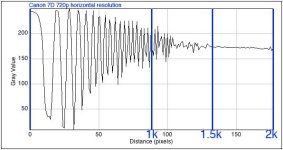
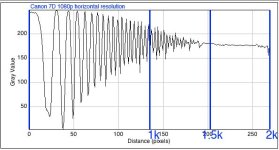
First analysis is horizontal resolution. I plotted the scanlines in image-J of the 2k zones. It's a linear zone plate so it's easy enough to put on resolution markers.

1080p should measure as close as possible to 1920 horizontally, but we can see that it doesn't get close. Given that the camera has a much greater horizontal resolution potential than 1920, what we are seeing is very poor downsampling from the full raster, leading to resolution barely above 720p, and quite visible aliasing.

In 720p mode, the resolution is 1280, which is correct for 720p, but shows an increase in aliasing, as you'd expect from poor downsampling.

Next, I'll follow up on vertical resolution.
 

Attachments

  • 7D 720p 2k.jpg
    7D 720p 2k.jpg
    54.5 KB · Views: 0
  • 7D 1080p 2k rez.jpg
    7D 1080p 2k rez.jpg
    55.9 KB · Views: 0
Last edited:
Vertical Resolution

Vertical Resolution

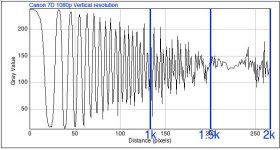
Now, when we look at vertical resolution, things get interesting. Of note on the image itself is the vast amount of false colour. This can only be due to some gross deficiency in the downsampling, specifically in the vertical direction.

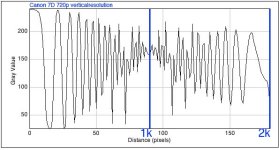
Both 1080p and 720p show vast amounts of aliasing corrupting the image in the vertical direction. The aliasing is so strong as to be un-diminished in it's amplitude, which can be seen to extend out to the edge of the 4k zone. This is showing that not only is there inadequate filtering to stop aliasing at the 720p or 1080p level, that there is inadequate filtering to stop aliasing at 4k, if such a mode could be recorded on these cameras.

In 720p especially, the corruption of the aliases produces data as strong in amplitude as the real data from real resolution! This means that when you see aliases, you'll see them very strongly indeed. In both 1080p and 720p modes, vertical resolution, if you can call it such, is 1080 and 720 respectively, but such resolution hardly counts when it is utterly corrupted and distorted by the vast amounts of aliasing.

Now, interestingly, the aliasing on the 720p occurs at what looks to be precisely 1k (and 2k and 4k) resolutions. Now in 16:9, 2k has dimensions 2048x1152. To see strong aliasing at a detail of 1152 pixels (and multiples thereof) vertically is very interesting as 1152 * 3 = 3456, which just happens to be the vertical photosite count of the 7D sensor. If this doesn't lend a lot of weight to the skip 1 out of 3 lines theory of 7D (and 5D and 1D mk IV) sensor operation, I don't know what does.

Graeme
 

Attachments

  • 1080p v rez 2k.jpg
    1080p v rez 2k.jpg
    59.3 KB · Views: 0
  • 720p v rez 2k.jpg
    720p v rez 2k.jpg
    58.1 KB · Views: 0
Images

Images

And so you don't have to download the movies, here's some grabs of the detail showing exactly what I'm talking about. Go compare to link I posted on the RED and see what a zone plate should look like. The 720p zone plate from the 7D is actually the worst I've ever seen.
 

Attachments

  • 7D720pZoneDetail.jpg
    7D720pZoneDetail.jpg
    69.2 KB · Views: 0
  • 7D1080pZoneDetail.jpg
    7D1080pZoneDetail.jpg
    87.2 KB · Views: 0
Graeme - interesting. So we assume that they are skipping the lines because they need a smaller image from a larger resolution (3456 with the 7D) which they don't have the horsepower to process down correctly. Thus just skip lines.

So how much power do they need to down sample the image properly is the question and will they address it?

The sensors make nice images, just look at the still photos they create if they can just get the motion stuff out with proper sampling and a better codec.
 
There's more to it than that - skipping lines allows you to read the sensor faster, which can reduce skew, and can turn a 10fps sensor at full frame into a, say, 30fps sensor. Skip 5 in every 6 and you turn a 10fps sensor into a 60fps sensor.

Proper downsampling is quite expensive in terms of the hardware needed to do it - you need to do a full demosaic, then look at every pixel and filter them, then decimate. You'd have to as an asic designed what that would cost in terms of die area, power consumption etc., but I'd reckon it must be significant.

Indeed, the sensor as a still sensor makes a nice image. Shoot stills and video, downsample the still properly to the video rez and compare to see what their video mode throws away and corrupts and it's astonishing.

Graeme
 
As I see it, there is only one solution to this problem. Release EpicX/ScarletS35 now so I can toss the 7D into the bin.
 
I'm working on it Jeff....
 
Back
Top