Welcome to our community

Be a part of something great, join today!

  • Hey all, just changed over the backend after 15 years I figured time to give it a bit of an update, its probably gonna be a bit weird for most of you and i am sure there is a few bugs to work out but it should kinda work the same as before... hopefully :)

Ask David Mullen ANYTHING

Hi David.

I'm considering using a scarlet fixed with a.7 wide angle adapter but the question I'm asking could apply to an s35 or any camera really that will have an adapter on the end of the lens.

My question is regarding filters. If I were to shoot with a gentle diffusion filter like a 77mm soft fx 1/2 and then place the wide adapter on the end, would the shots match up? Or must I buy a wider version of the same filter to go on the outside?

Also what about a smoque filter? or other types of filters?
 
There's kind of a distinct look among modern studio comedies (specifically the kind of movies with red text on a white poster) like super high key and soft--and I'm wondering if you know how this look is achieved. Even just a sitcom look, really.

I figure it takes a lot of light, which may be why I've never been able to light this way, but is it as simple as shooting on stages with space lights all over the place and then adding kickers/backlights or is it some kind of difficult balancing act positioning soft boxes strategically to light faces evenly and well but also hide shadows?

I figure the sources are mostly toppy rather than frontal (due to a general lack of shadows on walls) but then I'd expect unpleasant eye shadows like you get on an overcast day and I don't even really see those on sitcoms. I remember someone telling me (secondhand via Paul Weitz) that Robert Elswit used to put fluorescent lights all around actors' feet to kind of fill eye shadows, but this was like years ago so I forget the specifics...

Also, what do you use for fill lights on Big Love? Space lights and china lanterns on stages or chimeras and kinoflos? And lastly, are all the shows (movies and tv?) you've worked on union only for the entire crew? (I assume most have been.) I want to work as a grip on something that actually pays (while I rack up hours to join like a grip union) but everything seems to be either unpaid or union-only. Does an in-between (even if it's minimum wage) exist for grips? Thanks as always.
 
Last edited:
Hi David.

I'm considering using a scarlet fixed with a.7 wide angle adapter but the question I'm asking could apply to an s35 or any camera really that will have an adapter on the end of the lens.

My question is regarding filters. If I were to shoot with a gentle diffusion filter like a 77mm soft fx 1/2 and then place the wide adapter on the end, would the shots match up? Or must I buy a wider version of the same filter to go on the outside?

Also what about a smoque filter? or other types of filters?

Generally you wouldn't use a diffusion filter on a wide shot on a wide-angle where you want maximum clarity, but if you did (let's say it was a distorted close-up on a wide-angle), you'd put the filter in front, not in between the adaptor and the fixed zoom. The softening from using the adaptor probably would (almost) be similar to the softening of the 1/2 Soft-FX (more like a 1/4 Soft-FX equivalent, if there were such a thing), though you wouldn't get the halation effect.

I'd keep an eye on whether the pattern in the filter came into focus too much when shooting stopped down outdoors.
 
There's kind of a distinct look among modern studio comedies (specifically the kind of movies with red text on a white poster) like super high key and soft--and I'm wondering if you know how this look is achieved. Even just a sitcom look, really.

I figure it takes a lot of light, which may be why I've never been able to light this way, but is it as simple as shooting on stages with space lights all over the place and then adding kickers/backlights or is it some kind of difficult balancing act positioning soft boxes strategically to light faces evenly and well but also hide shadows?

I figure the sources are mostly toppy rather than frontal (due to a general lack of shadows on walls) but then I'd expect unpleasant eye shadows like you get on an overcast day and I don't even really see those on sitcoms. I remember someone telling me (secondhand via Paul Weitz) that Robert Elswit used to put fluorescent lights all around actors' feet to kind of fill eye shadows, but this was like years ago so I forget the specifics...

Also, what do you use for fill lights on Big Love? Space lights and china lanterns on stages or chimeras and kinoflos? And lastly, are all the shows (movies and tv?) you've worked on union only for the entire crew? (I assume most have been.) I want to work as a grip on something that actually pays (while I rack up hours to join like a grip union) but everything seems to be either unpaid or union-only. Does an in-between (even if it's minimum wage) exist for grips? Thanks as always.

Well, if there is going to be a lot of light everywhere, then at least you want a good black reference in the frame to provide visual contrast. For example, let's say you have a big soft light hitting a performer in a white cyc - if the performer were wearing a black jacket, had black hair, or even black eyeliner, at least you'd have a black reference in the bright frame to give the impression of a full tonal range. So if your hey light is slightly toppy or not, and rather frontal overall, you'd let the small area of shadow fall-off to black rather than fill it in too much, though in close-ups, you may use an eyelight to get rid of the bags and make the eyes stand out.

Now how to fill in a shot just depends on the shot, where the fill can come from, and whether it's an overall wash designed to simply increase the ambient fill in the room, or whether it needs to be more focused on certain areas but not others. It's the old problem that it's hard to project and cut soft light, but hard light creates hard shadows, and generally you don't want your fill creating an additional shadow. So it depends too on how far the subject or object to be filled is from a light-toned wall.

A weak amount of bounced light into the ceiling or floor or large white frame behind camera may increase overall ambience and reduce contrast. I'd often do that on "Big Love", either rake something across the ceiling or throw a white bedsheet on the floor and hit it with some low level of light. But when the actor was closer to the camera and all I wanted was to just fill in their faces, I'd often use a Kino near the camera, or a bounce card under the lens hit with a Source-4 dimmed / scrimmed down.

I do all sorts of things for eyelights when the actor is closer to the camera lens, whether a LED Micro on the camera, or a Dedolight, or a snooted 200w light or a 750w Zip with Egg Crate, etc. You can use blackwrap to create snoots on these lights to control the spill.

As for working as a non-union grip on a union show, I'm not sure how that would happen, though you can be on a non-union show that turns union and get grandfathered into the union.
 
Last edited:
Generally you wouldn't use a diffusion filter on a wide shot on a wide-angle where you want maximum clarity, but if you did (let's say it was a distorted close-up on a wide-angle), you'd put the filter in front, not in between the adaptor and the fixed zoom. The softening from using the adaptor probably would (almost) be similar to the softening of the 1/2 Soft-FX (more like a 1/4 Soft-FX equivalent, if there were such a thing), though you wouldn't get the halation effect.

I'd keep an eye on whether the pattern in the filter came into focus too much when shooting stopped down outdoors.

Thanks David. Would ND's be different? (I am assuming the ND would give the same effect whether it was before or after)
 
David. When you say you use snooted 200w or dedolights, are you talking about scrimming them down and aiming them directly at the talent from as close as possible to them? I Hope this is not a stupid question. I think of eyelights as LEDs or bigger in surface and a snoot sounds even smaller than an already smallish LED on the camera.
 
You can slip a piece of diffusion between the light and the snoot if it can take the heat, to take a tiny bit of the crispness out. Or you can try a piece of Hampshire Frost or Opal in front of the snoot to defocus it a bit.

Here's a shot in "Northfork" where I used a Dedo with a blackwrap snoot for an eyelight:
northfork24.jpg
 
Hey David I'm gonna be purchasing a Scarlet Cinema with a set of the Mini's and had been wanting to get a decent/chepish Cine Zoom lens to use, only for my run and gun days. So I came across this Lens and figured it was a C-Mount and worked for the Bolex, so it could fit the Scarlet, and decided to place a RIDICULOUSLY low bid of $75 just to se what would happen, and he accepted it. Which frankly suprised the heck out of me.

My question is, if this lens is in acceptable shape, how well, if at all do you expect it to perform on the Scarlet?

There wasn't much I could find online but what I did find was a discussion between two guys back in 04 which considered this canon sharper than the Angi version.

Please your on thoughts?
 
I don't know this lens, but Canon zooms are popular for 16mm. It will probably look better stopped a bit from f/2.8 though.

Thanks David, but I figure for that price, it's well worth a gamble, lets just hope i got a STEAL of a deal. :confused:

Also what do you think the price would be to get it serviced, also being that I'm new to s16 glass what is all involved with a Lens being professionaly serviced?
 
Name That Flare ...

Name That Flare ...

Mr. Mullen,

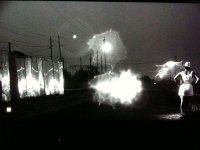
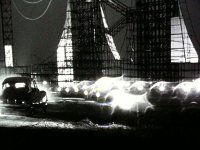
So my friends and I were watching 8 1/2 last night and we saw these flares that we could not identify / figure out. I was wondering if you had any insight as to what is going on here? From what we surmised, it is a flare off of the internals of the optics of the lens. There is nothing consistent about the flares, as they change shape through out the image- some starry, some circular, some wave shaped ... so we did not think it was from filters ...
 

Attachments

  • LensFlare01.jpg
    LensFlare01.jpg
    74.5 KB · Views: 0
  • LensFlare02.jpg
    LensFlare02.jpg
    87.1 KB · Views: 0
Thanks. :)
 
Looks like raindrops on the lens not quite cleaned off.

I can see that for the flares to the left that go 360 deg around the light, but look at the flares to the right, they are like crescent shaped
 
David, how would you personally go about it if requested to recreate that shot? Maybe drops of water or oil on an optical flat?
 
I bet it was on purpose

Yep, I bet the are intentional as well. These flares are the only ones like them in this scene, and it happens when the are approaching a "space exhibit". They do help add to the feeling / setting of the scene. After these shots, the rest of the flares in the scene are normal.
 
Thanks David, but I figure for that price, it's well worth a gamble, lets just hope i got a STEAL of a deal. :confused:

Also what do you think the price would be to get it serviced, also being that I'm new to s16 glass what is all involved with a Lens being professionaly serviced?

I just serviced 2 Angenieux s16 lenses at Visual Products - converted one from Cameflex to PL mount. Greased, though not a full rebuild. $750 total if that gives you an idea of cost.

And they look great, BTW. Old glass is great. I'm addicted.
 
David, how would you personally go about it if requested to recreate that shot? Maybe drops of water or oil on an optical flat?

Yes, it's always best to try things out on an optical flat rather than the actual lens.

Ever seen "I am Cuba"? There is a cool sequence where they poured oil in front of the lens during a student riot.
 
Back
Top